
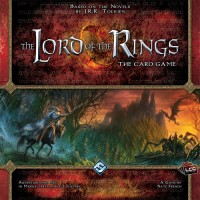
The Lord of the Rings: The Card Game
The Lord of the Rings: The Card Game is a cooperative card game that puts 1-2 players (or up to four players with two Core Sets!) in control of the most powerful characters and artifacts of Middle-earth. Players will select heroes, gather allies, acquire artifacts, and coordinate their efforts to face Middle-earth’s most dangerous fiends. By cooperating to overcome the obstacles drawn from the encounter deck, you will complete the quest before you and claim victory!
The Core Set includes 226 cards that can be used to assemble a wide variety of decks right out of the box. Included are three perilous quests that, along with countless combinations of settings and enemies, offer near-limitless replayability.
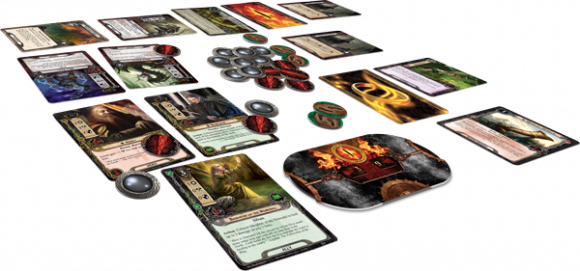
Additionally, players can build a party from a set of 12 hero cards, and focus their decks on any combination of four distinct spheres of influence: Leadership, Lore, Spirit, and Tactics. Each sphere offer unique benefits to the party, so choose wisely!
Monthly 60-card expansion packs called Adventure Packs will introduce new quests, heroes, allies, attachments, events, and encounters, allowing players to fully customize their game and continue their fight against the Dark Lord!



Add a Review for "The Lord of the Rings: The Card Game"
You must be logged in to add a review.
Overview
LOTR is a great card game that will let you experience the dark thrill of much of Tolkien’s saga in games of 1–4 players. You each take on the role of three heroes (mostly, but not exclusively, characters found in Tolkien’s novels) and embark on a quest that touches upon the events of the books (usually, the quests take place slightly earlier than the main events of The Lord of the Rings books). The game combines varied gameplay, beautifully rendered components, thrilling experiences, a true Tolkien saga feel, and hours of fun as you team together to try to beat the game in different scenarios (called quests).
I gave LOTR a strong 9 on a scale of 10. The only thing stopping me from giving it a definite 10 was the fact that the basic game only includes three quests (which means that you have to start buying expansions quite soon) and two threat trackers (which means that you have to use pen and paper to record threat levels if you play with 3 or 4 players;
Components
The box contains two threat trackers (a kind of score boards that are beautifully made), 96 tokens of different types (used to display resources, damage, and quest progress; these too are really appealing), a first-player token (this is the only unattractive and disproportional, albeit useful, piece of the game), a rulebook, and over two hundred cards (featuring player characters, events, attachments, enemies, quests, etc.).
Game mechanics
LOTR is a cooperative game. As mentioned above, each player picks a team of three heroes (as you get more expansions, you have the option of switching heroes and building specialized decks), get the corresponding deck and starts on a quest of their choice. In the basic game, you will get four sets of heroes, each set with its own deck of card with allies, items and events. Each of the four sets has a really different feeling and varying focus, which translates to more variation and challenges. The quest differ somewhat, but have in common that you travel through different Middle-Earth locations, while trying to pursue your quest without attracting to much attention from Sauron’s minions. Each character (either the three heroes that each player starts with or the allies that they soon call to their aid) can only make one action each game round: pursue the quest, attack an enemy, or defend against one enemy. This makes for a great menacing feeling, as you always have to give something up to progress through the quest; there never seem to be enough characters to take care of all enemies and move on at the same time. Every turn the threat level of all players increase, so if you do not make progress you will soon perish..
Difficulty
LOTR takes a while to learn and play, in terms of the difficulty of the rules. There are many rules and although the rulebook is (mostly) clear you do need to play a few games and re-read the rulebook in order get acquainted with everything.
In terms of difficulty for the player characters, LOTR really provides you with many challenges. The quests are all weighted for or against the players in different ways, which means there are some quests that are quite easy and others that will prove a challenge even for experienced players. The three quests included in the basic game have different difficulty levels of 1, 4, and 7, respectively, on a scale of 10.
Will you like it?
You will probably like LOTR if you enjoy at least one of the following: the thrill of bonding together against an unforgiving game found in cooperative games, the kind of deck-building found in collectible card games, the possibility of playing solo, fantasy games of different types, or if you in any way are interested in The Lord of the Rings saga.
Pros and cons
Among the pros are the creeping menace that grips you while playing (you really have to choose among several bad options and try to stay alive long enough to solve the quest), the versatility of varying quests and the deck building capabilities, the exquisite game components, and the many expansions. Among the cons is the fact that the basic game only includes two threat trackers (since you really do not need to buy another basic game in order to play with 3–4 players, FFG might as well have included threat trackers for 4 players) and that it, with three quests, will only serve you so long before you will need to buy expansions.
Value for money
At almost $40 (MSRP), LOTR is not expensive, especially when compared how great the game is and how beautiful the components are (everything from the tokens to the cards are truly exquisite). On the other hand, you will both want and need to buy expansions in the form of adventure packs and at almost $15 (MSRP) these will put a drain on your game funds.
Summary
LOTR combines the best parts of cooperative games and deck-building games with beautiful components, a true saga feeling, and great versatility through varying quests and solo-play possibility. It became an instant hit with our gaming group for many different reasons and that it perhaps the greatest perk: there are so many things in this game’s rules, appearance, quests, cards, and feeling that most players will find something to fall in love with. I warmly recommend it.
Pros: challenging, complex, thematic, scalable, portable, easy to set, fast, expandable, cheaper than ccg
Cons: core set doesn’t include 3 copies of all the cards, cards could be thicker, not so cheap when you want to keep up with the expansions. And believe me, once you get your hands on it, you’ll want!
You’ll like it: if you like the Lord of the Rings or similar settings, if you enjoy playing solo and/or coop, if you enjoy complex card games, if you want a challenge.
You won’t like it: if you hate the theme, if you seek a competitive game, if you get overwhelmed when having to track complex rules, if you don’t have fun losing.
Difficulty: The core set includes 3 adventures. One is a piece of cake, thought for introductory games. The second one is quite challenging, specially if you have not mastered deck building yet. The last one was designed by the Dark Lord himself and it’s just cruel.
This is not an easy game, and you will find yourself losing 50% of the time, if not more often; but that’ll give you a nice feeling of achievement when you finally manage to beat the Shadows, making solo play interesting and rewarding.
Theme: As a matter of fact, the theme kept me away from this game for some time. I expected it to be some cheap franchise-milking scenario; plus, even though I used to like LOTR as a teenager, I had grown to find elves, dragons and the such a little cheesy. Still, sthis game somehow managed to suck me in and bring me back those feelings of adventure and magic I had forgotten. The purist won’t be happy with a few inconsistencies (but when are they, anyway?), but the card art, together with the quest mechanics, manage to bring the most theme you could get from a card game.
The game has all these little details, such as when Gandalf enters play to help and then just leaves you when you need him most; or when you use a torch for exploring a dark passage, under the risk of bringing new enemies to the staging area*; or playing the sword that was broken on a hooded Aragorn, so he gains the leadership sphere icon* (leadership being the sphere of noble characters).
Mechanics: As there is plenty written about it, I won’t get into details, but the mechanics are well thought and fun. They manage to make a solo game difficult and surprising, while it scales perfectly well when adding other players. For instance, the shadow effects during combat are a random way of surrogating the events (instants, if you play Magic) that an oponent would play on you when you thought you had his minions under control. The threat counter is not just a way of losing, but it also gives Sauron a reason and time for sending his forces upon you. And so on.
Interaction: For a game that plays so well solo, it has a good deal of interaction. Some cards have special abilities that won’t be useful unless more players are at the table, and they do work really well. It’s not the most interactive game ever, but it’s not a multiplayer solo. There are decisions to take together, cards to play on other players and strategies to devise in order to defend and attack the minions as a team. My best deck is a multiplayer support deck.
Closing thoughts: I feel this game is sometimes overlooked because of its theme, because of being a LCG or because of its solo/cooperative nature. Yet the theme is nicely developed and interwoven with the mechanics; the LCG system, if a tad expensive, is still cheaper than games such as Magic; and the solo and coop mechanics work quite nicely, offering something different to bring down to the table.
LCG addendum: You may be thinking about getting just the core game, but are afraid of an endless number of expansions. Well, don’t! When you start enjoying the game, you’ll probably want to add some, but you don’t need them to have a good time, nor do you need to get all of them. I got Khazad Dûm and then bought a couple of minis from the Dwarrowdelf cycle. Now the Hobbit is on its way… and that will be enough for some time. Also, the fact that every expansion comes with some new quest, makes the purchasing of new expansions quite similar in price and experience to getting some adventure book each month, or going to the cinema every other week… plus you end up with a bunch of new cards for your decks!
*These two last examples I got from cards not on the core set; but that doesn’t mean there are no such details on them, I just couldn’t trouble myself to find them.
The Lord of the Rings: The Card Game is one of Fantasy Flight Games Living Card games. That is, it’s like a collectible card game, except instead of purchasing randomly placed card packs, you buy expansions with specific cards in them. This can help keep costs down, but it still can get expensive. The base game comes with three adventures, one easy, one hard, and one that’s **** near impossible to beat with the cards in the base set. I only own the core set, so I can’t give advice on the expansions.
Cons:
– Steep learning curve. This game will chew you up and spit you out.
– Complicated rules. The rule book is 30+ pages long. And, let’s face it, FFG is not known for
their well written rule books. You can watch a video on the games website, however.
– Only three adventures. If you want more, you’ll have to buy some expansions.
– It’s supposed to be a 2-4 player game, but it only comes with two threat trackers. If you want
more, you’ll have to buy another copy of the core set.
Pros:
– As I said, this game is dripping with theme. The card art is beyond gorgeous.
– You feel like you’re in Middle-Earth. The funtion and theme work together.
– Inexpensive. You can pick this up on line for less than thirty bucks.
In conclusion, if you can get past the difficulty and complicated rules, this is an excellent RPGish game to have.
Overview
The Lord of the Rings: the Card Game is a solo or co-op card game taking place in the Tolkien’s Middle Earth (obviously) during the time period between the end of The Hobbit and the beginning of The Fellowship of the Ring. As such, the game features characters and locations from the novels, but doesn’t retell the events of the series (though new “Saga Expansions” have started to change this). Also, as you may have picked up on, the game is based on the novels, not the movies, so don’t expect to see Elijah Wood or Orlando Bloom showing up in the card art. Players work together to complete quests while overcoming challenges represented by a “challenge deck”.
Setup
The initial setup for the game is about on par with other LCGs. You have some tokens to punch out and a rulebook to read, but it shouldn’t take too long. The rulebook is pretty clear and the rules are relatively simple (especially for a card game), so it doesn’t take much time to get through. After that, it’s simply a matter of grabbing all of the cards for your chosen sphere for the initial playthrough.
Subsequent playthroughs may require deckbuilding if you choose to go that route which, let’s be honest, is probably part of the game’s appeal. The starting decks are also not awful but certainly not that great and are all single-sphere focused, so you’ll probably want to spend at least a little time brewing up your own. Whether you build your own decks or not, you’ll need to assemble the “encounter deck” using the sets of cards whose icons match those on the first card of the quest you selected. Assuming you keep the game somewhat well organized, it shouldn’t take more than 10 minutes or so to get everything ready for play (not counting reading the rulebook).
Gameplay
Players begin the game with their heroes already in play. The quest and encounter decks are placed in the middle of the play area, players draw their starting hands, the first player is determined (first player is identified by a marker that rotates to the next player clockwise at the beginning of each turn), any initial setup described on the “A” side of the first quest card is completed, and initial threat levels are calculated (by adding each player’s heroes’ threat totals together). Play then begins with the drawing of a card and placing a resource marker on each hero. The first player then gets the chance to use the resources accumulated on heroes to play any allies, enhancements, or events they wish to play (events can also be played at the end of each turn phase or when the conditions of a “response” trigger are met). Once the first player is done playing cards, each player gets the chance to do so, going around in clockwise order.
Next comes the questing phase, which begins with committing characters to the quest. Each quest has a number of progress tokens that are necessary to be placed on it in order to move on to the next part of the quest. To do so, players commit heroes or allies to the quest. Each player decides who, if anyone, to commit and exhausts them (turns them sideways). One card is then revealed from the top of the encounter deck for each player and is placed in the “staging area”. Any “when revealed” effects are resolved, and the “threat total” of the cards in the staging area is added up and compared with the total willpower of all committed characters (threat and willpower are both indicated by values on the cards). If the willpower is higher, a number of progress tokens is placed on the quest equal to the difference between willpower and threat. If threat is higher, each player advances their threat totals by a number equal to the difference.
Then, the first player can choose to travel to a location in the staging area if the party isn’t currently already at a location. The location is moved from the staging area and no longer contributes its threat to the threat total. Each location requires a certain amount of progress tokens to discard the location. As long as the party is at a location, they must discard the location before they can travel to another or make progress on the current quest.
Next comes the engagement phase. First, each player may choose to optionally engage an enemy in the staging area. After this, if there are still enemies in the staging area, engagement checks are run. Each enemy unit has an engagement number at the top. Starting with the first player, each enemy compares this number to the players’ threat totals. If the threat total is equal to or greater than the enemy’s number, the enemy engages the player. If not, it will continue to check players’ totals going clockwise around the table until a player is engaged or all players have been checked and fail to meet the minimum threat (whichever happens first). Once all players have done engagement checks for any enemies in the staging area and any enemies are engaged, play progresses to the combat phase.
In combat, the players choose one of the enemies they are engaged with and can choose a hero or ally to defend the attack by exhausting the character. They then repeat the process for each engaged enemy. Then, a card is dealt from the encounter deck to each attacking enemy. If the card has a “shadow effect,” it is applied to the engagement (generally a buff of the attacker or debuff of the defender) Attack and defense values are then compared to determine if any damage is dealt to the players’ characters. Then, players can choose any ready (i.e. not exhausted) characters to attack the enemy. Unlike with defenders, any number of ready characters can attack a single enemy, using their total combined attack value. If an enemy isn’t killed in the attack phase, they will remain engaged with that player for all future turns until killed or returned to the staging area by an effect.
After combat, the turn ends with the refresh phase. All exhausted cards are readied, threat dials are all advanced by one, and the “first player” marker moves to the next clockwise player. The next turn then begins.
The players win by completing all of the quest cards’ requirements. A player is out of the game if all of his/her heroes are killed or if his/her threat dial reaches 50.
Learning Curve
The game is extremely easy to learn. If you’ve played any CCGs or LCGs before, things will seem very intuitive, though the fact that you’re playing against an enemy deck that plays itself rather than an enemy player does necessitate the addition of a few steps not normally found in card games. None of them should be too confusing. After a single game round, you’ll probably have a good understanding of how everything goes.
Even if you’re not a card game veteran, you’ll probably be able to pick it up just fine. Even my complete non-nerd, non-gamer wife volunteered to play the game with me and was no longer having to ask for clarification on the phases of turns by the second or third turn of her first game. By the end of the game, she was even clear on action windows and was starting to spot combos and card interactions (she also found it pretty fun, too).
All in all, most people should be more than competent players by the end of the introductory quest, which takes about half an hour to complete.
Components
The components that are included are all high quality, from the threat dials to the tokens to the cardstock of the cards, everything is quite durable. The artwork on the cards is also generally phenomenal. Whether it is portraying the beauty of the Shire, the heroic characters players use, or the ominous locations and the horrific threats you face during your quests, the art does a great job of capturing the feel of the world and the mood of each card’s subject. It’s also nice to get a fresh take on this familiar world, as the art tends to eschew the style of previous adaptations of the source material, including significant distance from the style of the Peter Jackson movies that has come to dominate most Middle Earth-related art in the last decade or so.
The rub, though, is that despite the quality of the contents, there is a significant lack of some contents (roughly half sized decks, only two threat trackers, etc.) due to what seems to be a pretty heavy handed attempt to get players to buy a second copy of the core set.
Overall Judgment/TL;DR Takeaway
Overall, the game is great. The co-op nature makes it more welcoming to non-gamers than a competitive LCG, while the challenge level of most quests and the prospect of deckbuilding will still keep more traditional and hardcore gamers interested. It’s an easy game to pick up as well as teach, and has rules for an “easy mode” too, making it something of an unexpected contender as a gateway game, particularly if you have non-gamer friends who are fans of the source material. As my wife’s enjoyment of the game shows, though, even if you know non-gamers who are barely aware such a thing as the Lord of the Rings exists, the game isn’t so dependent on the Middle Earth theme that there isn’t something for Tolkien outsiders to enjoy.
Sadly, although the game is wonderful, this core set is significantly disappointing. The core set contains a deck for each of the four spheres, as well as three separate quests of varying difficulty levels which gives you a good amount of replayability without having to buy any expansions (the fact that you’ll probably fail at least one of the quests sometimes further increases the replayability). The problem is that, like with all LCG core sets, Fantasy Flight wants you to buy two copies. As such, the decks you’re supplied with for each sphere are only about half the number of cards that are recommended for a deck. As such, you get a very limited experience with each one. The game is also designed to allow multi-sphere decks, but most of the cards that make this a significantly viable proposition are spread throughout the first cycle of expansions. Even if you attempt it with just the core set, you’re going to run into the problem of not having enough of the good cards to make a multi-sphere deck very consistent. A second core set makes this more viable, and makes the single-sphere decks stronger as well. The box also says that you need a second core set to play with more than two players, but that’s a lie. There are only two threat tracker dials included in the set (again, for seemingly no purpose other than to try to sell you on a second core set), but you can just as easily track the third and fourth players’ threat levels on paper, and if you ever run out of resource tokens (if one player were to be stockpiling them), you could always just use beads or any other type of marker.
In the end, it’s a great game, but the core set significantly hampers it (particularly as an introduction to the game) due to significant intentional limitations in an effort to force players into buying multiple copies of the core set.
If you love LotR and co-op you’ll most likely love this. Living card game allows you to know exactly what you are getting when you buy an expansion. Great with 1-4 players (3-4 suggests 2 sets of base game). Most balanced with 2 players though.
Fight through scenarios with a set of 3 heroes that can stem from 4 spheres which I’ll include specialties but are not limited to – Tactics (fighting), Leadership (hero buffing), Lore (healing), Spirit (questing)
Build a deck of at least 50 cards to help your 3 chosen heroes and fight your way through monster, location, and treachery cards to complete your quest.
Once players have their decks ready the quest is set out in between them and then the flavor text is read aloud to set the mood. Once that is read do what the card says for setup and then its on to the players turn.
Each player then draws 6 cards and decides if they like their hand. If they don’t they can mulligan once and draw 6 new cards.
Players then go into the first step of the game which is resources. Each player receives 1 for each 1 of their heroes and puts it next to them. This is because each hero has their own separate pool of money. Then the players each draw 1 card.
The second step is planning and in the phase players (in turn order) are allowed to play ally and attachment cards from their hand paying the associated costs and making sure that they pay using currency only from any of their heroes with the same sphere as the card being played. The third type of card players will use are event cards and these can be played through out the game during every phase including this one, though they normally benefit from being played in later phases.
Now the questing begins and starting with the first player, players choose which heroes and allies they will be including on the quest. Whoever is on the quest will need to exhaust (kneel/tap/turn sideways) this means that they will not be able to defend or attack later unless able to exhaust because of special effects. Based on what cards are in the staging area from previous rounds or from set up players then need to equal or exceed the amount of threat generated by those cards and extra drawn cards based on number of players (1 card per player) with that of their combined willpower from all included characters. Equaling the threat from the staging area will break even and nothing will benefit or hurt the players. For every point over the players then place a progress point on the current location, if there is one, if there isn’t then they go on to the current quest. Failure to do so will increase player threat. If a players threat ever reaches 50 the players lose.
Once the quest phase has been completed the players may choose to travel to a location if they currently have no location active. Location cards cards usually give a positive or negative effect after traveling. Traveling to a location removes it from the staging area and removes some of the threat from questing in subsequent turns, but also works as a buffer between the quest (which is the main objective usually)
Next comes the encounter phase. Each player starting with the first player can choose to optionally engage a creature in the staging area. After that any and all creatures that have engagement costs equal to or less than the players will engage them.
The combat step follows and starting with the first player each engaged creature receives a shadow cards, which is just a card from the encounter deck. Players in player order then choose 1 and only 1 character to defend each attack from creatures in front of them. After defense is made by each player it is the players turn to attack.
Starting with the first player each player can choose any number of their attackers (other players if they have ranged attacks) to attack a single creature. This is done until all attacks have been made. Any creature still standing and the end stays engaged and doesn’t commit to the threat during the quest phase but they will attack during the next combat phase.
Lastly the players do a refresh phase which they can then un-exhaust all their characters and equipped cards (equipment exhausted separately from characters). They raise their threat by one and pass the first player marker to the next player.
This game can be so much fun but it can be also very frustrating at times. Knowing what cards can come up from the encounter deck helps when trying to build a deck. Some quests are location heavy and require a lot of questing power and some quests are monster heavy and require lots of strength and defense.
… said Legolas, bending his bow and fitting an arrow with hands quicker than sight. ‘You would die before your stroke fell.'” – Lord of the Rings: The Two Towers
Ahh, my all time favorite line from J.R.R. Tolkien’s epic Lord of the Rings, and part of the beauty of this game I am about to review…
I’ve been playing customizable card games since their inception in 1993 and I’ve tried out an incredibly large amount of the card games that have hit the market. Star Wars CCG by Decipher is still my all-time favorite even after it’s demise when the license rights went to Wizards of the Coast in 2001. That being said, this new Lord of the Rings LCG game by Fantasy Flight Games is already solidly in the #2 position and if the game continues on the path it’s currently on, I can see it becoming my absolute favorite. The biggest difference with this game and most customizable card games is the “Living Card Game” design FFG went with. Personally, I think it’s genius and for the cash savvy customer it makes life much easier as the focus is on gameplay, not rare hunting. Every month a new “adventure pack” is released that features new cards for your hero decks (and enough copies per card to fully stock your deck) and a new enemy scenario to play against. The scenarios follow an overall story arc so for those players buying the sets in order, they can follow an alternate adventure set in the world of Middle Earth. Diving into a box of booster packs and tearing through 36 packs of cards after an expansion release has always been one of the most exciting parts of playing CCG’s, but this new take gets you into the action faster, cheaper and at a steady even pace. I’m a fully fledged fan.
As for the gameplay… well, the Lord of the Rings saga is no stranger to card games, with the cult favorite from Iron Crown Entertainment called “Middle Earth Customizable Card Game” that came out in 1995 and the Decipher movie themed game “The Lord of the Rings: Customizable Card Game” in 2001. Those games had their merits, but I personally feel this game trumps them both. The game is unique in that the players all are on the same team cooperatively trying to defeat Sauron. This sets the bar pretty high for me since the essence of the story was about Fellowship and unity between the races and ties back to how I opened my review… ‘He stands not alone.’ so having a cooperative mechanic in the game imbues the game with another element of charm. The Shadow game mechanics are truly genius as you play against the deck and each scenario synergizes certain cards against you. Since the creatures and villains you need to fight get dealt “shadow cards” that can provide temporary boosts or other game effects that will affect your heroes and allies, that brings an element of the unexpected similar to players playing interrupts from their hand in other ccg’s. The game also scales based on the number of players playing (1-4 players) adding difficulty the larger the party (and threat) that party provides Sauron.
Another thing that I love about this game is that the mechanics are built to allow for solo play since you’re playing against a self running deck, just the same as multiplayer games. Solo play can be a little difficult at times, but strong deck building will assist in that department and later sets have added several cards to the pool to enhance solo play. It’s exciting to be able to play this game solo when your gaming group isn’t available. I find myself breaking out LOTR:LCG more often than turning on the PS3 or Wii lately.
The core set provides you with a handful of the Fellowship players, but saves the ringbearers themselves and others associated with the light for future expansions. Aragorn, Gimli, Legolas are all available, as are some other familiar Middle Earth heroes like Gloin, Eowyn, Thoedred, Thalin, Glorfindel and Denethor as well as some not so familiar faces such as Gondorians and Dunedain Rangers. Now take fantastic game mechanics, easy access to the card pool and a simple complexity and add in the stirringly beautiful art work and you have the makings of one of the best Tolkien-based games, if not one of the best games period, on the market today.
After playing through a few games, getting used to some of the timing rules like when to voluntarily engage enemies versus having them seek you out to fight you, I was salivating for future expansions and hit my local gaming shop on release day to get the adventure packs. If you enjoy the Lord of the Rings, quality gaming, a moderate level of complexity and strategy and/or beautiful art work… this game is so definitely for you. If you do decide to play this wonderful game, be sure to check the game’s discussion page here on BG, there’s a lot of great discussion going on about rules, resources, and the like.
I look forward to reviewing the expansions of this game soon, since they each bring about new elements to the game system that deserve a look on their own merits. Until then, good luck questing and thanks for reading!
I got my Lord of the Rings Core set in the mail the other day and instantly was excited. This was one game I was looking forward to playing for a while now because, at my heart, I am a CCG player. The problem I’ve always had with CCGs, however, has been the cost to stay relevant in the game – and my lack of having anybody to play where I am. So, for me, the Lord of the Rings LCG offers something in both of my problems. The non-random nature of the packaging of the game is great for my wallet, and the solo play of the game is great for me who doesn’t have a consistent gamer to play these types of games with. So, how did I think of the game? I think its fantastic, and has lots of room to grow better and better.
Again, I want to say that these observations are based on the solo game rules. So, the experience may change based on having more players around. First off, the packaging! The game comes in a rather big box – smaller in size than the Summoner Wars Master Set, but fatter than that one too. Inside the box comes two sets of cards in a ziplock bag, sorted more or less into 4 different starter decks and your Encounter deck, which serves as the bad guy. The box also contains pop-out pieces for damage, influence points, quest tracking and a threat tracker that you need to put together. The threat tracker was not hard to put together, but it was a big annoying to put it together too. I had to look under a card-board insert within the box to find a group of plastic pieces that are used to fasten the numbered dial to the card board tracker piece. Like I said, it goes together relatively easy – just takes a moment to put it together. The pieces are well put together, really, and the cards are printed on your standard CCG card stock – so they are pretty resistant. Maybe a little less durable than a Magic the Gathering card, but not by much. The art work on the cards are really very good, even if they are your standard fantasy art work. The layout of the cards are really visually appealing as well, which is great. Overall, the packaging for the game is pretty good. I also found the rule book to be really easy to read and very accessible as well.
The objective of the game is to complete your Quest – a set of 3 ( at least in the Core set) Quest cards that have a Questing objective attached to them. As you and the other players are trying to complete the quest, a side deck called the Encounter deck will try to stop you by summoning Locations, Monsters, Events and such to try and kill your Heroes and prevent them from succedding. One thing that is interesting about the game mechanics is the Threat system, where the monsters will attack you based on how much threat you are putting out. If your threat is high, then monsters will be more likely to attack you than if you keep a low threat. You start with threat equal to your Heroes, and then you add threat by failing a Questing challenge. Heroes come in four flavors – Tactics, Lore, Leadership and Will (its late, I’m tired and so I can’t remember the last group easy at the moment). Each sphere has its own strengths and weaknesses. As such, if you play solo you’d want to try and mix-match spheres and if you play in a multiplayer format, you can build a solo sphere deck that much easier. The rules are pretty easy to understand, but look a bit more complicated than they actually are.
The game play really is full of flavor, which I love. It reminds me, of all things, of Warcraft with the threat mechanics built into it. Having the Encounter deck trying to kill me is a neat addition to card gaming, I think, and there were a couple of times that I had a character get close to death in the easy mode Quest. Glancing over at the other quests, I can see how they can get harder and harder – with one quest even putting one of your Heroes in prison. I’ve only run through the easy starting quest so far, so I haven’t tried the more complex/difficult quests, but I do see how they’d get harder. Having the pre-constructed decks is great to open the game with, helping players who don’t understand the full system of the game yet. I love the way everything really is put together really, but with that I DO see how some players say the game can get redundant. I don’t see that happening for a while, but I think if you just go through the same quest by yourself over and over again it’d be getting old after a little. Luckily, the expansion packs come out regularly – giving you new quests and cards to play with to keep things fresh and interesting.
In all, this is a great game that really scratches my CCG itch. The LCG nature of the game makes me interested in trying the other LCGs that the company produces (Game of Thrones, Warhammer and Cthuluhu) and that’s pretty good I think. The art and gameplay is top notch for the game and I really don’t have much bad to say at all. Who would I recommend this too? Well the easy answer is fans of CCGs who are burned out over the marketing/packaging structure of the game. Fans of fantasy and Lord of the Rings may be interested in the game as well. If you like card games, then definitely check it out and if you are a lonely player then check it out for sure for the solo play of the game too. Who wouldn’t like the game? The game plays with up to 4 players ONLY IF you buy 2 Core sets, but that’s something you can probably get around with a little extra help outside. This makes it less assceible to larger gaming groups, because the cost of 2 core sets may be a bit pricey and having to come up with extra outside stuff without a second Core set could be annoying too. That’s about it really, I think there’s something in it for pretty much any kind of gamer and its definitely worth a look at if you want to try something that’s fun and interesting.
We’ve got to cross the river! Okay, so far I have experienced the quests in the main game, a little bit of The Hunt For Gollum and the Massing at Osgiliath. Rivers are the bane of all heroes! Water is supposed to be the source of all life and goodness. Well, not in Middle Earth. I digress.
I would hate for the bold statement at the top of the page to make people think that I don’t like this game. That would be so not true that it would be unfair to FFG and Tolkien.
The gist of the game:
Each player has a group of 1-3 heroes (no reason to use less than 3 really). The players work together to go on quests where they must fight enemies, travel to locations in Middle Earth, and quest their way to victory. There is an Encounter Deck that reveals threats for the heroes to face. Each player has their own deck of cards (in a deck that they have pre-constructed). Survive and make your way to victory!
You lose when all your heroes die or your threat goes up to 50. Think of threat as sort of how visible and famous that your party is. The higher the threat, the more the bigger guys are paying attention to what you do.
You must balance your group into characters that will quest, defend your party, and attack. These choices can mean life or death.
Replay Value:
Constructed deck games have massive replay value. I have tried many many different sets of cards and heroes together. The challenge of the quests makes you want to try again and again to beat your last attempt.
Components:
The cards are a little bit flimsy so you will want to invest in at least 50 card sleeves for a tournament worthy deck or even at least 60 for two mono source decks right out of the box. The threat counters are great. The tokens look nice and are rather sturdy. Also, you can play with 4 players out of the box, but you will need some dice or paper to track the 3rd and 4th players threat. The decks will be only 30 cards each, but they work for your first few games.
Easy to Learn:
If someone knows the rules to begin with, the game is much easier for people to learn. The people that I have taught so far have had a strong grasp of the game after getting through half of a quest. The nuances of when to engage optionally and who to send on quests is what takes time to figure out.
1-4 players The game is very difficult, if not impossible with just 1 player. The more players there are, the easier the game seems to be. This is true especially if all the power sources are covered. 13+ age I can’t suggest this game for a younger crowd unless they are sharp as a fresh set of kitchen knives. 30+ minutes It is really hard to say how long the game will take and it almost makes me laugh thinking about the variance in game lengths. You could be done in 5 or less minutes as a loser or you could take 90 minutes when you make it to the end. It doesn’t always take 90 minutes.
Conclusion:
The Lord of the Rings LCG is going to be a game that I will be spending a lot of money and time on. If you like deck construction, this game will give you hours of entertainment. Deck construction is so insanely fun since you can also play the game in solo to try out your decks. I have spent hours and hours doing just this.
If you are a man with a woman who isn’t huge into gaming, this one could bring her in. IF you have a girl that is into Lord of the Rings, that could draw her in. Since it is cooperative that makes it much easier to drag her in. So I wouldn’t say that this is a gateway game by any means, but it is a girlfriend/spouse pleaser to many ladies.
The quests are challenging, but that makes it very exciting when you do beat the quests. You will literally cheer!
Having played this now as a 2-player and a 4-player, I really enjoy the game. It’s a co-op in which each player really has a distinct role to play which feels entirely different from the others.
We had an experienced player to teach the game to us, and that helped immensely, as we picked it up quickly and did not feel as though it were all that difficult. We had all played other LCG’s such as A Game of Thrones, so perhaps that helped as well.
Essentially, after crafting the decks to be used, each player has three heroes that form their band for the game. Each of those Heroes, while alive, generates a power token each turn which is spent to play cards from your hand, which fall into three categories. Allies, which are other characters designed to help you either attack, defend or which may have some special purpose. (Gandalf falls under this category.) Attachments, which are usually weapons and armor, but can also be magical in nature. And Events, which are generally played as a reaction to certain events and can help you or your fellow players.
There is a stack of quest cards representing what you are attempting to accomplish in the game. Each turn you can send some or all of your Heroes “questing” which exhausts (taps) them, but contributes towards the quest victory. Some decks will be better at questing than others. Legolas and Gimli, for instance, are not often sent questing. They really shine later in the turn, when it is time to kill monsters.
After the questing, there is an encounter phase in which you reveal locations and creatures from a single “evil” deck, representing things you encounter on the quest. Combat will ensue, and Allies, Monsters, and sometimes Heroes will die.
One of the neat mechanics in LotR TCG is the Threat mechanic. Heroes all have a threat value and at the beginning of the game you total the threat for all 3 of your heroes and that is your threat score to start. Each turn you will gain a threat, and failing in quests can also boost your threat total more quickly. Players with a high threat value will be assigned larger, nastier creatures than players Sauron is less concerned about. If any player ever reaches 50 threat, Sauron decides that player is far too uppity for their own good, and smacks them flat, removing them from the game entirely.
Decks fall under 4 types. Tactics, Spirit, Leadership and Lore. In a 4 player game, with one of each, it becomes very obvious the role each is designed to handle. One player will be healing damage dealt to heroes, and using attachments that bolster characters. Another will be playing gleaming weapons and polished armor on their characters, and wading into combat, with cards designed to mow through enemies. A third may be blitzing through quests with a high Willpower, but need to be protected from monsters. The synergy between the decks is well designed and very fun to work with.
All in all this was a very fun game I look forward to playing again soon.
This is my first true experience with a collectible deck building game. I really like Fantasy Flight’s Living Card Game format because I don’t want to be pressured into buying booster packs a la Magic. The Chapter pack expansions for this game are really nice because each one adds a new scenario to play, so instead of just adding cards to your collection like the Game of Thrones LCG, you’re kind of getting a new game with each pack.
Anyway, a couple of things: A. Don’t let the 30+ min in the description fool you. Unless you lose quickly, it really means 30+90. B. Unless you are familiar with deck building and the flow of these Magic-esque games, the learning curve is going to be a little steep. Fantasy Flight is not known for the most easily digestible rulebooks and this one keeps with the trend. Basically, you have to understand how to interpret the flow of the game. In the rule book it says something to the extent of, ” Remember the Golden Rule: text on cards override rules in the book,” so the timing and order of things gets a little murky at times. I often have my laptop handy to Google questions about the rules. Luckily, Fantasy Flight has great customer support and lots of helpful things are posted on the game’s website.
The number one thing you should understand about this game before buying it is this: THIS GAME IS HARD. Solo or with a partner, the game is designed to present you with a challenge. But this is a good thing. If you could just pull a deck out of the box and beat all the scenarios on the first time through, what’s the fun in that? You’re going to get the most out of this game if you’re the sort of person who doesn’t mind losing as long as you’re learning things you can use on your next play though.
Perhaps my favorite things about this game are the production value and the theme. The cards are beautiful – they’re the only cards I’ve ever bought sleeves for. As someone who hasn’t delved into anything with much of a roleplaying element to it, I was really impressed at how the mechanics of the different scenarios reflect what was going on thematically. For instance: in one of the quests, you and your party are supposed to be traveling down the river on a raft, so for this portion of the quest, the enemies can’t attack you are “waiting for you on the banks.” Once you finish this stage, though, you are confronted by all the enemies that were waiting for you. I found this really cool.
So in the end, if you’re looking for something highly thematic and deep, that plays well solo or cooperative, and you’re interested in the deck building element, I’d highly recommend this one. If you’re like me and are a Lord of the Rings fan who hasn’t read the books/watched the movies in a while, you might find yourself really wanting to re-immerse yourself in Middle Earth.
Lord of the Rings – The Card Game is a co-operative, Living Card Game that pits the heroes of Middle Earth against the forces of darkness. The game is loosely set in the time between the Hobbit and the Lord of the Rings trilogy and is broken down into a variety of modular quests. The game is highly customizable as both the quest and players assemble decks of cards which modify the play experience.
It’s worth a little side discussion to define a Living Card Game (LCG). A LCG is Fantasy Flight Games’ proprietary term to describe a customizable card game with a fixed distribution of cards. This simply boils down to how the cards are distributed and purchased. Rather than buying randomized cards, an LCG will provide you with a set of cards in which the contents are fixed and known prior to purchase. Once purchased, the cards can be played as deemed useful to the player, keeping the customizable element, but reducing the need to purchase blind packs of cards in hopes of finding the rare cards a player wants to play with.
Prior to playing LotR – The Card Game, a single quest must be selected by the players. The base game includes three quests to choose from and they have varying difficulties; further expansions increase the amount of quests available. With a quest chosen, players will create both an encounter deck (composition is determined by the quest), which represents the forces of darkness, and player decks (composed by the players) that represent the hero’s resources. As with most customizable card games, the cards interactions are what drive the complexity and strategy of the game and both encounter and player cards are broken down into a vast amount of sub-groups and sub-types. Quests are typically broken down into multiple stages that are revealed in sequence and the individual stages as well as the overall quests have variable requirements for success.
At the core of the player decks are the heroes that are in-play from the beginning of the game and generate the resources necessary to play the remaining player cards. As a player, the heroes and remaining cards from the player decks are used to address three conflict areas presented by the encounter deck for each quest: questing, defending, and attacking. Players can typically only commit their heroes and supporting cards to one of these conflict types at a time, so the game is essentially the management of all three conflicts with the resources available to them. A game is won when the players meet the various requirements of the chosen quest. The game is lost when all player heroes are killed or accumulate too much threat (essentially a negative resource) thematically receiving the wrath of Sauron.
I have intentionally written this review to provide a basic overview of the game, and avoided detailed discussion of deck assembly. Players familiar will collectible card games will find many aspects of deck construction comparable, but may find the mechanics to make this game co-operative innovative and exciting. Since LotR – The Card Game is based on a LCG business model, be prepared to make further investments in expansions to get the full value of out this game!
Replay: Customizable player decks and multiple modular quests are what drive the replay value of LotR – The Card Game. Played alone without expansions, the base game is slightly limited since it includes only a starting amount of cards and the depth of strategy grows with each expansion. Unlike many other collectible card games, the LCG model and co-operative play encourage a gaming group to pool funds to take full advantage of the expansions and expanded replay. The game also includes a point tracking system to rate the success of given quest, allowing players to compare final score or play again to beat their own records.
Components: The cards are standard quality, however the artwork is fantastic and completely new. While I enjoy the artwork of Alan Lee, John Howe, Ted Nasmith, the Hildebrandts, and Tolkien himself, the game has made a wonderful decision to create their own art to illustrate their vision and does not use images from the recent films either. The game also comes with a handful of tracking tokens and threat trackers for two players. As the game will support one to four players, the choice to only include two threat trackers seems odd – my full thoughts on this are included in Personal below.
Learning Curve: Medium. The rules are designed to work under a variety of quest scenario and are fairly straight forward. Basic terms will need to be learned, but the rulebook is very helpful and provides good player guidelines. As the game expands, individual card updates and errata will be released and card interactions may need to be clarified.
Defense:
Co-op card game? – While this game can be played solo against the quest, the game really does shine with multiple players. The innovation to combine the customizable elements of the player deck and a modular quest experience is amazing.
Collectible games cost lots of money – Yes, however the LCG model reduces the costs considerably and you can choose to pay for the cards you want to play with. Additionally, the co-operative game play makes pooling funds an option that doesn’t work as well in a competitive format.
Another Lord of the Rings game – I will admit that I get a chuckle out of the name “The Card Game”, but that aside I really feel like the co-operative game play and individual quests really support the theme. The game designers have done an excellent job capturing many of the elements of Tolkien’s world.
Personal:
I agonized over purchasing this game because I love the Lord of the Rings setting but worried about the execution and many of the reasons listed above. I should say I agonized until someone showed me a demo of the game – I fell in love instantly. I have a history of enjoying collectible card games, but like to be conscience of my budget so I really appreciate the LCG format.
The only issue I have is the starter box card distribution and threat trackers do not fit with the larger LCG concept. The game allows a maximum of three copies of a single card in any player deck, however the starter box provides only a single copy, or two copies of some of the more “powerful” player cards where as all the expansions provide three copies of every card. Combined with the inclusion of only two threat counters, it’s as if it was intended for players to buy two starter boxes, but you end up with useless extra quest, encounter, hero, and many player cards. It would make more sense to me to provide three copies of every player card, and if the price point needed to be managed, split the starter into two parts with two quests and two player spheres each half. This would keep with the overall LCG concept of only purchasing what you want to use. Based on their website, FFG’s deluxe expansion, Khazad-Dum, (which kicks off the next story block) has learned from this issue.
Components
Fantasy Flight is well known for their game components. I find the games I have from them usually have components of good material and plenty of little tokens to keep my plastic boxes busy. The Lord of the Rings LCG comes with a variety of tokens, cards, and threat counters all made of standard FFG stuff. I really like all of the components except that the cards are a bit on the thin side (many of mine came slightly bent) and the box insert could have been developed better (just a middle space to hold everything…Thunderstone where are you?).
Theme/Artwork
The artwork is really where I think The Lord of the Rings LCG really shines the most. Taking it’s direction from the books instead of the movies, some of the characters (Legolas) are more in line with my original perceptions of what they looked like then they were in the movies. From the amazing color pallet of all the cards to various charming details, like how the Carrock (a future location card), can be seen in one of the Hunt for Gollums locations, add so much to the game and it’s theme.
The theme of various heroes from Lord of the Rings going on different quests is generally well presented in the quest scenarios. Their are three quests in the base game and the second quest involves going down a river. The way the cards are set up in this scenario you are going to see a lot of river locations pop up and enemies on the banks waiting for you to come ashore. In this way the theme comes across well. However, I find it odd that the theme is thrown out the window for the inclusion of well known Lord of the Rings characters. It doesn’t make sense for Aragorn, Denethor, and Eowyn to be on a quest, let alone a quest taking place before the Fellowship of the Ring. But I understand it’s a card game and FFG wants to use popular characters.
Mechanics
Let me get to what I like first before my semi-rant. I like how the stats are laid out for the heroes and monsters and how you have to make decisions between questing and fighting. I like that each scenario tasks you with doing different things and how many card combos work. The difficulty is also generally enjoyable to me even though at times it can be a bit too random and one sided (solo is a bit too hard on the last scenario). I also am also excited for the many more options this game will have in the future. My main problem with this game is that I really don’t like how the phase order plays out. For each round of the game there are seven phases: resource, planning, questing, traveling, encounter check, combat, and refresh. The problem is that you will be doing this each turn and when you engage a monster or monsters you will have to go back and do all of these phases again before fighting them if you did not previously destroy them.
Rant
I find this thematically wrong, as well as, a mechanic that drags the combat portion of the game down a bit. For example, say that my party fights an enemy. One hero is exhausted from traveling, one hero defends, and one hero along with an ally attacks doing one point of damage onto that enemy. After that resolves I have to go through six more phases which can take up to six or seven minutes in a two player game before I can damage that enemy again. I will also have to travel and quest again. Why are my heroes traveling and questing in the middle of a fight? Why does it seem like I am just poking at an enemy then running away to take a nap and cash in some Elven IOU’s for money so I can get some more people to poke at some more enemies? This honestly didn’t bother me at first since I saw how many of the game mechanics revolved around it, but after many plays winning and losing all the scenarios multiple times I must say that this is the single reason I don’t really feel like coming back to the game. Combat becomes a chore in micromanaging a few enemies against the encounter deck rather than an immediate life or death struggle. If they switch up the phases and mechanics to travel to a specific location then from that location having a certain amount of enemies (perhaps and enemy pile) come out that you have to fight and threat check against until they were all destroyed, then adding a set amount of progress tokens from that location to the quest I think it would have made for a better battle. I can also think of many other variations that would have made combat and questing work better, it’s just a shame that a game with so many good mechanics has one major flaw that (in my opinion) is holding it back.
Summary
All in all The Lord of the Rings LCG has a lot going for it. Great idea, great artwork, good deck drafting mechanics and combos. It just has a few major gameplay aspects that simply don’t work for me thematically or mechanically. If you like card drafting and LORT I think that this game is worth the thirty bucks you can find it for online. It gave me quite a few hours of fun and I feel like I got my money worth (though do note a lot of other people who focus more on the deck building aspect than I do have had a problem with needing to buy another core set…I really don’t think you do as I have played through and won all three scenarios in two player). I think with enough expansions this game could go up a half a point depending on how they take the game. While it would be hard to change the phase mechanics at this point I would like to see treasures, more end boss monsters, unique ways to trade with other players, and perhaps faster ways to travel through phases.
GOOD STUFF
This game is hard. SUPER hard. And that’s a good thing. It challenges you to keep trying over and over to accomplish the quests. Of the three quests, I’ve only been able to complete the first quest with my brother-in-law. And we only did it once among the three times we played it. One other great thing about this game is that there’s a solitaire version to play. And it plays just as hard. I get demolished every time I play the level 4 quest. I haven’t even begun to attempt the level 7 quest.
Fantasy Flight Games has produced another great chunk of coolness by creating this card game. And it isn’t an ordinary card game. Most card games [think Magic: The Gathering] have rarity built in, which only the elitist of players are able to achieve by spending oodles of cash on the rare cards to make their decks stand out among the best. This isn’t like that at all. In fact, this is specifically called a “Living Card Game” which will grow over time, based on small and inexpensive expansions. The game is initially pretty affordable at $39 [possibly cheaper online] and the expansions are only around $14. And there isn’t a rarity involved. It’s just straight up cookie cutter cool. And with the expansions, it adds a series of new quests to tackle, all thematic. The first one involves the hunt for Gollum, and is a part of a series of 6 different Adventure Packs.
The last good thing about this game is the cooperative mechanic. I’ve done some cooperative games before, but this flows really well, giving you a sense of pride when you accomplish even a small portion of the quest.
BAD STUFF
Some might think the game is too difficult to tackle. They’re probably right. I personally love the challenge, but hard-to-win games are a big turn off to some people. I’m afraid they’ll pick it up and think that it’s worthless to even try, and will stay upon their shelf for years collecting dust. And the game really only caters to hardcore Lord of the Rings fanboys/girls AND to game geeks. My wife loves…LOVES the book and loves the movies, but when she saw the game…meh. The rules are a bit of a complicated mess to get through, which apparently is typical for Fantasy Flight Games.
Another problem is that the box has a terrible insert. There’s barely room for the stuff it came with, and certainly no room for the future expansions which will only be about 60 cards. What to do? I dumped the crappy cardboard insert, bagged all of the bits, separated the cards into their respective categories and types and bagged them too.
I should note that this review should be seen in context as a review of the entire LotR:LCG family and not just the base game.
Some games takes a little time to really click. LotR:LCG might be the best example for me. Although I enjoyed it at the start I usually didn’t play it very often to get a great “feel” for deck building aspect of it. I’m now on a mission of getting to play all my unplayed games and expansions and there are a few of them for this game which has led to lots of plays lately which has led to more familiarity with the cards.
Intro:
LotR:LCG is a 1-2 player cooperative game where the player(s) try to complete a scenario with 2-3 heroes from the world of Tolkien and a deck built up of allies, events and attachments. The base game contains 3 scenarios but with all the deluxe expansions and adventure packs there are a great amount of adventures to be had here.
In addition FFG is releasing saga expansions which gives you the chance to play through the Hobbit and Lord of the Rings.
Gameplay:
Choose your adventure and prepare the encounter deck. Follow the setup and any preparations on the first object card which often will be to reveal a card from the encounter deck. You win by fulfilling the requirements of the last object card and loose if all heroes are discarded or your threat reaches 50. Each hero has a threat value and that total will be your starting threat so three heroes with great abilities might look good on paper but…
A turn in LotR:LCG contains 7 phases.
Phase 1: Resource
Each hero belongs to a given sphere and there are 4 spheres; Lore, Leadership, Spirit and Tactics. At the start of a turn each hero receives 1 resource which may be used to play cards in that hero’s sphere (or neutral) and each player draws 1 card.
Phase 2: Planning
Players may play allies and attachments onto characters.
Phase 3: Quest
Commit characters to quest and exhaust them. Reveal 1 card per player, add them to the staging area, perform any “When revealed” effects and determine if it was successful quest by calculating the willpower of questing characters subtracting the threat value of cards in the staging area. Positive number and quest tokens to object or location, negative and each player must raise their threat by the difference.
Phase 4: Travel
The player(s) may travel to a location in the staging area. The location will no longer count against the threat value on quests but progress tokens must be placed on active location before quests.
Phase 5: Encounter
Each player may voluntarily engage one enemy in the staging area. Then engagement checks are made for every remaining enemies. If an enemy has a threat value lower than the current threat value it will engage that player.
Phase 6: Combat
Each enemy engaged with a player makes an attack and receives an encounter card face down, a player may exhaust one character to defend the attack and then flip the card and resolve any shadow effect on that card. Attack strength minus defence strength is the amount of combat damage defending character receives. Undefended attacks are given as combat damage to a single hero!
After resolving all attacks against a player, that player may attack back with any number of unexhausted characters resolving damage the same way.
Phase 7: Refresh
Refresh / untap all exhausted characters, raise threat by 1 and if more players move 1. player token one step left.
Deckbuilding:
While LotR:LCG doesn’t seem or feel very epic at first (it really is just a card game and no board!!), the more you play it, the more epic the adventure becomes. While you can specifically build a deck for each scenario, what I like to do is build a deck and play this deck against every scenario until I’ve beaten it a couple of times. I do have a few cards available to as a sideboard as some adventures needs specific countermeasures. What is great about playing the same deck is that you’ll become more familiar with your cards and combos and how to play it and that is when this game really hits the sweet spot. Even if you grow tired of a deck there are plenty of new heroes and cards to explore.
I’ve yet to take on the saga expansions but this is a part I’m very much looking forward to. From what I’ve read and heard it seems FFG has truly outdone themselves on these and created scenarios that almost make it needless to read the books.
Conclusion:
I love this game and the more play it the more I love it. The story of how I’ve rated it really shows how much it has grown on me. It started as a 7, moved up to 8 after a couple of years when I played it a decent amount, it made it to 9 when I started on the Mirkwood adventure packs and it would be a 10 now that I’m well into Dwarrowdelf.
I continue to be a sucker for theme, and Lord of the Rings the LCG certainly has theme. It is very evident that the game designer has an appreciation and understanding of Tolkien’s works. Obviously some artistic license has to be taken, but they really seem to have done their best to work this game into the narrative established by Tolkien.
The components are excellent, with beautiful artwork on the cards and a heavy, durable threat indicator (which you will use a great deal). There is bit of a learning curve, but after a few practice playthroughs, the game moves along smoothly. The gameplay, although at times a bit abstract (you are representing dangerous quests and fatal confrontations with enemies using cards, so what do you expect?), does an excellent job of presenting the hardships and dangers faced by the heroes of middle earth.
The novels seemed to represent the various races as always on the brink of being swept away by the encroaching wilderness or the rise of dark forces, and this is certainly how it feels in the game. It can be extremely challenging and what appears to be imminent victory can quickly turn to ignominous defeat with the aopearance of a few well-placed treachery cards. The game also appears to scale well, presenting an enjoyable solo experience as well as a fun cooperative game for multiple players.
The addition of affordable monthly expansions should keep the game fresh, and that, along with the prospect of experimenting with a variety of deck builds provides for a great deal of replayability. There are complaints that multiple core sets will be needed for more extensive deck-building, but for the more casual enthusiast like myself, this probably won’t present much of a problem.
I would recommend this to any gamer who enjoys Tolkien’s novels, as well as to anyone who likes LCG’s. The rich artwork and the obvious appreciation for the subject matter, coupled with a solid, enjoyable solo and multiplayer game, really make this an excellent game to own.
I’ve been on a kick of solo-play games lately to fit into my unpredictable schedule and LotR easily tops the list.
Why you might like it:
-It’s deck building and collecting like Magic, but without the random boosters or having to find someone to play. The basic game has all you need, each adventure pack adds an adventure plus 3 copies each of some useful deck building cards (non-random).
-It’s thematic. The game ties to Tolkien enough that it feels right, but doesn’t sacrifice good play.
-It’s equally enjoyable with 1-4 players. The game works seriously well as a single player experience, but scales well up to four players. While the box says you need two basic sets to have four players, if you track Threat on scratch paper you can play with four people out of the box.
-It’s challenging. It takes skill and planning to beat any but the easiest missions, but the experience is always fun. You’re never stuck right at the start. Good deck building and play makes formerly impossible challenges beatable.
Why you might not like it:
-It’s challenging. Of the four starting decks I was only able to beat the first mission with one on my first try. Playing cooperatively makes the game slightly easier. Deck building makes a huge difference, particularly tailoring your deck for a challenge on the second playthrough.
-It’s moderately complex. It’s on par with Magic in terms of complexity. If you’re like me (a former Magic player who doesn’t want to deal with that whole scene) this is a huge plus.
Overall I can’t say enough good about this game. It’s amazingly enjoyable, fits into a busy schedule (since I don’t have to coordinate with others to make a game), rewards strategy, and fits the source material.
It is not breezy. The lore is rich and detailed and getting to know its beauty involves lots and lots of reading and commitment. There is lots to remember and you might find yourself going back to refresh your memory to make sense of things. But if you make the effort, if you allow the fascinating, genre-defining world to engulf you – there is no two ways about it. You will love Lord of the Rings and the above applies as much to the Living Card Game as to the books.
How it works:
LOTR LCG is a cooperative customizable card game (because of the endless possibilities for expansions it is labeled as a “living” card game). Each game is a scenario that is played out in Middle Earth as 1-4 players embark on a selected adventure. The core set comes with three such adventures of varying difficulty.
Each player begins by selecting three heroes that will comprise their team. Heroes belong to one of the four Spheres – different fractions that offer distinct sets of abilities. For example, the Tactics sphere focuses on combat, while Lore is more about healing and obtaining additional information. Heroes represent a mix of well-known characters from the novels (Aragorn, Legolas, Gloin) and original ones that fit very well into existing narrative (you could meet them in other FFG games – like Thalin or Eleanor). Each hero has a set of RPG-like characteristics as well as unique special abilities.
The players then have to construct their deck. Initially the pre-made decks from the core set function very well, but eventually you become comfortable enough with the rules that you will want to mix and match cards from different spheres to create a custom powerful deck. The player cars represent allies you can bring with you on adventures, items to outfit your adventurers or events that help you or hinder your enemies. The “feel” of the cards fits very well with their respective spheres – e.g. the sphere of Spirit will have allies that are great explorers and events that allow players to avoid or deal with hazards they encounter while travelling.
The scenario you picked will dictate the make-up of the deck you are playing against as well as victory conditions. The game itself consists of a cycle of players sending their characters to explore, making progress towards the current goal, encountering hazards and enemies along the way and overcoming these through wit and combat. Each obstacle card – be it a perilous location or a nasty Warg, create a certain amount of Threat and you have to overcome that threshold by sending adventurers to explore. Fail and the threat can overwhelm you – each player has a counter that rises with each unsuccessful quest, higher threat making you susceptible to negative effects and eventually causing you to lose.
You have to be careful not to over commit characters to exploration though – you have to keep some available if you want them to fight off the baddies. You start with just your heroes but each turn they generate a certain amount of resources that can be used to bring into play cards from your hand, expanding your options and growing your team, allowing you to take on tougher challenges.
As you progress through the stages of the quest by defeating monsters, finding objective cards and exploring locations – you get ever closer to victory. If you manage to achieve the win condition of the scenario you are playing (which can be as simple as defeating a monster or as complex as finding an object and exploring wilderness) – the players win. If your threat reaches a certain level or all your heroes are dead – the game is lost and other brave souls will need to give it a shot another day.
How it plays:
There are two distinct ways to play the LOTR LCG. One is a simple game with pre-constructed decks – just pick a sphere and begin playing. The other invites you to customize your decks and mix heroes from different spheres, thinking about how their respective powers help each other. This is a much more in-depth approach to the game and you can easily spend a good 20 minutes planning and deck building before even starting a game.
The “simple” way to go works quite well for the times when you want a quick game, but the customized decks are more powerful and if you want to tackle the harder scenarios – you will want to give that a shot. At least the introductory scenario in the core set is perfectly playable without the deck building and lots of enjoyment can be found even without going into the deep end.
The core set claims to be fit for 1-2 players but there is no objective reason for it not to be playable with 3 or even 4, if everyone sticks with a single Sphere. The game’s complexity does increase with more players as you have more effects to keep track of, so beginning solo or with two players is advisable.
Solo games go very quickly, often fitting into 30 minutes, especially for the less complex scenarios (or ones so brutal they just kill you outright). More complex games featuring more players can easily stretch into the 90 minutes maximum game time – it all depends on the scenario you are playing. With the three scenarios contained in the core set it is only likely with 3 or 4 players.
The flow of the game depends greatly on the familiarity with the mechanics. There is usually a lot of intricacies to take into account and it takes some time to get a hang of everything and double-check that your reading of the rules is correct. The player interaction comes mostly through discussion of who does what and how well you are going to be able to handle the hazards before you. While not technically a part of the game – this interaction does engage players in a shared experience and at no point does the game feel like a group solitaire. It does, however, work very well as a solo option, even if it reduces the range of options available to you and forces you to create teams that can do everything as opposed to spreading the responsibilities across several players.
The alpha player problem is also not particularly strong – the cards players have are not visible to others and the number of suggestions that to make is limited. Analysis paralysis is not really a problem because most of the time everyone does their thing simultaneously, so it’s not like you’re waiting for the other player just to take your turn.
The flow of the game, unfortunately, is sometimes interrupted by an intricate entanglement of the rules that requires clarification before a certain sequence of events unravels. Experience with the rules helps smooth these over, but expect to keep the rulebook handy first dozen or so games.
How it feels:
Exactly like reading Tolkien. You keep wondering if all this reading is worth the effort and then something so awesome happens that it does not leave a doubt in your mind – yes, it is totally worth it!
The basics of the game may appear over-mechanical in their execution but after playing a few games you start “getting” what story elements are transmitted by abstract notions of “progress tokens”, “shadow cards” and “engagement checks”. The game is built on a sequence of tiny little systems that intertwine with each other, creating a rich variety of scenarios they can depict and tactical options to tackle the obstacles.
Furthermore, by tweaking each of these tiny sub-systems, a game can change, sometime dramatically, and the system smartly uses these changes to tell a story. For example in one scenario, the heroes sail on a boat along a river, while a growing horde of monsters chases them along the shore. That means that the orcs will not be able to attack you for this stage but once you clear it and hit the shore at the beginning of the next one – you will have to take on all of the baddies at once!
However, I hesitate to call LOTR LCG and elegant game. There is A LOT to it and I can honestly say that players have to be comfortable with complexity to tackle this one, especially if custom deck-building and further expansions are of interest. This limits the audience for it, but those who do stick with the game will be rewarded with rich engaging stories in a beloved world.
The difficulty of some of the scenarios can also be significant and players should be comfortable with a healthy number of defeats, some due to an uncontrollably ****** card draw. There are ways to mitigate it in game, but sometimes things will go terribly, rocks will fall and everybody will die – be prepared for it. If luck as a factor is a deterrent for you – steer clear. Finding that approach that finally cracks a scenario that felt impossible does make for some triumphant fist-pumping, that much I can tell you.
A word on structure:
While I think LOTR LCG is a very good game – it is certainly not for everyone and I hope this review explains why. However, the Core Set of the game offers a great way to dip your feet and get a good feeling of whether you would like it or not. If you don’t – you can stop right there and if you do – there is lots and lots (and lots and lots) of expansion materials available – to date there are 62 additional adventures you can buy, each introducing new heroes and player cards that you can use to help you with the old scenarios and the new. The game keeps growing, justifying the “living” name, and there is a vibrant community around it. For example, I highly suggest visiting the Tales from the Cards blog for tactical advice and guides on both playing and purchasing the expansions. It can certainly get pricey, but you can be sure to get significant mileage out of every purchase.
Fantasy Flight Games, offering excellent fan support, even has an online hub to track your best scores and gaming stats.
A word of thanks:
I have to admit that the complexity and level of abstraction in LOTR LCG initially left me lukewarm. I have to offer my sincere thanks to my friend @Cyberman for inviting me again and again to return to this wonderful world that I am now fully committed to. Thank you, Eric!
In Conclusion:
The LOTR LCG rewards those who are willing to put in the effort. If you enjoy Tolkien’s works and appreciate an in-depth, multi-layered game that is highly customizable – give it a shot. Manage your expectations and at worst you’ll play a game you don’t particularly enjoy and at best – will open a whole new gaming universe that you will spend many hours enjoying.
Thanks for reading! If you enjoyed this review please consider visiting Altema Games website for more neat board game materials.
This is one of fantasy flights ‘living’ card games or ‘money spinners’ designed to give you a good base game and then flog you endless expansions to keep you playing. I say that not to be derisory, it is what it is, but know this – if you like to really get into your games this one will hurt your wallet.
The theme is, unexpectedly, set in middle earth – lord of the rings, tolkien stuff. The game comprises of scenarios where some of the books / films characters get to go on missions and achieve various feats all whilst battling Sauron and the ever building evil.
The base game is set to appease the lonely or generally unpopular folk and plays with one or two players but for those of a more social nature you can pay for your popularity and purchase an additional set to play with three or four.
In the set you get a load of cards, hero cards (weapons, allies and events to help you out), quest cards (scenarios to work though), event cards (monsters, quest events, locations) and character cards (i’ve probably used the wrong terminology but you can’t be all things to all men). You also get two threat counters, which are in fact small wonders of cardboard engineering allowing you to track the threat level of the evil Sauron. Additionally you get some cardboard counters for wounds, quest points and because we all love counters.
So you firstly select a scenario, the base comes with three and there are many more to buy from your local gameshop or tax dodging internet store. These create game ‘ambience’ by telling you whats going on and endlessly quoting passages from the books.
You then select yourself up to three hero cards. Each hero has a points score, really good heroes have a high score, less able ones a lesser score. Once you’ve chosen you add these scores and set your threat level to that number. The threat level increases each turn as a kind of game timer and if it hits 50 you lose. Horribly. Therefore you can chose three ****** heroes but they won’t have long to save the day, alternatively a balanced team will have longer to succeed.
Then you construct your deck of hero cards all of which have a resource score to play (every character gets one resource every turn). There are four schools to choose from and you can mix and match. If you like deckbuilding you’ll enjoy this or if you like setting things up quickly like me you’ll just mix the cards up and hope for the best!
So you have three characters and doing something ‘exhausts’ them, so the game in essence has you managing your characters between ‘questing’ to tackle locations, attacking enemies, or defending your team. Deciding what to do each turn is the strategy here.
Every turn you’ll get a resource and a card, then decide who to send on the quest, then see what horrors await you by drawing event cards, then you visit locations or battle monsters. Then it all starts again!
Its a great game, you get loads of flavour and variety from the hero cards, the quest cards give you clear objectives and make every game different. The cards also dictate what goes into the event deck so each scenario has its own unique cards to throw at you. It works for me as a fan of the casual game but if you like building decks by looking at cards and going ‘ooh’ and ‘aah’ and ‘this is going to make me unbeatable’ then you’ll equally love this.
If there is one floor its that it could have been brilliant. If the base game was for up to four players it would have been wonderful. Having said said if you have the dosh then you can make it great. My advice? Get spending, who needs to eat, right?
Originally posted at menwithdice.com – used with permission.
But this I will say to you: your quest stands upon the edge of a knife. Stray but a little and it will fail, to the ruin of all. Yet hope remains while all the Company is true. – The Fellowship of the Ring
Among licensed properties for games, the Lord of the Rings has to be one of the most coveted. You can almost picture gaming execs in their boardrooms wringing their hands and saying, “We wants it, my precious.” And there have been several fairly successful adaptations of the license to boardgame form, most notably in War of the Ring but also in games as varied as The Confrontation and Middle Earth: The Wizards. The last is of particular interest, because it was the first attempt to adapt the written works to a card game form. I played it quite a bit during its heyday in the late ’90′s – it was one of my favorite two-player games at the time with a wide variety of strategies and approaches. The primary problem of the game was that it only marginally felt like playing a Lord of the Rings game – the One Ring was so ridiculously hard to get into play and keep in play that a player had to choose to focus entirely on dunking the Ring or ignore it entirely.
This is what I loosely think of as the problem of the Ring for games based in Tolkien’s world: how do you address the importance of the Ring to the narrative without the game becoming scripted? Generally speaking, it seems that games have followed one of those same two paths: it’s either central, or it’s so peripheral as to be ignored. The Wizards is the only game that I can think of that leaves that choice up to the players. War of the Ring makes it central – the primary means of victory for Free Peoples is to get the Fellowship to Mordor, and while FP military victories happen, they are relatively rare (as they should be). FFG’s Lord of the Rings LCG takes the opposite approach. The game is set in the period of time between Bilbo finding the Ring and the Birthday Party, when he passes it on to Frodo. Mechanically, it’s an interesting approach. It fairly nicely dodges the question of what to do with the Ring entirely. Thematically, it’s a bit odd. It’s clear that the game is not supposed to represent an alternate scenario approach to the books – it’s more about filling in the gaps of the story where Tolkien chose to write little. A lot of familiar faces show up; some unfamiliar ones do as well, such as the characters from Middle Earth Quest, which is set during the same period.
The game revolves around completing scenarios, which are represented by a quest deck and an encounter deck. The quest deck is small, thus far no more than four double-sided cards, arranged sequentially. Encounter cards are grouped into sets; each quest will indicate a collection of encounter sets that are shuffled together to form the encounter deck for that scenario. Players attempt to complete scenarios by placing enough progress tokens on each quest card to reach the Quest Point total for that stage, as well as accomplishing any additional objectives listed on the quest card. Of course, the encounter deck will continue to churn out a mix of enemies, locations, and treachery cards to hinder progress and thwart the quest, along with occasional scenario-specific objectives that can be claimed if the right conditions are met. Enemies and locations are played to a central staging area, from where they contribute their threat value to the total threat of the quest. From there, players can travel to locations and engage enemies to eliminate the threat, but they’ll open themselves up to injury or delay.
In order to progress through the quest, players will need to balance multiple priorities during the turn, typically without sufficient resources to handle them all. Each player starts the game with one to three heroes in his or her party. Heroes are important for two reasons: first, if all of a player’s heroes are killed, he or she is out of the game; and second, heroes generate resource tokens every turn, which are used to pay for other cards such as allies, permanent attachments, and one-time events. A player’s heroes determine the kinds of cards that he or she can pay for. Each hero belongs to a particular sphere, and resources from that hero’s pool can be used to pay for other cards from that sphere. Different spheres are better at different aspects of the game – Spirit, for example, is the best questing sphere, while Tactics excels at combat.
Each turn, players will need to commit characters to quests, attempting to commit more willpower than the quest’s current threat. Enemies and locations that have been played from the encounter deck to the staging area add their threat to the total. If the players commit less willpower than the current threat, then their personal threat total is increased by the amount that they lacked. A player is eliminated if his or her personal threat level reaches fifty. In addition, enemies in the staging area will attack players once the player’s threat equals or exceeds the enemy’s engagement cost, possibly resulting in injury or death for a player’s characters. Because characters typically can commit to one task in a turn without the assistance of other card effects, players need to plan carefully. How many characters should be committed to the quest this turn? Progressing through the quest is the route to victory, but overcommitting leaves the party vulnerable to enemy attacks; on the other hand, undercommitting too often can raise the threat level dangerously. Defending against attacks is important to the long-term survival of the party, but attacking can eliminate the enemy permanently – typically, a character can’t do both.
As a co-op game, LotR succeeds fairly well. Because players are working together against the game, the AI has to work well enough to present interesting decisions while not overwhelming players with more than they can handle. If the game is too difficult, then it becomes an exercise in frustration; too easy, and it’s not worth the effort. The encounter deck system is ingenious – it allows the designers to create interesting scenarios by swapping subsets of cards, giving the encounter deck a semblance of customizability and extending replayability significantly. The decision tree for enemies is also well done – because enemies will only engage a player once that player’s threat hits a particular level, managing threat becomes a key part of the game to avoid becoming overwhelmed. On the other hand, because players can choose to engage enemies at will, players must decide whether enemies are more problematic as threat or as attackers. And the Treachery cards that the encounter deck generates add a level of unpredicatability, causing direct damage or ongoing effects that hinder progress, preventing players from simply min/maxing their way through a scenario. These elements combine to create an experience that surprisingly doesn’t feel scripted, but instead feels dynamic and challenging. It’s one of the best engines that I’ve seen for a true co-op game.
It’s not a perfect implementation, though. I don’t think the encounters scale all that well. The game’s balancing mechanism for more players is drawing one additional encounter card per additional player during the Quest phase. This, in theory, increases the difficulty of the quest proportionally to the number of players. In practice, the increased efficiency of having two or more players, each focused on specific roles, more than makes up for the increased productivity of the encounter deck. This is particularly true if playing the stock decks from the core set. Monosphere decks are at a severe disadvantage in this game when played solo. Because each sphere focuses on certain mechanics, they simply lack the versatility of multisphere decks. Multiplayer games also generate significantly more resources than a solo game, allowing far more cards to hit the table in the course of a game. Two players, each running a monosphere deck, will see far more of their decks than one player playing a dual sphere deck. That’s not to say that the game isn’t enjoyable as either a solo or multiplayer experience – the game engine scales well. Particular quests, however, seem to have an ideal number of players at which they’re best. Passage through Mirkwood, for example, is laughably easy for more than one player, while Escape from Dol Gulder is frustratingly difficult solo.
Some players will want to grab decks out of the box and simply play the game. And the game will accommodate that, but I’m not convinced that there’s a ton of replayability there – the game is clearly designed with deckbuilding in mind. A simple method for deckbuilding with the core set is by simply combining two of the spheres into a single deck, removing cards until the deck is the desired size (sticking as close to 50 as possible is ideal), and choosing the most effective set of three heroes to complement your strategy. This actually extends the replayability of the core set significantly – players can try different combinations of spheres and heroes and comfortably expect to get at least a few dozen plays out of the box. The former CCG player in me wants more options, so I do find the lack of a full playset of cards in the core set to be somewhat frustrating. Some gamers will find that to be a dealbreaker – personally, while I’m not exactly jumping up and down in excitement about it, I enjoy the game enough that a second core set was a good investment for me.
Is LotR:TCG the one game to rule them all? Probably not. For my money, the best game out there that gives me an immersive sense of being involved in the narrative of the books remains War of the Ring. The thematic focus in this game doesn’t quite feel like the books, which is I think by design – but it doesn’t connect with me in quite the same way. The scalability difficulties make this a game that plays very differently at various player counts. Still, the game presents very interesting challenges and some innovative mechanics that come together to form a complex but worthwhile whole. As a solo game, it succeeds remarkably well; as a co-op, with the right scenario it offers an engaging and challenging experience. Given the variety that the expansion packs to date have already introduced, I think it’s safe to say that this game is one that will continue to get better as the cardset continues to grow.
Before I go any further I’ve only played this game with more than 2 players, I know the box reads 1~2 but our group found an online variant and we played that. Now that being said lets go on.
Pros:
Easily the most visable is the art, beautifully screened onto each of the cards is something that’ll just make the theme of this game pop. I feel this is one of those games you should sleeve to preserve the card art.
Its cooperative, who doesn’t like a game working together with someone to vanquish some evil.
The game offers different scenarios that FFgames with hopefully be putting out often, also the games offers a random element so each game won’t be exactly the same even if you’ve played through a given scenario.
Cons:
Not enough cards right now, the deck building aspect of this game is still young and needs more expansions, FFgames, I want to give you my money, so please hurry up and give me a reason to do so, I’d like to customize my decks more but so far you haven’t given me enough to do so.
Multiplayer scaling. I know I stated I’ve only played games with 1~2 more than recommended, but, even observing games played through with 2 players it seemed they were blowing through the stuff too easily, we did have some games that played were the heroes got hosed early on though.
Overall this game has a lot of promise to do good, and with Fantasy Flight I’m sure we’ll get there after a few more expansions, a second edition, and some FAQs, but in the end it will be a great game, but while we wait the pretty pieces will always lull us into a false sense of security.