
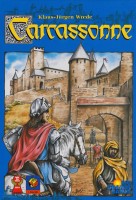
Carcassonne
2-5
8+
45
A clever tile-laying game. The southern French city of Carcassonne is famous for its unique Roman and Medieval fortifications. The players develop the area around Carcassonne and deploy their followers on the roads, in the cities, in the cloisters, and in the fields. The skill of the players to develop the area will determine who is victorious.
This is now without the River1 expansion.
Digital Versions:
Digital versions of this game are available for iOS and Android devices! Click on the links below to learn more.
Carcassonne for iOS >
Carcassonne for Android >




Add a Review for "Carcassonne"
You must be logged in to add a review.
Carcassonne (remember spellers, double the ‘s’ and double the ‘n’) is often highly ranked on lists of best “gateway games”, and I feel this is for good reason. With a lower entry price compared to some of its highly ranked brethren (Settlers of Catan and Ticket to Ride), Carcassonne is an easy game to teach and play. It has two major decisions a player needs to make each turn, with the first being very intuitive (drawing and placing a tile), and the second allowing for some strategy, while not overwhelming a new player with too many options.
Gameplay
Each player’s turn consists of three actions:
1) Draw and place a tile (required)
In a sense, you’re building a giant puzzle, but the pattern has not been predetermined. Each turn, a player will draw a tile (see the House Rules section of the site for variations on this) and place it into the growing landscape. Like a puzzle, a piece may only be placed where it “fits”, but instead of odd shapes allowing a piece to physically fit, you’re matching the edges. Cities attach to cities, roads to roads, and open land to open land.
2) Place a follower/meeple (optional)
On the tile you just placed, you may put one of your followers (a little wooden person known as a meeple). While your meeples are identical, they can be used in different ways, depending on what geographical feature you’re placing them on. They can be placed on roads, cities, farms, or cloisters with the game calling them thieves, knights, farmers, or monks respectively (I find it easier to just ignore the titles as it really doesn’t do anything for the game, they’re just meeples). Meeples are very polite and will only go on a feature if no other meeple has previously claimed it; no matter how many tiles away, if it’s connected and has a meeple on it, you can’t play your meeple on it.
3) Score completed features (when possible)
Roads, cities, and cloisters will score when they are completed. A road is completed when both sides have come to an end, or a loop has been made. A city is complete when it is completely surrounded by walls. A cloister is complete when its tile is completely surrounded by other tiles (all eight possible orthogonally and diagonally adjacent spots have tiles placed in them).
For these three features, whoever now has ownership will take back their meeple(s) and score points (1 per road segment, 2 per city segment, 9 points for completed cloister).
Farms are different as they are only scored at the end of the game. Depending on your game’s edition there are different scoring rules for farmers. In general, the idea is that the player with the most meeples in their color farming a city will gain points.
Game End
Play passes around with the next player taking their turn until all tiles are played. At the end of the game, points are awarded for uncompleted features, the farmers are scored, and the player with the most points wins.
My Thoughts
Carcassonne is a great game for introducing new players to modern boardgaming. There are primarily two things a player does on each turn, draw/place a tile, and decide whether to put a meeple on it. While there is some strategy to where you place your tile, the rules are very intuitive, and hardly seem like rules that need to be learned. By thinking of the game as building a puzzle, half of your rules are taken care of for you. In general I find having fewer rules a person has to “learn” makes a game more accessible and enjoyable (this is why later teaching a game with similar mechanics is easier – the player has already learned the basics of the mechanic, and just needs to understand how that mechanic relates to the new game).
By limiting the ability to place a meeple to only the tile just played, a gamer is not overwhelmed by multiple options. If a player were free to place a meeple on any tile on their turn, the game could easily double in length, especially with new players as they analyze every option. It’s worth noting that it wouldn’t be all that beneficial to go back to previous tiles and place anyway, so you’re not losing too many strategic options.
The difficulty in teaching/playing the game the first time is in the farmers. Having a piece that you play once and never get back, while hoping for points later, can be difficult for players to grasp. Without having a board setup in advance, it’s tough to illustrate how farmer scoring will work. The rulebook seems to have gotten better over time with illustrations, and unless you have a fully assembled board from a previous game, showing the figures in the rulebook is probably the best way to go.
There are those that recommend skipping farmers the first game. I personally like making all of the rules available to a player, but if you have younger players or people that are really having problems grasping the farmer rule, skipping farmers the first time may be beneficial. If you do this, I highly recommend, after final scoring, putting farmers down and showing exactly how they work on the completed board. It should only add a couple of minutes, and will make the rule more concrete for people who may play again in the future.
It generally takes some time for players to start seeing how multiple meeples can occupy the same road/city/farm. I enjoy seeing the delight people take in attempting to fight their way into a city, while another player desperately tries to shut everyone else out. Often such play doesn’t lead to optimal strategy, but you see people having fun, and looking ahead to future turns, which is a fantastic moment in any game. The rules give full points to all players that are tied when a feature scores, making it less likely a player will spend a quarter of their game going after something to find themselves completely shut out.
Carcassonne is a fairly simple game with quick enough play, easily grasped rules, and a hint of strategy that makes it one of my go to games for non-gamers. The ever growing countryside that appears on your table gives a shared sense of building something, while everyone can enjoy their turns without spending minutes agonizing over what to do. I highly recommend giving Carcassonne a try with younger gamers, or friends that have expressed an interest in learning about boardgaming.
And, if it ever gets stale for you, there are plenty of expansions to put the spice back into the game! Grab your meeple army and populate the countryside of Carcassonne!
In the game of Carcassonne, you and your friends will build a French countryside one piece of cardboard at a time. There are, more importantly, wooden Meeples that you can make dance in between turns, and also perhaps make do disgusting things. Whatever you are into.
This is primarily a game of strategy if I had to label it. You are essentially jockeying for position with your Meeples to gain points while placing tiles in ways that will (hopefully) aid you more than your opponnents. The game plays 2-5, although I would recommend 3-5. I would say to plan for an hour to and hour and a half to play, depending on how well versed your group is playing this game. It could be less.
In the box, you will find 72 cardboard land tiles, 40 wooden Meeples in 5 different flavors, a cardboard scoring track and a rulebook and summary sheet.
The overall gameplay is pretty simple. To begin, everyone takes all of the Meeples of their chosen color and the starting tile, which can be identified by its different back, is placed in the middle of the table. The remaining tiles are put face-down where everyone can reach them. The first player will take a tile, look at it, and choose where to place it.
Each of the tiles will have various attributes that will create the map you are playing on. There are roads, cities, fields and cloisters depicted. There are simple rules regarding placement. Roads must connect to another road. City tiles must connect to another appropriate city tile. You cannot put the innards of a city, for instance, right up against a road.
Playing the tiles themselves is not the ultimate goal. You will be placing your Meeples strategically upon tiles to gain points. Depending upon where they are placed, they will fulfill certain roles;
either Knight, Farmer, Monk or worthless dirty Thief.
Here is how it works. Starting with the politician… I mean Thief. You declare it a Thief simply by placing it on a road segment. The Thief will remain on this segment until the road comes to a termination point on both ends. Once that happens, you remove the Meeple and gain one point for every tile that makes up that completed road segment.
For the Knight, you will place one of your Meeples into a city tile. Once that city is complete, by placing tiles that create a continuous city wall, the player with the most Meeples in that city will get two points for every tile that makes up that city.
To create a Monk, you place your Meeple upon a cloister. Once that cloister tile is surrounded on all sides, including corners, you take back your Meeple and score 9 points.
With the previous three types, once they score you get them back. The Farmer works differently. They will stay on the board until the end of the game. A farm is a continuous field, and a Farmer is a Meeple laid on its side is said field. At the end of the game, the player who deploys the most farmers is the same field scores three points for every completed city that farm supplies, or touches.
In addition to this, partial cities, cloisters and roads get points at the end of the game. Although a player cannot put a Meeple on a city or road occupied by another player’s Meeple, it is possible to have two players place Meeples on segments that were not originally connected in any way but end up being so. The player with the most Meeples gets the points, but a tie scores for both.
There are about 15,000 expansions for this game, adding all sorts of new tiles and rules. I find this to be a light, friendly game to play, and is a good way to introduce players to the world of board games along with Settlers of Catan and Small World. This is a good way to do it when you want to avoid any type of cut-throat gaming. While everyone is trying to score points, beyond placing a tile to benefit you and not your neighbor, there are not a whole lot of ways to stick it to your buddy.
Its nice and its light. It doesn’t always fit the bill when it is gametime depending on what everyone is looking for, but it won’t be likely to start a fight either. The only real negative I see is there isn’t a whole lot here, but it beats the heck out of Candy Land. You should be able to find a copy pretty cheap, so there is no reason for a gamer not to have a copy in the closet.
Carcassonne is a fun tile laying euro game where your meeples set out to claim farmlands, cities, roads, and cloisters. Draw the right tiles and claim the right property and you can find yourself ahead and victorious!
GAME PLAY:
Carcassonne is an easy game to teach and learn. There are only a few basic moves and the pieces repeat regularly so there are no curve balls half way through the game. The game is played by drawing and playing a tile. On each tile there may be a city, road, cloister, and/or farmland. Only you can claim an area on your tile and you can only claim one area, even if there are several different area types on a single tile. You claim an area by playing one of your meeples on it to show that it is your land. Here’s a rundown of the different areas and how they work and score.
Farmland: Takes the most space of your land. It can yield quite a few points, or if you’re not careful, none at all. To claim a farmland you play your meeple on his side and he gets points for all the completed cities within your pasture land.
Roads: Simple to score and can quickly return your meeple back to your collection. You get one point for every section of road.
Cities: Cities give you two points per section if it is completed and one if not at the end of the game. There are also bonus tiles with a little blue shield that earn you two times the points for that tile.
Cloisters: These are your money makers. You get one point for every square around them, up to nine, counting itself.
Once you close a tile off by completely closing in your city or cloister you will get your meeple back to play him again on another piece of land, but you have to be careful in how you use them or you won’t have enough to go around.
COMPONENTS:
The components are pretty simple. Classic nice wooden meeples and sturdy cardboard tiles. We have played through this game many times and have seen little wear on the cardboard. You will get lots of play out of the pieces.
PROS:
• The game is easy to teach. There are just a few actions that can take place in the base game that make it easy for new players to learn how to place.
• Game play is fairly quick. It won’t take long to teach or play, allowing for lots of replay value.
• There are lots of expansions for this game to add on to it. You can play a short quick game with the base, or draw it out and really make it last with a few expansions.
CONS:
• I think the game is more luck based then strategy based. You never know what tile you are going to pull, but you do have to know how and where to put your meeple.
• At first its difficult to say Carcassonne. We pronounce it car-cas-sone.
OVERALL:
I would say this is a pretty decent game. All of the components and mechanics work very well. That being said, Carcassonne is not a game that I long to play. I was recently at a dinner party, and while some of us guys were waiting on the ladies we hashed out a game. It’s a good filler game, and I could see how others would be more obsessed with it and want more or all of the expansions. Final words… I’m glad one of my friends owns it, but that I don’t.
THIS REVIEW IS BASED ON THE 10th ANNIVERSARY EDITION
Me and Carcassonne
If I remember correctly, the first time I played Carcassonne was a few years back. I was spending my evening with a couple of friends at a local pub when someone thought that we should play this game (games at pub, awesome!). Having never played it I accepted. It was fun the first time, but the novelty has worn off a bit by now.
The premise
You are a feudal lord / city planner during the medieval times. Your job is to build roads, cities, monasteries and fields around the city of Carcassonne. You earn your victory by building the biggest cities, longest roads and best supporting farms. Ok so the theme isn’t as awesome as in let’s say Arkham Horror, but this is a family game!
Out of the box
The box is thick cardboard and funnily shaped. While this is refreshing it’s also kinda hard to fit in your shelf space. It is well made though. The pawns are made out of plastic (Boo!), I liked the wooden bits better! It’s also funny because the 6th player pawns you get in one of the expansion ARE made out of wood, so it isn’t very coherent looking. The box has little extra space for anything else but the base game. I’ve managed to fit in the River II expansion and the bag you get with Traders & Builders.
Actual gameplay
If the box or the pawns didn’t exactly shine, the gameplay is luckily a bit better. You don’t get River I with this, but instead you get a new mini expansion called the Festival. It basically grants you the chance of picking up pawns from the board.
The gameplay itself is pretty solid even though there is a luck factor involved. You grab a tile from the bag and try to fit it on the board somewhere so that it would score you points. This is pretty fun as the board will always be different, so that’s a plus. This allows two different types of gameplay as well. You either play the “friendly game” where everyone focuses on their own projects, or you play the “up yours” game in which everyone tries to block and take over stuff from the others. This is also good as there are two different “game modes”.
The base game gets a bit dry fast though. I don’t know if they wanted to make more money by making it so simple or what, but you basically have to either buy more expansions for it or just play it rarely to keep it interesting. That’s a minus.
Final words
The game is simple enough (maybe excluding the farm mechanic) that you can take with you and introduce new people to the world of board gaming. The 10th anniversary box isn’t suited very well for travelling though: the stuff inside is all messed up if you move it.
However, the game gets old fast. That’s why it doesn’t fit very well for a game that is played very often. Now and then is just fine, but you’ll find out that the game tastes like saw dust soon enough.
I was recommended this game and decided to give it a try with the family to see if I could move them on from the long drawn out arguments resulting from a game of Monopoly….
I am not going to give a detailed overview of how the game is played since there are many of these on here already. Instead I will give a summary of the main things I like about the game.
The Results:
It was a really easy game to play with all the family (wife and daughters aged 10 & 12). Everyone got to understand the rules quickly and could see how we could support each other in deciding where to place the tiles. The children enjoyed seeing some victory points being earned early on in the game from the robbers. The game is quite short (less than an hour) so it avoids dragging on like some other games can. The games vary every time since there is a randomness in the order that tiles are drawn, therefore making the game board change each time.
Having played it with family, I found it great to play with friends as well, which provides for a more strategic game as people are trying to plan further ahead to ensure victory at the end of the game.
The Expansions:
Having played the game and enjoyed it, the expansions have started finding their way into the house. Initially the “King & Scout” and “River II” because these were cheap little add-ons for the children to get. All the expansions add more variety to the game and my local game store (Avon Toys in Leamington Spa) has them all in stock most of the time. More expansions will certainly be bought in the future.
The Future
Definitely will buy more expansions, and will play it with more friends, who really like the idea of the game. Going to meet up in a couple of weeks at our local games club to have a proper go with better gamers, but certain that this will be as much fun.
Summary
A “must have” game for any collection – great to play with gamers, friends or family and pick some of your favourite expansions to add more variety (they are priced £4.99-14.99 in the UK and probably a lot less in the US!!) and are certainly worth the money. If you are really into it, watch out for the box set which comes with the game and loads of the expansions as well!
Kinda like building a jiggsaw puzzle but with scoring,
…and meeples,
…and the end-game looks like a bunch of poop-cities floating around in a strange alien intestine.
In a Nutshell
Carcassonne is a great starter game and lends itself well to being played with a group of people who just wanna hang out and talk while playing the game. The scoring might be hard to follow but it doesn’t seem to matter too much because the game is quick and fun.
Specifics
Each player takes a tile from the pool and places it on the table alongside another tile that has already been played. The meeps are placed on the tiles and receive points as certain features are built (like roads, cities, and cloisters).
Catan vs. Carcassonne
Catan and Carcassonne were both made in Germany, have similiar themes, and were designed by men named Klaus. (Klaus vs. Klaus…lol)
Personally I like Carcassonne better than Catan, although I recognize that Catan is a superior game mechanically. Catan starts to wear on me, some Catan games are drawn out. I consider both games to be gateway games to be played with new gamers, so I’d rather play something quick and light like Carcasonne. Maybe I’m just sick of asking “wait you are selling sheep?!?! or asking for them?!?”
The Takeaway
I have suggested 2 game variations in the tips section.
1. Players select 3 tiles to hold in their hands and play them like you would in Scrabble or Dominoes.
2. The Carcass-Zone…hahah read more about it in the tips section.
whatawhale
Carcassonne is a great game. It is extremely simple to understand, very quick to set up and has great replay value.
So what is Carcassonne?
Really? You’ve never heard of it?
Nope.
Well then you’re in for a treat. Take my word for it, go and get this game and play it.
I’m going to need more convincing than that. How do you play it?
In Carcassonne there are lots of square tiles. On the tile there is a small segment of a map. At the start of the game there is only one tile down (the starting tile), and all the other tiles are turned face down so none of the players can see them (in fact I would recommend you go all-out and get yourself a bag to put them in). In turn each player chooses a tile at random, reveals the tile and adds it to the other tiles, building the map as you go along.
I’m guessing there’s some kind of scoring to this?
Yes there is! Each player has a set of small wooden people, which are called “meeples”. The map that you build up with the tiles has fields, cities, roads and cloisters. On your turn, the features on the tile you place have to align with the tiles already in play (i.e. a field has to align with a field, a road has to align with a road and so on). After placing your tile down you have the option of putting one of your meeples on one of these features if it is unoccupied. If a feature is completed you pick up your meeple and gain a score based on the size and type of the feature.
– A road is complete when it is continuous with a start point and end point (for example a crossroads or it enters a city). It scores one point per tile.
– A city is complete when it has a continuous boundary and no tiles are missing inside it. It scores two points per tile, plus an extra two points for every shield it contains (some of the city segments have a shield on).
– A cloister is complete when it is surrounded by tiles (including diagonals, i.e. it is at the centre of a 3×3 square). It scores 9 points (one for the cloister tile and 1 for each tile surrounding it).
– A field is never completed during the game.
At the end of the game any meeples still in play are scored.
– Any uncompleted roads score one point per tile.
– Any uncompleted city scores one point per tile, plus one point per shield.
– Any uncompleted cloister scores on point for the cloister tile plus one point for any tile surrounding it (including diagonals).
– Fields score 3 points for each complete city it touches.
The highest score wins!
So what makes this game fun?
Many things. First there’s the strategy element, placing a tile can be advantageous to you or disadvantageous to your opponents (or both). I think it’s best to show everyone each tile as it is chosen, and everyone can talk and argue about where it should be placed (of course, it is up to the player who picked up the tile to decide). Also, although you can’t put a meeple on a feature where another player already has a meeple, it is possible to have features “join up” and share or steal points from an opponent. Finally, bear in mind you only have a limited number of meeples, so there’s always the decision to be made if you want to use one up because you might not get it back until the end of the game.
OK, I’m sold.
I knew you would be.
COMPONENTS
The games consists of a large number of cardboard tiles, a set of wooden meeples for each player and a board for score tracking. Everything is of very nice quality.
DESIGN
Since it is an older classic this game has different designs. I am reviewing my, about 10 years old Rio Grande version. I really like the design of tiles, and pretty much like the design of other versions I saw… As for the meeples, everything I need to say is that meeples represent one of the symbols of board gaming, and this is the game that got them in the form we know them today.
RULES
Each square tile in Carcassonne represents a part of a city, road, farm and/or a cloister. On each turn, a player takes a random tile, and puts it on the map bordering at least one other tile in such a manner to not make impossible connections (an open part of the city, must be continued to a city, a road to a road, and so on…). When he puts a tile, he may put a meeple on that tile on a city, road, farm or cloister segment. City will score 2 points per tile when finished (or 1 if not finished by the end of the game), road will score 1 either way, farm will score 3 points per finished city it borders by the end of the game, and cloister will score 1 point for each tile bordering a cloister (including itself). Apart from farms, meeples are returned to the hand of a player if the segment they are on is completed. Very important rule is that player must not put meeple on a segment already occupied by another meeple (friend or foe), and if at some point meeples of different players end up on the same segment, only the player with more meeples scores points (or both, if there is a same number of meeples).
FUN
Carcassonne is one of my favourites. It is a fast, fun and simple game in its core, but with much more depth than it looks. You may run for the extremely large city, and lose many points if you fail to finish it, you may go for the farms, but you will lock to many meeples till the end, you may go for the roads, but they don’t bring too many points, you may also try to take a hard work from others, by trying to connect your small segment with their large, or put tiles in such a way to make them unable to finish theirs. It is a beautiful game, full of interaction, very fast and easy to learn!
REPLAYABILITY
A large number of tiles that are randomly drawn will make every game different from any other, but the game might feel the same after some time. Lucky for us, Carcassonne has many great expansions, out of which I recommend Inns and Cathedrals and Traders and Builders, because I have those… I guess there are many other great expansions.
OVERALL
Carcassonne is great game for almost everyone. It is very simple and fast in rules, but also great for outsmarting your opponents. It is very family friendly, and a great gateway for those new to the hobby.
10
Carcassonne is a gateway game of tile-laying and worker placement, introducing two fundamental strategies that will make it easier to learn more complex Euro-style games later on in your Hobby development.
That is not to say that this is only a game for beginners, or isn’t a complete game in itself. Much the opposite. For many gamers, including my wife, this is a timeless classic that gets lots of plays, and can be a welcome gaming experience when you don’t feel like learning something new, or want to play with people who are not “gamers” who typically play Euros.
Lets look at the nitty gritty of the game:
Components:
The main game components are a Score Board containing the scoring track,
MANY tiles (which can be added to with expansions),
Wooden tokens shaped like little people (affectionately called Meeple) in each players’ colors (some expansions add new types of tokens).
Setup:
One specific tile is placed in the center of the playing area as the starting position for gameplay. The rest of the tiles are placed upside down and shuffled (or placed into a drawstring bag).
Gameplay:
The sum total of the actual gameplay is as follows: Each player, on their turn, draws a random tile, places it on the growing map, and may, optionally, place one of their Meeple on the tile that they just placed. That is the entirety of the gameplay.
Strategy:
There doesn’t seem to be much to the game by this description, but the strategy comes from the rules for tile placement, and the decisions for placing your Meeples (also with it’s own set of rules) to either score more points, or deny your opponents opportunities to score.
Tile placement rules:
Tiles must be placed so that they
1. must connect to an existing tile on the board.
2. features on the side(s) that connects to other tiles must connect to the same feature on the other tile.
For example: roads must connect to roads, cities to other cities, and fields to other fields. A road cannot end connecting to an emply field, or run into a city at the edge of the tile, a city tile edge cannot connect to a field edge, and so on.
When tiles are placed, their features instantly become part of the features that they connect to: a city on the tile becomes part of the existing city that it connects to, as do roads and fields. They are not separate ones if they connect. If they do not physically connect to existing features, then they are new ones, not connected to the existing features, though they might join up later. Much of the games strategy comes from this.
Worker placement rules:
You may only ever place a worker on the tile that you just placed this turn. You may only place your worker on a feature that is unoccupied by any other meeples of any player including yourself. Once placed, meeple are locked in position until they score. Meeple placed on roads become highwaymen. Meeple placed in cities become guards. Meeple placed in fields become farmers.
Scoring rules:
Highwaymen score when the road they are placed on closes on both sides. Roads close when they connect to anything else, including other different roads at an intersection point on a tile. Roads score one point per road section on each tile. The shortest possible road is two sections.
Guards score when they cities they are in become fully enclosed by walls. Cities score two point per city section on each tile, with some bonus points for “shields” on the city spaces. The smallest possible city is two sections, but only scores two points instead of four.
Farmers score at the end of the game. Any farmer placed in a field is locked until the game is over.
Here’s the catch: Only the majority player in each feature scores the points. If one player has two meeples in a city, but another player has three meeples, then only the second player gets the points when the city closes.
It is especially painful to lose fields in this manner, so always be mindful of farmers, and who is placing them where. One tile can join two fields together, completely changing it’s ownership.
Some expansions change these scoring rules.
Summary:
There is a lot more to Carcassone than first meets the eye. It can be a very light friendly game, suitable for children and family groups, and to introduce Euro games to non-hobbyists. It can also be a brutal cutthroat game suitable for tournaments and hardcore strategists, where the struggle is to lock your opponent’s meeple permanently with as low a score as possible. This is a remarkable accomplishment for such a very simple game. It’s not one of my favorites, but I will gladly play this game, even after over a decade of plays.
If you read the other reviews on this page you will learn the mechanics of drawing and placing tiles to build a map and placing little wooden markers (“meeples”) in an attempt to score points. There is so little to the rules that they can be explained to a newcomer in moments. The tile placement rules more or less amount to “does it look right?”.
Even the scoring is very simple, with one exception: the “farmers” (meeples placed in fields) which stay until the end of the game and are scored in a way that may not be obvious to everyone. I feel that there are two ways around this: either you ignore the use of farmers completely (which loses quite a lot of depth from the game but makes things very much easier, especially for younger children) or you explain as best you can and then just go for it; the game runs quickly (we usually take about half an hour) so you’ll probably have time for another go once everyone has seen it all work out.
Presentation of the game is great. From the colourful, chunky tiles which look great as they expand into a table-filling map, to the wooden meeples and… Well, actually that is all there is to the game other than the scoring track. You’ll want a decent sized table to play on, though, as the map can spread quite a lot on occasion.
The random drawing of tiles can make the game feel pretty random, but with a limited supply of meeples and the need to keep an eye on what other players are doing, I don’t have a problem with this. Reducing the amount of randomness (there are assorted suggestions on the tips page) can slow the game significantly and I think speed is one of Carcassonne’s great assets.
Overall I really like Carcassonne and it is definitely my gateway game of choice if I want to introduce folks to the joys of Euro games. It works just as well with young kids as with adults and has just enough depth and strategy to keep most folks happy for a little while at least (though with “serious” gamers I’d only occasionally bring it out as a light filler).
Finally, the price is excellent, which makes it easy to recommend to just about anyone.
What constitutes a classic? The Morgan is a classic car because of its history and enduring style. Citizen Kane is a classic film because of its great story and filming techniques that still seem fresh today. What about classic games? Monopoly? Chess? Carcassonne?
Carcassonne is the fortified city in the south of France and is also a tile laying game that is deceptively simple to play. Each turn a player takes a random tile and flips it over to reveal its features. Each tile contains sections of cities, roads, farms or a single cloister. The player then places this down so that it fits with pieces already on the table. The player can then place down one of their followers; tiny wooden people often nicknamed meeples, onto one of the features on the tile. When the city, road or cloister is completed the player scores points based on the number of tiles used and the follower is returned to the player. Farms are scored a little differently with players gaining points at the end of the game based on the number of completed cities the farm connects to. A player can’t claim a city, road or farm that has already been occupied by another player but with careful tile placing two features can be joined to steal locations off opponents.
Carcassonne’s rules are simple enough to make it a great family game but there’s enough depth to build deeper strategy. Farms can be fenced off with roads, cities can be blocked by an awkward road location and both features can be stolen. The game plays between 2 and 5 players and it tends to work best with 3 or 4 players. At this level there is a good balance of strategy and randomness and more chance that the opposing players can screw up you plans. At 2 players you can end up doing your own thing at opposite ends of the table and with 5 players things can be a bit crowded. More players also mean more downtime. Carcassonne is a game that can lead to a lot of analysis paralysis; the dreadful situation that exists when players stop and think carefully about their move causing the game to grind to a halt. The more players you have the more this becomes a problem.
The game comes with a handy scoreboard for, well, keeping score obviously.
The most contentious issue with the game is the farm scoring system. Farms are the most strategic mechanic in the game, only 3 points per city seems like a meagre amount of points at stake but if you can connect a farm to a lot of cities there are a lot of points up for grab. The concept itself isn’t complicated but scoring farms at the end of the game is prone to errors. It relies on players visually inspecting the entire board and tracing the network of road and cities that act as barriers. You may want to ignore farm scoring for a simpler game and this is strongly recommended for younger players.
Early in the game and some one has left that big city on the right unclaimed, crazy fools!
The components have a classic enduring appeal. The basic tiles are sturdy and thick and the meeples themselves are wooden, a material that always adds a touch of class to the game. What is lacking is some form of draw bag for the tiles (though one is available in the Traders & Builders expansion).
A typical game of Carcassonne will last around 45 minutes to an hour, an almost perfect game length for a game of this depth. There are a lot of expansions available for Carcassonne and these will be covered in more depth in later reviews but it’s worth noting that all the expansions add extra tiles, which in turn make the game longer to play. Too many expansions and Carcassonne loses the brevity that makes it a great game.
Carcassonne is a classic game. Like all the best games the rules are simple and easy to learn but offer a depth of strategy that give the game longevity and interest. Its quick to play and completing high scoring features is a gratifying experience.
Also posted on my blog at http://www.polyhedroncollider.com
Traditionally, a gateway game is any board or card game that helps people get into the large world of hobby board games as opposed to the usual exposure and experience that most people get from the big box stores like Walmart and Target.
In many ways, Carcassonne does fit the bill for this ideal because it’s an easy game for people used to games that hold all their rules in the box lid to get into. It’s fun, quick enough to grasp, and still has plenty of elements that allow players to try to outwit each other.
Where I don’t quite agree with the gateway game moniker is that most gateway games fall largely by the wayside once you’ve gone more deeply down the rabbit hole and seen the wider world available in the Wonderland. But Carcassonne isn’t a game you should be leaving behind.
The simplicity of the tile and worker placement may be quick to learn, but the strategy, expandability, and thinking you get to do with this game make it worthwhile no matter how far from the gate you stray.
And just to give how clear things are for learning this game – laying the tiles is so easy to teach because it uses the same principles learned in dominoes, sides have to match. Worker placement’s a breeze too because it’s just first one on is the only one who gets to be put on that terrain feature and you have to plan carefully because you have a limited number to use.
Scoring can be a little wonky at times, mostly because of the farms, but the rules are printed up in a very clear way and are easy to reference at end game for those new players.
Overall this is a game worth playing no matter where you are as a gamer. A lot of folks label this a Euro style game, and I guess that’s true in certain ways, but ultimately I don’t really think of it like that. This is a fun game. That’s all there really is to it. Who cares where it came from or what kinds of games you’re “supposed” to be playing. Just ask “is it fun?” and if you answer in the affirmative, PLAY THE GAME! 🙂
The high points:
Easy to Find
Plenty of Fun Expansions
Affordable (Unless you feel the need to have all the expansions – that’ll get pricey eventually)
Easy to Get Others to Play
Even Available Online and Certain Video Game Consoles
Get a medium size to large table, open up the Carcassonne box, and build cities and roads and fields until the cows come home. Because cows in your home might knock over the table and mess up your game of Carcassonne so that might be a good place to stop.
Carcassonne is a game of tiles. It’s like a multiplayer puzzle. Each player picks a tile and places it on the board/table/floor/playing area. This tile will have different things on it such as a field, or part of a road, or maybe even a city wall. These pictures must match up to their surrounding tiles and build off them. Once you complete a section, such as completely walling off a city, you get the points for that city if you have claimed it.
You claim an area by placing a meeple on it. A meeple is a little wood or plastic person-ish shaped counter. The most points at the end of the game wins. Fairly simple, pretty straight forward, but the end result is usually an entertaining game and a funky looking french countryside littered with the oddest shaped cities and most ignorant road placement you have ever seen.
Pros:
-Easy to learn.
-Good play time. Not too long, but not too short.
-MEEPLES! What more do you need man?
Cons:
-There is a lot of luck involved concerning tile draws, but not so much that it overrides good decision making on placement.
-Some of the scoring might be a little confusing at first, but nothing a game or two more won’t fix.
Conclusion:
Look. This is a very popular game for a reason. It’s not super flashy and the box might not exactly scream “Excuse me kind sir. Will you please play me because I’m fun and WOW EXPLOSIONS!” or anything like that, but after your first game you will see why so many people put this game so high on their list. Some people use it as a gateway game to get new players interested. The really good thing is that even after they are hooked, they will come back to Carcassonne again and again even after they are addicted to the sweet sweet drug of board gaming.
This was my introduction to European games. That being said, its also the only one I’ve tried so far. I still think it is a decent game to start with if you are curious about the genre.
Carcassonne is a tile placement/worker placement game. Each turn, you pick up a tile with various elements of a landscape on it, and make it fit with the tiles already on the table in a way that makes sense. You are basically making a map with the other players. After you’ve laid the tile, you have option to put a meeple (one of your little wooden guys)on one of the features that appears on the tile you just put down. These include cities, roads, monasteries and fields. All of these features are scored different, and all of them are worth more points per tile if you can manage to complete the structure (a city must have walls on all sides, a road must be connected to structures or crossroads or even loop on itself). Added bonus- if you complete a feature, you get your meeple(s) back.
This might sound simple, but you only get like seven or so meeples to work with, so your have to think over your investment a bit. These is especially so for fields- once you put a “farmer” in a field, you never get it back. The pay off is that opponents tend to forget about them and they can actually get you big points in the end.
The biggest issue with Carcassonne is that scoring features can be a pain in the but at first. Everything has two values depending on whether they are complete or not. they include a score board, but I prefer not to use it. If you play until you run out of tiles (that’s what the rules say to do) you easily go around the board a couple times. I recommend just jotting scores on a piece of paper as you play.
Aside from that, I think the mechanics and general feel of the game is intuitive. Its like putting a puzzle together, and then colonizing it with tiny figurines. I often hear that these eurogames aren’t big on theme, but I didn’t get that sense playing Carcassonne.its based on a Medieval place, and that’s what the tiles look like. I guess that’s because geography is so central to both gameplay and theme.
The components are especially good, and meeples are always charming.
At first I thought it was silly that there were only enough meeples for five players, but if you played with more it would drag out the game a little bit. The biggest game I played was three people, and that was fine.
If you want to convince someone to get into eurogames, introduce this charming little number, give them a basic idea about what all the features are worth, and definitely volunteer to keep score. 🙂
In the game of Carcassonne you and your opponents build a middle-ages land. Yes, the whole land: with its fortified towns, meandering roads, solitary cloisters and cultivated fields. The game contains a number of square terrain tiles that represent these structures or their fragments. Players take their turns putting those tiles on the table; in the process the appropriate features on the tile edges (i.e. roads, towns, fields) have to meet their counterparts on all the tiles the newly positioned one touches.
On a freshly placed tile the active player may put an inhabitant: in a cloister it will be a monk, on a field – a peasant and so on. (The small wooden dweller figurines are nicknamed “meeples”. This strange name is meant to be an abbreviation of “my people”; it is used now for any similar wooden figurines in many games, but the first use of this term was for the very game of Carcassonne.) When a structure is finished the player with most meeples in/on that structure is rewarded with a number of victory points.
The game is pretty simple and easy to learn. It allows a lot of playing styles: from concentrating on one’s own structures only, through competing for dwellers majority up to deliberate putting terrain tiles to disturb opponents’ creations.
At the end the players may marvel the world they have made. No kidding here – the landscape created during the game often has a substantial aesthetic value!
The main drawback of the base game – in my opinion – is that it is too short. The number of tiles should be higher. Fortunately, there are a lot of expansions around and one can always add a bunch of expansion tiles to the mix – even when sticking to the basic game rules!
I have only ever experience Carcassonne with 2 players at the time of writing, but I am perfectly happy with this. In fact, I have almost no desire to play it with more people because for me it is the ideal 2 player light strategy game.
Carcassonne is, as the game description will tell you, a clever tile laying game. Players draw tiles at random and must connect like sides – each side of the tile will contain a road, city or field, and these sides must be placed next to tiles with matching sides. When you place a tile, you can also choose to put a meeple (miniature people) on the tile to say ‘I’d like to try and score off this tile’.
Then, whenever the feature you have placed your meeple on (road, city or church) is complete, you score points based on the size of that feature. You can then pick up that meeple and use him again to score more points. This leads to a very clever dynamic. You’re trying to make the feature as big as you can before completing it to score big points. Your opponent on the other hand is either trying to finish the feature, put you in a position where the tile you need to complete the feature is hard to come by, or cleverly join their meeple to your feature to try to steal your points! The game ends when all the tiles have been laid. Any extra points are added on, and the winner is declared!
The game is kind of like a more tactical version of dominos, and that’s what makes it so good for 2 players – any more, and the game is too unpredictable to be tactical. Any computer gamer will know that a free-for-all game of Quake can be won by anyone because of its chaotic nature. Carcassonne’s strength is in its 2 player elegance. The illustrations on the tiles are lovely, the meeple have become a symbol of light strategy games and the scores are totalled up by moving around a track, which makes it quick and easy.
The best bit however has to be that it sets itself up. You don’t have to set up Carcassonne; it builds itself as you play!
UPDATE
Having had a lot more experience playing Carcassonne with more players now (I took it to my family’s house and they all played it), I can tell you that it’s still a blast. You can’t plan ahead as far, but the game didn’t lose any of its competitiveness or fun.
Carcassonne is a game that helped open the doors for Euro Games for many people, it was one of the first games I started with and in the beginning I made sure to get the latest expansion. However there are so many great games that come out every year and my life got so busy that I forgot all about this wonderful game and my copy ended up…well I actually have no idea where it ended up.
For a full Review complete with full sized images go to http://toddsboardgames.blogspot.ca/2013/01/carcassonne.html
I borrowed a copy from my local gaming store and showed it to a couple friends last night. Other than scoring details I didn’t have to even look at the rules it all came back to me fairly quickly but much to my surprise I ended up placing last? This is one of the greatest intro games around and this review is going to explain why.
Gameplay:
The gameplay is really very simple, you turn over a tile, place it somewhere so that all of its edges match up (a road cant run right into a field and your castle cannot have a field for a wall, etc) and you then have the option of placing a wooden man on the tile or not. Where you place the man determines how you will score points. Here are the options for placing your workers:
Castle: A completed castle is worth 2 points for every section as well as 2 points for every ‘shield’ or pendent. Only the player with the MOST workers will score points, if there is a tie players will split the points. Completing a castle results in your men inside being returned to you. At the end of the game every incomplete castle tile and pendent is worth 1 point.
Road: Each section of road is worth 1 point to you, if you complete the road your men on it are returned to you. At the end of the game unfinished road sections are worth 1 point each.
Farm: A well placed farmer can turn the entire game around. Your farmer is not returned and once you place him you cannot get him back until the end of the game. However at the end of the game every castle inside your farmer’s field will score you 3 points. Fields are separated by roads, other tiles and non existent tiles. You simply trace the field around and any castle inside of it scores you 3 points, I recommend scoring farming last and using your wooden people that you are not using anymore to mark castles so you make sure to score them all and make sure not to double score one.
Monastery: When you place a monastery you are trying to form a ‘cluster’ that is all the areas adjacent to the monastery including diagonals. If you finish your ‘cluster’ your man is returned and you score 9 points. At the end of the game unfinished clusters award 1 point for every adjacent tile and 1 point for the monastery tile itself. It is a good idea to hold 1 worker back in case you draw a monastery tile.
Components: The tiles are solid quality as are the wooden men that have become a staple for euro games. The base game comes with a free ‘river’ expansion. If you want to expand your Carcassonne collection there are mini expansions that include a few tiles and meeples and expansions that include a wheel of fortune, a tower, a catapult. Although the artwork seems a little outdated and does look a little old Carcassonne is more than 10 years old now, its a classic and remains a great starter game.
Who is going to enjoy playing Carcassonne? Simple. Everyone.
Family Gamers: There is no conflict or adult themes in this game, you are simply placing tiles to complete different structures and placing wooden men to claim the structures as your own. The mechanics in the basic game are simple enough that anyone can play so its fun for kids and adults. There is no text involved so simply explain the different ways to score and I can almost guarantee Carcassonne will be a hit!
Casual Gamers: Carcassonne hits a number of points on the head for casual gamers. It is light (there are not a ton of rules) it is fast playing (our game was about 30 minutes with 2 people having never played) but there is still enough to the game that it leaves you wanting to play again. Even with the simple mechanics there are still a ton of choices to be made and different ways to score this gives options and options get people hooked. Carcassonne is a great game on its own and can be used as a great bridge to get into more advanced games.
Gamer Gamers: There are tons of expansions out there for Carcassonne and adding a couple of the right ones can make the game more complex for advanced gamers. Plus for people with strategic minds there is a lot more going on, you can look at the number of tiles left and plan if you should try to finish your castle or bother starting something new, you can use your pieces to block other players and if you play your tiles right you can sneak into a castle that someone spent the last 10 turns building. There are a ton of options and if you add the expansions you can turn Carcassonne from an intro game into something much much more.
The Basics: Carcassonne is a simple tile laying, area control game where you will draw a tile on your turn, legally play it on the map, and then play a meeple on it if you wish. When we first started playing this game most people just kept to themselves working on their own cities, roads, etc. But as we played more it turned into a “take that” game where other people are enlarging your city in hopes that you will not close it before the end of the game or sneaking more of their meeples into the city or road to steal the points from you. There is a lot more strategy to this game once you actually get into it and it can cause some “flip the table” moments when someone places a tile to steal your 30+ point city from you!
Replay Value: We couldn’t get enough of this game after someone in our group first bought it. We made sure it hit the table every game night and sometimes multiple times in a night. But now, at least I am sooo tired of the game. There are a ton of expansions which aren’t too pricey (if you can find them separate from the main game) which add a little more variety, but it is still the same thing…pick a tile, hope that it is the one tile you need, be disappointed when it’s not, and then place a meeple.
Components: The components are great. The cardboard land tiles are durable and sturdy plus they all seem to line up well enough. The only thing that irks me a bit is that the back side of the tiles are slightly darker on the expansion pieces leading people to try and grab those ones over the base set sometimes. The meeples (isn’t this the game that created the meeple?) are awesome, made of wood, and mostly the same size.
Ease of Learning: This game is a breeze to teach people…until you get to farms. The farmers confuse so many people the first couple times they play the game that it is almost easier to play a complete game (or have a completed game laid out) and show them how farms score and how farmers are allowed to be played. Other than that, this game is pretty simple and the 3 steps (place tile, place meeple, and score meeples) per turn are easily learned by most people.
Overall Impression: Okay, let me start off by saying that I drank the Kool-Aid and fell in love with this game the first time I played it. Then we introduced it to our group and it instantly became the big game that everyone wanted to always play….ALWAYS. My group fell in love hard with this game. Don’t get me wrong, the game is fantastic and we have probably played it close to 25 times, but that was enough for me. Maybe I am still jaded from playing it so much lately, but this solid game got old quick for me. My wife enjoys it which says a lot since she is a non-gamer and I don’t mind playing it, but it has gotten to the point now that when people ask me to play Carcassonne I first ask what else we have available…
No board game exceeds Carcassonne in the rules to fun ratio.
As city-builders in medieval France, players vie for creation and control of most impressive features of sprawling countryside – immense cities, isolated cloisters, winding roads and fertile farms. Control of each feature scores you points. Player with most points at the end wins.
Each turn a new tile is turned over with landscape elements and must be placed adjacent to existing tiles so that all elements match (e.g. roads continued, city walls linked, fields sprawling out). A meeple from a limited source is then placed to “stake out” the feature. Meeples stay on until the feature is complete, at which point they come back to supply.
While you can’t add your meeple to a feature someone is building, you can link your road/city with someone else’s to piggyback on their work, or even take it over entirely. This introduces a non-obvious but tense player interaction. So does placing a tile in a way that prevents your opponents from reaching their goal – blocking out their unchecked expansion of cities etc.
There is a fair bit of strategy in Carcassonne, a staggering achievement for the simplicity of the rules, but not an unlimited amount. It is beautifully simple, elegance of design exemplified. The player interaction is not aggressive but competitive, striking another fine balance.
The only tricky part comes in one specific part of scoring (namely farms) that takes some getting used to. It can be easily avoided though as most people will introduce the game without that particular element and add it in several games later. For some players even the farmerless version will be enough and that’s perfectly cool.
Carcassonne does not do well as a “feature” game for game nights – not enough meat there. It will not engage experienced players for extended length of time. Expansions attempt to add the complexity and whether these succeed is a matter of reviewing these products. The base game should be judged for what it is – a beautiful simple design approachable by anyone, enough to get people hooked on a wonderful world of modern board games.
I think all of us who enjoy the hobby owe a great deal to this game for its contribution to the genre and all the boardgamers it helped spawn.
Carcassone is a game that I always recommend to couples at the game store that I work. It’s a game that scales well despite the number of players that it has and plays just as well with 2 as it does with 4. This is something that’s pretty rare in games and is why I recommend it so heartily.
It also certainly does not hurt that this is a very simplistic and all around great game. Deep strategy it is not, but it’s a great way to introduce people to the concept of gaining points and thinking toward an end game goal if they are new to this concept.
It is a rather simple game that can be played with friends over a few drinks while not being a total “beer and pretzel” kind of game either. You do have strategic decisions to make through out the game but making the wrong move early does not necessarily devastate you for the entire game either.
It’s also not a very intense game. There’s not a lot of room to back stabbing or hurt feelings, which makes the game all the better for families and couples.
Overall this is a great game that can be enjoyed by multiple ages and multiple levels of interest in board games. It’s not for everyone, but it’s a game that will certainly suit a lot of people’s tastes.