
Thunderstone
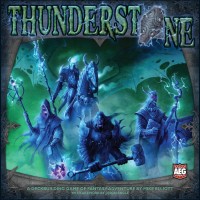
For ages the vile Doom Knights have sought to gather the remaining Thunderstones to fulfill a prophecy of corruption over the lands. Now the first Thunderstone has been discovered in the Dungeons of Grimhold and the Doom Knights have sent their minions to claim the relic. The Villagers of Barrowsdale gather brave souls to face the dungeon and keep the Thunderstone out of the hands of the Doom Knights.
Thunderstone is a new and exciting fantasy deck-building game from Alderac Entertainment Group. Fight the evils of the dungeon to prove your worth. Gain powerful weaponry and level into new and mighty hero classes. Claim the best cards and survive to take the Thunderstone. Featuring beautiful art from Jason Engle, Thunderstone is a welcome addition to any fantasy gamer’s collection.
- Will you claim the Thunderstone?
- A Fantasy Deck Building Adventure.
- Amazing Replay Value.
- Build Up Your Character as you Play.
- Over 500 Cards.
- Challenging Game Design by Michael Elliott.
- Stunning art by fantasy artist Jason Engle.
Add a Review for "Thunderstone"
You must be logged in to add a review.
Thunderstone on its own terms:
Thunderstone is a deckbuilding game, which means it’s in this genre where each player pulls cards from a central pool to increase the potency of his own deck, and in the end the superior deck should be the one to reach the win condition first.
Specifically, in Thunderstone you use the cards to build a fantasy adventuring party, composed of heroes and their equipment, by using the coin values of some of your cards to make purchases from the selection of ‘Village’ cards in the central play area.
If you aren’t going to the Village to beef up your party, you can go to the Dungeon and try to kill a monster from the Dungeon deck. The winner is the player who kills the most points’ worth of monsters.
If you kill a monster – and this is a critically important element of game play – the monster card goes into your deck, giving you some points toward victory but also cluttering your deck.
The box comes with a wide variety of monsters, heroes, and village cards, and every game is different from every other, depending on the monsters in the dungeon and the available heroes and equipment to provide for them. Some monsters are stronger than others; some a more difficult to defeat with magic, some more difficult to defeat with weapons, and so on.
With all the variables – the deeper you go into the dungeon, the more light you need; the heavier the weapon, the more strength, and so on – this game has a lot of replayability.
It plays fairly slowly, though, partly because the players are constantly fighting against the accumulating clutter – in the form of killed monster cards – in their own decks.
If I could get this game down to the 45 minutes it’s *supposed* to take, I would rank it higher. It takes my kid & me at least 70 or so minutes for a two player game, though.
Thunderstone v. Dominion
Still, if I had to choose between owning the base game for Thunderstone or the base game for Dominion, without question it would be Thunderstone. *So* much more replayable than Dominion, in my humble opinion.
My guess is, if you are going to be a cutthroat-type player you really need to be prepared to invest a lot of money in Dominion. If you have the base game of Dominion, and nothing else, you have the Chapel and the Witch and the precious few cards that will dominate most games you play. It’s only getting away from those cards that you can start mixing the game up with *other* dominant cards, from other sets, and the game (hopefully) opens up more.
Dominion, as I wrote in my review of that game, is similar to chess: In any setup, there are a few correct moves and a great host of incorrect moves, and any incorrect move can be unforgiving. Except that you’re not playing on the same board as your opponent, so there’s not as much interaction.
Thunderstone has more paths to victory, and also, to my mind, is more fun to teach, because I don’t have to choose to stay away from the Guaranteed Win that a newbie wouldn’t ordinarily be able to see.
Thunderstone is just as light, but much more thematic, much more fun, and much more fun to *teach*, than Dominion. As I said, I only wish it played a little faster.
Strong Suits
– Hero cards you buy can be leveled up to do even cooler things
– Solitaire (1-player) variant is almost more fun than playing with others
– Every expansion provides more game depth and better card storage
Weaknesses
– The card edges can easily get roughed up so you might want to sleeve them
– If you’ve never played a deck building game like Dominion, it can take awhile to get the hang of things
– The games can take a long time… 60-120 minutes.
– It can take awhile to set up and take down the game, but not too much more than your typical Dominion game.
Suggestions
When playing a game like this for the first time, try buying each village card and hero card to get a feel for how they work. You might think that a card is pointless, but once you’ve got it in your hand, you start to see the strategies behind each card.
If you find your games are taking too long, choose monsters that aren’t as tough. Or, rather than choosing three monster types, choose two, and shuffle the thunderstone into the bottom 5 monster cards.
Don’t be discouraged by the box and card separators that come with the base game. You’ll soon be wanting to buy an expansion, and the expansions come with better card storage.
Summary
If you’re a fan of Dominion, and you like fantasy games, this is for you. The illustrations are on par with Magic: The Gathering, and the added depth of the game mechanics are a breath of fresh air after playing Dominion. It’s only been out since 2009, and there are already 4 great expansions for it, each adding new mechanics and endless combinations of cards, making each time you play a unique experience.
Note: I have only played the base game and none of the expansions.
Thunderstone is a great game right out of the box for people who have played a lot of deck building games like Dominion but are looking for something with a little more theme or depth to it. For newer players it’s not impossible to learn all the ins and outs of the game but it can take a bit of learning and time to get them down right.
Right out of the box Thunderstone is dripping with theme which will either turn people on or off to the game immediately. The game is based around going into dungeons and killing monsters and gaining stronger equipment, spells and items to be able to fend off these monsters. The monsters are determined randomly by shuffling together the dungeon deck and building up your supplies by visiting the village. You can also trash cards from your deck so as to thin out what you don’t want to be cycling and drawing repeatedly.
While my experiences with this game tend to lead me to think of it as a pretty well balanced game there are times when the monsters and the available cards just don’t mix or it would be significantly easier to face certain monsters with certain heroes. There is of course always the option of attacking and failing and the monster runs away, but it really feels like a wasted turn when you do that.
As for the light mechanic, which is by far the most confusing part of the game for most players, this is one place where I think they could have done better. To attack a monster successfully you have to have both a number of Attack resources and Light to be able to delve into the dungeon and find it. If you do not have the light, then you suffer a negative penalty for each level that you are trying to attempt but don’t have sufficient light to penetrate. Trying to balance all of these resources can be difficult for new players and even experienced players. Balancing all the three resources in both your deck and during a turn can be difficult.
Other than these rather minor complains Thunderstone is a great game for experienced deck building fans who enjoy dungeon crawls and fantasy based games.
Thunderstone is an entry into the relatively new sub-genre of card game currently being referred to as a “deck building” game. The central mechanic in these games has the players gradually building a deck from a pool of cards that is randomly determined at the beginning of each game. This mechanic, first seen in the mega-hit Dominion, has a lot to recommend it, but it also has a built-in weakness—it is anti-thematic. Maximizing the efficiency of a deck will nearly always become a mathematical exercise. In Dominion, the mechanic dominated the theme to the point that I never felt I was doing anything other than trying to build a better card engine than my opponents, and I was wary of Thunderstone which presents itself as a deck-building, dungeon crawler. Dungeon crawlers are among the most thematic of board games, and card game versions of dungeon crawls (even those that used some of the cards as dungeon tiles) have always seemed unsuccessful in capturing the theme. Thunderstone was not just a card game, but one with a central mechanic that is known to obscure theme. My hopes that the game could pull me in to the theme and be otherwise a successful game were, admittedly, pretty low. The good news: I was wrong. The better news: not only does the game feel like a dungeon crawler, it is one of the better dungeon crawlers of the past few years—despite being worlds away from the classic miniatures plus tile games like Hero Quest, Warhammer Quest, and the recent smash, Descent.
Players begin the game by randomly selecting the following: monsters for the dungeon, heroes, and items for the village marketplace. The monster deck is pretty self-explanatory: it consists of the monsters that the players will have to fight during the game. Similarly, the heroes will be available to fight monsters during the game. The village cards consist of everything from weapons and spells to food and tools. The heroes and the items are set out in stacks to form the village. The monsters are shuffled together and place above the village to form the dungeon. The top three monsters are flipped up and placed beside the deck to form levels one, two, and three of the dungeon.
Each turn the player draws six cards from his deck and, after evaluating his hand, decides whether to go to the village to make a purchase or hire a hero, or to go fight in the dungeon. Nearly all of the cards, including some heroes, have a gold value for use if the player goes to the village. The cards may also have a positive or negative effect according to which location they are used in. If a player goes to the village, they can either hire a hero or make a single purchase from the available cards in the village. Hired heroes and purchased cards are immediately discarded along with all of the cards from the player’s hand whether they were used to make the purchase or not.
If the player decides to go to the dungeon, he picks a creature to fight and adds up all of the attack values in his hand. If his attack value is higher than the monster’s toughness, the creature is defeated and goes into the player’s discard pile (That’s right, defeated monsters become part of the player’s deck. Some even have dungeon effects when they are in the player’s hand). Of course, things aren’t quite so simple. Before attacking, the player must account for the lack of light in the level of the dungeon he is attacking. This part is a bit clumsy: first you subtract any light source in the players hand from the dungeon level, then, you multiply the result by two to get the light penalty So, if you are attacking in the third level and have only one point worth of light source the penalty will be (-4). As a result, it would take eleven points of damage to kill a creature with a toughness of seven. If that same creature had been in the second level, it would take nine damage to kill it instead. It is important to note that the player could work out all of this math before deciding to go to the dungeon or village. As such, the only time a player really loses a combat is when he chooses to. The only penalty for losing a combat is that the attacked monster is removed from the dungeon. This means a player can purposely attack a monster to remove it from the dungeon in order to keep an opponent from defeating it and collection the experience and victory points. A player could also decide to do this just to accelerate the end game if he or she were ahead.
That is basically the game. When the Thunderstone which has been randomly inserted in the last few cards is flipped up in the dungeon and advances to the first level, the game is over. Players score points for all of the VP values on cards in their deck. The player who killed the monster that allowed the Thunderstone to move to the front (assuming that happened) gets points for the Thunderstone (3 pts). The highest score wins.
I have really enjoyed my games of Thunderstone so far. The light and level mechanism really adds to the immersion in the theme. I have the ability to immerse myself in a theme even when it is pasted on, but Thunderstone legitimately feels like a dungeon crawl. I have to assume many people will disagree with me on that, but, I’m pretty confident in saying this is a fun game for players who enjoy the dungeon crawl theme and like card games to boot.
Final Score: 9/10—Excellent
Ah, it’s about time to write a review for one of my favorites and one of the games i’m proud of, Thunderstone. Do not be deceived by the look of the box / package, it’s a card game, a simple card game though the box really made you think otherwise (like some medium heavy box games which contains lots of components and board, but it’s heavy alright). Published by AEG (Alderac Entertainment Group) in 2009, this game was designed by the designer Mike Eliiot (the man who brought you Earthquake, Battle Spirits, Duel Masters and the soon to be hit dice game, Quarriors).
For ages the vile Doom Knights have sought to gather the remaining Thunderstones to fulfill a prophecy of corruption over the lands. Now the first Thunderstone has been discovered in the Dungeons of Grimhold and the Doom Knights have sent their minions to claim the relic. The Villagers of Barrowsdale gather brave souls to face the dungeon and keep the Thunderstone out of the hands of the Doom Knights.
1. The Theme
Thunderstone is a fantasy deck-building card game which players take the role of heroes trying to fight the threat of the Evil forces and gain the Thunderstone (Stone of Mystery). As it was written, the Thunderstone is a supernatural stone which need to be collected by the Doom Knight to fulfill an evil prophecy which can bring corruption throughout the lands. Now the first Thunderstone has been discovered in the Grimhold dungeon near the village of Barrowsdale. While the Doom Knights are set to claim the relic in the dungeon, Barrowsdale must gather forces consist of brave souls to face the threat of the Doom Knights and get the stone before the Doom Knights have it. So it’s a fantasy based with dark and grim atmosphere (presented by the image of the monsters and the dungeon exploration itself). So anyone with the feel of adventures are likely gonna love the theme.
2. The Artworks
I would say no doubt that the game artworks are marvelous. Love all the illustrations from Jason Engle (A Game of Thrones, Castle Ravenloft, Magic The Gathering and Legend of The Five Rings). His artworks are simply stunning and it really fits into the theme. I like his illustrations of the Doom Knights and other monsters and also the heroes. If your’re fantasy RPG fan, you’re gonna like his artworks.
3. The Game Components
Well, this one is simple, what else, cards… lot of cards (guess what 530 cards in the box), that explains the card game category right? The 530 cards consist of different categories range from heroes, village, monsters and the randomizer cards (also include the separators). The box is big and heavy (for more than 500 cards, no wonder) and also inside the box there’s a separate containers to categorized each type of cards for easier setup. And cause it’s a card game, sleeve is important accessory, so i spend 530 sleeves just for the base game (pheew….)
4. The Game Play
This 2-5 players card game gives you the opportunity to embark on an adventure in dungeon crawling to colect points and of course the objective of the game, the stone of mystery. First start each player receive 12 cards which formed as their deck (in time this deck will be growing) as 6 militia, 2 iron rations, 2 torches and 2 daggers.Shuffle the deck and draw 6 cards (alway 6 each turn, unless there is special condition stated otherwise). The main deck consist of 2 separate place (village and dungeon) which each place provide an action (go to village or to the dungeon). These places are set with randomizer to balance the game. When players enter village, they can buy items (weapons, spells, foods & lights), heroes (4 different types), upgrade their heroes or play cards in their hand (6 cards in hand) with the village ability. Dungeon hall is filled 3 rank of monster that are drawn from the monster deck (randomly shuffle the monster cards and insert the Thunderstone). Just as the ocean from If Wishes Were Fishes, this hall provide special condition when battling the monsters. Rank 1 monster is the face up monster card that placed in the farthest of the deck, and rank 3 monster is in the nearest from the monster deck. Each rank gives light penalty of 2 (-2 attacks), which mean rank 3 monster card gives the penalty of 6 attacks when engaged. Upon entering the dungeon, player can choose which monster he wants to fight, and reveal all cards in his hand and resolve the fight. Whether he win or lose, the cards in his hand are discarded. The last action available is rest (which sums up the actions available for players to choose, village / dungeon / rest).
Monster cards provide players with coins, xp points, special ability and VP, while the last and highest level of heroes also provide players with some VP (though the range is between 2-3 points). The goal of the game is to collect points, and player with the highest VP when the Thunderstone is claimed win the game. Weapons, items and spells provide modifier for players attack. While character cards in the village provide special action which can be used in the village. Discarded card will be placed on the used card deck and will ba shuffled again to form a newly deck after the deck is empty, while destroyed cards are completely out of the game. Players will take turn to do their action, expand and build their decks to challenge the dungeon.
5. The Replay Value
Honestly, i haven’t play the game often (just about 4-5 plays) and i still find it interesting and always eager to play it again. Well, so far the replay value did meet my criteria. When i analyzed the replay value, it did come to my mind that the game play must getting us bored by the time about such individual interactions between players, since nobody does give a **** about others action and only concern to build their own deck. But somehow it really turned out to be different (well must agree there is aspect that showed the light of this matter), since the competition aspect of the game really well placed, so you must (or were forced) to take account every actions your opponents take. And the situation is more gripping when the Thunderstone card is revealed in the dungeon hall (now we’re talking, this is some intense bull-**** situation which you hope that players before you doesn’t have the right cards in his hand this turn. And also you must pay attention on the card ranks and how the game flow after the Thunderstone is revealed in rank 3 cards. Well, this really gives you something to think about. The randomizer also add replay value of the game since with it there will be different experience each game. And don’t forget all the interesting expansion that AEG has to offer (4 expansions) with new additional heroes, monsters, items and many more and also new game rules and systems.
My Thought of The Game
This game is so outstanding, i love it very much. Well if i would say about the good and the bad, it almost strike 10. The theme, the artworks, the game play, are perfect. The only downside of the game is the setup process and the complicated rules that need lots of clarifications. Whenever i play the game, there always one time like “what’s that supposed to mean?” or “we should ask someone!” or “****…it’s dead end, the rules doesn’t explain it” or else… so yes, the rules did sucks, but the rest are epic!
When you mention this game, it’s always bring the arch-rival into matters, which is Dominion, some said both of the games are resemble each other. Since Dominion was realeased previously, some said that Thunderstone did was made by Dominion’s game system (i wouldn’t disagree on that). But let’s state the fact that Thunderstone is known as the Dominion game with theme (now that’s something i tell you). I haven’t played Dominion yet and really wnat to try it, but if the theme is that makes it different, then i would prefer Thunderstone. The downside of Thunderstone is the game setup (preparation of the deck is taking little bit steep overtime, and so is after the game). I love the game and probably have the plan to get a copy of all the expansions (already got the hold of the ‘For The Dwarf’ Promo Card from Geek Store and the promo card 1 & 2).
*Note* This is a review for the web version of Thunderstone created by Zabu Studios and playable only on Facebook.
Being a fan of Dominion and Ascension, I had always wanted to try out Thunderstone but I had heard some negative comments about it from my game group and I don’t think anyone owns it. So, when I heard about Zabu Studios (who also created web versions of some of Knizia’s games on FB (Lost Cities, Take it Easy, etc), creating a web version of Thunderstone, I had to try it out. And I wasn’t disappointed.
First off, the tutorial is very well done and will get you off on the right foot (although it doesn’t explain everything completely clearly – but you will learn by playing). My first few games were definitely a learning experience and I lost horribly to the amazingly decent AI. One thing that I didn’t realize was that you can’t trash your VP cards and keep the VPs! Once I figured that out, I was finally able to win against the computer some.
Aside from the tutorial, the game features three modes of play – Campaign, Skirmish, and Multi-player. Campaign is the only mode I have played to date. After about 20 plays, I am still only on stage 8 of 10 on Campaign One. Unfortunately, Campaign One is the only free Campaign while all of the others require the purchase of card packs that range from 15 to 25 FB credits per pack($1.50 to $2.50). Comparing this to Ascension on the iPad, you will definitely get more for your $ with Ascension.
Skirmish allows the selecting of cards (but only the basic cards unless you have purchased card packs) to compete in a game versus 1 to 3 other AI computer opponents. Multi-player mode sounds great in theory, but I have yet to see anyone on the site to actually try it out with.
The interface in Thunderstone is top-notch and the graphics and sound are very well done. The game offers full-screen mode and each individual card can be clicked on for each reading of the text. All card shuffling is done for you as well as all calculations of gold, experience, attack values, light, and victory points. Never having played the actual game – I don’t know how much of a pain it is, but it is very nice not to have to add up values in my head constantly and just focus on playing the game.
The only thing with the interface that I think could be improved is if there was an option to see a running total of victory points (and I realize you couldn’t do this in a face-to-face game, but it would still be a nice option in a web version). The AI is actually pretty good and only after playing several games did I key on some of its weaknesses and have been able to beat it fairly consistently.
Outside of the actual gameplay, you are given experience and a level for playing the game (not sure what this is really used for), and also some achievements to try for such as having a total of 50 gold or more in your deck at the end of the game.
Overall, I highly recommend this version of the game for those who enjoy deck-building games and Ascension on the iPad. Just be prepared to shell out some $ if you want to continue to play after you conquer the first campaign…
*Edit – Thunderstone is now available on the iPad (under the name Thunderstone Gateway) and it is the same exact interface as the Facebook version. In fact, progress and purchases transfer from one to the other.
Thunderstone is one of the early returns on the new genre forged by Dominion, and attempts to take it out of the abstract deck-building experience and into a fantasy-themed dungeon crawl. The results are generally favorable, but mixed.
Players begin a game of Thunderstone with a small deck of cards representing basic soldiers, weapons and other items. These cards also typically have a value in gold in addition to their other attributes. On his turn, a player takes a hand of six cards and can either go to the Village, buying heroes, weapons and items to enhance his deck, or to the Dungeon, where his heroes can equip their weapons and use their items to defeat one of three available monsters. Defeated monsters go into the players deck for points (and occasionally other bonuses); if the monster defeats you, he goes to the bottom of the monster deck to (conceivably) come up again. This goes on until the Thunderstone – the mystic rock in the bottom third of the pile – is either claimed or passes through the dungeon unclaimed.
The game consists entirely of cards, no other components are added to the game even through the first handful of expansions. The box for the base game mimics the Dominion layout, but to Alderac’s credit, their expansions started using a fantastic storage solution that deserves to be emulated by all other deck-building games. The artwork is good in this set, and improves across expansions.
The gameplay is kind of a hindering factor for this game. It’s difficult to get the right combination of cards in hand to go after a monster, especially if they have certain immunities that are difficult to get around with the available cards. A randomized monster deck can potentially mean that one or more large monsters could come up early, and so hamper the development of a deck that, by the time a player is strong enough to fight it, they breeze through the second half of the game like it’s nothing. One way to avoid this problem is to fight the monster and lose deliberately, getting him to the bottom of the deck and out of your way, but intentional tanking has not really emerged among many players, who don’t seem to think the benefit is worth the cost. The game also uses the same setup for any number of players, which ranges from an embarrassment of riches for two players, to an epidemic shortage for five players.
Despite its flaws, there’s a lot of good stuff going on in this game, and for those who like it conceptually, they will find that the expansions help address some of these balance issues and add more punch to gameplay. In addition, I tend to house rule the cards to scale per number of players, which I feel really helps finalize that sense of balance. So this game in particular may frustrate players at first, but will reward those who buy into the system.
Thunderstone is a solid deck building game. Inevitably, when someone asks, “What is Thunderstone?” someone answers, “Oh, it’s Dominion but with a DnD theme.” This is relatively accurate in that it is a deck-building game, but there are definitely some mechanics that separate it from its predecessor.
For one thing, Thunderstone is a bit more complicated than Dominion. Players not only have to choose what “action” to play, and what to “buy”, but now they must also decide if they will forgo shopping entirely to fight one of the available monsters to score victory points. There is a lighting mechanic that makes monsters deeper in the dungeon harder to see and therefore harder to hit unless you have appropriate lighting. So now a player has to keep track of card prices, attack values, defense values, lighting effects, point values, and special effects.
So here is by far my biggest beef with the game… the symbols on the cards to keep track of the aformentioned attack, lighting, VP’s, etc. All of the symbols look similiar?!? What!? What were they thinking?! Now anytime I pick up this game after not playing it for awhile, I have to reference which symbol means what because they are in no way intuitive. Why didn’t they make the “lighting” symbol look like a flame or even a lightbulb? Victory point value… shouldn’t it be a star or something?
The ambiguous symbols make this game that much more difficult to teach a new player. Be prepared to continually remind someone of what symbol on the cards mean what.
The Theme
Most players into gaming enjoy the fantasy theme. It is well implimented.
4 of 5
The Artwork
The artwork on the cards is your solid fair of monsters and dungeon delving. Each picture looks like one you would find in a player’s guide or monster manual.
4 of 5
Game Components
This is where the game takes a hit. Dominion has an awesome card organizer built right into the box. Thunderstone does not! The cards are of a good cardstock quality, and deserve no negative marks for their feel. However, the symbols on the card are the most confusing aspect of this game (see initial commentary)
2 of 5
Game Play
If you like leveling up heroes in a single play session, attack monsters, and earning spoils while playing a deck-building card game, this is definitely the game for you.
4 of 5
Replay Value
If you liked it the first time you played it, you will enjoy the second and third time you played it. Thunderstone has a good shelf life, only hurt by its competition (Dominion, Eminent Domain, Ascension, etc.)
4 of 5
Easy to Learn
My honest recommendation is to teach someone Ascension first. Then teach someone the concept of limited actions and buys in the game of Dominion. After they understand this, then they are well and ready for the added rules of Thunderstone.
3 of 5
Overall
What holds this game back is the learning/re-learning curve. I’ll always remember the rules to Ascension and Dominion, but have to look up the rules for Thunderstone again and again. This is mostly due to similiar symbols/icons used on the cards. And let’s be honest with ourselves, having to reopen an instruction manual is one thing that keeps so many people from pulling something off the shelves. Otherwise, this game is a contender for one of the best deck-building games.
4 of 5
It’s inevitable to not compare this game to Dominion, and I’m not at all surprised to see so many reviews doing it. The two games are like a pair of siblings, and if you like one of them you are quite certain gonna like the other. So, I’d like to stress two fundamental differences between the two:
1. The theme actually makes sense here. In Dominion it was obvious they found a cool mechanic they wanted to explore and just covered it in a medieval theme, but there’s really no connection between the title of the cards and the action associated with them. Thunderstone is much more logical in that respect, start with heroes, equip them with weapons and other stuff and see how cool your current party is compared to the monsters. To me this means it’s much easier to fall in love with Thunderstone, even though I enjoy Dominion a lot.
2. You have what you have. In dominion a large part of the trick is to keep playing cards that allow you to do more actions and draw new cards, and it can de quite silly. That’s basicly non existent in Thunderstone, you have the cards you are dealt, and you will need to see how they can be used. This also means the game turn goes faster.
As in Doninion the greatest flaw is the lack of player interaction, and personally I would also have appreciated if the expansions offered some more variation in the game play. Right now you have the three choices 1) Dungeon (fight) 2) Village (buy cards) 3) Rest (Destroy a card). How about giving more options like certain quests? Or something similar? OK, it’s cool to have more stuff to chose the active cards from, but in essence it’s just the same (but hey, I’m a compulsive collector so I have them all).
Another minor flaw is that the basic randomization can get you really strange combinations were either spells or weapons are completely missing. Fortunately there are a bunch of apps where you can make control the mix of certain items and cards.
So, if you like DBG, this is a fine one. I like it a lot, and I seldom turn down a game of Thunderstone. Try it out, I think you’ll like it.
I’m a big fan of Magic the Gathering. I’m also a big fan of Dominion. This game takes the best of both of those worlds to make a very fun game.
The artwork is really well done, which is very welcome when compared to Dominions eclectic art on it’s cards. I did find that the cards can get roughed up more easily than magic cards, but unless you’re keeping a keen eye, it won’t take away from wondering what cards your going to draw. My only real complaint is that the card dividers are super cumbersome. I would have preferred the box have slots for each type of card. But if you get the Wrath of Elements expansion, all of those complaints are gone.
What I like most about the game is that you can’t just stick to one strategy. Depending on the monsters you come across, you might have to buy completely different cards. I also love that you can buy hero cards (your strongest attackers) and then level them up as you defeat monsters, almost adding a bit of RPG to the game.
All I can say is if you like deck building games like dominion, and you’re a fan of fantasy and Magic the Gathering, GET THIS GAME!
Thunderstone is a deck-building game in which each player forms a party of heroes and slays monsters to earn victory points, competing with the other players to have the most points by the time the Thunderstone is discovered.
I must preface this review by saying that the rulebook was a colossal train wreck. I read the rulebook thoroughly, and I still had many major unanswered rules questions before even sitting down to play. Apparently I wasn’t alone, because the rulebook was massively rewritten several times in the weeks after the game’s release. As of version 1.3, they’d added several entirely new steps to the sequence of play, errata’d several individual cards (meaning you couldn’t rely on the printed text while playing), and I still found several glaring flaws and inconsistencies on a cursory reading of the new-new-new rulebook. I stopped reading their edits after that.
Admittedly, I’m kind of a stickler for clear rules. But I’m also quite good at memorizing (and inventing) new rules, so if there was a solid game underneath this morass of incompetent editing, I would be playing my heart out even if I had to rewrite the entire rulebook myself. But I can’t seem to find any reason to.
The cards read like someone’s initial brainstorming list of cool stuff to try to work into the game. Cards with equal prices can vary wildly in power. Many cards are only useful at all due to some hyper-specific interaction with another card that you may or may not have included during set-up.
But the frightening part is actually how little that matters, since the game gives you so much money that you barely even notice costs past turn 2. Imagine playing a version of Dominion where you could plausibly buy Gold on both of your first two turns. Even the victory cards (monsters) give you copious amounts of money! Your average cash-per-turn starts at 5, so when you see a weak card that costs 2 and a strictly-better card that costs 4…it just looks like a bad joke. Then they include only a single (very weak) card that even gives you the option of splitting your money between multiple buys, and it’s one of the random cards (not available every game).
The combat portion of the game has the opposite problem. Building a deck with high attack power is not trivial–unfortunately, monsters are basically all equally hard, so it’s not helpful, either! Since players that are capable of killing something are generally capable of killing pretty much everything, the front two dungeon slots get filled with ****** monsters no one wants to kill, and then you spend most of your time fighting whatever new monster was just drawn after the player to your right killed the previous best option. This means that whether you get a lot of points or few points has little to do with the efficiency of your deck; it’s basically just luck of the monster draw. I had several games end with the comment “sorry; you clearly had the best deck, you just got unlucky monster draws”.
Sure, there are a few monsters that are genuinely hard to beat, but mostly through gimmicks like “magic immune”, which means that beating them is a matter of memorizing all the monsters so you know in advance what trick to prepare for in a given monster set. And even in the rare event that a great monster shows up and the player to your right can’t kill it, he can still fight it and deliberately lose to discard it and prevent you from getting it (and that may well be a bigger point swing for him than killing a weak monster instead).
I want to emphasize that I wanted, and expected, to like this game. “A more complex version of Dominion with a dungeon crawl theme? What could go wrong!” I thought to myself. Two weeks later, Thunderstone earned the distinction of being the first (and so far only) board game I’ve ever sold.
So in summary: the economic system doesn’t work, the combat system doesn’t work, the rules were blatantly unfinished at release, and winning is mostly luck. As a strategy game, Thunderstone is an unmitigated disaster.
I guess you could play it as an experiential game purely for the art and theme. That’s not my cup of tea, personally. But even if that’s what you’re looking for, surely there’s a game that provides it with less number-crunching and errata than Thunderstone?
When I was in my local game store I happened upon Thunderstone, a deck building game that was Non-collectible. I had played a little Magic the Gathering in high school, so I thought I had some general idea of what a deck building game should be, but now I think have a better definition. I would now consider Magic the be a BUILT deck game, where in games like Thunderstone and Dominion you are required to build your deck as a part of the game play. An element I always hated about Magic was that it seemed like the richest guy always wins, so when I found out a little bit about the mechanics and how it was avoided in this game, I had to pick it up. I didn’t write a review when I bought the base game, and I am already three expansions deep thus far, so I will just try to give you my opinion on many of the different options and components available in the game as a whole.
THEME
The theme of Thunderstone was immediately what jumped of the shelf at me. The theme is a fantasy world that is rich and vibrant, filled with monsters, exotic heroes and treasures of course. This game does have plenty of color, and the mechanics re-enforce the storyline well. I only wish the cards had some small text in the bottom with a little bit of background about the hero or spell, similar to what Magic the Gathering did. I think knowing a small fact about a certain hero, monster or spell would have fleshed the game out even more. Although the theme in the base game is good, it has seemed to improve dramatically from expansion to expansion. In Wrath of the Elements, we were introduced to traps, and Do*ate legion brought us treasures. The element of suspense and danger added by the traps, and the rewards offered by the treasures make the theme more life like (Assuming their were such things in real life). I was playing with a Korean friend of mine, and he even remarked about how much it really felt like he was getting ready for a battle every time he drew a new hand, and I have to agree. The moment you draw your cards, and start equipping heros with weapons and spells to do battle, I think you will feel the same.
PRICE
The price of the base game is roughly 25-30 dollars, depending on how you shop, and each expansion was roughly 20 bucks after that. I think that for that price you are definitely getting a good deal, and for every 20 bucks you spend on it, you will have added a significant amount of detail to the game. I will gladly fork over another 20-25 bucks every time the newest expansion is released, and feel good about it if AEG maintains this level of quality.
QUALITY
The cards in this game are well designed, glossy, and will hold up to heavy levels of play. I do have some concerns about using black borders, (usually meaning they will wear out quicker), but sleeving them will solve this nicely. The boxes for the game have gotten better since the original, and the designer has included some brilliantly designed separators to keep everything organized.
ARTWORK
The artwork of Thunderstone is absolutely amazing, and it is hard to comprehend that one guy was able to make all of it, (until Dragonspire). Jason Engle has got to be the worlds hardest working fantasy artist, and if I were him, I would be very proud to have my name and artwork displayed on this product.
LEARNING
This game can be a challenge to learn, not because it is a very complex game, just because the rule book is absolutely HORRENDOUS! It took me a couple of read throughs, and several forum searches to figure out what was going on. Once one player has picked the game up though, it is a snap to teach others how to play. I have found that even on the first play through, players can understand what they are doing enough to win the game, (something that couldn’t be said about Dominion even though it is a simpler game to teach).
COMPLEXITY
The game starts out at it’s easiest level with the base set, and introduces new mechanics through the various expansions very nicely. I have seen the game growing increasingly complex through each one, and so play time has also increased. Those looking for a simpler game might want to stick to the base set, and if they feel the need for something different add in one or two other sets. Truthfully, I love this games level of detail, and every new mechanic introduced so far has made the game better and better. I am completely excited about Thornwood Siege coming out in June.
INTERACTION
There is not a whole lot of player interaction in this game, and only a few cards truly punish your opponent. This game does feel like you are playing solitaire with other people, but **** who cares if it is as fun as this is. So far everyone I have taught this game to, has had a really good time playing it. There are times you have to think about what your opponent is doing, but this usually only means going up against a monster that you know you can’t beaten just to deny your opponent those points. I will be waiting to see how future expansions change the level of interaction between players, but for me it is a non-issue if the game is strong enough on it’s own, (besides, it is a game about fighting monsters in a dungeon, not another player).
WAITING
The wait time in this game is very short, and if playing with experienced players it seems like it is your turn again before you even finish drawing new cards sometimes. So if you don’t like to wait, you are definitely in luck here. The only time I have even a player take a long time for their turn was in the beginning of their first game when they had to read all the cards in the village before deciding what to buy. After a few turns everyone involved will have an idea what kind of strategy they are going for, and down time will shrink.
LENGTH
The designer claims that the game lasts 45 minutes, but I have found that it usually takes an hour to an hour and a half. The length of the game depends on what type of layout you have, and how new all the players are of course. As for me, it is good to have a card game that lasts over 30 minutes though, and I don’t mind the longer games at all.
RE PLAYABILITY
The level of customization available here is overwhelming, and there are tons of different ways the game can be set up and played out. While the base game might be rather limited in cards, the addition of one or two expansions make the game seem HUGE! I like the fact that I can set out my own custom layouts with only a few seconds of thought, or even use a randomizer like the iThunderstone iphone app. I will most likely be playing this game for the next 10 years, and am curious to see what the future holds for this game. I would rank it’s re-playability among the best there is on the market, and look forward to every game.
OVERALL
I thing that AEG delivered a solid product here, and a game that is not only fun to play, but looks great too. I get a great feeling when I pick up the box with all the expansions in it and feel how incredibly heavy it is. I think this game deserves a place in anyones collection that likes card games with fantasy themes. The production quality is amazing, and AEG really seems to listen to what their customers are saying. I see this product getting better and better, so I would highly recommend it. I rate Thunderstone 7 out of 10 as a standalone game, and 8.5 out of ten with all the current expansions added to it. I hope you enjoy it as much as I have.
I know I gave this game a bit of a high score, and this is easily explained with a few words: I was able to enjoy the game, while my much less ‘gamer’ subset of friends where able to enjoy it as well.
Thunderstone is like dominion yes, but there are a few very key differences that do not throw powergamers extremely over the top where this game is concerned that make it a great choice when playing with those friends of yours that do not have the want to wrap their heads around something like nightfall (when it comes to draft games). Which makes it awesome, really by the middle of the first game they where already making decisions without a lot of questions and we where treading a long.
Now I understand that the level of strategy in thunderstone is very very small(although it is there) which makes it a large turn off for me anyways, but there is enough in the game to explore with and figure out combinations of drafted cards with (like in most draft games) that makes it a solid. The theme and cards are good (although the redesigned symbols in the advanced version are much better) and in all honesty nothing beats a good not overly interactive (with still some interaction) game for players that are more social but still want to play with powergamers.
So the reason for my score? this is an amazing bridge game, to bridge the gap between different kinds of gamers 🙂
Totally love this game but it really takes some time to get it from the box to the table. set up is a bit long and all the rules feel overwhelming at first. The game runs super smooth once you get down all the rules and set up one of my favorite games that I own. I have not been playing long and can only tell you my experience thus far.
Ok when you open the box it looks like a lot of cards but you won’t play with all of them. first is your random set up there are a group of textless cards that let you select what your game will look like everytrhing from your adventuring party to your your village items that you can buy. you start the game with a deck built from some basic cards that are featured in every match. you get the basic mailtia hero a torch and iron ration and a dagger.
you then can take these cards and sell them for reusable gold each turn in the village to purchase new cards for your deck or go to the dungeoun and battle monsters to earn victory points which is the key to winning the game.
I kbow it dose not sound very hard but it has lots of depth because you can only draw six cards a turn and your not always going to get the best combination of cards to battle monsters with so you must think out stratigally what cards to add to your deck that will make an inpact and hopefully allow you to hit the dungeoun a whole lot more than staying in town.
The game visually is beautiful and is really fast paced I cannot stop playing and I hope you won’t either
If you bought this game upon it’s release you may have thought “Good game, but it’s missing something”. Now 3 expansions and release of the stand alone Dragonspire/or expansion, this game keeps redefining itself as a leader for deck builder games.
What I enjoy about this game is how many different combonations of cards can make up the village, which is used as the holding place for buying cards to put into your deck.
Your deck is used for money, to buy cards, and for fighting monsters that come out of the dungeon.
Heroes gain experiance as they defeat monsters and they can level up durring the game. This game just has a ton of theme to match its great game play. It feels like an adventure every time.
At the end of the game when the Thunderstone is found (Randomly in the last 10 card of the monster deck)all players add up the points in their deck and the player with the most wins.
A++++ its my faviote deck builder.
I’d seen this game on the shelves of my local game shop and wondered if I should get it. I was happy, then, to see a version released on iOS for the iPad, so I could try it out. I did, and this game is fun!
The interface is decent, though sluggish (on the newest iPad even) and requires an Internet connection even when playing solo. The Tutorial mode could have been a bit clearer, but after a few mistakes in my first real game, I quickly figured it out. The market for purchasing additional card packs for campaigns beyond the first (free) campaign has yet to work for me, and the open campaign is getting a bit stale (you don’t always have the same cards, but the pool of available cards in the free mode is quite shallow—if there’s a card you don’t like, sorry, you will be seeing it a lot).
Overall, I’d recommend this game for iPad. It is compelling enough to warrant expansion purchases, and I plan to do so when the market is available. However, if you’d like some occasional entertainment at the low low cost of $0 and you enjoy deck-building games like Ascension and Dominion, give this a try.
At first glance when you open this game or even look at it on the back of the box, it looks amazing. The art work is beautiful the cards are well designed and laid out. The fantasy theme in this game is also fantastic great types of enemies from Dragons to Undead. It is easy to pick up if you have played other deck building games but slightly harder to learn than dominion because of the combat part of the game.
However I have found that the last 5-6 turns for almost every player are spent “going to the dungeon and killing the evil monsters” there reaches a point near the end of the game even when you add the expansions when your deck is very powerful and you don’t have to add anymore cards to it and instead you just go and kill monsters, and almost everyone will be killing monsters only their last few turns. Because of this I find the last 15minutes of the game to get rather repetitive.
First came Dominion and with it were several complaints about how bad it was the lack of interaction between players and how the theme did not fit the game. Then came several expansions trying to resolve these issues. And in my opinion they managed to solve the interaction issue pretty well. Today you can play Dominion with much more interaction and strategy, while the lack of theme is still heavily present.
Then came Thunderstone, a game that promised to be a solution to the deck-building format and even more, with a really good theme applied, that would allow a greater immersion. And Thunderstone fulfilled all these things! It’s a very nice game, with components very well made and designed. The mechanics of the game is slightly different from that of the Dominion, but it has a good reason: the theme, and it works pretty well.
But it seems that the development team at AEG simply forgot the term “interaction”. I could’t believe it when I played! There was no way to sabotage the other players, had no way to make them lose victory points, had no cards that destroy their strategy, I was so disappointed!
So we can summarize the game as a Dominion with a super cool theme BUT you´ll be playing alone against the game….. along with his friends.
I really have no great desire to try it other times.
Thunderstone takes Dominion’s deck building mechanics and adds a purpose to buying the cards. The point of using your deck in Thunderstone is to attack monsters in the dungeon, and its these monsters that grant victory points. Buying your weapons and heroes with their special abilities leads to the attack phase, where you can gain victory points (as well as valuable gold and experience). The fact that there is another step in the process, and you can not buy cards on the same turn as you attack monsters adds more complexity and depth to the game. Dominion is great in its simplicity, but Thunderstone is better with its added complexity. Learning Thunderstone has a bit of a curve to it, as there are many different types of cards, different monster abilities, and different times to do certain things. This is the most complicated deck-building game I have come across but is worth the brain-space. Thunderstone is a fantastic game, with great card components and plenty of expansions to keep the game entertaining for a long time to come.
While AEG has been making card games for may years, they fell into some of their old habits. Namely, using multiple printers for expansions, so there are slight differences in cards from different sets making them stand out, as well as the problem of making symbols on the cards not as easy to determine as they are in other deck building games.
As with all versions of this genre, Thunderstone can occasionally suffer from the degenerative combos that the random deck design spawns.
Looking past the two small flaws, you will find a game that is very enjoyable, and very easy to learn.