
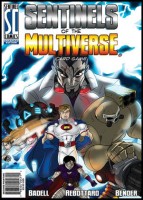
Sentinels of the Multiverse
Overview of the Multiverse!
Sentinels of the Multiverse is a cooperative card game where 2-5 players take the roles of super heroes and attempt to defeat a super villain bent on world destruction, galactic domination and other lofty, evil pursuits. Each player’s hero has a unique deck of cards with powers and awesome action-packed moves that are exclusive to that hero. The Villain character “auto-plays” throughout the game and presents the heroes with devastating challenges and deadly conflicts. The game ends when either the heroes have won the day by reducing the Villain’s hit points to zero or when the Villain stands gloating above the smoking, broken bodies of the fallen. ‘Nuff said! Lets get to it!
Set Up
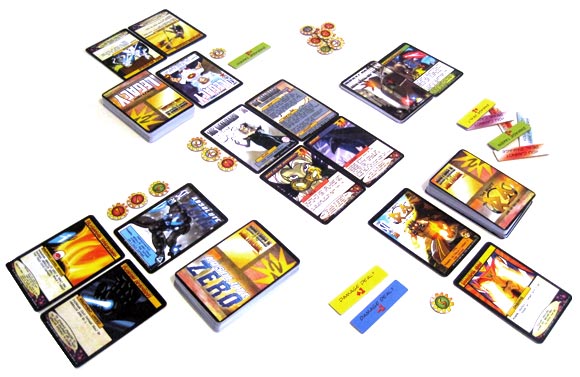
Players choose a Hero they want to play from the 10 available heroes, take the matching deck and hero card, lay the hero card in front of them, shuffle their deck and draw four cards for a beginning hand.
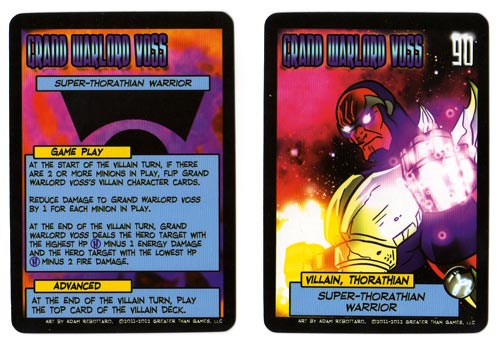
One Villain is chosen from the four available Villains in the base set and that Villain’s two cards are laid out in plain sight. The main Villain card describes that Villain’s powers and lists his or her hit points. The other card lists all the game effects that take place when that Villain has a chance to wallop the heroes. Also, the accompanying Villain deck is shuffled and placed there as well.
An Environment deck is then chosen from four available in the base set. The Environment deck provides the setting where all the action in the game takes place and presents the heroes with unique obstacles and events they will have to contend with while battling the ultimate evil. The Environment deck is shuffled and also placed in the midst of the heroes.
Gameplay
Gameplay for Sentinels is broken up into three main phases or Turns: The Villain Turn, the Hero Turns, and the Environment Turn. Let’s take a closer look…
- Villain Turn: Three phases dictate the actions and effects of the Villain in the game. Effects listed on any cards in play that trigger at the beginning and or end of the Villain turn will activate and a new Villain card is turned over from the Villain deck, usually with really nasty results. Yipe!
- Heroes Turn: To Battle! Each player, on their turn, plays one card from their hand, uses one super power and draws one card from their deck (in that order). Also, any effects listed on any cards in play that trigger at the beginning and or end of that Hero’s turn will activate.
- Environment Turn: After all Heroes have played, it is time to see what effect the Environment has on the story. The top card is flipped from the Environment deck and its effects occur. Also, any effects listed on any cards in play that trigger at the beginning and or end of the Environment Turn will activate.
Sounds simple? It is! The gameplay and turn order is very easy to digest. But, being a card/effect driven game system, the individual choices presented to players through their unique Hero decks, and the interaction from card effects from the three decks can create many unexpected interactions. KAPOW!
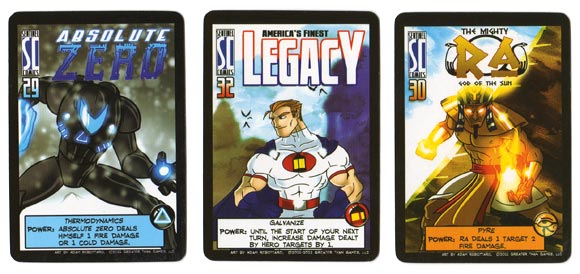
The object of the game is for the Heroes to defeat the Villain by depleting his or her hit points to zero. Of course the Villain is trying to do the same to the Heroes! It’s all about causing damage! Throughout the game the Heroes and the Villain will be going to battle against each other and will use powers, attacks and equipment to damage the opposing team’s characters. Damage can take many forms, from electrical (ZAP!) to fire, cold, sonic melee and many more. Often times, card effects will prevent these certain types of damage. The Villain will also have many minions that will attack and can be attacked. Even an Environment card may need to be battled!
Survival and teamwork are crucial. However, even if a hero is defeated, they are not “out of the game.” When a hero is reduced to 0 or less hit points, that hero becomes “incapacitated.” Their deck is removed from the game, their Hero card is flipped, revealing three Abilities of which one can be used during that player’s turn.
Advanced players may want an even more lethal challenge. All Villain cards have an Advanced section on them, creating the ultimate test for the heroes!
Components
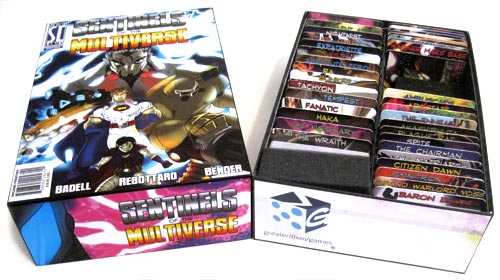
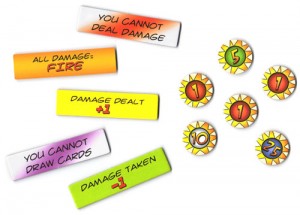
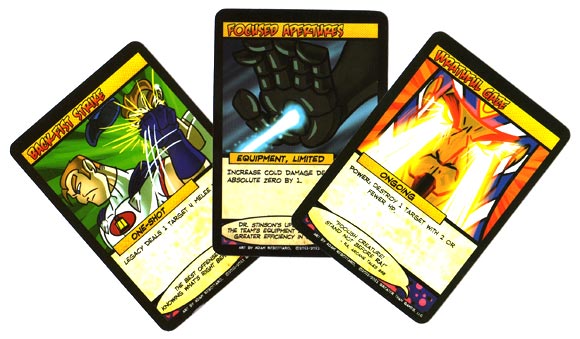
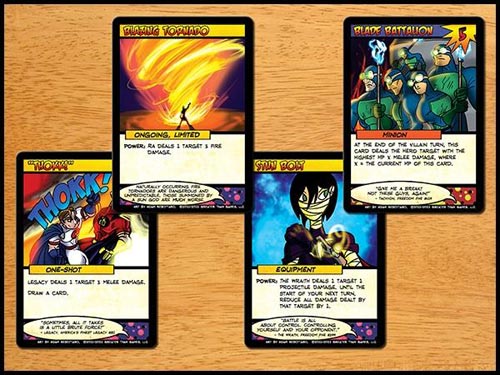
Adam Rebotarro’s comic book art styling gives this game an irresistible look and feel. The Enhanced Edition of Sentinels of the Multiverse includes quality cardboard damage and effect counters and a sturdy box that will hold all the cards from all the current expansions. The card quality is great, easy to shuffle and doesn’t warp.
Learning Curve
Low! Shuffle and play. As with all card effect based games, though the turn sequence is quite simple the true “curve” comes when learning the multitude of strategies that manifest themselves when the card effects interact.
Who would enjoy this game?
Final Thoughts
Originally released in 2011 at Gen Con, Sentinels of the Multiverse captured an untapped niche in the hobby market: the cooperative super-hero card game. And it took the hobby by storm… why?
Immersion. There are no super heroes in the game that you have ever heard of. What designers Christopher Badell, Adam Rebotarro and Paul Bender have done is taken the most appealing aspects of what comic book fans love and created a new intellectual property to explore. Every character back-story, every bit of flavor text on every card adds to this environment and immerses the players into the story and struggle of the heroes. This level of immersion invests the players in the game with ease. This makes for an amazing cooperative gaming experience. You feel the game becoming your own as you play – almost creating your own comic book series as the game unfolds.
Innovation. The three deck system that Sentinels introduced creates a wonderfully balanced cooperative challenge. Each player with their own Hero Deck, their own strategy and strengths (and weaknesses) facing a Villain deck, with his or her own agenda and unique deck interaction taking place in an Environment (deck) that creates unexpected hazards for everyone. The combat system is straightforward and simplistic but a host of game effects and conditions based on different types of damage make for these streamlined battle rules to become anything but simple. The game grows more and more dangerous and desperate as play continues. The stakes rise when certain game effects cause a Villain’s cards to flip which augments his or her powers; unleashing more terrible and dangerous powers – creating true peril for the heroes.
Interaction. Sentinels provides the quintessential experience in cooperative gaming since each hero must be dependent on the other heroes for survival. Although the heroes represent familiar archetypes, players are free to develop their personalities and relationships to other team members. Even though it may seem that some heroes are more powerful than others, each is designed to a unique strategy that interacts with the other hero decks uniquely. This ignites freedom and creativity into the game and its interaction. It’s a characteristic unique to Sentinels. The game has the feel of a superhero RPG where your cooperative relationships develop through gameplay.
From its humble beginnings in an IHOPS restaurant, Chris, Paul and Adam envisioned a game that they wanted to play – not a game that had the most innovative mechanics (although they are) or a game to appease an already established fan base (which it now has) nor even a game that would sell out, reprint and have reasonable financial success (which it did, has and continues to do.) This above all offers an experience that is new, fresh and untethered. A player can feel it in the design and in the gameplay. The game is personal and accessible, with nearly limitless possibilities for replay, and expansion.
Expansion Reviews
Rook City review >
Infernal Relics review >
Shattered Timelines
Let’s Compare
Since Sentinels hit the scene, two other superhero themed card games have been released: Legendary for the Marvel Universe and DC Deck-building game. How do these games compare to Sentinels? Here are some major points:
- The main difference of course is that Sentinels is a cooperative game. This fundamentally changes the focus for players and intensifies the experience of struggling to fight and defeat the Villain together as a team. Winning or losing together typifies most comic book hero teams and Sentinels provides the perfect re-creation of that experience.
- Sentinels is not a deck builder. The hero decks in Sentinels are built and tuned. And very well tuned in most cases – even when pitted against various Villain decks and Environments. This is another quality that focuses the gameplay on the task of defeating the Nemesis rather than building or tuning a deck and strategy during the game.
- Players don’t mix heroes in Sentinels. Players take the identity of one hero and have all they need in order face the scourge of the galaxy. This gives the game its quality of personalization and immersion.
- Finally, the designers have created the world of Sentinel Comics, a new, vivid and unexplored “comic book land” to get lost in. Thus, Sentinels allows you to be more than just puppet master for your favorite superheroes, you are the hero. You create a legacy for each hero you play. What’s better than that?
All of these aspects create a surprising gaming experience. Sentinels is not just another card game or deck-builder. Sentinels of the Multiverse offers a gaming experience that becomes more of a role-playing/story creation game. The personalization of the heroes and the cooperative mechanics actually give the game a feel of a card driven RPG. It offers a grand, adventurous environment for anyone who loves the superhero genre. It’s easy to learn, promotes amazing player interaction and offers levels of immersion, innovation and interaction that just are not found in other similar games. Put on your cape or cowl and challenge this gem of a super hero card game.



Add a Review for "Sentinels of the Multiverse"
You must be logged in to add a review.
Sentinels of the Multiverse is my first card game. Being relatively unimaginative, games without boards and bright, shiny pieces were a hard sell for me. But I was successfully worn down by the abundance of effusive praise here and took the bait. Through 100-some plays, this is what I’ve found:
Observed Set-Up and Play Time
The first play took around an hour to set up. This involved removing decks from cellophane wrap and reading through the rulebook one time… the simplicity of it is pretty remarkable in hindsight. However, that first game lasted about an hour-and-a-half and was left unfinished (it was a work night, and for some reason I chose Omnitron and his game-high HP as villain). Since then, games set up in less than 5 minutes (unless you’re incredibly indecisive on picking your heroes) and are consistently played in less than an hour. I’ve had several games in the 30-minute range with both positive and negative outcomes.
My Learning Curve and Teach Time
I had the basics of the game down pat after the first play-through, but had I played that game to fruition I would have met an unfavorable outcome. It took around 5 games before I could confidently hope to win each game, and really only won about 50% of my games against these 4 base villains through the first 10 or 12 games. I have been successful in teaching the mechanics of the game to newcomers with roughly 10 minutes of preamble followed by one 45-minute game.
Group Sizes and Dynamics
I have played Sentinels with as many as three players… but well over half of my games have been solo. I have an absolute blast with this game as a solitaire game, easily managing 3 heroes against a revolving door of villains and environments. Provided you are playing with others at your experience level, the game is just as fun in a group. However, I do not enjoy it as much when I am playing with inexperienced players – these are mostly “sacrifice” games to get them up to speed, and you may end up “sacrificing” 10 games before that happens.
Objectionable Material
The base set of Sentinels has little objectionable to it. All violence is implied, not illicit, and all language is family-friendly. There may be a few frightening-to-a-young-child images in a few of the decks (I’m thinking Citizen Dawn’s cult members in particular), but my guess is that any child that may be frightened by them is much too young to play the game anyway. While there is nothing thematically that would prevent me from teaching a 5-year-old the game, it is so reading-intensive that I would guess a bright 8-year-old would be about the youngest you could go.
Comparable Titles
Sentinels has two titles in direct competition with it, DC Comics Deck Building Game and Marvel: Legendary. All three are superhero-themed card games, and these alternative titles have the benefit of using established properties with built-in fan bases. Chief among the differences is that both DC and Marvel are competitive games where Sentinels is cooperative. The Marvel game has the disadvantage of not allowing players to control single heroes as they do in DC and Sentinels (the player is instead a S.H.I.E.L.D. agent recruiting heroes to the cause). I have yet to find a review that doesn’t rate Sentinels favorably against these titles, but having played neither I can’t proffer an opinion.
Without hesitation I can state that Sentinels of the Multiverse is my very favorite game. Once you’ve mastered every enemy, pick up an expansion. Once they’re all mastered, switch to their “Advanced” settings. Even without purchasing an expansion this game is infinitely re-playable. And to me, it’s so much more impressive that the designers have done this without the use of an established property. Through this game alone, superheroes like The Wraith, Tempest and The Visionary mean as much to me as Iron Man, Batman or Rorschach. Well, maybe not Rorschach.
The Gaming Renaissance has seen the capes come to town in the past year. DC Heroes, Marvel Legendary, Heroes of Metro City – it’s like the Fortress of Solitude finally melted due to global warming and a flood of spandex has finally begun to wash ashore.
BUT before the coming of Storm to the tabletop (and unless you knew someone that had Capes and Cowls locked in a safe in their gaming den) – the heroes at Greater than Games did Capes. They did it well.
The Sentinels of the Multiverse still stand strong and proud – the first and best in the Cardboard Cape Cavalcade.
DC, Legendary, and Metro each bring something to the table in their own right – but at the heart, they are DECK BUILDERS . You are scrabbling about on a turn jigsawing together a ‘team’ card by card.
Sentinels is a DECK PLAYER .
Each hero is based on a 40 card pre-constructed deck. Your play style, theme, and variable powers are set before the game even begins. You are that hero – undiluted.
And Sentinels brings the heroes.
Between the extensive base, the 3 ‘booster’ type expansions, and the latest mega Vengeance set, you can basically pick your favorite hero from the Paneldom, scrub off their name and find them represented somewhere in the extensive roster of decks.
And each archetype plays out just like you think they would through each deck’s unique mechanics. Speedsters can take on multiple targets with short attack bursts and avoid retaliatory damage. Tanks can dish out and absorb. No one feels samey – the Rage Tank plays far differently than his Brother in Armor. Even more esoteric heroes like Mentalists and Arcanists are represented in the Multiverse – each with their own play style.
The same goes for the Baddies. Each Villain you fight is represented by their own unique over-sized card with their own play style and powers. Each villain comes with their own deck of minions, schemes, and powers that your heroes must deal with turn by turn, card by card. Twisted Geniuses, Tricksters, Dark Gods, and Joykills are all represented. They don’t pop up every now and again with a ‘Remember Me?’ – each turn the Villains bring something to the Tabletop Metropolis for your heroes to face.
Sentinels is co-op at its best. Each round you are working together, deciding who needs to do what to stop the madness you confront. A successful game relies on heavy interaction and table talk and working together to be the best team of heroes you can be. Sentinels ‘ssemble!
Co-op is the name of the game because this one can kick you in the spandex if you aren’t careful. 😉 Replay is high and Greater than Games ranks each Villain and Hero deck on complexity so you can fine tune your challenges and play your way through the learning curve which at a basic level is negligible. They even have a nifty Achievement Sheet on their website to help you set-up situations and scenarios mirroring those of the Pages and Panels so you can take a stab at them yourself – Sentinel style.
A good cape romp lets you play at being heroes. Sentinels lets you BE the hero and that’s why it soars above the rest.
SENTINELS ‘SSEMBLE!!!!!!!!
What Is It About? – An Overview of the Game
Sentinels of the Multiverse (SotM) is a cooperative card game for 3 to 5 players. Each player takes on the role of a unique hero and must defeat a super villain and his particular minions. It is a fight to the death from Jurassic jungles to bases in outer space.
What Do I Get? – The Components in the Box
As with any solid card game, there are over 500 cards in the box. This is broken down into 10 hero decks of 40 cards plus 1 character card; 4 villain decks of 25 cards plus 2 character cards; and 4 environment decks of 15 cards each.
There are round hit point (HP) tokens along with rectangular tracking tokens to keep all the game changing effects straight. The box has plenty of space to hold two expansions and various promotional material. To help keep everything organized, dividers are given for each deck.
The enhanced edition of the game is the current edition that is available. The original version lacked tokens, card dividers and the larger box to store everything. The rules were also updated with more clarifications in the enhanced edition though some important rules were inadvertently left out.
What Do I Do? – Playing the Game
As with most cooperative games, each player gets a turn and then the game plays against everyone making life difficult. SotM accomplished this by allowing the Villain to go first, followed by each player in a fixed order, and then capped off by the Environment deck also mixing in some chaos. For each of these turns, the order of play is typically resolve any on going “start of turn” effects, play a card (from the top of the deck for Villains and Environments; from the hand for Heroes), then resolve any on going “end of turn” effects. Heroes get two more steps by using a “power” and drawing a card to their hand.
Cards that are played are either “one-shot” events that do something and are discarded or “on-going” cards that remain in play such as equipment, relics, minions, etc. Any card with an HP value can be a target. Most of the cards result in someone taking damage, which is tracked by the tokens (or any other preferred means). Damage is usually not blocked unless a card can prevent or reduce it so it becomes a matter of whichever side staying alive the longest wins. Heroes have around 30 HP, while most Villains are upwards of 80 HP. Minions and other incidental targets are usually under 10 HP and more typically only a few HP total.
Most of the Hero cards that remain In play, including their starting character card, grant some Power: an ability that can be used once per round. This is typically the main way that they can attack the Villain or his forces. But other Powers include drawing more cards, healing others, and even granting more Powers during the turn.
Villains all have a “flip side” which is triggered at a certain point, changing the way they behave. Some flip back and forth endlessly, such as Omnitron, while others are a one-time flip. Their effects can be very damaging especially depending on the team fighting against them. A hero, like Wraith, that is dependent on equipment will find equipment-destroying Villains particularly difficult. Each Villain is (or will be as some are still unseen) paired against a Hero as arch-nemesis doing an extra point of damage each time they battle.
The Environment deck affects everyone about the same and the Villain can find himself the target almost as much as the Heroes. The main benefit of the Environments is another multiplier in the vast number of ways to replay the game.
The game is over when one side or the other is defeated (HP reduced to zero). While a player’s hero can be eliminated, his hero’s character card is simply flipped over and grants the surviving members of the team 1 of 3 actions. This is thematic represented as the standing heroes fighting harder in memory of their fallen brethren.
What Do I Think? – Final Thoughts
Setting the game play aside for a moment, I am absolutely in love with the universe that this Christopher Badell and the design team created. At first, I was put off by the idea of generic super heroes. But the depth of backstory they have given has the edge of Image Comics and the richness of the Marvel or DC universes. Legacy is the archetypical leader embodying the strength of Superman, the patriotism of Captain America, and the family history of Green Lantern. The previously mentioned Wraith is the female version of the Dark Knight: the rich socialite with the array of wonderful toys. Each card has a quote from an “issue” the character appeared in developing the ongoing story. Art previews future Heroes and Villains giving that “aha” moment when new material is released. The art is just tremendous, especially given that it is all done by one artist, Adam Rebottaro. I find myself immersed in the game before I even start to play it.
The game itself is strong. With the enhanced edition, they introduced the “H-factor” – a means to more easily balance the game. And given this sliding scale, it is easy to accommodate players outside the recommended 3-5 with very minor tweaks. On top of that, Villains are given difficulty ratings so beginners can start with the easier bad guys and work their way up. They even rate the Heroes on levels of complexity so new players can take the straightforward characters. As with most co-ops, this can be played solo though a player will want to control a team of at least 3 Heroes. And given the structure of the game turns, this is very manageable.
The replayability is tremendous. Using 1 out of 4 of both the Environments and Villains and typically 4 out of 10 Heroes makes more quite a few possibilities. Each of the decks play so differently that it goes beyond “more of the same” with just a different theme. Tachyon, the speedster, plays off her discard pile giving her more strength as the game goes on. Absolute Zero tries to damage himself to channel a burst of energy against the Villain. Even the Villains play so differently from one another that each game truly feels unique.
The only negative of this game is some of the production. When the first expansion came out, the cards were wider than the original and a more sturdy thickness. With the enhanced edition, they went back to the original size and switched to the heftier cards. But they made a mistake by now making the cards too long. The good thing is that since each deck is independent, it really doesn’t matter. But for an otherwise excellent offering, this is a disappointment none the less.
Overall, this is one of the freshest games I have played in a long time. Not only is the game play rewarding itself, the universe runs through my head frequently between sessions. I look forward to playing this one many years down the road.
What Next? – Other Recommendations for this Game
As hinted at by the title, this is a multiverse with many more places to explore and an endless cast of characters. Two expansions have already been published: Rook City and Infernal Relics each introducing 2 new Heroes, 2 new Environments, and 4 new Villains. At the time of this review, a successful Kickstarter campaign just funded 2 more expansions: Shattered Timelines following the same pattern of new material, and Vengeance introducing some Villains as playable characters in team play.
Of course, what would a comic book be without promos and alternate realities? There are a handful of promotional Heroes, Villains, and soon to be Environments available through Greater Than Games website. There are also many alternate Hero and Villain cards to further change up the way you attack any given set up.
As far as other cooperative card games that have a similar feel, I find Lord of the Rings: Living Card Game is the closest. Both have the fantasy setting allowing players to contribute different ways to win. Both games are driven by a villainous deck working against you. Each have their own form of environments creating a good deal of replayability. The major difference besides theme is LotR:LCG requires building a deck before play while SotM is fixed deck.
Superhero team ups are a natural occurrence for most superheroes. The best part of a team up is the cooperative effort to take down a villain(s). Sentinels of the Multiverse (SoTM) is a game of none other than a co-op team up of superheroes and you are your friends get to dawn their capes and masks in amazing showdowns with dire villains!
SETUP
The set up is the easiest part of the game thanks to each deck being clearly labeled as to which hero, villain, or environment it belongs to. Simply separate the decks and shuffle. You will need one villain, one environment, and 3 heroes (up to 5 heroes.) Each hero starts with a hand of 4 cards.
GAMEPLAY (this is easy too)
VILLAIN TURN
Draw villain card
Resolve affects (usually one time abilities, start of turn, or end of turn)
HEROES TURN
Play a card
Play a power
Draw a card
The biggest tip I can say here is keep up with all your modifiers and special abilities on your cards. Some heroes have some really complicated modifiers as they go along. (I personally like the challenge)
ENVIRONMENT TURN
Draw environment card
Resolve affects (usually one time abilities, start of turn or end of turn)
*Environment cards affect hero cards and villain cards.
WIN/LOSE
The win conditions usually involve destroying the villain (bringing him/her to 0 hp) The lose conditions is when all heroes have died.
GOOD
-cooperative gameplay
-original,great artwork
-back story for all characters and environments
-simple mechanics (play a card, play a power, draw a card)
-cardstock is strong
-box houses original core set and all expansions to date
BAD
-stacking modifiers can be tricky for new players
-some villains seem overpowered
-some environments seem overpowered
FINAL THOUGHTS
I was on the fence after playing this game the first time until I realized we were playing it wrong! (2 players with a hero each.) You need to have at least 3 heroes to even have a chance to win. This is an amazing game! It is so fun and the artwork is really eye catching! There is a lot of thought and love poured into this game and it shows. If you buy this game I strongly recommend you buy the Enhanced Edition. I bought this game before that edition was out. When the Enhanced Edition was on Kickstarter I backed it. It is vastly improved over the original version. The cardstock is heavier, the box has great dividers to neatly stack your cards, and there is room for expansions. This is a great game and I’m looking forward to playing more of the expansions.
Here is a game that perfectly captures the feel of a superhero “team”. Sentinels of the Multiverse is a cooperative game for 3-5 players, each taking on the role of a superhero, who must band together to take down a powerful supervillain. Each hero or villain (ten and four in the base set, respectively) may feel somewhat familiar, existing as the game universe’s pastiche on a character with whom we are already conversant, but the creators of the game have gone a long way to set up their own universe and atmosphere. The art is of a consistent, comic book quality; the Hero decks are capped by a card that evokes a comic book cover, complete with unique logos and tag lines (“The Indestructible Bunker”).
Setup is as simple as selecting (or randomly assigning) heroes for each player, a villain, and an environment. The decks are entirely pre-constructed and designed to be shuffled up and played straight out of the box. Certain decks (primarily villains) will start with one or more cards in play. Turns are simple: a card is played from the Villain deck, applying any effects as necessary (including ones from cards in play). The Heroes all play their turns in order, being able to play one card and/or take a Power action. Finally, a card is played from the Environment deck amd all necessary effects are resolved. This continues until either the villain is defeated, or the heroes are. The decks are well-tuned, with all of them playing to different strengths and weaknesses, and thus most games will feel very different from each other unless your group likes to choose the same heroes each time.
The true depth of game is learning how to interact like a team, in ways that will be familiar to anyone who has played a superhero RPG or engaged with multiplayer content in an MMO. Certain heroes will specialize at being Bricks, dealing out high levels of damage; others will play Buff roles to make their team more effective overall; still others act as Healers. Communication is key, with teams being more effective if they strategize their turns together — since there is no single “winner,” there is no sense in playing the game in a vacuum. Each villain presents its own special challenges — what works against Baron Blade may not necessarily fly when dealing with Citizen Dawn — thus players need to be adaptable as they move from session to session of the game. Power levels are scalable, with villains becoming tougher based on the number of heroes they face. Villains also all have an Advanced mode to provide greater (and sometimes nearly impossible) challenge. The Environment deck can be boon or bane, frequently a spoiler effect that can disrupt the heroes’ well-laid plans.
The little touches add to this game, such as “nemesis effects” between certain heroes and villains, and the alternate promotional versions of Hero cards, which do not change the base deck but instead alter the hero’s starting power. Individual heroes can be defeated and knocked out of the fight, but the designers have even taken that into account by providing multiple “incapacitated” actions on the reverse of each Hero card for a player to take on behalf of their team — not direct action, but support to the others.
Each of the games expansions adds more of everything: heroes, villains, and environments. The challenge level varies wildly, but a gaming group can get tons of mileage out of changing up what they fight against, and who they use to do it. Highly recommended for nearly any sort of gamer with a group.
Pros:
Easy to learn and set up after initial shrinkwrap shelling
Relatively short games (30-45 minutes)
Hundreds of sessions of replay value based on game variance
Immersive comic book world experience
Cons:
Early games may involve getting stomped by the villain before learning how to use teamwork properly
Certain heroes are very hand-dependent
I’ve read lots of glowing reviews for this game and knowing that a few markers aside this was a game all about the cards…. So many cards, i approached with a massive dose of scepticism.
Sentinels is a co op game, the main game comes packed with cards all of which separate out into three types of deck – heroes, villains and locations. The box also comes with dividers which means that you can get an unreasonable amount of enjoyment from just opening the decks, sorting them and then perfectly dividing them into your perfect box of loveliness.
The instruction manual is in comic book format (i love those sort of touches) and is irrationally short and concise – it can’t be that simple? Surely? The entire game is summarised on the back of the rulebook.
Yet it is, but that’s not the best part, i’ll get to that.
So you choose a villain deck, a location deck and then a hero deck for each player. You draw a few cards for each hero. Then you follow the instructions on the villain setup.
The game then proceeds like this: the villain plays a card and follows instructions, the heroes play a card, play an effect of one of their cards in play (a power), and take a card. Then play a card from the location deck. Rinse. Repeat. Prepare for bitter defeat.
This game is hard, or i’m not very good yet. Probably a bit of both.
Oh and the best bit, every review bangs on about the ‘thematic’ element of the game. And they’re right, but its not the art or the comic book style quotes. Its the way the cards work.
The first game i played we were against the big evil sentient weapons factory. The card simply says that at the start of the villain turn flip the card. Ok you think, a bit odd. On the reverse is a new description where the weapons factory turns into a big robot. Next turn it goes back to a factory, but at the end of turn randomly brings back into play a drone from its discard deck. I was confused. Then like a moment of divine realisation the game spoke to me.
So the robot rampages for a but, then transforms (cue retro sound effects around the table – just me?) and then becomes a factory, repairing its damaged minions and pumping them back out to the battlefield before turning back to a rampaging robot. Who doesn’t love that?
And this is the beauty of the game, the cards are so well thought out, their effects and the way you play them bring this game to life. Oh its so good.
My scepticism has gone, now where are those expansions….
Sentinals is a cooperative card game where a team of superheroes fight against a evil supervillain. The base game comes packaged with no real good way to store the cards once they’re opened so that is one downfall. The other downfall is that every player needs to track their hit points and they need to track the hit points of the supervillian and their minions. The game doesn’t include any way to do this. There are print offs you can find online that help, but the easiest way is probably using mini poker chips.
Players start off by choosing a hero however they prefer. The game includes 10 different heroes to choose from each with their own flavor, and most of them are easy to see which superhero they were modeled after.
The players then choose a villain that they will be fighting and also a location where they will be fighting.
After the first player is determined they flip one of the villain cards and do what it says. After the villain and his cronies will attack if able and then its on to the superheroes turns.
Each player can play one card from hand, some are one time use and are discarded and others persist and stay to buff the hero. After this they have a chance to use one of their abilities. At the start the hero card includes one ability and they gain more through cards played, so your hero will become stronger as the game progresses. After they do their ability (which isn’t always attack) they draw a card.
After all players have taken their turn they reveal a location card and do what the card text says if able. Then they start back over with the villains turn until either the heroes are defeated or the villain is defeated.
This game is super simple and there are no real big elements to make it complex or symbols to be confusing. You open the small box and you have cards and that’s it nothing else, which is a big nose turner to a lot of people. And rightly so for 39.95usd msrp they could have included some type of counters, and it is near impossible to put the cards back into the box once they’re opened. That being said the game is very fun as a party game and for newbies to games.
Baron Blade and his minions are attempting to destroy Megalopolis using their mobile attack platform! It’s time to join forces with Legacy and the other heroes of the Multiverse to take him down!
Sentinels of the Multiverse is a co-operative card game for 2-5 players, which can be played in 30-45 minutes (although you might just find you want to start another game straight after…)
Gameplay
Each player begins by selecting the character they will play, the villain they’ll be facing and the environment where the battle will take place.
Each hero, villain and environment has their own pre-built deck of cards, all of which are unique to that character/environment, and each hero begins the game with a hand of 4 cards, drawn after they have shuffled their decks.
Game turns work in three stages: the Villain Turn, the Heroes Turn and the Environment Turn.
On the villain turn, any ‘start of turn’ effects shown on all active villain cards are resolved, then a card is played from the top of the deck (this can usually be either a one-off action, a piece of weaponry/equipment or a minion coming into play), then finally any ‘end of turn’ effects are resolved.
The inclusion of effects which take place at either the start or the end of a turn is nice, meaning that some cards start to impact you straight away, and others give you a full turn before you feel their effects – this really keeps you on your toes, as for example a devastating weapon may come into play that you know will decimate you if not destroyed before the start of the villains next turn.
Next, the heroes each take turns to play (in clockwise order). Each hero turn breaks down to: Play a card, use a power, draw a card (although card effects may increase these actions).
Played hero cards usually take one of two forms: a one time action or a card which gives some kind of continuing effect.
When it comes to using a power, each character has their own innate power to use, or they may be able to gain more options through the cards that they can play.
Finally, it’s the turn of the Environment, and again like the villain turn there are usually start and/or end of turn effects to resolve, with a new card drawn and played in between. The environment can help or hinder both the heroes and villains, and adds a great element to the gameplay, often forcing players to choose whether to deal with issues in the environment (Help! A train’s about to crash into a crowd of people or to keep focusing on the villain and leave the environment to wreak it’s own havoc.
The game continues until either the villain or all of the heroes been reduced to zero hit-points and are therefore defeated. Interestingly, as this is a co-op game even if a hero ‘dies’ they can continue to play along, just taking one of a selection of simple actions (often giving extra moves or support to another hero), on the rationale that the other hero’s are fighting harder to avenge their fallen companion.
Another nice touch is that there’s no ‘decking’ in the game – if you run out of cards you simply re-shuffle your discard pile into a fresh deck.
Components
The cards are a nice quality, and feel like you’ll get a bit of use out of them, and you certainly get a lot of them for your hard earned cash! The core game comes with almost 600 cards, which includes decks for 4 different villains to face, 4 different environments to face-off in and a whopping 10 different heroes to play as!
The ‘Enhanced Edition’ (which is really the only version of the base game that you should consider purchasing) goes one step further though, including around 160 tokens for keeping track of character health and status modifiers (and trust me, you’ll really appreciate having all of these as you play the game – there can be a lot to keep track of!)
One of my favourite inclusions with the enhanced edition though is the good sized box and divider cards – there’s plenty of space to keep all of the base set cards, along with the expansions (and the amazing guys at Greater Than Games also include divider cards for all the cards from both the Rook City and Infernal Relics expansions!) – if you like to keep your cards well organised you’ll be in heaven with this package.
At this point I should also mention the card art, which to be honest I wasn’t too keen on to begin with, however I’ve found has really grown on me. The art style is very comic-book-ish, and goes with the theme well, but – in my mind at least- it looks a little ‘amateurish’. Having said that, it is great that the GtG guys have created all of these characters themselves and put together such a great package in-house.
Play time
A game of SotM usually takes a little over half an hour to play, although this will vary depending on how well your team works together, the villain that you’re facing and the environment where you’re doing battle. It’s not uncommon to want to play again straight away though!
Summary
Sentinels of the Multiverse is a fantastic co-operative game, with great replay value. It is steeped in theme, and half of the fun of playing is getting really submerged in the world of the Multiverse (right down to the in-character smack-talk that is surely mandatory when playing this type of game!).
Unfortunately a few small grumbles prevent me from giving the game a higher score, mainly because of the sheer amount of stat-tracking involved (I honestly don’t know how anyone who bought the original base-set managed to cope without the tracking tokens!)
These frustrations mainly present when playing the more complex characters, and may slowly dissolve as our gaming group gets more used to the game. The game creators do at least provide a handy difficulty rating for each character (moving from easy to difficult although annoyingly in the base set there is no medium rated difficulty villain included.)
Despite these small annoyances though, it’s hard to not have fun with the game, and it’s certainly possible to play several games using the easier characters. As is often the case with theme-heavy games the life you’ll get out of the game is directly proportional to how well you can submerge yourself in the theme, and to be honest, if you’re a comic book fan you’d be crazy not to pop Sentinels on your shopping list.
Sentinels of the Multiverse is an excellent card-driven game. Each player takes the role of a non-licensed superhero through a specific deck of cards. A villain is chosen, also played through a specific deck of cards. Finally, an environment in which the epic battle takes place is chosen, also played through a specific deck.
Game play is actually quick and fairly simple. The Villain deck cycles and bad guys attack. The heroes get to draw a card, play a card, and use a power. Finally, the Environment deck cycles and effects occur.
The devil, as they say, is in the details. The interaction between the Villain effects, Hero powers, and environment cards is where a fair amount of book-keeping is required.
The goal is to get the Villain down to zero hit points before all of the heroes fall in battle.
I suppose that given enough time, the game could be mathed-out and “solved”, but the puzzle-like nature of the game is dwarfed by the evocative and well-drawn artwork. The game was practically created to have expansions, as all you have to do is add decks of Heroes, Villains, and Environments.
What Brings This Game to the Table?
The hero decks do not change, so it is fairly easy to hand a new player a deck of cards and briefly describe the feel of that particular hero.
Knowledgeable players will be able to pick the decks to give to which players, and which villains and environments to face.
Play occurs fairly quickly, and everyone gets involved. There is a sense of helping each other out, and trying to cover for each other’s weaknesses.
Victory! Good Sentinel games come down to the wire, with most heroes only having a few hit points left, and wins are exciting.
What makes people *not* want to see this game again?
Playing the *wrong* hero. There are a few heroes (like Visionary) that simply aren’t going to appeal to most players. For first time players, go with heavy hitters.
There is a chance, as in most co-ops for “alpha player” syndrome; that is, one player impressing their decisions on other players. Let them do their own thing!
Picking too hard of a villain. If playing with new players, don’t go foe the hardest villain in the box.
Should I Buy the Expansions?
There is a lot of game in the initial box. If you get at least 20-30 plays out of it and still want more, I would definitely consider purchasing an expansion. Each expansion adds exactly what you would expect: more heroes, more villains, more environments. The sets go in and out of print and are fairly cheap, start from the first and go from there.
Disclaimer: The main goal of “Down to the Basics Reviews” is to show what the game is about, getting down to the basics, the bare minimum necessary to captivated the reader.
So, about Sentinels of Multiverse:
1) What it is?
A cooperative game where a team of super heroes fight against uber villains.
2) How do you play?
Draw and play cards to defeat a villain. Each hero, villain and ambient has its own deck of unique and thematic cards. Everyone has a set of features and the deck of cards represents them pretty well.
3) What are the decisions that you make?
You have to work as a group and decide what to do based on the current villain and ambient cards in play and what combos you can activate. You will have to decide:
– What card you will play
– What power you will activate
– Or ignore all above and draw two cards
4) What is good about it?
– The theme is really amazing and goes well with the mechanics of the game.
– The replay value is huge, even considering only the base game. You can choose between 4 villains, 10 heroes and 4 ambient decks.
– The art style is beautiful.
– Each hero/villain/ambient is well thought and have its own unique features.
– The game has depth, good decisions and plays relatively fast.
5) What is not so good about it?
You have to keep track of a lot of things: damage bonuses, damage type, defense bonuses and others. This may be a bit overwhelming even if you are familiar with the game. Also, there may be (a few) times when your cards won’t do you any good at all.
6) What it feels when you play it?
You feel like you are part of a super hero comic book. The game has it all: compelling art, greatness, bad and good moments, funny one-liners and a lot of punches, kicks, super powers and injuries. All packed in a new and original universe to be discovered and appreciated.
Overview
Sentinels of the Multiverse or SotM for short is one of the first superhero games that really paved the way for quality superhero fun time. It is a cooperative game where players pick a hero to team up to defeat an evil villain bent on world domination.
Pros
THEME!!!! DRIPPING WITH THEME!!
Each hero and villain play very differently thematically and mechanically
Environment decks provides a lot replay value and theme.
Original heroes and villians
Cons
Hard to keep track of all the effects and damage modifiers late in the game.
Which leads too Analysis Paralysis on player turns
Doesn’t play as well with two unless players play more than one hero.
Gameplay
SotM has surprising fairly straightforward gameplay, so long as you keep in mind how each turn is broken up into phases. Each player picks a hero deck to play their hero, and players decide which villain and environment to play against. The turns for each round go in order starting with the villain, each hero, then the environment. The phases for each turn are the following:
1. Start of Villain Turn
2. Villain draws and plays a card from his or her deck
3. End of Villain Turn
4. Start of Hero number # Turn
5. Hero can play a card or draw extra card in draw phase
6. Hero can use a power or draw extra card in draw phase
7. Hero draws a card (or extras based on which they did not do beforehand)
8. End of hero turn
9. Start of environment turn
10. Draw and play an environment card
11. End environment turn
This is important, because each card will explain their effects based on the start or end of someone’s turn, so you must pay close attention. Each hero starts with a hand of four cards from their deck to play from. Play starts with the villain taking the first turn, the play proceeds until either the heroes pound the evil mastermind into submission by doing damage or they get all get pounded by the villain or environment. Of course, victory and win conditions are not always determined by depleting hit points, because there a few special cards that will state victory conditions on them that players MUST pay attention too. Those cards can be in the villain deck or in the environment deck.
Conclusion
SotM is simply a GREAT superhero game. The designers did an excellent job of connecting the mechanics of hero to theme and making them play very different from each other. The base game comes with A LOT of variety and replayability given that you get 10 heroes, four villains, and four environment decks. The difficulty level can be adjusted based on the villain you want to fight which the rule book defines for each villain, by selecting the environment to play, or the number of heroes to play. So you can really tweak the game to your heart’s content, and I haven’t begun to talk about the cool expansions!
My only beef with the game is the amount of “effects” or “damage modifiers” that you have to keep track of during the game (particularly near end game when lots of cards are in play). It can sometimes give me a headache. The only way to work around this for every player to stay on top of what their hero effects do, then making someone responsible for tracking environment effects and another in charge of villain effects.
Also, some of these villains are almost impossible to take out with two heroes if you’re playing one hero per player. That is why I recommend for two players to pick two heroes to play instead of one.
I should note that I find the addition of an environment deck simply brilliant! If there was no environment deck, this game would really become a set of dull rounds of villain fight then hero fight. The environment deck is what really brings the theme home even stronger! How many times have you read about your favorite superhero who not only has to overcome their archnemesis, but they also have to overcome some strange environment where they are located like the enemy’s base or some hostile alien planet? What’s great is that the environment can either help or hinder your team depending on the current environment card, so sometimes it can be to your advantage.
I could probably go on and on, but I feel like I hit the high and low points adequately. I really enjoy this game. My son really enjoys this game.
Gamer Recommendations
Family Gamer – MAYBE – may be too difficult to track everything with younger kids less than 9 years old. Artwork is well done and not as graphic or sensual as other comic book imagery.
Causal Gamer – NO – probably too many rules to keep track of for the casual gamer
Social Gamer – MAYBE – Co-ops are social games, so it really depends on the group if they want to dive into this beauty. Lots to keep track in game however.
Strategy Gamer – NO – this game is probably to tactical and random for a pure strategist
Avid Gamer – YES – right up their alley with all the combos and player variability. Replay value is so awesome
Power Gamer – YES – ditto for avid gamer
Time to break out the spandex!
I love comic books, have been avidly collecting since the 1980’s , worked/hung around in a good friends store for several years (worked is a very loose approximation of what took place). They are in my blood, if you cut me I’d bleed in four colors. But here’s a thing there really isn’t very many comic book board/card games. Or at least good ones.
I’ve been circling Sentinels Of The Multiverse for a while it was either this or Legendary and as a friend picked that up recently it made my choice to grab this a whole lot easier. The reason I’d hesitated up to now was reviews deriding its fiddly and late game algebra style mechanisms. But there was only one way to know for sure, so I jumped in.
So Sentinels isn’t a deck builder, in this you start with a complete preformed deck for whatever character you chose to fight as, lets get another thing out of the way as well, this is very much a homage to the classic big Marvel team up comics which see’s you battering the speech bubble out of some dastardly villain. This is all about the take down, that epic huge splash panel throw down between earths mightiest and the baddest of the bad. Its a co-op and everyone has one thing in mind beating the snot out of a villain.
The rules are easy, and pretty much involve the villain pulling a card and activating its effects, some cards are triggered at the start of certain turns and others at the end and that’s really it. The heroes have powers and as well as playing a card they can also use a power from one of their cards that are out. And once everyone has had a go a card is played from a nearby environment deck, which can help the heroes, hurt them or apply other modifiers to the fight.
So far so easy right? Well it is and it isn’t, things start to get complicated once everyone plays a card, because essential each new card subtly or in some cases not so subtly alters/breaks the rules, these can be anything from simple damage modifiers to hero crushing effects that activate at the start or ends of specific turns. This is when things get a bit complicated and its really only with further plays that you can settle into the quirky groove of how this game works. I will admit at first losing the plot with card effects scattered here and there and villain and environment cards applying effects and modifiers. Aaargh my brain.
The game comes with a stack of tokens for HP and others for keeping track of the various damage modifiers which certainly help. I was really beginning to think this was an awful game and lets not mess around the rule book is so slight because all of the rules are on the cards, and for the first couple of games that’s all you are doing, play a card read the new rules so on and so fourth. Its only on subsequent plays as you become more familiar with the characters that you can just play the game, and you know what its actually a huge amount of fun. This captures that superhero mega battle far better than Legendary (which I do like) when playing with friends you can start to combo super powers together, with someone taking on the role of healer, someone else as damage its sort of like playing a Warcraft Raid.
And I really dig the art style, it doesn’t try to compete with the hyper stylized ultra detailed art prevalent in most modern comics its its own beast, it reminded me of the work of Michael Avon Oeming who worked on the Image comic Powers, more akin to a Saturday morning cartoon. I love that the villains all have they’re own special skills and interact with their decks, and my group loved the card flip effect, where you have the baddie on the ropes and then his card is flipped adding a cool twist to the finale.
So yes I do love this, even in the base game there is a graphic novels worth of variety and once you start to bolt on the expansions you have a crazy array of choices. And boy this is a hard game, some of the level two villains are ridiculously difficult to take down, as to the level fours forget it. Yes it is fiddly and requires a lot of bookkeeping and to start with you are reading cards constantly, but this is a game that rewards perseverance. It certainly isn’t for everyone and can run on a tad long with a larger group, but if you are all in the right mindset and learn your characters powers then there is a lot of game in this box.
So if you are on the fence then all what you’ve heard about this game is true, and if you like the sound of that then you need to give it a go. Its a quirky game and does its own thing, but I applaud it for managing to capture that epic throw down of that big end of comic moment and I enjoyed immersing myself in the universe and the powers of each of the heroes, there’s very little downtime as even when not playing there is so much other stuff happening that you are constantly involved in the latest plot developments. Its a great co-op, you really do need to work together as a team to defeat the big bad, we’ve had some epic battles. Surprised by how much I enjoyed this one, give it a go it might surprise you too.
Greetings, true believers! Who hasn’t dreamt of battling the forces of evil with your crew of superhero friends? In Sentinels of the Multiverse, heroes like the valiant Legacy, the armor-clad Bunker, the shadowy Wraith, or the psychic Visionary work cooperatively to defeat villains like the nefarious Baron Blade, the giant robotic Omnitron, or the otherworldly Grand Warlord Voss in a variety of environments like Insula Primalis with its roving packs of velociraptors or the Wagner Mars Base with its threat of meteor storms.
Initial Thoughts
As a fan of comic books, the theme attracted me immediately. Initially, I was a bit skeptical regarding the “store brand” superheroes, but they actually work very well. Marvel and DC superheroes have their canon, their limitations, and their pre-existing strengths and weaknesses. The heroes in the Sentinels multiverse, while similar in many respects to their mainstream counterparts, don’t. The designers are free to go crazy with the character development. And they do: each character comes with a fully-developed back story complete with illustrations, stats, and a nemesis! The pantheon grows with each new expansion, too!
What’s In The Box?
10 Hero Character Cards that look like comic book covers (double plus theme points!)
10 40-card hero decks complete with action-packed comic art
4 villain character cards
4 25-card villain decks
4 15-card environment decks
36 divider cards, one for each hero, villain, and environment from the base game and a few expansions
Loads of fiddly bits for tracking health, damage, buffs, mods, and what not
20-page rulebook with clear, easy-to-follow directions and diagrams, a quick-start guide, and even bios of the heroes and villains
Gameplay
Each round starts with the villain’s turn. They have start-of-turn powers, they have abilities that come into play when a card is played, and they have end-of-turn effects that kick in after these which are sometimes worse than what has already gut-punched your heroes. Seriously, the AI in the game is ruthless and unforgiving.
Next comes the hero turn, and it follows three steps: Play, Power, Draw. In turn, each hero has a start-of-turn phase, a play phase (they/you play a card), a power phase (they/you use a power printed on a character card or another card of theirs already in play), and a draw phase (they/you draw a card from their personalized deck). Sometimes these card abilities can trigger more cards being played, more cards being drawn, or sometimes cards being destroyed.
But wait! Now the environment gets to throw down. There are start-of-turn abilities, then an environment card is played, and then there are end-of-turn abilities. What makes this turn interesting is that the environment doesn’t pick-and-choose between your heroes and the villain. Everybody gets swept up in the mayhem!
Play continues in this manner until all of the heroes are defeated. Their cards is flipped to show their once-majestic hero now beaten, but all is not lost! Defeated heroes can still affect the game with abilities listed on the back of the card. The only other way the game ends is when the villain is finally wiped out.
This leads to one of the major drawbacks: the sheer amount of mathy bookkeeping necessary. Yes, the heavy cardboard punchouts help to keep track, but it can become a bit overwhelming. One plus I’ve found to help with this (for you Android owners) is the Sentinels Sidekick.
Final Thoughts
This game is a terrific gateway game for those who are looking an immersive experience that has interaction and teamwork. There is no dice rolling or player movement, just turn upon turn and chance upon chance to explore how each hero contributes, how well your team works together, and how your players can stack combos. The defeats are crushing, and the victories are exhilarating. Sentinels, ASSEMBLE!
Overview
Sentinels of the Multiverse is a fixed-deck, cooperative card game in which players take on the roles of original superheroes working together to stop the bad guy.
Setup
The most time consuming part of setup is choosing which heroes to play as, which villian to fight, and which environment to use. Choosing the right combinations is important to avoid making things too easy or nigh impossible to beat, and choosing a hero that fits with your playstyle is obviously probably important to your enjoyment of the game. The more games you get under your belt, the more you’ll get a feel for what works with what and how each hero plays, so this will take less time with each subsequent game.
Once everything has been chosen, it’s just a matter of shuffling the decks, drawing opening hands, and reading the “setup” section on the villain’s card.
Gameplay
Gameplay is pretty simple. You start with the villain’s turn, checking for any “beginning of turn” effects. Once all (if there are any) of those are resolved, you play the top card off the villain’s deck, either resolving its effect or putting it into play depending on the card type. Then you check for any “end of turn” effects and resolve them, concluding the villain’s turn.
Next come the heroes’ turns. Starting with the player clockwise from the villain, each hero will take his/her turn. At the beginning of a hero’s turn, they resolve any “beginning of turn” effects, and then have the opportunity to play one card from their hand and use one power from a card they have in play (including the hero identity card). Once they’ve done so, they draw a card or, if they didn’t play a card or use a power this turn, draw two cards. The hero’s turn ends and any “end of turn” effects resolve. Play then passes to the next hero, and continues around until all heroes have taken their turns.
Finally, the environment gets a turn. Environments and villains play fairly similarly, so this will probably sound familiar. First, resolve any “beginning of turn” effects, then play the top card of the environment deck, then resolve any “end of turn” effects. Once that’s done, it’s the villain’s turn again, and everything continues in this order until the villain is defeated, the heroes are all defeated, or an alternate loss condition (set by the villain or environment) is met.
Learning Curve
There is virtually no learning curve to the mechanics of the game. It’s incredibly simple at its core, but as with many card games, the interactions and abilities on the cards can complicate things, sometimes very much. The main learning curve, though, comes from learning the individual heroes and how to play them effectively, and learning about how the villains and environments play against you. There’s such a wide variety, even without the expansions, that it can take a few games before you really start to feel like you are able to effectively come up with a gameplan.
Components
The components are great. I normally sleeve card games, but due to the large number of cards available across the base game and expansions, I never did with this, and the cards have held up very well. They also have good, superhero-flavored art. It’s not the style that has become popular in the last 25 years in superhero comics, though, so if you’re looking for “grim and gritty” or hyper-detailed art, this won’t meet those criteria, but it fits the game’s tone exceptionally well. My only real beef with the cards is the use of Comic Sans font. I know it fits thematically, but my background in publishing has instilled a hatred of all uses of Comic Sans font. Your mileage may vary on that one, though.
The game comes with a ton of tokens and markers, though. While they’re all good quality, I can’t recommend that anyone use them exclusively, as the game becomes insanely fiddly. I suggest using a combination of the global modifier tokens and some d10’s to track life or downloading one of the available apps to track everything. It’s nice that they included the tokens, but things change so frequently, you’re constantly making change or consolidating tokens.
Overall Judgment/TL;DR Takeaway
While the game isn’t perfect, it is still my favorite purely co-op game, and hits the table much more frequently than any other ones. The member of my gaming group who typically is opposed to anything other than competitive games says he “doesn’t hate this game,” which is very high praise. If you’re in the market for a superhero game that perfectly evokes the theme, this is the game for you. Sure, the heroes aren’t licensed heroes everyone recognizes (though I personally like that they’re original creations, and many are analogues for big name heroes anyway) and it may take a few games to really get a feel for all of the characters, but it’s definitely worth it. There’s just so much variety in the box that you could play dozens of times before even needing to think about the expansions. With such a low learning curve and a hero for every playstyle, you’ll feel like you’re saving the world in no time (even though you’ll probably fail a fair amount of the time).
Hello my little superdudes and dudettes! Welcome to another review by the ever-aging Granny.
First off, I need to explain the disastrous rating I gave this game a couple years ago. I had funded the game on Kickstarter,and had high hopes it would be a fantastic game to play with my two boys. The rules were a bit clunky, and the cards required so much sorting… by the time we got to playing the game we were tired and never fully figured it out. We loved the art and the cooperative aspect, and I gave it a 7 here… because I loved the idea of it… just not the execution.
Cut to two years later and a completely different experience. If I could, I might give the game a 10… but most assuredly a 9. The new edition of Sentinels includes greatly simplified rules that show you just how easy this game is to learn. In fact, they could have just used the rules on the back in a one-sheeter and saved some money on printing. All the real instructions are on the cards anyway. They also provide handy-dandy dividers to keep all the cards in place… making it easy to organize, pick a team, and get cracking!
How to Play
Umm… 1) Play a hero card and use a power. 2) Play an environment card. 3) Play a villain card 4) Rinse, repeat.
I know… sounds repetitive and stupid, right?… WRONG!!!! This game is the best thing since the invention of Silly-Putty. The collection of superheroes, villains and environments makes for what appears to be an unending supply of game combinations (If you believe math is real, you might argue that there could not be an unlimited number of combinations, and may even give me some EXACT number of combinations… to which I say “BAH!”…you are obviously not taking into account the variable of unending parallel and possibly perpendicular universes a Multiverse contains… ’nuff said.). Nevertheless, once you get over your “logic,” and throw yourself into this mind-blowing cornucopia of delicious gaming goodness… you will truly know my bliss.
My Conclusion
Ultimately, this game may not be for everyone. However, just like chocolates… if you don’t like eating superheroes, there’s more for me. They are tasty… and Sentinels of the Multiverse is the Whitman’s Sampler of superhero games. Sometimes, you might get a bad hero… but there is always a scrumptious caramel around the bend.
I highly recommend this game if you like cooperatives, card games, superheroes, or being tolerable to fellow humans. If you don’t like superheroes… you will probably not like this game. I repeat, if you do not like superheroes… you probably will not like SotM (cool shorthand for Sentinels of the Multiverse).
Another example of this game’s greatness are the expansions. For a measly 5 bucks you can get a new hero, villain or environment deck that expands your endless combinations even further. And, yes, again, you can expand endlessness in the Multiverse.
This is unlike my other reviews, but I have been forever changed by SotM, and will probably look even more critically upon all games from now on… or not.
My only beef with the game is there are no superheroes over the age of 40 (except maybe The Scholar). What happens to old superheroes? Eh… I digress.
Granny says, “Buy this game!”
I was looking for a game that was cooperative that my wife would be interested in playing but I could also play with friends who are into heavier strategy. I found all of those things in this game. It can be light or heavy and fun either way. One game against Warlord Voss took almost 2 hours (lots of conversation on strategy) and another took about 45 minutes against Baron Blade. One game took 20 minutes, but that’s because we lost really quickly…
Set up
The set up is relatively simple. You and your group select heroes (we like playing with a minimum of 3 heroes or 2 heroes and sidekicks), an environment and a villain. Follow the villain’s set up, draw your starting hand and lay out your character card and then save the universe!
There is a lot to like about this game-
-Lots of variety, with the different environment, heroes, and villains, you can really mix things up. There are also a lot of expansions that add more variety.
-It’s a fixed deck game, but there is a lot of strategy in how to play each hero, how to play against each villain, and how to work with the environment. Also, how those heroes play as a team is equally as important.
-It’s not easy! You will lose a lot of games, especially as you are figuring out the heroes, or if you don’t know the villains yet.
-Very engrossing, my first time playing I didn’t think I’d get that into it, but the game turns into one you WANT to beat. I mean, you can’t let Baron Blade take over the world!
-Short set up, and easy rules helps new players get into it.
There were two things I didn’t like as much-
-The wording on the cards is not always clear. There were a lot of times we had to look up online how to play a card, or noticed contradictions. However the game developers have a fantastic forum for answering these types of questions. What would have been better, was having consistent language and terms in the cards.
-Sometimes a lot of effects can be in play: certain damage is increased, someone is immune to a specific type of damage, someone has armor that decreases damage etc. this can get very confusing. The way you track it is with tokens but this slows the game down a lot. It would have been nice to have an easier way to track it.
All in all
This is a great game, that I recommend. I think I realized this game was great for me and my group when the “Countdown Clock” came out of the environment deck and Grand Warlord Voss was close to having 10 minions out and taking over the world. It was just a super exciting situation. With teamwork and planning, we were able to fend off both threats (barely!) but ultimately lost the game. I look forward to playing this more!
PS Kudos if you got the Megaman reference in the title.
I picked this game up on a whim, after hearing so many different critics laud it. I had been wanting a good cooperative game for a while, because there are only so many times you can stop infectious diseases and escape sinking islands. It came down to purchasing Sentinels or Legendary–and not to knock Legendary, as I haven’t played it yet, but I am SO glad I bought Sentinels of the Multiverse.
Mechanically, ths game is sublime. I wasn’t sure how all the characters were going to interact with one another, but in just the first game my friends and I had as much fun beating up on the villain as we did figuring out how all of our heroes worked. It is a giant gold star on this game that each character, both villain and hero, have different mechanics and play styles. It not only makes it a challenge to play your character optimally, but brings about unique situations of certain characters finding that perfect kink in the villain’s armor, all becuse of a few powers you have that fit so well against the oppressing forces.
Give it up to Greater Than Games, too, for paying attention to details. From the stylized art, to the flavour text (with issue numbers!), to the sheer fact they’ve created an entire world, not just a vague set of characters with paint on them. Tachyon not only plays differetly than Haka, they FEEL different. They feel vibrant and intense, and that theming is beyond beyond.
If I had one gripe, one little grievance, it would be this: I’m glad I picked it up when the Enhanced Edition was available, because the deck dividers are gorgeous and perfect. But the box inlay itself can be a little unfortunate at times. Thankfully I have tiny ziploc bags to put the different HP chips and status effect bars in, because otherwise it’d be chaos in that box. The foam blocks don’t keep things in line as much as I’d like to, and while I don’t have to move the box at weird angles a lot, when I’m transporting it to friends’ houses for game nights, some of the cards tend to become…entropic, to say the least. I know there’s only so much you can do with a box inlay with an ever-increasing set of cards, but it can get a little bothersome.
But seriously, that’s my only issue with the entire game, and that’s such a negligible thing to me. I have seen far worse box inlays, and it doesn’t affect the way I play the game.
In short? Buy this game. Whether you like superheroes or not, BUY THIS GAME. It has a great, variable skill level, so anyone from your best gaming friend to your parents can understand this game without more than a few rounds of teaching. We taught ourselves in one round, and were playing fluidly by the end.
First time I played this game was a few months ago at a gaming night. And that experience wasn’t great. We (my husband and I) wound up joining two guys who had played this game countless times and knew too well what they were doing and directed our efforts. It made the game no fun at all.
We wound up buying the game anyway a couple of months ago and now also have two of the expansions- and I have come to really enjoy the game- once I was given the opportunity to read through everything and explore the game with someone as being told “just play this.”
The game will (or at least for us) will take up to two hours. The villain will will win half the time (which means we lose half the time).
We bought the sidekick app for my iPad which has been tremendously helpful in keeping up with damage. (I recommend this).
Why I like this game: the character’s abilities are creative- and depending on which heroes you are playing with and even in which order they are played in- changes the game tremendously. Which means- lots of replayability. The fact that you win or loose rather evenly means that it’s not a forgone conclusion at the get go which helps a casual gamer like me be invested in the process of playing the game.
The game will take a couple of play throughs to get the hang of it. But it really is fun. The variety of heroes and villains and environments (not to mention the comic book quality and ever expanding verse) all make this a game worth while.
There are a lot of Superhero RPGs out there and, let’s face it…most of them fall pretty flat. I believe because more classic-themed role players have a growth level that runs counter-intuitive to the hero themes of comic lore. Examples: Superheroes don’t change. They don’t gain more levels and gain more powers…the comics keep them fairly static for decades. So what are you shooting for in playing? Further, unless you have a wickedly good narrative system in place, heroes are all there for the good of mankind. They don’t loot corpses, they don’t fight do the death amongst themselves. But, the fighting is the high point of most comic book themed rags…and SotM does this very…VERY well.
The villains are alluring. Further, they are borderline unstoppable. The game mechanics built in to the function of the villains make them unique from one another and DEMAND communication and dynamicism from the hero players. Nowhere in the gaming universe are you going to find as comprehensive a strategic superhero experience as this game (and its expansions…don’t pass those up).
My only complaint is the game’s dependence on status checks, specifically regarding hit points. Obviously how close a hero is to defeat is integral to the team’s ultimate goal. Somehow this system needs to consolidate how to quickly change and display a hero’s health as many of the villains (Hello, Matriarch) can hit several heroes with multiple damage, and what their HP is from attack to attack can determine if they are the next target (example: at 26, HP Bunker has the most health. He is hit for 4 points, because he is the highest, by one of the villains weapons, knocking him to 22 hp. Now, a villain’s minion hits him for 2 ice damage because he is now the lowest health of the group, and so on).
I am certain experienced gamers can create their own workaround process for this using dice, cards, whatever they can fabricate.
But don’t let that slow you down. If you want the best superhero bang for your buck…this is it!
As a kid, I can remember daydreaming about what super power I’d choose if I could have just one. Would it be flight? Shooting stuff from my hands? Super strength? Telekinesis? I think I might freeze up if ever pressed with having to make such a tough decision. Thankfully in this game, you don’t have to.
One of the great things about Sentinels of the Multiverse is the variety of choices. The core game comes with 10 heroes that are all quite unique. I won’t go into too much detail on each hero as they are well documented in the other reviews. I will say however that I was surprised by how much I grew to enjoy them. Let me clarify. Many of the reviews focus on the fact that each hero in this ‘universe’ is directly comparable to one from the DC or Marvel cannon. For example, Wraith does indeed share some traits with Batman and her backstory is quite similar. She doesn’t feel like a knockoff though. If anything, her character design is an homage with tongue firmly planted in cheek. Once you actually get into the game, you see the characters as themselves. The way they play, how well they team up with others, and their specific strengths in battle are all uniquely their own. You wind up developing a relationship with each character based on previous battles. This is where the game succeeded for me. This is where the replay-ability factor shines.
The villains can seem a little overwhelming. Even the ones that are given a ‘1’ complexity rating can wipe the floor with your team given the right circumstances. If that’s not enough, the Environments can be even more daunting. ‘Wagner Mars Base’ had our team of heroes clenching our collective butt cheeks every time we flipped a card from that deck.
It’s not all roses though. It’s important to point out one major quibble. At various points of the game, the number of moving parts and modifiers in play can be quite easy to lose track of. Each and every card in play can (and will) interact with each action in each phase. After a few rounds, the modifiers and elements to keep track of can pile up. The modifier markers can help tremendously, but it’s super (pardon the pun) easy to miss one. We did have to backtrack a few times after discovering we’d miscalculated or omitted a card with a rather obscure effect we’d forgotten about. I’m betting as our familiarity with the game increases, these occurrences will be less frequent. These issues won’t keep me from recommending the game, but it might not be for everyone in your gaming group.
In summation, the theme is fantastic, and you can really get caught up in the struggle of taking down the big baddies. If you can deal with all the juggling, knocking down a 100(HP) villain can be a uniquely rewarding experience.