
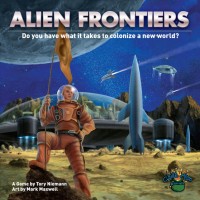
Alien Frontiers
2-4
13+
60+
Alien Frontiers is a game of resource management, worker placement, and area control set in a retro-future scifi universe.
The dice you receive at the start of the game represent the spaceships in your fleet. Docking your ships at the orbital facilities will earn resources, expand your fleet, raid your opponents, discover alien technology, trade commodities, and build colony domes to land on the planet.
Winning will require careful consideration as you assign your fleet, integrate the alien technology and territory bonuses into your expansion plans, and block the other players from building colonies of their own.
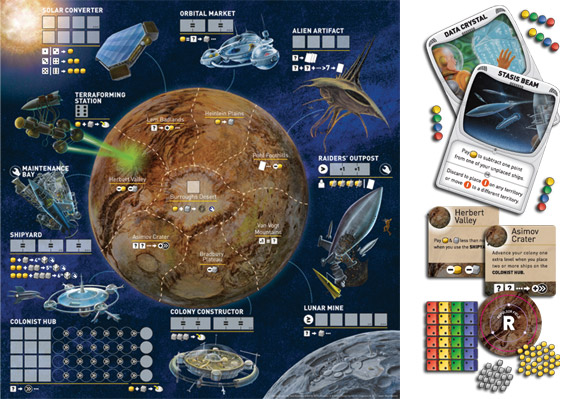
image © Clever Mojo Games



User Reviews (19)
Add a Review for "Alien Frontiers"
You must be logged in to add a review.
When I got into board gaming I read a lot of subjective articles ranking writers’ opinions of the “best” the hobby has to offer. The two names I saw most frequently residing at the top of these lists were Power Grid and Alien Frontiers. I spent a lot of time looking into both games; I ultimately decided that Power Grid was not for me (I do “economy” professionally, so I want nothing to do with it leisurely), and that Alien Frontiers, while most certainly for me, was a game I’d have to work up to. I threw it onto my Wish List and forgot about it for 6 months. When I felt I was ready to tackle something as “daunting” as worker placement (I was very new to boardgaming at the time, so even mechanics I’d now deem simple seemed too complex), Alien Frontiers was out of print and going for over $100 on eBay or Amazon. I was finally able to get my hands on it a few months ago when the new printing became available. So is it among the best gaming has to offer?
A quick disclaimer: everything in my review pertains to the most recent edition of the game (the 4th edition, funded on Kickstarter in 2013 and released to retail April 2014). This combines the contents of the original base game with the contents of the Upgrade Pack (domed plastic colonies, plastic miniatures for the Field Generators and dock cover chits for 2 and 3 player games), and includes awesome tuckboxes to store all the parts. It also contains a 2-sided board – one side identical to the previous editions, the other with “rocket dice” shaped docks to work with Game Salute’s rocket dice to be released later this year.
Observed Set-Up and Play Time
The only “putting together” you have to do when you first open Alien Frontiers is assembly of the tuckboxes and organization of the parts into them. It’s a task that takes around 10 minutes. The rulebook is straight forward – particularly if you have prior experience with worker placement games. I started my first game around an hour after opening the box, and it lasted around an hour and a half. Setting the game up for repeat plays is simpler than some other worker placement games – no more than 10 minutes work. My games – whether 2, 3 or 4-player – have always taken between 1 and 2 hours.
My Learning Curve and Teach Time
If you have prior WP experience, getting good at Alien Frontiers does not take long. You really just need to get comfortable with the available Alien Tech cards and develop a strategy around managing the board. If you have no prior WP experience, your first handful of games will be dicey. My first WP game was Lords of Waterdeep, and most of my decisions were pretty embarrassing for the first 4 or 5 games. Teach time is relatively quick, even when teaching to somebody who’s never tried worker placement. Alien Frontiers is so elegantly designed that the board itself – while highly thematic – manages to cram in most of the instructions for the game in logical symbol-based form. No more than a half hour is required to teach someone as long as you are already familiar with the game.
Group Sizes and Dynamics
Of every game I’ve played, this one feels the most classification-proof to me. The only tough sell may be to power gamers, but they should be able to forgive the shorter playing time given the thematic immersion (although I’m sure they’d prefer Eclipse). My friends who hate Euros love it because they’re playing a science fiction game; my friends who hate theme-heavy/mechanic-light games love it because they’re playing a real Euro. Unfortunately, until the new edition’s expansions make it to retail (supposedly end of 2014) I can only play with 3 others. The bigger my gaming circle gets, the more I appreciate games that can support at least 6 players – and right now, Alien Frontiers is limited.
Objectionable Material
There is nothing above a PG rating in Alien Frontiers, but it’s not a game I could see playing with a child. While extremely thematic, the “science fiction” is more 60s B-movie than Phantom Menace, and I believe only adults appreciate B-movies. The game mechanics and strategies are also a little advanced for children, and there is no way I can see to “dumb it down”. I would tab this exactly at the 13+ manufacturer’s recommendation.
Comparable Titles
There are two titles that immediately grab me as comparisons to Alien Frontiers: Kingsburg and Euphoria. Kingsburg is definitely the gateway game that would lead to the other 2, and is likely to get shelved once you’ve graduated – even with the expansion, it’s got far fewer options than the others, and a flimsier theme. But Euphoria is real competition for Alien Frontiers. They are both thematically and strategically rich, and they use the same means to mitigate the randomness of dice rolling. Euphoria is the more complicated game, but I prefer Alien Frontiers overall. You can’t go wrong with either, but Alien Frontiers flirts with gaming perfection.
Alien Frontiers – particularly this stunning 4th edition – has proven well worth the wait. I’ve played it several dozen times in the few months I’ve owned it, and don’t see it slowing down any time soon. The theme catches you in a manner that few Euros can, and the experience will only get richer when the rocket dice become available later this year. This is a game that everyone should have in their library.
Space, the final frontier. Oh well, we do know there’s a lot more frontiers than this, for instance other dimensions and Chthulu-stuff (which of course is real!). A whole lot of worlds. Fortunately, since we’ll never have a chance to prove or disprove any of this in our lifetime, we can enjoy a lot of fun in the world of science fiction. And Alien Frontiers includes space, and mystical alien structures.
The setting
The setting of Alien Frontiers is the finding of a new and empty planet. However, the planet isn’t really empty. Orbiting around the planet are abandoned facilities which provides extra possibilites. There are also abandoned facilities on the planet, enabling additional powers to the one controlling the area. To win in this game, you need to have the most victory points when a player places his last colony on the planets surface.
Gameplay
To use the facilities oribting around the planet, you need to dock your spaceships in them. Of course, the space is limited, and some stations don’t allow for many ships at a time. Your spaceships are represented by your dice. These dice are rolled, and depending on the result, can be placed at the various stations. At first it sounds like pure luck is involved in this game, since rolling the correct result gives the best options. However, there are a whole lot of means to alter the result, such as the alien technology cards that are avaliable. And all that is required to get one is that you roll more than 8 in total of your 3 dice. And of course, there has to be room for another spaceship.
Your ships occupy that space until it is your turn again, blocking all opponents to place where you have. Some stations have room for more ships, but that space might also be blocked. When it is your turn again, you pick up your dice from the board, and roll them again. You may place it back where you got them if you meet the criteria, and of course if you want to do that at all. You always have at least 3 dice at your disposal, and it’s possible to purchase up to 6 dice, and 7 if you have control over a certain space on the planet.
The facilities
The orbiting stations are the main focus of the game. You cannot place ships on the planet, only colonies. But the choices are many. Each station has their own requirement for ship placement, easily identifiable by the iconography.
If you want to purchase a new ship, you need two dice with identical value. You’ll also need fuel and ore, and how much depends on how many ships you currently have at your disposal. This station has space for two sets of ships at a time. For solar fuel, you only need 1 dice, and the higher the number on the dice, the more fuel. You may also trade fuel for ore, where ore is the more valuable resource. Here you’ll need two dice with identical value, and the trade ratio is one to the number of your dice. So here you’d like to have a lower value on the dice.
There are many more stations, and then there’s the additional powers on the planet, which gives a bonus to a matching station orbiting the planet. If you want to purchase another ship and control a certain area on the planet, you get a discount of both 1 ore and 1 fuel. That makes for a huge difference to the game. Other areas give bonus to a corresponding orbiting station.
It sounds like a lot, but it really isn’t.
Components
The game board has great visuals set in a retro sci-fi theme. Each station has their own neat design, matching all other artwork in the game. The planet itself is just large and orange and gives me a feeling of the planet “Arakkis” from Frank Herberts “Dune”. That being said, each sector on the planet is named by a famous science fiction author, such as “Herbert Valley”. I don’t know many of the names, but I do know what they give homeage to.
It’s very easy to recognize the possible actions. Each station is a square as the size of a die, and the way the squares are connected show if you can place a die alone, or if you need more. It also tells you what rule they go by. I’m impressed how easy it is to read. The cost is also shown with easy recognizable symbols of fuel and ore. The planets bonuses are the same, and you can pick up the bonus chip to get a closer look.
The dice feel great in your hand, and are a bit larger than what I would call “normal” dice. The colors are easily distinguishable from another (I don’t know how they are for color blinded). However, the colonies themselves are just small drops of wood, giving no flavor to the game. They are quite uninteresting. Colonies aside, the game looks really great.
Conclusion
If there is one game I would compare with this, it would be Kingsburg. You use your dice and allocate them to gain resources. However, Alien Frontiers offers a lot more depth and control over your dice, and you are not limited to just collecting resources. I keep both in my collection, using Kingsburg for a more introductionary game, and Alien Frontiers for a deeper game.
Alien Frontiers is a good game, but I will strongly recommend you purchase the visual upgrade kit. It introduces awesome colonies, with a transparent plastic dome over each piece. Also, figures for some of the field generators that can be used, as well as tokens to place when playing with 2 or 3 players to hide unavaliable actions. This is one of my favorite games to play.
If you grab the expansion, this game is a real blast, and allows for up to 5 players. And I really recommend the expansion. Maybe not 5 players, but it does work if no one is prone to think a whole lot.
Pros:
– A lot of ways to alter the dice results
– Many paths to victory
– Much interaction
– Great theme
– Relatively easy to learn
Cons:
– Some downtime
– Ugly colony components
– Seems harder to learn than it is
Alien Frontiers is wonderfully simple and elegant territory development game that uses dice as the chief means of producing the resources needed to expand your dominion. If you’re thinking that could be a one-sentence description of Settlers of Catan, you’d be right. But Alien Frontiers plays quite differently, and almost every difference works for the better.
Each player has a number of “ships” represented by standard six-sided dice in various colors. A turn consists of collecting your available dice, rolling them, and then assigning the results to different stations on the board. By placing dice of certain values – or in pairs or threes or straights – that station gives one of a variety of effects: providing or trading resources, building ships and colonies, taking technology cards, or raiding your opponent’s stash. That makes this more of a worker placement function (a la Caylus) than rolling for production. The game proceeds one player has placed a certain number of colonies, and the highest score wins.
The components for this game are great, especially for lovers of science fiction. Not only is the game board laid out with artwork depicting space stations orbiting a colonized planet, but the regions of the planet are named after legendary science-fiction authors like Bradbury, Asimov and Heinlein. There are distinctly-shaped wooden bits for the resources and colonies, and even the cardboard bits are solid. About the only thing missing are plastic space ships, which you can always just drop in the box on your own to complete the set.
The elegance of this game lies in the fact that the gameplay itself is simple – it can be learned in one to two game rounds at most – but the number of options available, combined with the tension of having to cope with the results of your roll and sharing space with the other players, gives this game a considerable amount of strategic depth. One area where it shines over Catan, is that the technology cards are numerous and have a much wider variety of powers. In particular, the ability to manipulate or re-roll your dice is a big plus in my book, when dealing with dice-based games.
This game scratches a lot of the right itches for me: space theme, simple gameplay with strategic planning, short-to-moderate play time (four players, nine colonies, two hours tops), nice bits, dice manipulation, good player interaction without massive screwage. Highly recommended.
Lately I have come to discover that I have a soft spot in my heart for games that use dice. I like to leave certain things up to chance, because sometimes in life you have to take risks for great rewards. There are simple dice games and there are games that only use dice as a means to an end, but rarely is there a game like Alien Frontiers, that makes the dice a central theme to the game, but doesn’t FEEL like a dice game.
I LOVE this game.
The game itself is themed around colonization and construction. There is no actual space exploration; everyone is in the same sector (as it were) and trying to gain control of territories on a planet. They do this by building colonies on the planet, and when one player has built their final colony on the planet, the game is over and the winner is determined by points on a victory board tracker. For each colony established, the player gets one victory point. If the player has control of a territory by having the most colonies, they get an extra victory point. Pretty simple, right?
You need materials to build your colonies, however. And that means navigating your ships around the board. The dice themselves are the ships, you see. You start off with three dice, and by rolling those dice, you can pilot your ships to certain areas of the board. At the solar converter, you can dock a ship to get fuel according to the value of the die you roll (1-2 gets you 1 fuel, 3-4 gets you 2 fuel, and 5-6 gets you 3). At the lunar mine, you can get 1 ore for any value of die, but you can only dock a ship there if your ship/die has a higher or equal value than the highest value die already there. These resources are important, as almost everything in the game requires their use.
Once you have resources, more options become available. If you roll doubles on three dice, then you can place those two dice at the shipyard, where spending a fuel and an ore will build you another ship (i.e. getting another die to roll). You can build up to three ships, giving you a maximum of 6 dice to roll (although there is a way you can roll 7 in the game). Each subsequent ship costs one extra fuel and ore to build, so getting your fleet is an investment. But with more ships also comes more options. In order to build a colony, you can construct one at the colony constructor if you roll three of a kind and have three ore to spend. Or you could go the slow route and place a ship or two at the Colonist Hub to gradually gain the chance to build a colony for one fuel and one or. Or, if you’re determined to plant down a colony on a territory before anyone else, on a roll of a 6, you can destroy that ship and spend one fuel and ore at the Terraforming Station. Why would you want to do that? Because with the territories comes unique advantages for the one that controls that territory.
Named for various science fiction authors and personas, each territory can grant unique abilities. The Pohl Foothills can make the use of alien tech cost one less fuel per use, which means that some alien tech can be used for free at that point. The Bradbury Plateau allows you to construct a colony with the Colony Constructor with one less ore. And the Burroughs Desert contains the Alien Ship which you can use by paying one fuel and one ore (giving you 7 if you already have your full compliment of 6).
You heard me mention alien tech just a moment ago; the game also has cards that represent alien technology. You can get alien tech by landing on and using the Alien Artifact location, and this tech can affect the game by allowing the user to manipulate dice values, reuse ships, and even gain victory points outright. There is also a way to steal technology and resources from an opponent, by using the Raider’s Outpost. It’s not nice, but hey, they’re raiders, right?
There are just so many options in this game that there is always something that you can do, and you’ll find that this game brings out the creative side in you. You’ll learn to do calculations in how to make your ships the most effective with any roll that you get, and there are so many strategies to employ that the game doesn’t become stagnated or predictable. This game is good head to head against someone or in a four-way free-for-all, and the ease of setting up the board and putting it away is an added plus; there hardly seems to be any effort involved.
In summary, this game is simple to get a handle on in the rules department, but also complicated enough to formulate strategies and remain interesting and innovative. As far as dice games go, I think this is one of the best around.
Alien Frontiers is one of my favourite worker placement games, I am a fan of dice rolling if it’s done correctly and I tell you Alien Frontiers has a pretty awesome way of integrating dice rolling and worker placement into one game.
For a full review with pictures and additional explanation go to http://toddsboardgames.blogspot.ca/2012/12/alien-frontiers.html
Gameplay:
The goal of the game is to be the person with the most points when one player runs out of his/her colonies. You score points for each colony placed, each territory controlled and for having victory ‘tech’ cards. Ties are broken by the player who owns the most ‘alien tech cards
Your workers (spaceships) are your dice, and at the start of your turn you will roll all your ships. Your ships can go to any location although some require doubles / triples, a certain number or a run. The location determines what action you will carry out, and the number on your ship determines the details of the action. The details would be how much of a resource you collect, the trade value of your resources, if you can launch a colony, and if you can buy an alien tech card.
This game has so many different strategies to it that there is a way to play that suits each player’s personal style. There are 3 different ways to place colonies onto the planet and each of them can be activated by a different combination of dice and resources. In Alien Frontiers you are not ‘screwed’ by your dice rolls instead your dice rolls leave you with strategic choices and a good player can turn the crappiest rolls into a victory!
Each location however can only have a limited number of ships in it. This makes for even more strategic choices especially when you are blocked from the resource or location that you really want.
Getting the Edge:
There are lots of mechanics that allow you to tweak the way you play this game and give you the edge over your opponents. This works great to counter ‘being blocked’ out of a location or resource.
There are two different ways to get the edge over your opponents other than building more ships (dice):
Alien Tech Cards: You can purchase these by docking ships with a value equal or greater than 8 at the alien artifact. You can discard the current cards for sale and get 3 new ones by placing any value ship in the alien artifact. In addition to granting you some powerful abilities Alien Tech Cards can also be worth victory points.
Territory Bonuses: The player with the most colonies on a territory gains its bonus. If there is a tie the player who previously had the bonus must return it to the territory until the tie is broken. In addition to giving a bonus action, dominance over a territory also scores you a victory point.
Components:
Although the colony markets are kind of cheesy they serve their purpose. The tiles awarded to whoever asserts their dominance over a territory are good quality and they have their special ability printed right on them. The cards are fairly standard although they are a pain to pick up I would recommend sleeving them for sure. One thing that sets this game apart from others to me component wise is there is no colour I don’t want to play. The dice / matching colony tokens are all a sort of off colour that I find more attractive than most games.
Alien Frontiers is clearly not for everyone, or is it?
Family Gamers: Although this is not family friendly where anyone can walk up and buy it off a shelf take it home and play with their kids, if your family is experienced with board games this one isn’t too hard. After a couple turns pretty much anyone can get the hang of it and with the right guidance this can be a great game to improve critical thinking skills. The space theme works for some kids / families, for others it doesn’t if your family is experienced with board games and or enjoys the science fiction theme you should check this game out.
Casual Gamers: There is a lot of strategy, planning and thinking in this game so if you plan on playing a game with some dinner guests this is not the one. However if you are trying to lead some casual gamers towards more in depth games this is a great game to use. It is pretty rewarding to see your strategy come together and after a couple turns, tech cards, more ships, and a territory bonus you can see your plan come to life. This is a great part of any game and is what gets people ‘hooked’ and wanting to play more of that game. There is enough customization / personal strategy that there is room for multiple play styles, however because there are a limited number of spots at each location you are sometimes forced into locations and this keeps the vast amount of choices available to you from becoming overwhelming.
Gamer Gamers: This is a great worker placement game, there are lots of different strategies that can be used to obtain victory. One thing Alien Frontiers does better than other worker placement games is it really gives you the ability to ‘screw over’ your opponents. In a family setting this would obviously not be your first choice of action however at the local games night with a group of avid gamers this is what turns this game from your typical worker placement into a game for strategic masterminds looking to find a balance between blocking opponents and scoring points yourself. Dice haters might be turned off but usually if you low roll in a game you are stuck with ****** results and thats why dice haters hate, however rolling low is not always a bad thing and tech cards allow you to add, subtract, flip or move points around your dice and your workers being your dice actually adds a unique element to Alien Frontiers.
I do not live under a rock, so I have heard of Alien Frontiers, and I have heard a lot of reviewers I respect say good things about it. It has always been on my “buy” list, but there always seemed to be a game I wanted more.
Things have changed now. I got chance to sit down and play it at GenCon last week, and I was in love within 10 minutes. Here’s my laundry list of reasons why I love this game:
Theme: Space! I love science fiction in general and space in particular, so I was hooked. The design integrates theme very convincingly. Even the “dice as space ships” mechanic works, although I bet that’s even more evocative with the upgraded dice that are available.
Components: Top notch, nice chunky dice, solid wooden bits, even a little plastic space ship. Add to that the absolutely stellar art design (a gorgeous combination of form and function), and you have a winner. My only quibble is with the cards. They are of fine quality, easy to read with nice artwork, but the background color is a stark white, which to me makes them seem slightly at odds with the rest of the color scheme.
Rules: I cannot speak to their quality in terms of learning the game, as I was taught in my first play, but in two subsequent playthroughs with a friend who was also a newbie, we had no trouble finding answers to our questions.
Time/Space: The game has a fairly standard footprint. Should be easy to play on your typical card table sized surface. It you have a dice tower or other dedicated place to roll the dice, that will help. You do NOT want to roll your dice on the board. The games plays in a very satisfying time frame; a table of 4 inexperienced players learned the game and played in through in less than 2 hours. In 2 two-player games, one a learning game, we played twice in two hours.
Game Play: I am not going to go into a lot of detail describing game play, as this game has been around for a while, and other reviewers have covered this at length. Just take a look at the other reviews here and you’ll find out everything you need to know about game play.
Number of players: I have played two player and four player, and both have interesting dynamics. In two player, the sense of “take that” is more intense, since there is only one target of any such action. In four player the game has less direct back and forth, but the frustration around limited available courses of action seems more prevalent.
Complexity: Deceptive. The mechanisms themselves are not complicated, and they blend well with the theme to generate a good common sense basis for understanding how the game works. Goals are clear, and there is almost no hidden information, so knowing where you stand and what you need to accomplish is apparent. The challenge is in the HOW. Discovering and understanding the interaction of the mechanisms is the most difficult part of the game, and also the most fun part of it. That said, the game could certainly induce analysis paralysis in some players, especially in early playthroughs. To provide some context I would say that anyone who can play Catan or Lords of Waterdeep can easily play (and enjoy) Alien Frontiers.
Final Thought: As I said, I love this game. The goals set before you are very straight forward – almost seems simple. The trick, as I mentioned, is in the How of accomplishing the goals. There are a lot of choices to make, and your power to manipulate your situation is entirely based on what you decide and plan for. Sure the dice rolls every turn definitely set limits, but there are so many ways to mitigate that luck factor that a good player can win even with “bad” rolls. I have only played this game three times, but each time I figured out some new way to “work the system” to overcome obstacles (if not opponents). The only tragedy is that game is currently out of print, and will not be available again until approximately November. If you haven’t played this game yet, go find a copy and play, or get in line (behind me) in November.
This is my review of the board game Alien Frontiers, by Clever Mojo Games.
I am always on a quest to find board games to play with my wife, and friends that are by no means “Gamers”. Finding a game that appeals to me and the masses can be at times a monumental task. At first glance Alien Frontiers appears to be a little too meaty for this kind of group. When friends of mine glance at the back of the box, they always say, “This looks complicated”, but explaining how to play this game is a breeze, and after the first few turns everyone seems to be getting into it nicely.
1. Theme:
In Alien Frontiers you are attempting to colonize a moon by utilizing the various orbital facilities around it and managing the resources or tools that they provide. Facilities are used by rolling dice, (Your fleet of ships) and docking them at a facility to use that facility’s ability. One ship you may dock at the Lunar Mine, allowing you to receive one ore, and a different ship you might dock at the Solar Converter, allowing you to claim a certain amount of energy. Ore and energy can be used for all sorts of things at the other facilities, like building colonies, building new ships, activating Alien Technology cards, and so on. When a player has enough resources and has met the right requirements, they can place a colony on the surface of the moon scoring points and maybe claiming a special bonus associated with the territory. The mechanic in this game reinforces the theme very well, and you really do feel as if you are racing to colonize a new world. My wife and I are not necessarily huge sci-fi buffs, so I was a little worried about buying a game in that genre, but now that I have it, I find the theme quite pleasing.
2. Price:
The game is priced around 50 dollars, but Amazon is currently selling a few copies as high as 75 dollars; this is due to the games availability. I was lucky enough to have preordered the game so I received a substantial discount and received a promo card and some rockets used for score keeping. Now, here is the question, would I pay 75 dollars for this game if I had to buy it again? I would say yes and would feel very satisfied with my purchase. I have paid 90 bucks for some of the Fantasy Flight big box games that I didn’t enjoy half as much as Alien Frontiers.
3. Quality:
The board and the components included are of extremely high quality, and you can really tell that the crew over at Clever Mojo is extremely proud of their creation, (and rightly so). The wooden pieces are well made, durable and fit along with the theme very well. My only complaint is that territory bonuses are fairly large and don’t fit into their perspective colony very well and can cause the board to seem slightly cluttered to a new player, (This is only a very minor concern and does no way detract from the game play). The board and scoreboard are extremely high quality, and oozing with style. I love the components of this game and am completely satisfied with their design.
4. Artwork:
The artwork for this game is done in a 1950’s retro sci-fi style and really does a great job of defining how this game feels. The board and all of the cards are beautifully illustrated and really drive the theme along. I can’t describe how utterly disgusted I was when I opened up Castle Ravenloft and saw the cards were all so bland, not here. Each card is glossy and well designed. The artwork reminds me of the early sci-fi movie posters, and that is a huge accomplishment.
5. Learning
The learning curve here is quite low, despite a ton of different strategies and abilities. Like I stated earlier, the game looks complicated, but it can easily be taught in the first few turns, (most players pick it up by turn three). The truth is, a new player has just about an even chance of winning the game as an experienced player, so it is uncommon to just get railroaded by someone that plays often. My wife did so well her first game that the other players actually had to team up to take her down. The rulebook is of high quality and is very easy to read and interpret. It was refreshing to read a rulebook once over without having to shift through pages of errata and faqs to understand.
6. Weight
While Alien Frontiers is a medium weight game, there are a ton of different strategies to victory. If one player is obviously going for one path, the other players can decide to move along another path with no setbacks. Most of the fun of this game revolves around placing your dice creatively and in the right sequence to achieve your desired outcome and can be EXTREMELY satisfying. Alien Tech cards allow you to manipulate your rolls by paying resources, and territory bonuses allow you to bend the rules in certain ways making these combos very possible. A lot of people say that this game causes analysis paralysis, but my wife (Being the worst AP sufferer) has no problems playing.
7. Luck
This is a dice oriented game, so some small degree of luck is involved, but using cards to manipulate your rolls, and the fact that the different orbital facilities require different types of rolls, really takes the luck factor down (Almost to the point of non existence). I have never felt that this game is dependent on dice rolls but more how you use the rolls that you have. There is a ton of strategy in this game, and even if the rolls are not with me, I have never felt like I had a turn where I couldn’t do something productive toward my strategy.
8. Interaction
There is a lot of interaction in this game, and that is accomplished by allowing players to block out facilities, steal cards and resources and even use other players dice for your gains. The more players you play with the higher the level of interaction there is, but the game scales well for two or three players. Just watch whom you steal from with the Raiders outpost because you might have made an enemy for the rest of the game.
9. Waiting:
Waiting for your turn can take a while in this game depending on whom you play with. Some people take a long time figuring out which orbital facilities to use and how to spend their resources. I find that even with the players that take forever, most games are done in an hour and a half.
10 . Re-playability:
I have gotten about 25 plays of this game in, and see myself and my friends playing this game for years to come. There is enough weight and enough player interaction to keep this game interesting for a long time. I enjoy exploring the different strategies and feel great when I actually pull one of them off. This is a game that you can’t really master, and even new players will keep you on your toes. I will be looking forward to the expansions and will DEFINITELY be preordering them, but there is enough substance to the base game to not even buy them if you are having a good time with it.
11. Overall:
Alien Frontiers has quickly become the favorite game in my household, and my wife actually asks me to play it (Score). This is a rare gem that should definitely be picked up if you enjoy resource management games or just games in general for that matter. I have recommended it to other gamers, and they have responded to my emails with praises about this game. Non-Gamer players have remarked to me that they have never played a game like this before, that they had a blast, and I have even caught them telling others about it.
I would feel very confident recommending this game to anyone and hope that you have as much fun playing it as we have. I rate Alien Frontiers a SOLID 9 out of 10
When I was in high school, I became friends with a cute girl that I found absolutely riveting. We shared a class that had a lot of down time, so I had a lot of opportunities to talk to her and decided that I needed to ask this girl out. Finally, after a few months, I summoned the courage, expecting to get shot down – but, surprisingly, she seemed genuinely excited. I don’t know that I’ve ever been as stoked about a first date before – I remember thinking when I picked her up that she looked just stunning, and I thought it was going to be the best date ever – until, that is, I tried to talk to her. She just did not engage in any conversation. For the entire date, I just could not find a way to get her to talk, and the moments of awkward silence were just excruciating. Worst date ever.
So – Alien Frontiers. Everyone has been talking about this game, since last fall when the first 1000 copy print run sold out in what seemed like no time at all. Drake loved it; Barnes loved it; Pete loved it; Vasel loved it. It sounded too good to be true – worker placement with dice, interactivity, screwage, and a play time of less than an hour? Sign me up. After months of waiting, my preorder finally arrived a couple of weeks ago, just in time for CabinCon, and I feel like I’ve gotten enough plays under my belt now to form a credible opinion.
For a small publisher that’s just getting started and a game that was funded through Kickstarter, let’s be honest here – this game has impressive production value. The art is fantastic, retro-scifi stuff that looks like it was pulled off of the cover of a Heinlein novel. The game board gives a tip of the hat to those authors too, with territory names like Bradbury Plateau and Asimov Crater. The tokens are thick and the cards are substantive and should stand up well to repeated plays. And the box even has a divot cut into the side to make removing the board as easy as possible – these guys thought of everything.
So far, so good – this was shaping up to be a great first date. The rules are relatively straightforward – each player begins with three dice that represent the player’s ships. Each turn, a player rolls his or her dice to determine what options are available. Actions are taken by placing dice on the board, filling slots at the various stations. Most stations have a requirement of some kind, such as two of a kind or a total of eight or greater. Docking a die or dice at a station allows the player to take the action associated with that station, such as receiving fuel and ore, building additional ships, stealing resources or tech from an opponent, or landing a colony on the planet. It’s the last that is primary in the game – players are competing for VPs that are primarily achieved by landing colonies on the planet and controlling territories through having more colonies in the space than any opponent. A few VPs are available through Alien Tech cards, which can also be purchased through docking ships at the associated station. Alien Tech also allows a number of other interesting options, including adding or subtracting from a die roll, moving an opponent’s ship from a particular dock, or rearranging colonies on the planet, affecting control of territories. Besides providing VPs, control of territories also provides additional benefits such as discounts at the shipyard or control of the Relic Ship (an extra die associated with one of the territories on the planet).
Alien Tech is rather important to the overall development of the endgame. At the beginning, the choices that a player has can be fairly limited – if you’re rolling three dice, for example, you’re probably not making frequent use of the Colony Constructor, which requires three of a kind. You’re probably also getting locked out of certain docks that you’d like to otherwise use – if a player’s die is in a space, most often it stays there until the beginning of his or her next turn, preventing opponents from utilizing that dock. It doesn’t matter how many doubles you roll if your opponent is parked on the Shipyard – you’re not building any ships until the spaces clear. Alien Tech gives you some degree of control over your own destiny. Dice manipulation comprises a significant majority of Alien Tech cards, meaning that you’re somewhat less at the whim of fate and instead can control your own fate with somewhat better precision.
The game has a decent amount of interaction, although it’s not what I would consider a strong metagame. The Raider’s Outpost gives players the ability to steal resources or tech cards from an opponent, and some of the tech cards allow a player to move ships around from dock to dock or even send a ship back to the stock. Players can block opponents from using a particular dock by filling all of the spaces, and a player can take away or claim a territory bonus by competing for control of the territory. I’ve seen this described as “screwage” – I’m not really convinced that it rises to that level, especially when compared with games such as Omen with particularly nasty anti-player effects, but it’s certainly not multiplayer solitaire and has a meaningful level of interaction among players.
Overall, the game is a lot of fun. It’s light, plays in about an hour, and presents interesting decisions. It has a decent level of player interaction and rewards smart choices. I’d compare it favorably to Small World, not in terms of mechanics but in terms of weight and effect of significant decisions. It’s a light euro that does a lot of things well, including some things that a lot of euros don’t get right, such as decent player interaction and a degree of conflict, however limited.
So why the comparison to my worst first date ever? Here’s the problem I have with Alien Frontiers: the games I’ve played have been almost completely devoid of real tension. For some reason, I just haven’t been able to generate any chemistry with this game. I don’t think the game is scripted by any means – the randomness of the dice prevents that, and you have to take into account what your opponents are doing. But at the same time, I do think there’s an order of priority to the docks that make a number of turns feel obvious. If I roll three of a kind and I have the resources, for example, I’m almost always going for the Colony Constructor. If I get a straight, I’m absolutely going to give strong consideration to raiding. If I have a six and a pair of something, I’m looking very closely at Terraforming Station + Shipyard. The dice in this game feel constraining, for some reason – rather than introducing tension as the dice do in War of the Ring, I just feel like I’m min/maxing my rolls. And in that sense, I think Small World is the perfect comparison. I’ve just never felt a significant degree of tension in Small World, and in almost the same sense as Alien Frontiers, many of the decisions are, while not scripted, at least at a low enough level that they approach the obvious. That doesn’t mean that there are no meaningful decisions – you can absolutely screw up. But once you reach a rudimentary level of understanding, I’m not sure there’s a ton of depth here.
And maybe that’s ok. Maybe the moral of this story is that managing expectations is a good skill to have, whether in dating or in gaming. Not every date can be The One, and not every game can be War of the Ring or Twilight Imperium. Sometimes it’s fun to take things a bit less seriously and enjoy something for what it is – in this case, a well-crafted, lightweight game with decent player interaction, gorgeous production values, and a fun 45 minute experience that’s a good way to begin or close an evening of heavier fare. We can still hang out, Alien Frontiers, even if I’m not going to fall in love. It’s not you – it’s me.
Originally posted on menwithdice.com.
At first glance, I must admit that I was rather underwhelmed by this game, mainly because it seemed like a simple worker placement affair with minimal interaction between the players. I couldn’t be more wrong!
Alien Frontiers is truly an ingenious mix of easy to learn (yet hard to master) mechanics, that can be enjoyed by all sorts of players. Minimal downtime, alternate paths to victory, constantly changing game plans and relatively controlled randomness (granted you roll dice, but there are so many of them that at some point your luck can and will turn) make this a really classy game.
Component wise (afaik the package I got was the 3rd printing, mind control helmets + scoring rockets) the game easily gets 5 out of 5. There is absolutely nothing wrong with anything in the box, the pieces and board are sturdy, the artwork fits the theme perfectly and everything is clearly marked out.
Rule wise, the game is pretty easy to learn, I don’t think that anybody that has played a few boardgames before needs more that 10-20 minutes to breeze through the rules and start playing. And if something looks a bit hard to grasp at first read (e.g. the use of the Terraforming station) after playing your first game you won’t have any issues with the rules whatsoever.
The mechanics are a clever mix of worker placement (spaceships, area control (colonies) and resource management (fuel and ore), where each turn you roll your spaceships (represented by nice large colored dice) and you place them in various areas of the board in order to trigger their abilities (harvesting resources, stealing from other players, building colonies, gathering alien tech, etc). The overall goal is to colonize areas on the other planet, scoring victory points and gaining more abilities by dominating said areas. As I said before, it’s very easy to learn (especially since you start with a small fleet), yet very hard to master, since the last couple of turns each game tend to be rather cutthroat as you try to sabotage everyone else and advance your path to victory.
The game is drastically enriched through the existence of the alien technology cards, that alter the rules in subtle yet important ways, from changing the values of the dice you rolled to blasting opposing ships out of space. Actually, I think that the brilliance behind AF lies in these cards, since they are the ones that grant the game its replay value as they have a very strong impact on the endgame each time.
Overall, it is an excellent game, one of the very few that the first time it hit the table everybody wanted an immediate replay once it was over. Here’s to hoping that the upcoming expansion will make it even better 🙂
Alien Frontiers, developed by Clever Mojo Games, is a great space themed game that utilizes its mechanics well for a solid game play experience.
Components
The components for this game are extremely well done.
The board looks great and also offers a lot of information, utilizing language independent icons. Dice are used in 4 different player colors to represent spaceships. Each player also gets small wooden tokens in their color to represent colonies they place on the board. A small handful of cards are used to represent Alien Technology that players can acquire to interact with the game and their ships. There are also wooden tokes to represent fuel and ore, which are collected and used to pay for various things in the game.
Mechanics
Dice Rolling – Yep, the “dreaded” DR phrase. It’s actually one of the core mechanics of this game. But it works really, really well. And with the right Alien Technology cards you can manipulate the dice to use them effectively. So yes there is some random element involved since you have to roll the dice, but there are ways to control it a bit. If you like Kingsburg and games like that, this mechanic will not bother you and I think you have the potential for more control of the dice in Alien Frontiers than you do in Kingsburg.
Territory Control – As you place your colonies, you’ll be thinking about if you can gain control of a territory, or if you can at least make it so no one has control. The reason for this is the player that has control of a territory gets an additional victory point and bonus abilities to use during the game. The moment they no longer have more colonies than anyone else (so even on a tie); they lose both the bonus abilities and the victory point. Placing your colonies and gaining control of territories are the two main way to gain victory points for the end of game win.
Worker Placement – In this case your workers are spaceships. Your choices for where to place those spaceships each round are determined by: what you roll, what you can manipulate on those rolls, and what areas are still open for ships to dock. Like most worker placement games, most areas on the board do not have enough spaces for everyone to use them. So you might have the perfect roll for something, but without an open spot to dock your ships you are out of luck. This adds a bit of a cut throat strategy element as well. You can use worker placement not only to your benefit, but also to your opponent’s detriment. If you like Kingsburg but wish it would move a little faster, or don’t like Kingsburg because of the slow pace, this might be a game to check out. The Worker placement isn’t as “round robin” as Kingsburg. You place all of your ships/dice on your turn and they stay in their spot until your next turn. The next player will remove their dice, roll them, and then work with the open areas on the board. So there’s less wondering if you need to take a spot or if it will still be available for your remaining dice. You place all your dice, work with the spots that are open, and you’re done. Yes, there can be some Analysis Paralysis, but it’s minimized greatly next to the amount I’ve seen in some Kingsburg games (I enjoy Kingsburg, don’t get me wrong).
Fluctuating Scoring – As mentioned above, having control of a territory gets you extra victory points, but losing control will also make you lose that point. There are also a couple of Alien Technology cards that will give you victory points as well, but those can be stolen. So your score is not a fixed element in this game. And you will be thinking not only about how you can gain points, but also how you can make your opponents lose points as well.
Variable Powers – Between the Alien Technology cards and the Territory control benefits, you will have variety of tricks at your disposal. And all of them can be taken away just as fast as you gain them! This helps make the game a bit more cutthroat as well. And it’s one more thing to be thinking about. Sometimes you’ll make a play to gain an ability and other times you might make a play just so no one has that ability for a turn or two. Almost all the Alien Technology cards have a “pay to use” ability and a “one time; discard to use” ability. So the cards can come in and out of play easily. There’s also a spot on the board to dock ships that allows you to steal cards from other players. So the additional abilities will be in constant flux.
Overall Impressions
I really, really like this game. I love that it plays pretty fast and allows for a lot of manipulation of the dice. The cutthroat aspect of controlling territories for extra points and abilities is pretty nice as well. It makes for some contention and makes you think about the best placement of your limited colonies.
From a teaching aspect, this game is great as well. I was able to grab the game, read through the rules, and teach it to a new player that same night. There was minimal referring back to the rules, and when you do have to refer back; the rulebook is laid out nicely and I was able to find answers quickly. I have only found one rule that was being played incorrectly so far, and that was not the fault of the book. It was me not paying more attention to a territory that I never really go after.
I will definitely add this game to my list of games to teach at game day events.
Alien Frontiers is a space-themed strategy game for 2-4 players. The components are top notch, with beautiful retro art, great wooden chips, and a great box to hold everything.
Alien Frontiers uses a really fun dice mechanic. On your turn, you roll 3 dice (by default, though you can add up to 6 throughout the game). You then assign dice to limited slots to do things like obtain resources, obtain cards, obtain new ships (i.e. dice), or place colonies.
Assigning your dice to spaces that not only further your own ends but deny your opponents is key. Alien Tech cards allow you to modify your dice and strengthen your actions, so the game never gets bogged down with infuriating dice rolls. There is always something for you to do with your dice!
The game plays in about an hour or less, depending on the familiarity of the players. It usually scores very closely and comes down to the very end.
This is a great game for people who don’t have a great deal of time to play games or don’t want to spend hours setting up or re-reading complex rules. I’ve enjoyed this every time I brought it to the table. It isn’t the deepest or most complex game, but that’s fine with me. I look forward to the upcoming expansion, which I backed on Kickstarter.
Overview
No muppets about it, this is a sweet worker placement game that flows well. You take the role of colonists trying to build the best set of colonies on this new alien planet while harvesting alien technology to your advantage. The goal is to control enough territory to give you the victory.
Pros
Awesome components (4th edition)
Strong gameplay
Lots of interesting decisions
Components, board, and graphic design are very thematic.
Lots of interaction
Good options for dice roll manipulation
Cons
Can be Analysis Paralysis prone depending on players slowing the game down.
Gameplay
Players begin with 3 dice (or ships) and one alien tech card. Each player takes their turn by rolling their dice once, and then determining where to place their dice on the board’s “orbital facilities” to gain resources, build ships, take items from opponents, draw alien tech cards, or place colonies on the planet. Each orbital facility details what rolls a player needs to obtain the facility bonus. During their a turn, a player can also use their alien tech cards to provide extra bonuses or resources depending on the card. Once a player is finished, they will leave their dice on the board until their next turn, and then collect them to perform their next turn. This makes the game very interesting, because your opponents dice may be occupying a spot you really need. Can we say “plasma cannon”?
Basically, you’re trying to get your colonies on the planet. This requires you obtaining solar energy tokens and lunar ore to build colonies. As you place each colony on the planet, you get a point for each colony. Some tech cards also give you points as long as you can continue to possess them. The planet is also broken up into “territories” that grant the player controlling the territory with a bonus power that helps you in the game. Each planet territory, except the middle territory, is connected to an orbital facility, and the power is related to an advantage at that facility.
There is also another element that lets you mess with other players territories by manipulating the field generators through alien tech cards. The positron field will grant a player an extra point. The repulsor field will prevent players from adding colonies or moving colonies to and from that territory, and the isolation field nullfies a territory’s bonus. These generators can also be stacked on the same territory to really hose someone over.
Play continues until someone places all their colonies on the planet. Once that is done, everyone will total their points, and whoever has the most points will win the game.
Conclusion
I really enjoy Alien Frontiers, and I’m glad I finally got my hands on a copy. This was definitely worth the hype and wait, although I wish Game Salute would sell this through other channels. The fourth edition is definitely a step up over the first edition components. The colony tokens are very thematic. The game provides lots of interesting decisions each round and has some nice player interaction capabilities through tech cards and raider’s outpost. I like how there are basically three ways to get colonies on the planet, and each of those ways require differing levels of higher cost based on how quickly you can put the colony down.
However, because it has a decent size decision space, players who are analysis paralysis prone can really slow the game down. That’s why I’ll probably never play five players if I ever get the “Factions” expansion. Four players is really the maximum for this game, and I would almost say three players may be the sweet spot.
My two older kids liked the game as well. My youngest is just learning to read and doesn’t like to wait around between turns, so your kids need to be comfortable reading and waiting for playing. It does make a good family game given that caveat. All in all, Alien Frontiers is a great game worthy of your collection.
Gamer Recommendations
Family Gamer – YES – Given the age of kids, nothing offensive, and good strategy.
Social Gamer – NO – .Not a lot of socializing in this game, but a lot of thinking
Casual Gamer – NO – Probably too complicated
Strategy Gamer – Maybe – dice may be a turn off, but game has luck mitigation
Avid Gamer – YES – Full of options and variety
Power Gamer – Maybe – Power game will like the choices, may want expansions
I will give a brief review in the following categories. Component quality, theme, learning curve, suggested number of players, interaction, re-playability and fun factor.
Component Quality:
Quality of all the components is very well done and has nice artwork.
Theme:
In my opinion the space theme comes through very well. When I bought a card and used it I “felt” as if I was actually using whatever was on the card. Might sound a bit odd but I was really pulled in by the theme.
Learning Curve:
Very easy to learn. Within 5-10 minutes you have learned the basics of the game.
Suggested # Of Players:
Two players is fun but the “screw you” component of the game is lost. Plays better with 3-4 players since no one really knows who is going to screw them over or when it is going to happen.
Interaction:
Lots of interaction and lots of “screw you” in the game also which I LOVE. Laughter, groans, etc. It’s all there.
Re-Playability:
Very good re-playability. There is so much interaction and so many strategies to try out that it keeps the game quite fresh.
Fun Factor:
This is one fun game. Great interaction, lots of strategies to try out, some nice “screw you” cards to play and overall just a simple, fun game.
Final Score. 9 out of 10. Get this game! 🙂
For all you new gamers out there. There are times you are going to play a game for the first time and love it. There are other times you are going to play a game for the first time and not think to much of the game. When that happens play it some more. When you do this you will learn the game in more detail including the mechanics and strategies. When this happens a game that you did not like on the first game play you might like once you really get the “hang” of it. I recommend playing a game at least 3 times before making a final judgement call on it.
Awesome game! It may seem a little difficult at the beginning, but once you play it a couple of times, the game mechanics start to reveal themselves and everything starts to make sense. You might want to check out some videos in Youtube before buying it. It may not appeal to everyone. Don´t be intimidated by the amount of info displayed on the board. It´s not that complicated
Summary of the game:
In this game all players are competing to colonize a planet, but in order to achieve this, they have to manage the two resources available (energy and ore) as well as make smart use of different stations orbiting the planet, which by the way, have different purposes, like for instance: allowing you to extract resources and/or, buy ships, place colonies, exchange one type of resource for other, buy alien technologies, etc. And, how do people use the orbital stations? Easy, with dice!!!. Each dice represent a ship which can be placed in the different slots in the board game. Yes, that´s right! You start with 3 ships (3 dice). Later on, you can build new ships to a maximum of 6. However, each time they are more expensive to build. The interesting thing about the ships, is that the most you have, the more you can achieve in a single turn due to more options that become available to you. Each turn you roll your ships, and depending on the results you can use them at different orbital stations if they happen to be unused (yes, sometimes you may not use an orbital station if others are there). For example, in order to use the shipyard, you need a double (does not matter the number you rolled), but if other players are using the station completely, you may not be able to use it at all, unless.. -and here comes the exception to the rules-, you make use of some nasty alien technologies to remove or destroy other player´s ships from a station, or use them as yours. Alien cards are extremely powerful and most of the time they allow you to bend the general rules. In fact, although there is luck involved in the game, it is controllable by using these cards. And for those of you who like confrontation and direct interaction with other players, you can always steal resources and alien cards from other players by using a special orbital station (kind of a pirate lair), provides you a string of number in your ships. Something worth to be mentioned is that not necessarily the person who places his last colony is the winner. There is a scoring track which goes up and down during the same.
I have played this game several times with my friends and family, and they absolutely loved it. It is not that complex and with the Factions Expansion, it has ton of replayability. I would really recommend this game to people who like dice, who likes resource management and who
Pros:
* Stunning art
* Fantastic theme
* Controllable luck
* Various mechanics going on: resource management, worker placement, area control.
* Players have different options during their turn
* Well written rules
Cons:
* You need to get familiar with the alien cards in order to understand the hidden strategies inside this jewel of a game.
* Very hard to find a copy these days
* Due to the different strategies available to players on their turns, especially when they have a lot of ships (dice) and Alien Cards, sometimes “analysis paralysis may occur”
Some interesting videos:
https://www.youtube.com/watch?v=VUInHW2cYaQ
https://www.youtube.com/watch?v=ecq0GDgOOMI
https://www.youtube.com/watch?v=6aAwW8ebTv4
At its core, this is a very good game, but it’s marred by three main problems:
1. It’s too easy to hog the two most powerful spaces: stealing and terraforming. With the right alien artifacts, you can hold a monopoly on these spaces, and easily dominate the game.
2. The game suffers from a version of middle child syndrome, where it’s not quite a casual game and not quite a solid strategic one either. True, it does have elements of both, which can be a good thing, but it’s a bit too long to be casual, and it’s too random (both from dice rolls and opponents randomly stealing what you have) to be strategic, and I wish it was either one or the other.
3. There’s too much time between turns. Since you won’t know what you have to work with until it’s your turn and you roll, there’s nothing for you to do but sit and wait for your turn, and if your opponent’s the kind to take his time, it can get really boring.
All that said, there is a lot of great aspects to the game. The gameplay is streamlined, balanced, and a lot of fun. I just wish it was either a bit deeper, or a bit quicker.
This game scratches a lot of itches for me – worker placement, dice, and sci-fi.
I have the 4th edition proudly displayed and played many times. I love it very much.
Based on the reviews on this site, I purchased it, and due to the policy of the publisher (which may have recently changed) of not allowing it for online sale, I went to many retailers to track it down. It was very worth the time invested, as the gameplay is top-notch.
My main criticism is that it’s too good – it has spawned eleventy-billion expansions, some of which are okay, but none are as strong as the core game. I see them available, and I remember how awesome the base game is, and I purchase them without doing any research. When they add little to the core, and I expel them in favour of the clean awesome core game, I get a bit of remorse. Not much, though.
Thank you!
Alien Frontiers uses a very simple worker placement mechanic using dice instead of meeples. However, “simple” in this occasion doesn’t mean simplistic, since the game offers many strategic choices, player interaction (which is more to my taste than in other Euro/worker placement games), simple rules and short learning time. The gameplay is good and most people I have played with have the same opinion. Only con, in my opinion, is playing time since most games lasted about 2+ hours which is a bit more than I would like it (but the playing time is customizable by changing the number of colonies) mostly because you can’t plan ahead since your die roll and the placement of other players’ dice affects how you play (so you usually start planning after you have rolled). Considering all these I find the game quite enjoyable to play with either gamers and non gamers, teaching the game is quite easy and every play is quite tight since it’s quite difficult to get way ahead of others and win easily.
After first review I saw, I liked the setting and the layout, however I did not expect it to be that tense. During the course of the game – where you try to get the best of your dice and your resources – you get first points, develop your colonies and your abilities – you discover that you do not really have a real leader. There is tiny difference between you and your opponents. However last 2-3 turns start to be strange 🙂 All of the sudden we spoke less, started to analyze more… and in the end we knew who wins. Then we started to negotiate 🙂 and nothing was obvious anymore. It was a game of thrones 🙂
I like it very much.
Initial quality of the game which is relatively low – can be improved by expansion packs that will give you plastic pieces in place of regular wooden tokens.
Looking forward to my KS expansion packs for fractions.
Great game, and my kids love it. They ask to play t all the time. You can order a set of replacement cards and get the space crane in the new set.
Took it to a game night with some friends, taught it to them while we played our first game, they all really enjoyed it. They commented on the uniqueness of the die placement. Overall was a huge success. Cannot wait to buy the new expansion, really looking forward to be able to play with five players.