
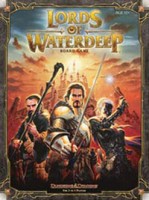
Dungeons & Dragons: Lords of Waterdeep
Overview
When Klaus Teuber introduced Settlers of Catan in 1995, the hobby gaming world was captivated by what is now known as the “Euro-game.” Many games using resource management and worker placement mechanics followed. These games were expertly crafted to be well-oiled game machines and often light in theme. On the other end of the gaming spectrum is the world of Dungeons & Dragons – specifically the Forgotten Realms. Originally created by Ed Greenwood and introduced in 1987, this fantasy “universe” offers a rich and vibrant world theme and immersion for role-players. What happens when one game form meets the other? Chemistry!
Gameplay
You are one of several Lords of Waterdeep with a secret objective, and you are vying against other influential lords for control of the city. To gain control you will send your agents out into locations in the city to recruit fighters, clerics, rogues and wizards to complete dangerous quests at your whim. Completed quests give you victory points and gold. Each Lord also has his or her own secret objectives as well. The Lord with the most victory points after 8 rounds of play is victorious.
Each turn, players assign “Agents” (D&Deeples as they have been named) to locations in the city of Waterdeep in order to seek out the adventurers needed to complete quests. If the player has the adventurers and or gold needed to complete that quest stored in their tavern on their play-mat, the quest is completed and victory points and gold are scored. After all the Lords in turn have placed their agents, gained their resources, and completed whatever quests they can, the round ends. Essentially, that’s all there is to a game round.
As in most “worker placement” games however, the interaction and competitive nature of the game reveals itself as each Lord seeks the same resources from the same locations to complete their quests. Only one Lord’s agent may occupy a building during a round – with some exceptions. So one important building an agent can visit is the Castle of Waterdeep – which give that agent’s Lord the First Player Marker. Being the first Lord to place an agent each round is a big deal.
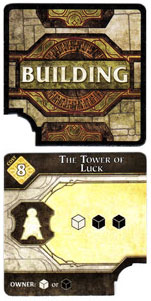
Lords can also purchase buildings (chosen randomly from a stack) that can provide resources, as well as other game effects for Agents that visit them. Purchased buildings provide not only an additional location for Agents to visit and resources but also grant a resource bonus to the Lord that owns them.
Lastly, Lords can gain Intrigue cards, and by having their Agents visit Waterdeep Harbor can play them on other Lords; often times with negative effects. Intrigue cards add those powerful and unexpected effects and add another level of interaction between the Lords of Waterdeep.

Components
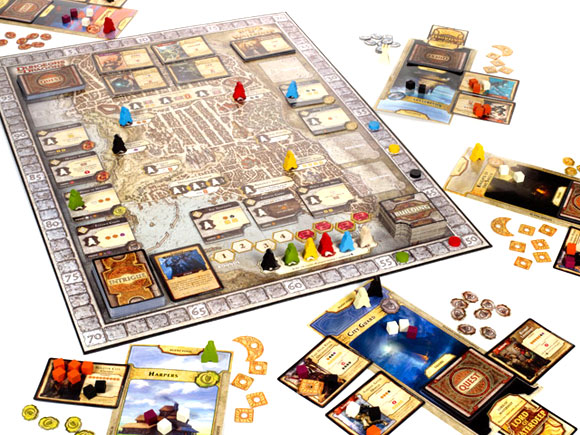
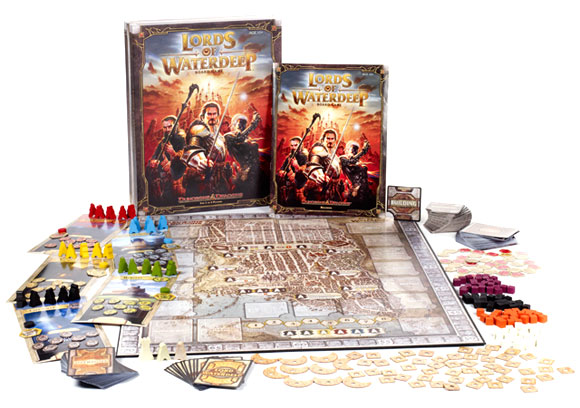
The components of The Lords of Waterdeep are as vibrant ad they are useful. Every aspect of the game is expertly crafted and provides a perfect synergy between game play and each component’s functional use. The cards are easy to read and well illustrated with Dungeons & Dragons themed art from a host of staff illustrators. One of the standout aspects of the game is the box insert. Every component has its place, and the insert even has small indentations that allow easy access to cards and tokens with a simple push. It is among best storage inserts to date. (with Airlines Europe) What a pleasure!
Learning Curve
Lords of Waterdeep has a low learning curve. The game can easily be taught in minutes, with an hour playing time – even for new players. Worker placement games traditionally have simple game phases. But the game’s complexity manifests itself in the form of play options or limitations as play progresses. In this game, the choices remain varied but they are manageable and steer the player toward a singular goal.
Who would enjoy this game?
Final Thoughts
Whether we like to admit it, there can be a deep separation between those folks that like to kick back with a good German board game and those gamers that play games to immerse themselves in the deep thematic plots the Forgotten Realms universe can offer. In fact, they are usually found in separate rooms at most gaming conventions. Was the idea to create a game that attempts to appeal to both of these groups? Does Lords of Waterdeep satisfy both these gamers’ itches?
In a word: no. Lords of Waterdeep can only be classified as a Euro-game. It is a derivative of worker-placement, resource gaining, and victory point tracking mechanics from many euro-games that have come before. This is not a D&D board game on the level of Wrath of Ashardalon. And any desire to roleplay, or imagine the small wooden cubes as small questing adventurers will fall a bit flat.
However, contrary to some opinions, the Forgotten Realms theme is not just “pasted on” but tightly woven into the mechanics to provide a fresh thematic journey for control of Waterdeep. So, what kind of game is this?
This is a game for anyone. No, it won’t turn a role-player into a euro-gamer or vice versa. But it strength lies in it’s accessibility. Perhaps the theme could have been anything, but its not. The vivid images and well conceived mix of variable player objectives, random Intrigue card draws and rich Forgotten Realms theme provides a perfect experience for those that have always wanted to try a euro, but found them too dry or technical.
Rarely has there been a game that combines so many enjoyable aspects from several sources, and still keep the game logical, compelling and accessible. Rodney Thompson and Peter Lee have created a gem: not for any one gamer type, but accessible to all. The Lords of Waterdeep is simply great fun.




Add a Review for "Dungeons & Dragons: Lords of Waterdeep"
You must be logged in to add a review.
My Wife is was a massive Catan fan, at her request we played it and played it and played it until I began to hate the game for a while until one day I stood up from the table and shouted ‘NO, not today’.
‘Okay’, she answered, ‘what do you want to play?’
I began frantically rummaging through my catalog of games I own in the library of my mind and stopped at Waterdeep. Would she turn her nose up at it because it says Dungeons & Dragons in the corner? I know it is easy to teach but will it be immediately interesting? I sighed and took the plunge.
I am glad I did. She loved it and I think it is great too. Now she asks for this all the time and will probably make me dislike it soon but, for now, we’re good.
Basically, you are a lord of Waterdeep… You know what the theme doesn’t really matter here. This is a game where you place little men tokens out on the board and gather the resources or perform the action listed on that space.
You have a list of quests, with a list of requirements, that you can try to finish by paying the list of requirements when you have acquired them. At he end of 8 rounds, the player with the most points after bonuses are added wins.
That’s it. Simple. If you have a quest that says get 4 black cubes and 4 gold to finish it, you look at the board and see where you can gain black cubes or money and place a man there to get it, unless your opponents have just claimed that spot.
The opponents are what make this interesting.
If they have claimed a space you need to figure out from a wealth of options how to either:
a) get another space onto the board to open the spaces up or
b)get a new quest or
c)play an intrigue card to rob a piece or just punish an opponent for hampering you.
I know I just made it sound like it is interaction crazy, but it isn’t really. Everyone is just trying to do the same thing as you and they usually place a agent on a space because they need it. Usually… unless they are evil incarnate.
This game plays well, it is fluid and there is always something you can choose to do.
Replay Value: This game scales excellently for 2 to 5 players and is always busy on the board. The quest and there bonuses means thaqt no two games are the same, and 8 turns means that the game will never go on too long. I have heard the expansion really opens the game up and takes it to the next level.
Components: Beautiful artwork, amazing box insert and easy to understand manual, Perfect.
Easy to Learn: Very simple, place a guy out and get whatever it says on the space, then finish a quest if you can, play passes left, then do it again. Easy.
The perfect step up after you wow people with Catan, show them a intro game with, (shock) no dice!!!!
I could write a glowing and accurate review of Lords of Waterdeep in just one sentence: it is a gateway game that’s so good it doesn’t feel like a gateway game at all. But as helpful as that sentence seems to me, I’m guessing most of you won’t agree. So let’s burn some wordage:
Observed Set-Up and Play Time
Waterdeep takes a good five to ten minutes to set up each play, but the good news is that it comes ready-to-go (only requiring you to remove parts from wrappers), so your first play takes no longer than the others. The instruction manual is well written and helpful, and can be navigated in around 30 minutes. But the first game does take some time, and you’ll check back in with that rulebook repeatedly. My first game was 3-player, and it took around 1:45… but by game #2 we were within the publisher’s advertised time of one hour.
My Learning Curve and Teach Time
I feel like I improved at Waterdeep through my first five games, but after that it’s been status quo. The game is pretty marginal on luck, and involves ample strategy… but an astute gamer should be able to piece it all together in a handful of games. I have taught this game to as many people as I have any other game, and it’s quite simple. It takes no longer than 10 minutes to give them the tools they need to play, and the game is balanced such that they probably won’t suffer a discouraging blow-out loss. Games that are designed like this – both elegant and simple – can be played so much more often than games you dread trying to explain to a first-timer.
Group Sizes and Dynamics
The base game plays up to 5 (the expansion can get this to 6), but I haven’t loved my couple of 5-player games. I think Waterdeep hits its comfort zone in the 2- to 4-player range, and shines at 3. My non-gamer friends have loved it – I think they feel like they’re accomplishing something by playing a difficult “non-mainstream” game and fully understanding it. And people who like board games will find loads to love here. The one lukewarm response I’ve gotten was from a “theme-means-everything” friend who enjoyed the game but would rather be playing anything with zombies, monsters or superheroes.
Objectionable Material
I struggle to categorize anything in Lords of Waterdeep as objectionable, but it is a “mature” game. It’s propelled by a story of coercion and underhanded political dealings. People who should be governing together plot against one another and sneakily try to “better” their peers. I wouldn’t want to explain these things to a child, even though they could grab the mechanics by 10 or so. It should be a fun theme to throw at a teenager taking their first class on government, though!
Comparable Titles
As much as it may be doing Lords of Waterdeep a disservice, the group of games I pocket it against are Settlers of Catan, Ticket to Ride, Carcassonne… the classic gateway games. And it smokes ‘em all. Easier to teach, more fun to play… what more could you want? It also shares the basics of worker-placement with games like Le Havre and Agricola… but those games are more challenging to get into than Lords of Waterdeep, and you’ll have a restricted group you can play them with.
I’m at a point where I begrudgingly play most gateway games, but Lords of Waterdeep consistently remains a game I get excited to play. That has everything to do with the fact that I don’t feel like I’m playing a “simple” game at all… I feel like it’s weighty, that my decisions matter and that my experience should give me an edge over my opponents. At the same time, I don’t recoil at the thought of running a new player through the basics because I know I won’t be fielding a hundred questions on points of the game that I feel should be common sense. It’s just great all-around.
The Lords of Waterdeep by Wizards of the Coast is a traditional worker-placement Euro style game set in the famed Forgotten Realms city of Waterdeep that is more than worthy of being added to your collection.
With Wizards of the Coast not known for Euros and Euros not known for adopting D&D/Fantasy themes, wariness was naturally called for when considering this game. Put your worries aside though as this game delivers fun in spades (and of course wizards, fighters, thieves, and clerics).
At the beginning of the game, you are secretly dealt a Lord of Waterdeep identity that will help direct your focus in Quest selection. Played through eight rounds, you assign agents (the number depends on the number of players) to recruit adventurers, secure gold, purchase buildings, and engage in intrigue among other tasks all to gain you power (read: victory points) in Waterdeep. Claiming quests (by securing a Quest card) and completing them (by fulfilling the requirements of the quest card – usually with a set number of adventurers that you have recruited) is the primary way you win the game. At the end of the eight rounds, you will add points to your score based on your wealth, remaining adventurers, and secret rewards based off of your completed quests and your Lord. These points are significant so winning the Lords of Waterdeep is always something determined at the very end of the game rather than the beginning or middle.
Two particularly nice options for your agent assignments deserve specific explanation. One, is to purchase buildings that immediately create a new place for agents to go. The rewards at these sites are typically very attractive but grant benefits to the owner of the building in a mild way as well. Consequently, purchasing these tiles is an attractive option as it either provides you a great place to go or generates resources for you when your opponent does (see my game tip entitled “Locations, Locations, Locations!”). Second, players can also send their agents to a locale that allows them to play Intrigue cards which do a variety of things to help you win the game (sometimes they help you directly while others thwart your opponent). This location is particularly nice because it allows the agent to be reassigned at the end of the round effectively providing a “two-for-one” move option. These sites both speak to another great facet of the game – you are always picking between places you WANT to go rather than picking between worthless choices. Sure, you are not always going to get to go exactly where you were hoping but the game remains constant fun rather than frustrating because you never feel like your turn has been simply wasted.
Reasonably priced, it is certainly worth noting that this game’s components are gorgeous. The board is striking in appearance and very functional in design. Admittedly, one might quibble with the colored cubes that stand in for wizards, fighters, thieves, and clerics but otherwise all of the parts are top notch and really add to the flavor of the game. Both the Quest and Intrigue cards include dramatic artwork that if examined can draw you into the story. The building tiles are nice and come with corner markers so ownership of the real estate is never in question. Instructions on the cards, tiles, and manual are all very clear and intuitive. Not so incidentally, the insert in the box is quite simply the best that I have ever seen – there is a place for everything and everything fits neatly and securely in its place. Everything is designed to pop up when pressure is applied so there is never frustration with getting out the sizeable number of pieces required to play. I am anticipating expansions for the game and if these come they will not fit in the original box, but otherwise if there is an award for best insert, 2012’s winner has been found.
This game offers tremendous replayablity through the nice collection of Quest and Intrigue cards, the differing emphases provided by the host of different Lords, and a fun mechanic that means choices are always going to be different depending on the opponent (s). Nevertheless, I will say that a Lords of Waterdeep expansion also seems a natural. Additional Quest and Intrigue cards would be an inexpensive and welcome way to expand replayability.
Some have and will complain that the theme is “pasted on.” However, I frankly think of this as a positive not a negative. The “pasted on” nature of the theme allows the many folks who don’t care for the fantasy theme still to fully enjoy this easy to understand strategy Euro. For those, who do love the fantasy theme, the names of the quests and components, the tremendous artwork, and the beautiful board etc. should provide more than enough grist for imagination mills (something fantasy and D&D enthusiasts should have well developed already). In other words, this game is tremendous for it is possible to either ignore the fantasy theme or embrace it depending on your preference.
The game serves two to five players and appears to scale well with all groups. I have played primarily in a two-person format and have found it very enjoyable. With only two players, many, many quests will be completed but players still have to thoughtfully prioritize their moves. The game allows and encourages player interaction but at the same time, you primarily concentrate on your own efforts so the environment is a fun competitive one rather than hostile. The game moves along quickly and time even faster with the game.
Don’t just stick your toe in, dive right in to The Lords of Waterdeep!
I finally got a chance to sit down with my new copy of ‘Lords of Waterdeep’ last night! Lets take a look at the game in some detail:
COMPONENTS:
Lords of Waterdeep has EXCELLENT components.Evrything from the box itself to the bits you play with is very well made. One of my favorite things to do when I get a new game (and don’t get a chance to play it for awhile) is to sit down and organize the bits. Whether it is bagging them or seperating them into Plano boxes, I enjoy organizing them. Lords of Waterdeep has such a thoughtful/useful insert that I didn’t get the chance to do anything with the componenets but put them into their respective and completely useful places in the insert tray, and leave them there. Sigh. Everything fits well, is super easy to get back OUT of the tray, and is very well organized. Though if you sleeve your cards they won’t fit quite right. The cards aren’t handled a great deal during the game so I don’t have any problem with this personally.
The components themselves are very nice wood and cardboard bits, a sturdy game board with excellent art and some very nice(if a *bit thin) linen textured cards. The agent tokens and counters are smooth and feel nice to touch, and the cardboard is thick and durable. This game will last for many, many games.
Overall I would give the components a 10.
GAMEPLAY:
Lords of Waterdeep is an easy to learn, but surprisingly strategic game. My wife always taunts me when I say a game is ‘easy to learn’. Since she doesn’t play a ton of boardgames, some of the concepts that we gamers understand quickly are lost on her. In this case, when I say the game is easy to learn, I actually mean it! Here is the quick rundown:
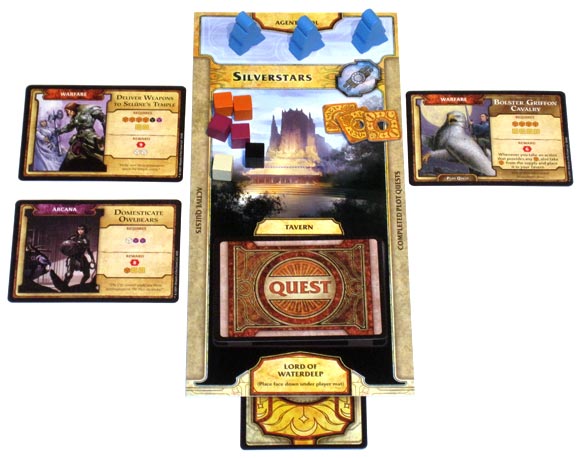
1. Everyone has an oversized player card in front of them that is broken into 3 areas- Agent Pool, Tavern, Completed Quests. At the start of the game every player gets a specific number of Agents that they will send out into the city. The number of agents varies based on the number of players. These Agents will sit at the top of your player card in the “Agent Pool” area.
2. The players are all assigned a starting bit of gold, with the starting player getting the least amount, and each subsequent plyer getting one more gold than the person he is following. Everyone also gets a Lord card that has a secret goal listed on it. This is kept secret from other players, and if the goal is achieved will give you get bonus victory points at the end of the game. This hidden victory point mechanic keeps the end game scoring pretty tense. Two Quest cards and two Intrigue cards are also given to each player. Quest cards give you in game goals to complete for rewards, and Intrigue cards are ued to gain extra resources and occasionaly do bad things to your fellow Lords.
3. In turn order, everyone places one of their Agents on a different area of the city. Most areas are allowed only one agent per round, but there are a few that will hold multiple Agents at a time. Some of these city areas give you resources (different colored cubes that represent the different class types in D&D. I.E. Purple cubes= Wizards, Orange= Warriors, White= Clerics and Black= Rogues.) These cubes are used to fulfill the requirements listed on the Quest cards. The collected…people cubes…are placed into the tavern area on your player card, and collected until you spend them to complete quests. It’s that easy. Some areas allow you to build new buildings, which then become new spaces for players to place agents on, but the owner of the building (the person that paid to build it) gets a reward whenever another player uses that building. This is a very fun mechanic.
The last few city spaces allow you to either get new quests, play your Intrigue cards, and even steal the first player token.
4. When all Agents are placed, the round is over and the Agents go home and await the start of the next round. Rinse and repeat. You play for eight rounds, and then the game is over.
The winner is the person that scores the most victory points by the end of the game. There is a pretty cool scoring track that borders the city and lets everyone get a quick glance at where scores stand at the moment. With the exception of the hidden VPs that will be applied at the very end of the game.
Lords of Waterdeep plays very elegantly and smoothly and the rules are very wll presented and easily understood. As our first game, I think I consulted the instruction manual two or three times during the game, and that was it. We all figured out the flow and some of the strategy of the game by the second round and were off to the races after that.
I would give the gameplay a 10. It is complex without being complicated, easy to learn, and the playtime is surprisingly quick. (We played with 3 people, first game ever, and were done in about an hour and twenty minutes.)
THEME:
This is where a lot of people take issue with Lords Of Waterdeep. I would say that on the surface, the theme is pretty thin. Using blocks to represent people, and spending those people like currency to complete quests does not let you form much of a connection with your subjects. We had many jokes during the game about suicide missions and the like. Killing your tavern customers off is not very good for repeat business! BUT, the theme really didn’t bother me at all personally. A bit of imagination goes a long way in this game and the three of us that played were able to give some personality to our suicidal little cube adventurers.
The look of the game, and the theming on the board, tokens, coins and cards is solid though. The coins are shaped like squares and half-moons and are just fun to hold. The card art and quest titles help to build some sort of story, and the building names help immerse you as well. Not everyone will see these things as immersive, but the good thing is that there is a solid game underneath it all regardless.
I would give the theme an 8.
CONCLUSSION:
After reading all of that I am sure you can see that I really liked this game. It plays fast, is easy to learn, has great components and sets up quickly. There is a lot of strategy and choice, but not enough to cause analysis paralysis. I am going to play this with my kids next weekend (ages 11 and 13) to see what they think, but I am pretty sure they will grasp the concepts and gameplay pretty quickly. I would say it is a good gateway game with enough meat to keep serious gamers coming back for more. Give it a try and let me know what you think!
Thanks for reading and have fun playing!
Lords of Waterdeep is a worker placement game that doesn’t necessarily do anything really new. Players take turns placing their Agents on various buildings in the City of Waterdeep to acquire resources (adventurers, gold, or intrigue cards) or to get Quests. They then use those resources to complete the Quests they have acquired.
While some say the theme is “pasted on” (and in many ways it is), if you use your imagination it can feel like you are recruiting and sending out adventurers to do your bidding. Most of the Quests make sense thematically, but you have to look for it. For example, the “Heal Fallen Gray Hands Soldiers” Quest requires 2 clerics, 1 mage, and 4 gold. The reward is 6 Victory Points and 6 Fighters. If you think about it, it makes sense that you send healers in and spend some resources, and you are rewarded with volunteers to help your cause. (The Victory Points reward are always abstract but seem to be fairly balanced based on the resources required to complete them).
But the beauty of this game is that it can appeal to those that like a heavy theme (even if it is “pasted on”–like myself) and those who don’t (like my wife). It drives me a little batty when she says, “I’ll take a purple please”… Doesn’t she know that’s a WIZARD! 🙂
But she actually enjoys playing the game, and that’s what counts. The game is extremely easy to teach, and plays very quickly. It plays well with 2 and 3 players (and probably with 4 or 5 as well–I haven’t had a chance to try it yet). The random buildings, quest, and intrigue cards provides a lot of replayability.
The components are fantastic, though the cards will probably show some wear and tear from shuffling (they have black borders). If you sleeve your cards they will not fit in the well designed interior of the box.
If you are a hardcore gamer, this game may not feel “deep enough” for you. But if you like to take a little break from games that cause “brain burn”, this game may fit the bill. It plays smoothly and quickly and can appeal to casual gamers as well. With its short playing time, I expect this game to hit my table very often.
9/10
Wizards of the Coast’s Lords of Waterdeep came as a complete shock to me when I first heard about it. A Euro-style game from my favorite hack-and-slash enablers? I wasn’t really sure they could pull it off. Then again, with the decades of focus they have had creating a variety of mechanics in both Magic and D&D, I shouldn’t have been surprised by how they were able to synthesize the pureness of the Euro gamestyle in a simplistic way that lets you dive right into the fun and entertainment side of things.
I freaking love it.
“What’s there to love?” you may ask. Plenty.
1. Variance. In each game, you play a different Lord of Waterdeep, with a different focus. Some are concerned with matters of Piety and Combat, and others focus on Skullduggery and the Arcane. These distinctions automatically give people different overall goals in the game and limit the possibility that players will be competing for every single quest and placement. Various quest types need different adventurers (what do Fighters know about Piety, anyway?), so players are forced to spread out around the gameboard. There are very few buildings that are of greatest benefit to every player at the same time each round.
In a game like Puerto Rico, if every player decides on a shipping strategy at the beginning, it can be tough for anyone to ship efficiently. In this game, your options are pre-defined. Of course, how you choose to meet your goals is still up to you…
2. Competitiveness. As victory points are given every turn a quest is completed, a player’s score will increase in spurts throughout the game. Which means that “first place” switches hands many times throughout the game. While some players may lag behind, I have yet to see a game where I knew who would win before the end of the final round. Every single time, it takes revealing the Lords of Waterdeep at the end of the game to determine the winner. As long as players are invested in playing the game strategically and efficiently, every game can be a close one.
3. Accessibility. Every single time I teach this game to new players, they play a single round and then hardly ever ask for help again. The actions and goals are so easily defined that people learn this game fast, and are making solid strategic decisions on their own within ten minutes. Last time I played, the newest player won, and I had to fight to take second against some other relatively new players.
4. Fun. The pieces are bright, shiny, and well-designed. Finishing the quests gives you that surge-of-victory feeling multiple times within a single game. Late game, there’s that tension that comes when you silently beg everyone not to put their meeple in the specific spot you want… I could go on and on. This game never ceases to entertain me. There aren’t any times I wish I was off playing something different. I just love it.
Play this game. That’s my end recommendation. Play this game, and then make other people play this game. Especially for those who aren’t familiar with the worker placement genre of games, this is too much fun to miss.
After reading many reviews on this game I wasn’t confident my wife, who would be the one playing this with me a lot of the time, would like it or not. Once we finished our first game though it was apparent that this is our type of game.
Being new board gamers we are exploring many different genres and this was our selection for worker placement with the added benefit of being placed in my favorite D&D campaign setting.
This game is great looking. The artwork and components are very nice looking and mesh with the overall look and feel of the game. The cards also carry this same quality and don’t feel out of place at all. There are a fair amount of components, but it seems the insert could have been designed slightly better as the pieces are a bit hard to put back in they way that it came. There is likely a method that I haven’t discovered yet but not the greatest design.
The gameplay is fairly quick, and you don’t have to wait a long time for your turn. With the right players this game can be completed in 30 minutes or so. For those that get analysis paralysis it could be longer.
I’ve played this several times already but it appears to have a lot of replay value. There is a fair amount of diversity in all the buildings that can be put out that procure different things like adventurers, gold, and abilities. There are different Lord cards that score extra victory points if specific conditions are met. With all that I can say we will be playing this a lot without much repetition.
While it’s well balanced, i feel that there is not many cut-throat tactics that you can play as a Lord. There are some extra victory points, but the gameplay seems identical no matter who you are playing, so it makes being a specific Lord seem not that important.
While it’s solid as a 2 player I think this game will shine as a 3 player. After that it would probably run longer than my liking. Smart gamers that understand basic mechanics and like to play in fantasy settings will love this game.
Pros:
1. Great design and top quality components
2. Quick turn taking
3. Theme is great and set in a very popular D&D environment with lots of history
4. Great replay value
5. Balanced
Cons:
1. Box insert could have been designed better
2. Needs more interesting Lord cards to give specific advantages to being a Lord.
At the end of my first game of Lords of Waterdeep I knew it was an insta-buy for me. From the components to the gameplay I am very impressed by the quality of LoW.
Lords of Waterdeep is a 2-5 player worker placement board game set in the city of Waterdeep, which is located the world of Dungeons & Dragons, specifically from the Forgotten Realms settings. You take on the role of one of 11 different Lords. Your goal is to send out your agents to recruit adventurers to your tavern and then send those adventurers out to complete quests in return for riches and glory (victory points). The game is played over 8 rounds, the player with the most VP at the end of the eighth round wins!
What’s In the Box?
LoW has some fantastic components. The rulebook is a good starting place. It is 23 pages long, but about half of that is glossary, quick reference, and specific component information. The game is simple to learn and the rules are very clear. Plus the rulebook has plenty of images and illustrations. The board itself is beautifully illustrated to resemble a map of the city. All of the spaces and symbols are clear to understand. You will also find a multitude of different components; gold, cards, building tiles, wooden adventurer, agent pieces, etc. All of the pieces fit neatly into the plastic container within the box, no need for making a mess on your table when playing. The artwork on all of the quest and intrigue cards also looks great. There’s nothing incredibly bright, flashy, or overly spectacular within the art, which is good. The art is some good flavor to the game but it does not distract from the important information on the cards, all of which is laid out neatly with clear symbols. Finally, the building tiles are incredibly sturdy and clear to read and understand. There’s no artwork on the buildings but once again the important information is easy to understand. Also, each building tile has a little notch in the corner where you will place your control marker on once you purchase that building (one of my favorite parts in the design). Enough ogling over the components, let’s move on.
How to play:
Before you begin Lords of Waterdeep each player is given a Lord Card that will be kept secret from everyone else. These Lord Cards will help determine your overall strategy because at the end of the game you will reveal your Lord and receive VP depending on how you played throughout the course of the game.
LoW is played over 8 rounds. In each round the players will go around the table placing one agent at a time on a building in order to collect adventurers, gold, quest cards, or intrigue cards. Once everyone has placed their agents the round ends, everyone collects their agents, and you begin anew! The goal is to score Victory Points (which is counted through the use of a score tracker around the board). You score VP predominantly by accomplishing quest cards that you have. You complete quest cards by turning in adventurer cubes and gold. Rewards from quests may vary, from flat victory points, to getting some adventurer cubes or gold back, or the quest may give you a continuous effect for the remainder of the game.
Players may also buy buildings with their agents. This is an important part of LoW; buildings open up new locations for everyone to place their agents, and the owner of the building get’s a little payment for people using them.
Another important aspect of LoW is Intrigue Cards. These are basically action cards that either give you a couple bonus adventurers, or may hurt your opponents by forcing them to pay a price.
At the end of eight rounds, play ends, and each player reveals their lord cards and the winner will be determined.
When explaining LoW to people I sometimes compare it to Ticket to Ride in terms of gameplay. The way you need to collect specific colored adventurers (train cars) in order to complete quests (routes) is similar between the two games. Because so many more people have played TtR I use this tactic to perk their initial interest. Obviously the themes are quite different between LoW and TtR.
Theme:
Being set in the Dungeons and Dragons universe many people may first be cautious of LoW. There is certainly a fantasy theme within the game, but it’s relatively mild. There be no dragons or trolls here, and there isn’t any actual combat in LoW. Does that mean there is no strong theme in LoW? Not necessarily. Yes, the theme may not be oozing out of the box compared to other D&D games. I feel that this is strongly due to some of the abstractions within the game. All of the adventurers are represented by colored cubes, and if it’s not explicitly stated what each are (Purple=Wizard, White=Cleric, Orange=Fighter, Black=Rogue) it is hard to grasp that these are people you’re collecting and not just some colored resources.
So, for casual gamers who are just looking for an easy game to pick-up then LoW can work. The theme is not in your face, but it’s still not absent.
When you start to look at the quest cards and imagine sending out your agents to different buildings there is some good thematic work. Each quest is categorized into 1 of 5 different types of quests. This not only has an affect on the gameplay but it also influences the theme. You begin to realize that “Skullduggery” quests require quite a lot of rogues in your tavern to complete them, and the title of the quest/artwork always fits the theme of stealing or spying.
For example the quest “Raid on Undermountain” requires you to gather a large band of different adventurers, each with their unique skillset that will aid your little group in their journey into the dangerous Undermountain. You may not know what Undermountain is when you’re playing, but the idea of a large scale raid is easy to picture and you begin to understand why you need so many adventurers. And the rewards are great at the end of the quest, with 20 VP and some looted gold. Each card also has flavor text on it to further immerse the player.
Even the buildings match the theme. You can imagine sending your agents to the “House of Heroes” to recruit some noble fighters and clerics for your cause. If you dive into the rulebook once again you will find flavor text for each building, each of the agent factions, and each of the Lords you will be playing. You begin to get a feel for character motivations and history.
So on the surface there may not be a lot of theme going on within LoW, which is okay. It allows players who aren’t a fan of the fantasy genre to enjoy the game. However if you want a little more immersion then there are plenty of opportunities for that within LoW.
Final Impressions:
So should you play Lords of Waterdeep? Absolutely YES! It appeals to a large range of players. There is strategy involved in term of when and where to place your agents or what quests to focus on first. There are plenty of opportunities to mess with your opponents plans as well. All active quests are visible so you can see what your opponent needs and you can either jump on it first, or you can play some fun Intrigue cards to mess with their plans.
Lords of Waterdeep is easy to learn and people will quickly understand the overall strategies and goals. It is a great worker placement game but it has the potential to be much more through the use of it’s established theme and minor story telling. I was lucky to have read some Forgotten Realms novels before I played, and while many of the specific names were foreign to me I was still able to appreciate many of the ideas and activities that occur within Waterdeep.
Overall I’m a big fan of Lords of Waterdeep.
Overview: Dungeons and Dragons: Lords of Waterdeep is a worker placement game for 2 to 5 players in which they manage resources to complete quests in an effort to gain control of a fantasy city.
Gameplay: Players take turns placing “Agents” on different locations on the board. Each location has a limited number of available positions, and once they are occupied, may not be selected for the remainder of the round. The player receives various resources based on what location was chosen. The most common are “adventurers”, represented by wooden cubes, and gold which are used for completing quests, the game’s main source of victory points. Other locations allow you to choose new quests, acquire or play “Intrigue” cards, and purchase new buildings.
New buildings provide additional agent placement options with increased benefits compared to standard locations. They also give the player who built them a benefit as a form of “kickback” when others visit them. Construction and use of these buildings is key to much of the strategy in this game, always being aware of what resources your opponents require and how to either lure them into giving you free benefits or to deny them the ability to find what they need.
After placing an agent, a player may spend his resources to complete a quest, which will provide victory points and sometimes other bonuses. Each player has his own secret “Lord” card which provides extra victory points at the end of the game for finalizing specific quests. Players continue placing agents until all have been used. The board is cleared and a new round begins. The winner is the player with the most victory points at the end of eight rounds.
The theme of this game is present if you choose to accept it. The requirements, and rewards, for the quests do make sense thematically for a player that wants to enjoy the fantasy genre. However, a fan of abstract games can completely ignore the theme and enjoy the game just as well.
Pros:
– Short, simple rules make this accessible to almost anyone, causing this to be an excellent choice for introducing worker placement games.
– Eight rounds enable enough strategic choices to be made but ends the game before it drags on.
– Player turns are fast, preventing major periods of downtime.
– While not standing out in any area, the game supplies “just enough” in almost all areas.
Cons:
– The bonus provided by the Lord card almost forces you into specific quests, which can feel confining.
– The theme is very thin and will disappoint players expecting a combat oriented dungeon crawl.
– The Dungeons and Dragons property carries a few stigmas which may prevent some gamers from trying this game.
Historical Figure/ Fictional Character I’d Most Like to Play Against: Goldilocks
Dungeons and Dragons: Lords of Waterdeep utilizes many slightly better than average elements to deliver an extraordinary game. It is neither too much nor too little. Almost everyone that plays it finds something they like and looks forward to playing again.
This is a game that is quickly climbing my charts becoming one of my favorite games in my collection. I am very happy I took a risk and made the purchase without ever playing the game myself. Let’s dive in and see what we are getting into.
Lords of Waterdeep is a worker placement game that is set in a town from the Dungeon and Dragon theme, but that doesn’t really matter because outside of the names and flavor text this game has nothing to do with D&D.
Game Play:
In the game you are completing quest to score victory points and win the game. But to complete these quest you need a number of recruits and resources. In the game you are sending your agents to gather these recruits and resources by playing them in different parts of the city. For instance, you can send an agent to the arena to recruit two fighters, aka orange cubes, to your cause. When you gain the requirements necessary to complete a quest you do so on your turn resulting in a reward usually of victory points or some other benefits such as additional resources.
There are a few other aspects of the game that I think are very intriguing. My favorite are the buildings. You can build different building that provide the players with more places to send their agents. The great thing about this is when someone else sends an agent to your building there is a reward that you get every time as the owner.
The other mechanic is in intrigue cards. These cards allow you to interact with the other players some. Sometimes you are attacking them, sometimes helping them. The great thing about this is to play a card you have to send an agent to the harbor. At the end of the round, eight rounds in total, you get to take your agent from the harbor and send him to another location. Very beneficial!
Components:
This is one aspect that I feel the game has generated a good amount of buzz about. And they are pretty great pieces and top quality, but nothing is really mind blowing. What I have heard a lot about is the box and holder for the pieces. Honestly, it can be frustrating. All the pieces have their own place which is great, but some of the spaces are a little tight and I have more than once shot gold tokens all over trying to get them into a slim space. Over all though good to great.
Two to Five Players:
I’ve played this game with different numbers of people; maybe not three, but the game scales great. I really appreciate when a game plays well with just myself and my girlfriend, but also with the guys. I also like that it plays more than four, I think it adds a lot more chances to get to the table and get your money’s worth out of a game when you can play it with more people.
Ease to Learn:
One of the things that really drew me into this game was how easy it was to learn. The first time I saw it in person I was late to a game night and game in at the middle of the game. I sat at the table and just starting watching. Pretty quickly I was able to figure out the game play just based on the action players were taking and the icons on the board. I didn’t have to ask too many questions to be ready to play, everything just kind of lines up.
Blemishes, Not Flaws:
Some of the negative things I would say about the game is that it may not be very deep. I’m not sure if there are more than one or two routes to victory. It would also be nice if some of the lord cards you get that influence play were a bit more varied in what they did. They are all the same minus one. I also think this could make the game a bit deeper. One idea I had was a lord who earned bonus points for completing quest over 20 vp. Another would be extra points for when you end the game with left over money, maybe the most or recruits.
Overall:
As I’ve stated this game is quickly climbing up my charts and I don’t have any real flaws with the game after a multiple play through, only ideas to improve. It can easily fill multiple rolls with a good amount of strategy, play length being about an hour, ease of learning and number of players. This is a game that I’m very happy to own and would suggest to many.
This game is old enough that I don’t feel that I should explain the basics- yes, the gameplay is solid; yes, the theme is a bit stapled-on; yes, the insert is sexy but the box-top is wonky. That’s all been said before.
I came into this game knowing I would love it. I’m a huge Forgotten Realms fan, and I have yet to play a Eurogame that I can’t at least enjoy, however thin the theme. No, the real question was whether my wife would appreciate the game. She enjoys gaming but can be put off by too much complexity, especially at first. I was really hoping that Lords of Waterdeep wouldn’t be too scary.
The first few turns were a bit rough. Like most games, once you get the rhythm down, the turns make sense, but at first, it can be difficult to pick a goal and work toward it. Eventually, though, we caught on and the game played at a pretty quick clip. I was always surprised by how quick each round went by. By the end, the only reason we needed any time to think about our placements was if the other player had just blocked a crucial space. The final tallies, while fun, didn’t really reveal anything we hadn’t been able to guess at/track already.
After the two player game, I tried a couple of 3-player sessions. The difference with even one more player is remarkable- I imagine that 4 or 5 players is almost a different game entirely. While the 2-player game had seen maybe three intrigue cards played, they seemed much stronger with 3 players- I’d guess that 4 players is the sweet spot for them, but at 5, you’d possibly be throwing away a vital move (again, rank speculation- I haven’t got 4 others together yet). This game went much slower, but still pretty quick. Here, I thought my hidden points from my Lord would rocket me into the lead, but one of my opponents astounded me with the number of tiny quests that gained her points- a total upset, and completely unlike game one. So…
PROS:
Fun, pretty fast gameplay. Plays differently for different numbers of players. The hidden points at the end can be just enough to keep it interesting until the very end. Between blocking, buildings, and intrigue cards, there is just enough player interaction for me.
CONS:
It looks more complex than it really is- Most Euros would probably be abstract and simple enough to make it look easy to learn, but Lords of Waterdeep has just enough theme to distract from the core gameplay.
Overall, I dig it. Getting different numbers of players should keep it fresh for a while- I can’t wait to try with a full 5!
Lords of waterdeep is a worker placement style euro game set in the dungeons and dragons universe. This combination of the euro and nerdy creates a fairly lite entry level worker placement gateway game (similar to games like stone age without the need to feed your workers).
The game is very high quality with a beautifully designed board. A lot of thought has gone into the layout, the pieces and even the design of the box which holds the components. The cards and artwork are great and fit the theme well.
The game is fairly straightforward as each player is given a number of agents (depending on the number of players) and each round take turns sending their agents around the city to perform actions. Each action will give them adventures (colored cubes that count as fighters, wizards, clerics and thieves) used to complete quests, intrigue cards that give bonuses, new quests, gold or an option to build a new building.
The main aspect of the game is that any location has a limited number of spaces available , typically one. As the turn progresses a location you wanted might become blocked which limits your options. This adds lots of weight for proper planning. Do you go for something early to guarantee a spot or block an opponent? Buy a new building or take a chance with an intrigue card? As the game progresses other buildings will open up increasing options.
I have played it many times and feel the game is fairly balanced. Each time we played the scores were fairly close which kept it interesting. This is quite lite for a worker placement game which makes it a great introductory game.
Sadly what makes it great for casual gamers may leave more said strategy gamers feeling disappointed. There is little player interaction so it is more of an individual race than a true competition. Although the cards and board are nice the cubes that are used for adventurers distract from the theme. The extra buildings are also well designed for mechanics but their simple design leaves you never fully immersed in the setting. The Quest cards also add little flavor even with the great artwork. It feels like a well designed game with a theme added as an afterthought or a game which could easily fit a different setting. Even the Lord’s or color you choose does not add much depth (unless you get the building lord). I feel some more thought into adding more dynamic lord scoring or making the different colors start or score differently (each start either certain cubes At the beginning or have their own house or quest scoring bonus) could have added a lot.
Those few criticisms aside Lords of waterdeep is a great introductory worker placement game. It is a lighter game geared for casual players and offers a great gaming experience with any number of the players possible. Even with my feelings on the theme and lack of depth it is super fun. I have played it with the expansions which added a lot more to the game and with the random nature of the game it can have a fair amount of replay value. Again avid or power gamers may find it lacking and want a more heavy game and some d&d fans may be kept wanting a greater immersion experience. This aside I highly recommend the game to the more casual audience looking to wet their beak with the worker placement genre.
So if you’ve played other D&D board games where they use tile expansion and the like in a dungeon crawl type game, this game is different and is more about worker placement and using cleverly played cards to get ahead of opponents.
The idea of the game is that you are a Lord of Waterdeep and you are vying for power amongst other Lords through the use of Agents. Agents are your workers in this game. During your turn you will have the choice of placing your Agent in a location on the board that will provide your Lord with resources. Quest cards (selected by you throughout the game) will be fulfilled through the collection of resources.
Each quest card will have certain resources needed to complete the quest. Completing a quest will give out rewards such as: movement for your colored peg, more resources, or beneficial powers. After completion of some quests your colored peg will travel around on the outside of the board. The location of your colored peg is important because the lead peg wins the game. Lords are provided bonuses for certain quests regarding the Lord’s class and the quest class.
Another aspect of the game is the cards. Cards gained at Waterdeep Keep will allow you to either backstab opponents or provide you with resource bonuses. These cards are particularly handy if you are lagging behind and need some way to boost your power or inhibit the power of others. I also allows for some interesting player interactions.
Though this may sound confusing the game is actually extremely simple. One read through of the rules is probably adequate to provide you with the info needed for your first game!
I personally love this game and I’ve played it quite a bit. Though relatively simple this game is competitive and fun. I hope you have as much fun as I did being a Lord of Waterdeep! Good Luck!
Oh lordy
Thanks to a brilliant move by Wizards of the Coast, players and people across the globe can now enjoy a euro game without moving to medieval France or getting a degree in accounting first. Lords of Waterdeep is a loving marriage between Caylus and a thieving Dwarf.
Gamerules are explained perfectly above, so I will not spend precious space repeating that here. Suffice to say that this game exchanges Contracts for Quests and Masons for Wizards in a fight for the control over the ‘City of Splendor’.
Theme
Not counting the standard wooden cubes that are supposed to represent the rogues and clerics you send out on quests, the game is oozing theme. The currency feels exotic, the player-boards have gorgeous artwork and the main board is a beautiful map of the city you want to exercise your influence on.
It are the Quests however that make you feel like a scheming Lord pulling strings from the shadows. For instance the Skullduggery Quest ‘Take over rival organization’ requires you gather a fighter, two rogues, a wizard and a hand full of cash to topple your rival. After you’ve completed this, next to VPs, you’ll get 4 rogues in return, who of course switched to your side as soon as their former employer got canned.
Completing Plot quest will not earn you as much VPs as you’d like, but they do stay in the game to give you an advantage for the rest of the game. Most often this makes full thematic sense if you bring some of your own imagination to the table.
Interaction? Meh
For me, often the biggest problem with cubepusher games is lack of player interaction. Other than, ‘I hope he doesn’t take the spot I want’ or I’ll take this space to prevent her from taking this’ there is very little back-and-forth. This is also a problem here, albeit more obvious since it’s a game about powerful organizations vying for control over a fantasy metropolis and not about vegetable farming.
I miss the scheming, fighting and plotting with or against others.
The ‘secret role’ element of the Lord cards is not really that interesting. There is no real advantage in figuring out what the roles of the other players are. It is simply a way to keep scoring the last VPs at the end of the game a bit more exciting.
Expansion
Lords of Waterdeep is a game I love to play, but I cannot help to hope that they will introduce some more elements to the game if there will ever be an expansion (and considering its succes there will be). More intriguing role cards so it is far more interesting to guess which puppeteers are played by your opponents. More plot Quest so there is more of an ‘Engine’ to be build during play. And hopefully it will somehow introduce more interactivity between the players.
That being said…
Lords of Waterdeep has something very important, Flow. With only one action per turn and few actions to pick from that make any sense, that game gallops around the table. It goes tadum-tadum-tadum *ding* end of the round. That’s a good thing. You can still plan ahead, but the game never stagnates on people rubbing their forehead for minutes on end.
Closer to Zen than nail-biting and closer to Puerto Rico than Neverwinter, this euro dressed in dragonscale is a one hour plan and plot fest I can recommend.
In this gently competitive worker placement game, 2-5 players take on the roles of Masked Lords of Waterdeep – powerful nobles who scheme and manipulate adventurers to achieve their goals. The setting is imported from the Dungeons&Dragons setting of Forgotten Realms and is littered heavily with references to canon.
The beautiful game board contains several active spaces where players can assign their agents to recruit a certain number of “adventurers” – wooden tokens of different colour. Obtaining correct combination of these tokens allows players to complete quests, scoring victory points. As the game goes on, new buildings become available, expanding the options for deploying your agents. Whoever has most points at the end of 8 rounds of play wins.
The components and the art are of high quality, adding to the experience of the game. The game does a great job of conveying most information about effects on the game board without the use of text. This makes the game very approachable to new players – there is an immediate connection between actions and consequences as you start to build up your teams of adventurers to complete quests.
The game flows quickly yet offers opportunities for strategical thinking – do you take what you need or block a building that your friend will want? There is also limited player interaction as you can play “intrigue cards” that allow you to affect other players either giving someone resources or taking these away.
The theme works great – it’s rich enough to please the fans yet the game works great if someone doesn’t really want to focus on the fact that they’re domesticating owlbears.
This game is great in that it offers a very universally appealing experience – good for gaming newbs/hardened veterans, good for fantasy nerds and for those who have no idea what a Beholder is. It is light, engaging, replayable and makes you think without giving you analysis paralysis.
The lack of player interaction prevents the game from being truly great – it does feel that you are all doing your own thing. Makes it a “gentle” co-op though – not many feelings are likely to be hurt over this one. The lack of tension in the scoring is also a bit of a drawback – I think attaching victory to achieving a certain score would provide for more exciting end-games.
Don’t let those minor criticisms take away from the overall quality though – LoW is a great and approachable game – it scales well for the number of players advertised and serves equally well as both a gateway into the hobby and a main event of a game night.
First of all although the Dungeons and Dragons logo is prominent on the outer box of this game, you need not be a fan of the franchise to play this game. There are no mechanics that lend to the D&D dungeon crawl, the association is purely thematic.
Game-play:
This is a worker placement Euro game. You start off by selecting a secret Lord of Waterdeep card which gives you a secret quest to do througout the game. During the game you may place agents on different areas of the city and recruit adventurers, set up quests, carry out intrigue or build buildings. Resources allow you to finish quests and score points, with some quests having long running effects or bonuses, such as an extra agent to play on your turn.
Pros:
– This is a beautifully laid out game. The insert is of very high quality and well thought through. You may think it’s a bit surreal for a review to go on about the box insert but the way it is laid out, with specific push areas to lift cards and round trays to organise adventurers makes the setting up and clean up after the game a breeze.
– The rules are simple. First time players are usually well in grasp of the game by round two. In my group last week, the newbie won the game!
– The game is quick and clever. You can have an easy game where everyone just goes for it trying to accumulate points or you can apply more subterfuge to the game by trying to trip up your opponents.
– The randomness of the Lord of Waterdeep card adds a certain element of uncertainty as you try to figure out what your opponents’ strategy is.
Cons:
– Adventurers; the are just coloured wooden blocks. This doesn’t matter to me, but based on the D&D marketing some gamers may be expecting painting figurines. Be warned.
– The D&D theme is very thin, this could be a bonus it really depends on the player
Who would enjoy this
– Family Gamers
– Avid Gamers
– Casual Gamers
– Strategy Gamers
Enjoy the Game!
Lords of Waterdeep Details:
No. of players: 2-5
Time to play: 45-60 min
Age:12+
Set-up: 5 minutes
Lords of Waterdeep Description:
Lords of Waterdeep is a worker placement game set in the Dungeons and Dragons Forgotten Realms. You are one of the rulers of the town Waterdeep and score victory points by accumulating adventurers to complete quests.
Lords of Waterdeep has a game board with buildings that allow you to add adventurers to your tavern, build more buildings, gather quests and play intrigue cards. On your turn you place on agent on an unoccupied building space and then you may complete a quest. You start the game with two to four agents based on the number of players, two quests and two intrigue cards.
Each quest card earns a reward and requires a certain number and type of adventurers to complete. There are four types of adventurers: clerics, fighters, rogues and wizards. Rewards usually consist of victory points and gold, but sometimes include intrigue cards or adventurers. Some quests are plot quests that grant you a bonus for the remainder of the game.
You also begin the game as a specific lord of Waterdeep. This card is kept secret and each lord grants you a bonus for completing specific quest types.
The game consist of eight rounds and the player with the most victory points wins.
Review of Lords of Waterdeep:
Lords of Waterdeep brings many classic worker placement mechanics together to create a great medium weight game. This game is very streamlined and plays quickly. Most games will take between 45 to 75 minutes regardless of the number of players.
Lords of Waterdeep looks fantastic and the components are of excellent quality. The box is unique and the interior tray is amazing. The tray has a place for organizing everything and all the components fit perfectly in the tray.
I really enjoy worker placement games and Lords of Waterdeep is one of the best I’ve played. It is not as complicated or deep as Agricola, but it is still a lot of fun. The unique scoring abilities of the lords keep things interesting. And trying to chain quests together, getting adventurers for your next quest by completing a different one, is great when you can pull it off.
The rules are well written and teaching the game is easy. The simplicity, depth and play time of Lords of Waterdeep guarantees it will hit your table often. Players new to gaming and non-gamers alike will enjoy Lords of Waterdeep. This is one of my new favorites.
Lords of Waterdeep is a worker placement game set in the world of Dungeons and Dragons.
Dungeons and Dragons? Isn’t that when you sit around with bits of paper and rolling 20 sided dice? That doesn’t sound like my kind of thing!
Fear not! Although this game is set in the Dungeons and Dragons universe, giving it a great theme, this is not your typical Dungeons and Dragons game.
OK, so what do you do?
At the start of the game, every player gets a character card (a lord of waterdeep), some agents, some quests some intrigue cards and some coins. Each quest has a cost and a reward. The cost will be a selection of coloured cubes and possibly some coins as well. White cubes represent clerics, orange cubes represent fighters, black cubes represent rogues and purple cubes represent wizards. On your turn you can pay the cost of a quest to complete it, and collect the reward which will be some victory points and possibly some coins and/or cubes as well.
So how do I get these cubes?
Players take it in turns to place their agents at various locations on the board. Each location allows you to do something, such as take cubes, coins, new quests or play an intrigue card. Each location can (usually) only take one agent, so once a location has an agent no other agents can use it. There is also a location which lets you build a building in exchange for coins, which adds a new location to the board, and gives you a benefit every time another player uses it. This continues until all the players have placed all their agents, then all agents are returned to players and a new round starts.
What are intrigue cards?
Intrigue cards are special actions that often involve interaction with other players. They may let you allow you to use a location that already has another player’s agent on it, take cubes from another player or give them a “mandatory quest” – a quest with a high cost compared to the reward which that player must complete before they can complete any other quests. They allow you to spring a suprise on the other players!
And when does the game end?
After 8 rounds the game finishes. Players reveal their lord of waterdeep card. Each lord will then collect bonus victory points, usually based on the number of quests you completed of a certain type (each quest is either a warface, skullduggery, piety, arcana or commerce quest). Add these to your score and whoever has the most points is the winner!
So what makes this game so good?
It has an amazing theme and encourages a lot of interaction between the players. You have to keep your eye on what everyone else is doing, but also make sure you are completing your own quests as well. It has a good balance of knowing what other players are doing (you can see everyones quest cards) and not (you keep your intrigue and lord of waterdeep cards secret). You have an idea of how well you’re doing during the game from victory points scored but there’s also the bonus victory points at the end to keep it exciting. It also works well with any number of players (between 2 and 5 in the base game, the expansion adds a 6th). As soon as you finish a game, you’ll want to play another!
Sounds great! Anything else?
I feel duty-bound to mention the box, which is absolutely amazing. Everything is of very high quality and every piece has its own place in the box. Putting a game away has never been so much fun!
So to sum up, good game?
I think good game is a bit unfair, this is a great game. Give it a go!
Dungeons and Dragons: Lords of Waterdeep (thereafter simply referred to as Lords of Waterdeep) was one of those games which I heard about almost immediately as soon as it breached the market, and I got a chance to play it not long after when a friend brought it to the gaming store near me. I was intruiged right away by the style of the game and the attention to detail that a lot of the components had. As a lot of my friends are familiar with the Forgotten Realms setting (which is where the city of Waterdeep hails from), I had no trouble recognizing familiar characters and settings. My first playthrough of the game left me with a lot of good impressions…and one or two detractors.
Lords of Waterdeep is a 2-to-5 player game that involves using pawns (referred to as agents) to acquire resources on the board in an effort to complete quests and build buildings. The game is tailored so that the fewer people that play the game, the more agents that are available at the start of the game. With two people, each player gets 4 agents. With three people, each player gets 3 agents. With four or five people, each player gets 2 agents. As the game progresses, players will eventually gain another agent to use during the game. The game is played over a series of 8 rounds, during which players place agents on the board in order, one at a time, starting with the player who has the first player maker. Once all agents have been placed, there is a reassignment phase to move agents who are eligible, then all players collect their agents for the start of the next round.
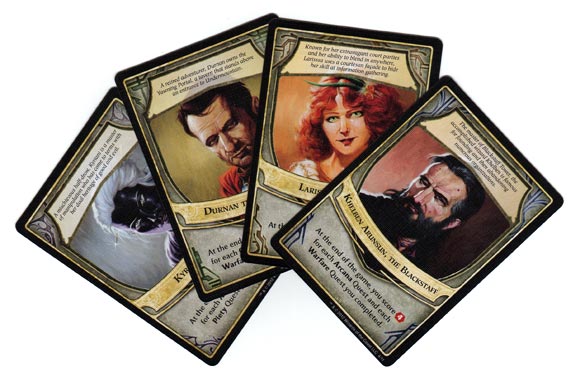
Each player also receives a secret identity card as a Lord of Waterdeep. These cards are kept hidden until the end of the game, and reveal additional ways that players can reap additional victory points according to how they play the game. For example, Khelben Arunsun, the Blackstaff, is a lord that will score 4 additional victory points at the end of the game for each Arcana and Warfare quest completed by the player who has his card. This is only for completed quests; uncompleted quests of the same catagory do not matter for this additional bonus.
Resources come in the form of gold pieces (a square gold piece counts as 1 coin, while a crescent moon gold piece counts as 5 coin), orange cubes (fighters), black cubes (rogues), white cubes (clerics), and purple cubes (wizards). Gold is primarily used to purchase buildings or certain services, while the cubes are used to complete the quests. Every quest (represented as cards in a Quest deck) has an affiliation (Skullduggery, Arcana, Warfare, Piety, Commerce), a completion cost, and a reward. Completion costs require a certain combination of cubes (referred to as adventurers) along with a possible gold cost. Once completed, the player who completed the quest gets the reward, which is typically victory points (which are scored immediately on the board), a one-time boon to be used immediately, or an ongoing effect for the rest of the game. Along with resources comes cards that players can acquire called Intrigue cards, which can be used to mess with opponents or gain a beneficial effect.
The board itself features 9 basic locations that agents can inhabit during the game. Of these locations, only four actually yield adventurers when visited (Field of Triumph – 2 fighters, The Grinning Lion Tavern – 2 rogues, Blackstaff Tower – 1 wizard, The Plinth – 1 cleric). The other locations have other varied effects on the game.
Castle Waterdeep allows a player to take the first player marker to go first next round, as well as drawing an Intrigue card.
Aurora’s Realms Shop gives you 4 gold a visit.
Cliffwatch Inn allows players to draw a Quest card from the available Quests in one of three ways: Take a quest and 2 gold, Take a quest and an Intrigue card, or Discard all available Quests, replace them with 4 new Quests cards, then take one of the new Quests.
Waterdeep Harbor allows a player to play an Intrigue card from their hand. At the end of the round, players can reassign their agents on Waterdeep Harbor to other available locations on the board and gain the benefit there.
Builder’s Hall allows a player to select a building from the available advanced buildings on Builder’s Hall and claim it on the board, provided they can pay the cost in gold to build it.
The advanced buildings on Builder’s Hall are different from the normal locations. Once purchased, they go on the board and the icon of the player who purchased it is placed next to the building to show who owns it. Any player may visit that building with an agent and reap the rewards offered from that location, but the player who owns the building also gets a reward as well. The advanced buildings on Builder’s Hall will also accumulate victory point tokens per round in which they are unbuilt, offering additional incentive to build the buildings.
Typically, only one agent can visit a location on the board. The exception to these are Cliffwatch Inn and Waterdeep Harbor, where up to three agents can occupy a space. As a result, the first player has most of the control on the board, while the player who goes last often has to compromise. Because of this, there is some strategy involved with visiting Castle Waterdeep, and often the order of play will change on the fly. As additional buildings are built, more spaces become available to visit, which opens up the game somewhat, but prime locations are always at a premium.
At the end of the game, all players will mark additional scoring with resources to add to their victory point total. All players receive 1 victory point per adventurer in their tavern (resource pool), and 1 victory point per two gold pieces they possess. Then every player reveals their hidden identity and score additional victory points according to the conditions listed on their lord’s description. After these points are tallied, the winner is determined by who is furthest along on the victory track.
I enjoy this game very much, and it’s one of the games that I’m always ready to play. Having said that, there’s a few things that take away from the game slightly. Lords of Waterdeep is very balanced in its mechanics, but once players are familiar with the game, it becomes easy to figure out what victory conditions and identities players have by their style of play. It then becomes possible for other players to take on an active role in halting another player’s progress directly, which can result in some ill feelings at times. The expansion to this game fixes this somewhat, as there are more identities to choose from. In addition, while this is a Dungeons and Dragons game, there isn’t any combat or spellcasting; this is strictly a resource game, and as such, another franchise label could have probably been placed on this game without losing any mechanics or theme. It could be a little misleading for those looking for high fantasy and adventure. These issues are very minor, however, and don’t inhibit a very good game that is very easy to learn and provides a lot of different options for enjoyment.
Lords of Waterdeep (LOW) is a mechanically simple, but otherwise rich and satisfying game that takes 10 minutes to learn but gives an hour of enjoyment with each play-through.
I was initially surprised that a D&& themed Wizards of the Coast game could be so… UNLIKE D&D… Wrath of Ashardalon, for example, bored be after a few plays; LOW, however, keeps me coming back for more.
Thematically the game if pretty nifty. Who wouldn’t want to be a scheming politician in a fantasy city, wrangling to gain influence and control? You build and control important locations in the city of waterdeep, plot and scheme against your opponents, and recruit adventurers to go complete quest for you. You also don’t know EXAcTLY who the opposition is: each player has a secret scoring condition that only they know; you have to be observant to figure out what it is…
the game mechanics themselves are fun and intuitive. Basically it’s about two things:
1) Resource management: should you use up your three difficult-to-get wizards to complete a quest that gives you an ongoing, passive benefit, or should you save up for a quest that gets you a large victory point payoff? Players have to make decisions about how and when to spend what they have
2) Differential turns: players have to be on their toes and adapt their gameplay quickly, as turn order affects what subsequent players can do. Should you try and become the first player, giving up the chance to hire warriors now for a possible increased payoff later, or is it more important to try and hire adventurers as fast as possible right now?
Replayability is high: you’ll be a different Lord in each game with different secret goals and different quests and buildings will come up (which can substantially change the game, actually) leading to new tactics and strategies
Components are simple and nice. Nice wooden pieces reminiscent of Carcassone, a few elaborate cardboard pieces, nice art.
An easy-to-learn game that’s a big bang for your buck!