
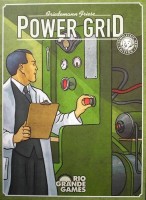
Power Grid
Power Grid is the updated release of the Friedemann Friese crayon game Funkenschlag. The latest cooperative publishing effort from Friedemann Friese and Rio Grande Games, removes the crayon aspect from network building in the original edition while retaining the fluctuating commodities market like McMulti and an auction round intensity reminiscent of The Princes of Florence.
The object of Power Grid is to supply the most cities with power when someone’s network gains a predetermined size. In this new edition, players mark pre-existing routes between cities for connection, and then vie against other players to purchase the power plants that you use to supply the power. However, as plants are purchased, newer more efficient plants become available so you’re potentially allowing others to access to superior equipment merely by purchasing at all. Additionally, players must acquire the raw materials, like coal, oil, garbage, or uranium, to power said plants(except for the highly valuable ’renewable energy’ wind/solar plants), making it a constant struggle to upgrade your plants for maximumefficiency while still retaining enough wealth to quickly expand your network to get the cheapest routes.



Add a Review for "Power Grid"
You must be logged in to add a review.
When you look at Power Grid it’s easy to be distracted by the area control elements and the resource market, even by the power plant auctions. The key to this game is that while all of the above is important, the real key is managing your economy, and never spend more than you must.
Power Grid is a game where each player is a competing Power company, trying to power the most cities at the end of the game. Money is only a tiebreaker.
This goal is accomplished via several actions:
1) Buy power plants in the auctions. Every round you have the option to buy one (and only one) power plant in the auction phase. This is optional unless you don’t have ANY plants (which only happens on the first turn). Each plant converts fuel into enough energy to power a certain number of cities. Each plant is all or nothing, on or off. You can have at most three power plants (four in a two-player game). If you buy one more than your limit, you must discard one of your old plants. During the game, the plants generally get more expensive and efficient as the game goes on. You want to selectively improve your energy output, and make sure that you can output enough energy to be competitive at the end of the game.
2) Fuel your plants with resources, bought from the resource market. Simple enough: buy at least enough fuel to activate enough plants to power your cities, and maybe reserves for future turns.
3) Expand your companies power grid by buying a franchise in new cities. You do that by paying the franchise cost (10/15/20 depending on how many people are already there, and what phase of the game it is), and any connection cost from your existing grid to the new city. The game ends on the round where the first player reaches a certain number of cities (depending the number of players).
4) At the end of each round you get income based on the number of cities that you provide power to with your plants, fuel, and franchises. If it’s the last turn, if you provide power to the most cities, then you win. If it’s a tie, the one with the most money wins.
The game shines in it’s player interaction, and game balance. The player in the lead must start the first auction, and can be locked out of better plants later in that phase. The buying of resources and expanding power grids takes place in reverse order, to give last place players an advantage. You must adapt to the other players strategies and actions, as they can have serious consequences. Too much competition in either geographical areas or resource consumption can be disastrous for all players involved.
This game is all about it’s Economy, pure and simple, and that’s why I love it.
This is my favorite game. It requires the balancing of 3 money drains (power plant auction, fuel market, city purchase) with a single inflow of “Electros” which is dependent on optimizing your purchases. If you were doing this in a vacuum, it might be simple, but there are multiple forces that you are dealing with that make it challenging.
You are competing with the other players. They are bidding up the good power plants, driving up the price of the fuel you need and claiming the real estate you need to power cities. The game causes everyone’s path-of-least-expensive-progress to overlap – and strategy will incite some players to increase your expenses intentionally, even if it costs them more.
There is a catch-up mechanism used during turn order. The player in first place always gets the least advantageous spot in play order, and the last place player gets the most advantageous turn order. Some players thing there is an advantage in trying to “slingshot” into the lead from a trailing position, but I think the the advantage gained from leading (greater cash flow) means that you never want to be too far out of first! Again more decisions on how to optimize…
This is a sit on the edge of your seat, hold your breath while the others move, try to recalculate the best 1-2-3 punch of purchases while the situations change experience. It is a fairly long game which requires a commitment of time, but the effort is rewarded with a game that plays tight and usually ends in a “photo finish”.
Sidenote: I have the game 4 stars for Easy to Learn, but I would give it less stars for “Easy to Administrate”. There are some quirky end of turn clean up rules that help keep things accelerating properly that require keeping an eye on the rules.
BOTTOM LINE: Decent theme, tons of playing boards adding to replayability, additional power plants for even more variety, awesome game mechanics keep you thinking and keep the game close. Best game around in the 3 hour mid-heavy weight category!
This is my kind of economic game. I can’t fully explain why, because there are subtle moves to be made in this game as you go about improving your electric company empire. This game in some way is reminiscent of some of the famous train games, but set to power company theme instead. The reason why is because instead of buying better train engines to deliver more product, you’re buying better power plants to use resources more efficiently. Instead of planning train routes, you’re planning connections to cities to supply power for profit.
The only product you deliver is power, but how you deliver it is where it counts. So it becomes a game of efficient planning and knowing which resources to use at the right time to maximize your profit. The game has 5 resources (really 6 for one special plant) to provide power: Coal, Oil, Nuclear, Trash, and Wind. You don’t purchase wind of course, but the others you have to buy. Each one has a different value, and that value changes on the resource market based on supply and demand. The resource market is really the most brilliantly designed piece of the game. As other players buy up resources, the price of that resource goes up, and vice a versa, when no one is buying it up. That’s part of the subtlety of this game: watching the resources and buying the right plants that use those resources to maximize profit.
There’s an auction round where you bid on power plants. Each power plant can only be powered by either one kind of resource or two (coal or oil). This becomes a factor in how you play the game, because some resources are naturally more expensive then others such as nuclear. As the game progresses, you get opportunities to get more efficient power plants that use less resources and power more cities. You have to make sure you keep up with the number of cities you want to power if you want to keep making money. Of course the winning condition is based on the number of cities you can power in the final round, and doesn’t come down to money unless it’s a tie. So on that final round, not only do you have to have enough power plants to power your cities, but you also have to have the right amount of resources to run those power plants! So spend wisely!
There’s a city connection round. Buying the first connection to the city is the cheapest. Up to three players can share a city, but each space gets more expensive. To build a city, you not only have to pay for the spot in the city, but you also have to pay for the connecting lines to that city from one of your nearest city sites. There a lot of tradeoffs to be made as you fill up the board and try to decide if buying that city is worth the effort at this time.
CONS:
The rules take a little getting used to because of the way the game is broken up into phases that cause certain rules changes at different times during the game. I downloaded some player aids from “BoardGameGeek.com” for this game to help me keep it straight. I recommend you do the same. Go to BoardGameGeek.com, select “Browse Games”, select “Power Grid” (near the top), go down to the “Files” sections, and you’ll find the player aids.
Overall, just an excellent economic game with a great theme!
Power Grid was my first exposure to games that genuinely employ economic principles (Monopoly et al don’t really delve into the good stuff), and it was a great way to start. The game has almost no chance involved in the mechanics, it gives everyone a chance to be competitive throughout the game, but against good players it can be brutally demanding.
Money is the single most important resource of the entire game, yet ironically makes no difference at all in the end, except as a tiebreaker. A game round begins with players bidding on power plants that can power a certain number of cities and require a certain number of various fuels: Coal, oil, trash, nuclear. In the next phase, players take turns buying the fuels they need; fuel resides on a track that shows the price to purchase, and while plentiful fuels are cheap, scarce fuels escalate in price. Classic supply/demand. The next phase has the players expand into new cities on the board, paying money both to place their piece there and the “connection” cost to their existing cities. Lastly, the players expend their fuels to fire their plants, powering some or all of their cities and collecting money for their efforts.
This flow of gameplay illustrates the supreme importance of money: you need money to spend on the plant you buy, the fuels you buy, and the cities you buy, and your ability to power those cities determines how much money you collect for your next turn. So at the beginning of your turn you effectively have to plan your entire turn in advance to make sure you don’t bid 40 on a plant worth 25 and then have no money to expand your empire in the third phase. Botching this planning can cost you an entire round sometimes, and losing a round puts you way behind in most competitive games. So the game works hard to keep things fair and balanced for everyone but is not afraid to punish you if you screw up too badly.
The best description for the components is utilitarian; the fuels are all different shapes and colors of wooden bits, which is nice, but the game plays with paper money and the colors on the board are rather subdued. This game was built not to sit there and look pretty but just to be played and played and played, and it works. A huge plus for the game is a new set of power plants to mix and match with the originals, and a ton of new maps to change up the strategies being used; France for example has a much larger nuclear market, and Korea has two fuel markets divided by North and South.
Power Grid is a gamer’s game: relatively easy on the rules but deep in gameplay, low on chance and high on challenge. And as a game for teaching basic economic principles it is one of the best.
Among a lot of economical games Power Grid is one of the highest-rated by the players. There are several reasons contributing to this outcome.
The game has a number of layers. The goal is to deliver electricity to cities. But in order to do so, one needs power plants, fuel for them, wires to connect the plants to the cities and finally transformer stations in the cities. Each of these elements has a different way it is simulated within the game:
– Transformer stations have fixed prices but players are not always able to construct them.
– The price of the wires depend on the distance they have to cross.
– Various fuels can be bought on a limited market simulating to a certain extent supply/demand rules.
– Power plants can be bought on open auctions but they become obsolete soon and they should be replaced with new ones a few times during the game.
There is a lot of variability in the game. And this is not because of randomness. In fact there is little (but not none) randomness in. The variability comes mainly from the facts that there the game contains not one but two large boards (representing Germany and the USA), and most of the games are played only on fragments of these boards – fragments that can be chosen differently each game. Moreover one can expand the game by new boards (e.g. China, Central Europe, Iberian Peninsula, Russia and more). Those maps not only provide new geometries for the wires, but they also include minor tweaks to the game (for example the Central Europe you cannot buy nuclear plants in several counties but coal for coal plants is cheaper).
Another factor to take into account is the rubber band effect enforced by the game rules. That is: the higher is your current place during the game the heavier handicap is applied to you. In Power Grid this effect is so strong that in my opinion it is not a “rubber” band any more – it’s a repulsive band as the one used in pinball tables! In theory it should give newbies some chances against more skilled players, but in fact it usually works in the opposite direction: a happy newbie may enjoy the first place throughout the whole game and during the very last turn, the turn that decides who’s the winner, the poor greenhorn may be pushed way back to the last place. I guess that’s why some players love this game some other hate it.
Power Grid is not one of my personal top favorites, but I must admit it is an interesting, expandable and well balanced game with complex yet not oversophisticated rules. Maybe I’ll not propose “let’s play Power Grid” too often, but when invited I’ll gladly play it.
After reading so many glowing reviews about this game, my wife and I decided this would be the first game we would rent from our local game store. Overall it was a good experience, but I do have some warnings and cautions for new players.
COMPONENTS:
There are a lot of pieces and parts. Parents and pet owners, be careful. Even so, the wooden houses, oil drums, garbage cans, coal lumps, and uranium cores are really high quality and look great on the cards and board.
Speaking of the board, wow! The are featured on both sides (yup, there’s two of them!) is gorgeous. Electric pipelines have frayed wires, linking familiar cities together across an industrial landscape. Both the continental U.S. and Germany double the replay value of this game. Game developers, take note.
The cards look amazing and feature some cool looking power plants. Very straightforward and unique in their square shape.
GAMEPLAY:
There are a lot of rules. The booklet is 12-ish pages long and there are different phases and steps that happen throughout the game. If you are all learning for the first time, it is going to be overwhelming if you don’t game that often. Maybe take some time reading it yourself before playing. The best case scenario would be to play with someone who already knows what they are doing.
Regardless, once things get going, it gets really fun fast. I love the auction part of the game. It definitely takes a lot of the luck out of this game. Powering cites and getting money for doing so is really rewarding.
One downside of play is that it takes a while. Nothing like Chess-Risk which takes fifteen hours to play, Power Grid winds down in about 2 hours, basically a night out at the movies. But there is definitely a lot of player interaction and many enemies can be made during this game.
CONCLUSION:
Overall, I really liked this game and I would love to play it again, but I wish I noticed how long it would take. It takes a lot out of you, but when it is all over, you want to play it again. Power up!
Some gamers enjoy a silly card-flinging romp or a visceral dice-chucking combat scenario. Power Grid isn’t for them.
The target audience here is anyone who find joy in looking at a roiling, complicated system, reducing it to a mathematical essence and wringing every point of advantage out of the matrix of options that emerges. This is gaming for engineers.
And it’s a fitting theme: expanding your company’s power grid while developing new power plants and, importantly, making money from it. But the most impressive part of this game is how intricate this system can be.
You have to have a keen (even preternatural!) sense for how much things are going to be worth not only when you buy them, but potentially for the rest of the game. Is it time to surge forward into new cities? Or do I need to hang back, stock up on fuel or a new plant? How much can I bid for that new power plant? And if I overpay, am I going to get stuck with unpowered cities and a crippled income stream?
A lot of players will find this extreme min-maxing fiddly, even tedious. And those opinions are totally valid. Power Grid is absolutely a game of extreme min-maxing. But for those who love that sort of thing, Power Grid is a masterpiece of a game.
Power Grid is what Monopoly should have been. The goal of the game is to supply power to as many cities as possible when a player expands his network of cities to a certain point (dependent on the number of players). The result is a game where players have to carefully manage their network of cities (which in turn affects when they buy resources and add cities to their networks), their power plants, their resources, and their money.
The element of randomness is relatively low. There are no dice rolls and resources are resupplied according to a resupply chart. The only randomness comes from what power plants are being auctioned, and even then, because 4 plants are constantly in the “Future market” (plants that are not available to bid on, but will be as the Current Market gets sold) for the first 2/3 of the game, therefore this game rewards careful planning and anyone willing to do lots of math. This is the caveat: If you want to win in this game, you will need to do lots of math. Have a calculator ready.
That said, if you do not mind doing the math or extensive planning, then this game is for you. The game’s theme matches well with the mechanics. For example, resources increase in price as demand exceeds supply, and some resources become more commonplace while others become scarce as the game progresses.
There are also lots of player interaction in this game. You cannot play in solitaire mode if you hope to win, since you must look at what plants others have in order to determine what plants you should hope to obtain. How they expand their network will also affect how much you will have to pay to expand your own.
The components are high quality, and the board has two sides (One USA, the other European) so you can change it up a bit if you’ve played one map too much. The game plays well whether it’s for 2 players or 6 players.
Overall, I highly recommend the game to anyone who does not mind doing the math and planning. It cuts out everything illogical and random about Monopoly, and creates a great economic-strategy game.
Pros:
– Rewards careful planning and mathematical prowess (Just like if you were a business man!)
– Mechanics fit the theme
– Good quality components
– Good replayability
– Plays well from 2-6
Cons:
– Math intensive, might not even feel like a game to some
One of my current favorite games. Area control with bidding and a fantastic fluctuating market.
During the first phase of the game players are able to bid on a set of power plants that may use coal, oil, garbage, uranium or even wind to produce power. Each plant uses a certain number of these resources and also powers a certain number of cities. Every round you have potential to bid on new power plants that could potentially be more efficient than your current ones. There is a current and futures market for power plants and so if a power plant is bid and won by an opponent you have the possibility of getting one of the futures power plants or a random one from the deck.
The next phase of the game takes you into resource buying. The game has its very own fluctuating market in that for resources bought the cost with that resource can go up and also the supply could be entirely depleted, in which case you may not be able to use a power plant you own that round.
The next phase is where you are able to buy into cities so that you can power them and get paid. During the first stage of the game only one person can buy into any one city. In the later 2nd and 3rd stages 2 and 3 people can buy into cities respectively, but the cost to do so increases. To connect more than one city into your power grid you must pay connection fees (if any) to a neighboring city and then pay the cost to buy into it.
After that round is over you spend resources from power plants that powered cities and then get paid based off how many cities in your grid that you powered that turn. You could have ownership in 4 cities but only power 3, in which case you would only get money for powering the 3.
The resources are then restocked based on set numbers corresponding to the stage in the game and then bidding on new power plants begins again.
The game ends once the number of cities connected in one persons grid equals or exceeds the number in the rules (based on number of players).
The person who and that point is able to power the most cities in their grid wins, in case of a tie the player that did so and has the most money wins. (note that the person to have the most cities isn’t always the winner because you have to be able to power them as well.)
*The expansion maps for this game are very fun and add flavor to the resource market since they base the resource restock rate on the countries/areas uses of those resources.
This is an interesting one. A game that plays well with 2-6 players, the scaling is excellent. No element of luck and money and resource management are your constant areas of attention.
We love this one in our league, even the lads who have played this the once, think it is great and want to play again. The board is big and colorful and invites you to study it in depth so you can consider extra strategies.
The game is also played in three steps that invite you to change your strategy as the game evolves. Excellent stuff, check it out quickly, whether an avid gamer or casual or in a league looking for games that are competitive, this fits the bill.
Replay Value: This is a game that you think about after it is over, what you did wrong and how you could have played better. You’ll be sitting in work thinking of where you will place your first house next time you play. That’s the sign of a very replayable game.
Components: Basic box holding some nice wooden pieces which is always nice in a resource management game. Fake, monopoly style money is used that is kind of flimsy but once you don’t have any ogres in your group, you’ll be okay. I like the power plant cards, they are solid and nicely presented.
Easy to Learn: Yes, once you have played two turns everyone will know what the score is and what they can do next. We introduced this on league night where we usually do a run-through for up to an hour before playing seriously, but each time we did this, the lads just said continue on, no restart.
There is a lovely mechanic in the game where resources get more expensive as they are being bought up and the player in last on each go gets an advantage when buying resources and houses and power plants. This is the first game where you can judge if you want to be in last to get an advantage and you then have to decide when to push for first. This is a new concept to me and one I find very interesting. Very tense and excellently thought out. Can’t recommend this enough. GET IT!
Power Grid is a resource management game: buy power plants, buy resources, build, burn resources, repeat – which on its face may not seem exciting. But it shines none the less:
1) Clean design – a great combination of easy to learn/teach, but with depth in strategy. Components are well made and easy to use/understand.
2) Player interaction – everything you do effects everyone else. Auctioning Power Plants – you can buy out others or drive up costs. Building – placing in cities you can out maneuver your opponents. Buying resources – you can drive up costs/ cause a shortage.
3) Replay Value – the package comes with a 2 sided game board. Each side has various sections available depending on number of players. 3-4 players can play one side 3-4 different ways. And each side (Germany or US) has its own set of challenges. And even with all that, there are a dozen different cheap options for expansion that will totally change the game around.
4) Flexibility – It plays well with 2-6. While different numbers of people may change game dynamic, it is well balanced with any number of people. My wife and I play 2 player often and enjoy the game, though auctions aren’t very pivotal as building. Larger group games, run longer but tension is higher and auctions more exciting.
I couldn’t be happier with this game in my collection. Everyone I have introduced it to has come back for more, and its not like anything else we have. I consider it a classic.
In Power Grid you are purchasing power plants and the fuel for them to generate power for your cities. The turn order is based on last place going first, and first place going last, so it encourages players to start out short and end the game with a big bang, but at the same time, building enough to not fall far behind or be forced to pay exorbitant rates for what they’re getting. Also, resources get cheap the more readily available they are, but the more players purchasing a resource, the more expensive it becomes. So again, another reason to go first and even stock up on resources, or build power plants using resources other players don’t want.
As the game progresses, more locations on the map open up for purchase, but also at a higher cost to the players. So you want to be the first in a region to get the lowest cost.
The components are simple, but fun. You have different shapes and colors for each resource, which is much more fun than simply variously colored cubes. The board is well designed. The rules are a little difficult to grasp, but after playing a couple times with an experienced player, are easy enough to understand. All in all, this is a great game to play, it is a lot of fun, and I definitely recommend it.
Power Grid is one of my favorite games, and with good reason. The game plays differently each time, with players taking different paths in their networks and power plant purchases. The expansion maps and new card decks make it even better.
Almost an archetypical euro-game, Power Grid has most of the base mechanics you find in the genre. Auctions, area control, resource and money management, careful manipulation of turn order.. With a built-in mechanic to keep leaders from running away with the game, it tends to keep things close for most of the game as well.
This is a good, solid game without being too much of a brain-burner. It can lead to analysis paralysis for some people, especially when trying to purchase cities in their networks, but fortunately the other phases lend themselves more to quicker decisions.
Luck plays a minor role in the game, but a noticeable one. How many times I’ve bought a power plant only to have a far superior one pop up for the next player, I can’t recall. It can also be very cutthroat as players vie for access to cities for expansion and block one another. The process is not usually vicious, though, merely good play.
With all the different mechanics and aspects this game contains, it always feels fresh and fun, no matter how many times I play. It goes with me everywhere I go, and probably will for a long time.
Power Grid (or Funkenschlag in the original German version) is an economic strategy game of grand proportions. In this game you have to power as many cities as possible by buying and operating power plants. Every round starts with an auction of the power plants available. These range from coal and oil burning facilities to waste using and nuclear power plants. There even are windmills for the more environmentally-minded. The auction is a time of cunning planning and strategic bidding in order to get the best plants you want (and leaving the worse plants to others).
All these power stations (except the windmills) need resources to operate, so after the auction you are able to buy them on the open market. But watch out! If a lot of people want a certain resource the price will go up. There even may be no resources left if the demand is too high.
After that you build houses in cities to power a city. Your power plants may be able to power a lot of cities, but if you have less houses in these cities than you can power, you only receive money for those you can power. So balancing your power output to the amount of cities you can power is very important.
When money is collected the new round starts. During the game the order in which certain phases are carried out varies according to the amount of houses on the board and the power plants you control. This way players that are ahead are kept in check, for the resource market becomes more expensive if you’re last in line to buy!
Overall this is a very well designed game and great fun to play it. Strategic thinking and planning is needed and you have to watch your opponents closely for opportunities to get ahead and leave them behind. Also the game board already has two sides in the basic version and more boards are available as extensions (each with an extra set of specific rules).
I love to play Power Grid and I have noticed that all kinds of player love the theme and the way the game is played. Winning is never easy and often comes down to a small difference in money. So every thing you do in this game matters! And the way resource prices change in this game is still a marvel to me. Well, enough recommendations, I suggest you try it out!
Power grid is a classic economic game that scales well from 2-6 players. I recommend 3 or more, as the two player game doesn’t feel nearly as rich. It’s been around since 2004, and it shows no sign of slowing down in popularity. If you like auction or resource games… this may be the game for you.
The game play is not too difficult to learn, but it can be difficult to grasp the strategy, as it does require the ability to keep track of money, resources, and routes all at the same time. There are auctions for Power Plants, Resource Purchasing to fuel the power plants, and City Network building rounds. It’s not for the faint of heart.
As others have said… this is not a game for someone who does not like math or finances. However, there is an element of direct conflict you don’t get from the real world when you are balancing your checkbook. And, because it is not real money, you can take risks or mitigate them by waiting for the best factories.
Ultimately, this game is a classic I recommend trying before purchase. However, if you have six players regularly, and like deep game play, this is one of your best options.
SO I do not cover what has already been covered in other reviews here is my take on the game.
I love Power Grid. I have played it with several of my avid gamer friends. However I was never able to get it on the table at my weekly game meetup.
After discussing the reasons for this we all agreed it took too long to play the game. After some investigation we discovered Power Grid: Benelux/Central Europe which can be completed in 60-90 min. The base game took 120+ to complete with 3-4 players.
This is a must own and must play for any serious gamers. Spend the extra money for the Power Grid: Benelux/Central Europe extension board and enjoy the game with a much wider group of people.
During the game play you need to watch what others are taking over so you do not bet boxed in until the next phase.
The order the cards come up adds some luck to the game but it does not impact the overall play of the game. It is more important to watch what resources are available for the plants you plan to build and their related cost.
I have not played with the other expansions but I plan to do so later this year.
So a few years ago at a con, me and a buddy had a demo of this game. We played it twice it was so much fun and I was instantly hooked. The game has a financial feel that is MUCH stronger than Monopoly with less luck and more thinking involved. It also has a slight map take-over element where you need to have your cities connected on a grid. If you have friends who love both Monopoly and Risk stop reading this right now…and go play this game with them.
There are a lot of pieces, and they look great, however setting up the game and putting the pieces together is a bit of a daunting task. However do not be intimidated, the mechanics of the game are actually quite simple. My 7 year old nephew has been known to join a game or two with my family (although with the 2+ hours of game time it would be wise to have an adult on the child’s team, to pick up when he gets bored and goes to play something else).
With the dual maps, there is a great deal of replay value as something as simple as starting on a different spot on the map makes for a vastly different game experience. Still for those who get bored easily Power Grid offers a host of expansion maps, also well detailed, with new challenges.
The best part about the new maps is that not only do they offer a new market system, and new geographical challenges, but many (but not all), offer a new game mechanic which adds a new flavor to the game. From China’s extreme control of their economic system, to No Nuclear power rules in Poland and Austria (while offering cheaper trash in Wein), each new map has its own quirks vastly changing the feel of the game.
If Power Grid is going to become a regular part of your game nights, expect to only get one game in. Also if this is to become a part of your family game nights, expect the little ones to become bored half way through (although they might want to rejoin in the middle of the game again), I recommend having someone on stand by to help them with their game play, and to take over when they need a break.
The rules are simple enough that even the most casual of gamers will have no problems after the first few rounds. This is a must own game!!!
For someone who loves games, plays a lot of different ones and was at best an above average student this game mentally drained me. At the outset there are a lot of moving parts to the game. From the auction phase, to buying resources, planning where to start your power plants and where/when to expand this game can be a little overwhelming. We broke it down into stages. Once we did that it ran a lot smoother, the picked up and I could enjoy it. I just had to compartmentalize a little to wrap my brain around this game. In doing so our whole family can enjoy it 2 boys (9) and (11) girl 18 and my wife and I. Lot’s of ways to win, different options during auction and expansion phases. A lot of math, and quite a commitment of time most games coming in around 2 hours. I always feel ready to jump right back in when the game is done, and that to me signifies a great game.
During the game, you’re supposed to buy power stations and build them around the country you’re playing in. But the stations themselves don’t do anything until you can provide a type of power plant. It can be wind powered, coal, garbage or even nuclear.
Each round there are 4 types of power plants avaliable for grabs, and it’s possible to see which other 4 power plants might be avaliable later. But in order to get this plant, you have to go through a bidding phase. Here you’ll bid until everyone has either passed or bought a power plant. And here is my problem with the game: money planning.
It’s an excellent game for those gamers who enjoy these sorts of games, such as St. Petersburg, where you have to save your money for the next round, or you won’t receive any noticeable income. But if you’ve spent money the previous round, you won’t be able to expand your network either. I don’t handle St. Petersburg very well, and that’s a quite simple game. And bring in more complex calculations in this game, and I’m lost.
And that’s another thing. You have to calculate your money at all times. If you buy this, you’ll have to spend 3 + 3 + 4 + 5 + 2 + 3 money. But then a player buys something ahead of you, and now you have to calculate all over, and find out how much you have left, and what you can afford to bid with when the power plant phase is on.
If you have a head for numbers and can plan ahead to the next round in a game with very long rounds, you might find this game extremely good. I know it is, but I just can’t cope with it.
Presents a good challenge. Enjoyable game. Good family game, as well as a competitive game for friends. Doesn’t take too long to learn & even my 10 year old grandson (smart for his age) enjoys playing it. Love that it has two sides you can choose from (Germany and the United States of America). Not to keen on some of the cities they selected for the U.S., but it’s not that big of a deal. Lots of strategy and one wrong move can leave you without enough money or resources to win the game.