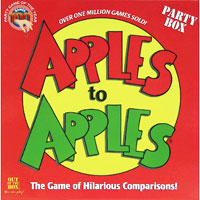
Apples to Apples
4-10
12+
30
Fast-moving fun for four to ten players, Apples to Apples is perfect for any get-together with family and friends. Just open the box, deal the cards, and you're ready to play! Each round is filled with surprising and outrageous comparisons from a wide range of people, places, things, and events. Comes complete with over 1,000 cards.
Add a Review for "Apples to Apples"
You must be logged in to add a review.

Apples to Apples provides a fun way to socialize, start friendly arguments, and just banter with your family and casual gaming friends.
Each turn, one player acts as judge and puts down an adjective card (like “Disgusting”). Every other player then picks one card from their hand of noun cards that they think best fits the adjective and turns it in to the judge. The judge looks over the cards, picks the one that they think best fits (Hmm…what’s more disgusting, a rat, an atomb bomb, or a high school bathroom?). Whoever’s card they pick, that player scores a point and the next player to the left becomes the judge with a new adjective card.
It’s simple, but it’s fun and easy to teach new people how to play. It also doesn’t mess up the game if someone wants to leave after the game starts or jump in mid game.
However, to enjoy this game you MUST allow discussion. I have seen players play the game where the judge looks over the cards, silently chooses a card, and announces the results. You have officially defeated fun if you play this way. If you don’t have your second cousin trying to justify to the judge that Hitler really was “Inspirational” because he inspired a whole country to do horrible things, you just aren’t playing right.
I find that often, people who consider themselves gamers (a group I certainly feel I am a member) have a tough time relating to others that don’t share our feelings about gaming. It’s easy to forget that not everyone finds optimizing positions, maximizing resources, and manipulating wooden cubes to be “fun”. While these are the games I am drawn to, I have learned the hard way that assuming that because I like a game – everyone will like it – can lead to unhappy gaming experiences. Many want a game to be a social activity that is relaxing and takes little brain power. Apples to Apples tends to be a great game to fit that bill.
Game Play
Apples to Apples, mechanically, is a very simple game to learn and teach. Each player will be given a hand of red cards that each has a word or short phrase on it (generally along with some quick blurb of information on it). Each round, it will be one player’s ‘turn’ to flip over a green card that will have a word on it (often an adjective, or description). Each other player will choose a red card from their hand and play it to a middle pile face down. The player whose turn it is will then shuffle these cards and lay them each out. Then, they will pick the red card that they think most fits the green card that was turned up. It is up to the player to decide how to ‘judge’ which the best fit is. Sometimes it will be the most closely related, others it will be the one they find most humorous. The player that played the chosen red card will be awarded the green card to show they won that round.
Play continues until one player has reached a predetermined number of green cards, at which time that player will be named the winner.
My Thoughts
In Apples to Apples, players aren’t necessarily trying to beat their opponents through optimal play or shrewd tactics. Instead, it allows people to share laughs and try to play to what they think an opponent will like. Often, knowing the person you’re playing with is far more important than how you are at making relationships between cards.
I’ve played many times where multiple games are played. In one game, a player may win handily, while in the immediate following game, they don’t score at all. Generally, in groups of people that enjoy Apples to Apples no one really cares who the winner is. This is a game that is not played for victory, but for the experience. Many people find this sort of game tedious as there is little use for strategy. Different people will look at the cards that were played and choose different ‘best’ answers.
In my experience, people that enjoy Dixit will enjoy Apples to Apples as they both contain easy rules, quick gameplay, and reward creativity over knowledge and analysis. It is not uncommon for people who enjoy Apples to Apples to not be overly interested in “moving on” to other more advanced games. Apples to Apples is often the type of game that a group that enjoys it will be willing to play over and over without a need to graduate to other games.
If you’re idea of a fun game involves cubes, resource management, and a good brain workout, there are many other games that will likely interest you more. I personally enjoy Apples to Apples from time to time as a way to catch up with friends and enjoy a game with non-gamers, but it is not something I will seek out on a normal “Eurogame” night. Apples to Apples has earned its spot on my game shelf, even if it doesn’t fit in with many of my more preferred games. If you’re looking for a social game that focuses more on the joy of interacting with a group over tactics and strategy, Apples to Apples could well be for you.
In Apples to Apples, you have a hand of nouns, and you’ll take turns being the judge. The judge flips over a green card which is an adjective. Every other player tosses in a card that they think is best described by that adjective. The judge then chooses which red card is the winner, and that player gets to keep the green card. Based on the number of players, the first player to obtain the required number of green cards wins!
Pros:
There are so many cards that this game has significant replay value
You can take many approaches to the game, picking cards that closely match the card, cards that are the most funny the most opposite of the card, the options are endless
Cons:
There are times when you don’t have any cards to match the current adjective
Some players will resent certain ways of playing. For instance, I like to take a comedic approach to the game and pick the funniest cards, but some people think you should always do the most appropriately matching card.
The cards in this game are good quality, but pretty simple, no unique pictures or anything. Each card even comes with suggestions or descriptions if you’re stuck or aren’t familiar with what is on the card. There is a wide variety of nouns and adjectives, so all ages can play the game.
I can agree with what some of the reviews here are saying. There is something that Apples to Apples shines at. That things is through playing it, (even if you lose) you get to know about how the other people playing think. You also get to learn things about people that you would not have guessed or thought that they liked.
I remember once, playing this game with a few people that I did not know. One of the other guys that was playing struck me as someone that I would not like. Someone that liked music which I did not appreciate. Someone that had no interesting hobbies. I learned throughout a couple plays of the game that he and some of the other people I was playing with were into some very intersting things. After the game we had lots of great conversation topics.
Conclusion:
This game has its place. It isn’t really that much of a game, so I wouldn’t call it a gateway game. However, it is a great thing to do to get to know people. If you want to get people into gaming, try Ticket to Ride or something else that is actually more of a game.
Apples to Apples is one of the simplest games to teach that provides almost endless entertainment value.
The game supports as many players as you want. Each turn, one player draws a green card from the stack which contains an adjective. Let’s say the adjective is Bossy.
Then, every other player plays one red card from their hand. Red cards contain nouns and pronouns, so everything from Circus to Humphrey Bogart. The player who drew the green card shuffles all the red cards and picks the one he or she thinks best fits the adjective.
The player whose card is chosen receives the green card, i.e. one point.
Laughter ensues.
The combination of green cards and red cards multiplied by the people playing means no two games are the same. It also changes the strategy. Some people are quite literal and want serious answers (my father). Some want the most random, bizarre answer (my girlfriend, who is guaranteed to pick “creamed corn.” Some players lack imagination, others have too much, and as a result you must learn to play the cards to the player who is picking.
I love this game. I’ve played it with countless people in so many social situations. I’ve never met someone who didn’t have fun playing it. If you host family gatherings or have friends over for dinner, you must have Apples to Apples. And once people get a feel for it, give Dixit a spin.
I’ve been playing (and owned) Apples to Apples since shortly after its initial release.
At first, I absolutely loved the game. It was the best party game I’d ever played. It had none of the trivia and word game problems (smart people — well, sort of. when you have a “Berlin, 1952″ and you don’t know what it is, it can be hard to play it well
) — and it has none of the “category” problems (“things you hold” … oh man, the arguments!) — but it was still an open-ended, casual, fun game with laughs.
So, on the general assumption that the game is a great party game, here are the downsides I’ve found:
* Playing with the same people game-over-game leads to an incredibly predictable game. For instance, about a quarter of the cards happen to be “favorites” of various people, like Sarah loves puppies, so if I get a “puppies” card, I save it until Sarah’s judge, and I play it, and I always win, regardless of the category. “cute”? Puppies! “evil”? Puppies! “Enormous”? Puppies! Win, win, win. This works to your advantage sometimes, but most of the time it’s just frustrating, because you had a really “good” card (either funny or accurate, whatever your judge calls good
), but you lose to a favorite.
* Playing with people you don’t know can lead to…bad situations. As other posters have said, you get some bad-taste jokes in Apples to Apples. Category: Hilarious. Cards played: Comedian, Toilet Paper, The Holocaust. The judge burst out laughing and immediately chose The Holocaust. The person who played Comedian (who I had just met) threw a fit, (“I don’t see what’s so funny about that!”) and to this day, she dislikes me.
So, as far as getting my money’s worth? I’ve had more great hours of fun out of Apples to Apples dollar-for-dollar than any other board game I’ve ever purchased. But if you ask me to play it tonight, I’ll groan.
Advice: If you’re in a group of friends or family who hasn’t already played Apples to Apples a ton, get it. (Or get Sour Apples to Apples.) — if half your friends have played a lot, skip it. And don’t play it during a first date.
Apples to Apples has the potential to be a very very funny experience, or one of the most boring experiences you’ve had around the table since mom’s leftover cornbeef hash…
Apples to Apples with the right group of people opens itself up to being lots of laughs, and an exercise in diplomacy and persuasion. Also, knowing your group makes the blank cards become the real star of the show. You can customize the game to feature in-jokes, family history or current local events.
With the wrong crowd, it becomes a game that you play for about 6 minutes and then everyone says “lets just play Settlers” (or Settlements if you’re my mom).
So go into the game with an open mind, and maybe an open beer and have a few light-hearted laughs. If you’ve got kids playing, maybe leave the beer in the fridge and open yourself up to the silly things they think are funny.
Apples to Apples is one of those games that somehow became divisive – most people seem to either like it or hate it. A little side game you can play is to mention the game just to see people’s reactions.
“What a dull game.”
“It’s fun with the right group.”
“Pure popularity contest.”
“We were laughing and laughing the last time we played.”
“Yuck.”
After having played it myself a number of times I’d have to say they’re right, all of them.
Apples to Apples is a great game for folks who don’t usually game (think: family gathering that includes your parents or grand parents). People who think the idea of trying to find any reason whatsoever to associate a word on a green card with any of the red cards the players tossed in. These groups tend to be more silly and freewheeling with those associations, so things like George Washington and Wrestling might get put together because the Cherry Tree Chop is a great wrestling move.
But at the same time, Apples to Apples is usually a terrible game for people who do game (think: friendly gathering in the biggest open room of the house with a game that’s rules could never fit on the inside of the box lid). Folks who want to try and figure out the best strategy or want to see how much they can push their luck. These folks usually hate the rule where the last person to put in their red card from their hand doesn’t get to play that round. They also got a grudge against the dude who picked Wrestling because they had President of the United States in there to go with ol’ George. They’re gonna try hard not to pick that dude’s card next round, so it’s a good thing cards are played face down and then mixed up before the person playing the green card makes their choice.
Overall I’m glad I own the game. I’m also glad I’ve got a bunch of other choices too. Apples to Apples is fun, but the trite bit about needing the right groups is 100% true. It’s laid back game design meant for a laid back group who wants to be a little silly. Funnily enough, the chance of being excluded for a hand because you didn’t put in a card fast enough is a great timer to keep things silly. People will make quick decisions and sometimes they’ll come up with great answers purely by accident – definitely a bonus for a party game atmosphere.
The high points:
Decent Replay Value Because There’s a Ton of Cards
Fun, Especially With a Non-Gamer Crowd, But There’s Still Gamers Who Enjoy the Game
Lets You Be Silly and Still Have a Chance to Win
Somewhat Psychological, Because You Have to Figure Out What Kind of Answer the Person is Most Likely to Pick
There seems to be a bit of a backlash toward Apples to Apples in the recent years, which might be related to how popular it has become. Though originally released over a decade ago, Apples to Apples has crossed over into mainstream success within the last few years. People who otherwise can’t name a game made in the last 20 (or 40) years somehow know of Apples to Apples, or at least “that apples game”.
The game contains a ton of cards. Well, almost.
There are 749 red apple cards, each of which feature a noun (a person, place, thing, or event), and 249 green apple cards, each of which features an adjective. There are also 10 blank cards included in the game, for you to fill in your own words, but they’re not necessary.
To begin the game, each player receives a hand of seven red apple cards. One player will start as the judge, and flips over a card from the green pile, to display an adjective.
Each non-judge player will then look through their hand and find a card that they think best matches the green adjective card in play. After everyone submits a card face-down, the judge gathers them up and chooses whichever one he or she thinks is the best match. The player who submitted that card receives one point, and the round is over.
For the next round, the person to the left of the judge becomes the new judge, and play continues in a similar fashion until a single player has reached a certain number of points.
What makes the game fun is when nobody takes it seriously. For example, if I were the judge, and the green card I flip over says “Delightful” people playing the game too strictly might submit cards such as “Being in Love”, “Grace Kelly” or “Poodles”. People who are playing the game just for laughs might instead submit cards such as “Bankruptcy”, “Challenger Explosion”, or “Meatloaf”. Of course, whether you find the game funny or not will often depend on the humor of those you are playing it with. The absurdity of some of the combinations of red and green cards is usually good for a few laughs.
Is this the greatest game ever made? No, of course not, and I don’t think it aspires to be. But as a party game, it’s a lot of fun, and hard to beat.
I have been playing Apples to Apples with my wife and various people for many years now. I have noticed that every player plays different. After awhile you can start to read the player and play to them.
Types of Players
The literal: They will play their cards as literally as possible arguing that that is the heart of the game.
The Ironical: They will play the most outlandish combinations hoping for a laugh that will lead to the point. (ie Cuddly Cactus)
The Dark Humorist: Always a bit of a chuckle as they play their card.
There are more types but you get the gist. I love playing with a mix of players, it keeps things going and can be down right hilarious.
The game itself is simple. Match the noun to the adjective that best (or worse) suits the other. If you have younger kids to high school age it’s best to pick up the junior version as they will get more of the references.
The components are equivalent to your usual deck of cards. A little flimsy and if you get a rougher player they can get bent up. You also get two trays to keep the cards separate and easy to draw from.
This game is great for the casual and social gamer group. Take it to a party where everyone is sitting enjoying their favorite beverage and have some fun.