
Space Alert
2-5
12+
30

Space Alert is a team survival game. Players take on the role of a crew of space explorers sent out through hyperspace to survey a dangerous sector of the Galaxy.The spaceship automatically maps the sector in 10 minutes. The crew’s task is to defend the ship until the mission is complete. If they succeed, the ship brings back valuable data. If they fail... it is time to train a new crew.
Space Alert is not a typical board game. Players do not compete against each other. Instead, they work together against the challenge presented by the game. The difficulty of this challenge can be chosen by the players themselves. Completing the most difficult missions requires close teamwork.
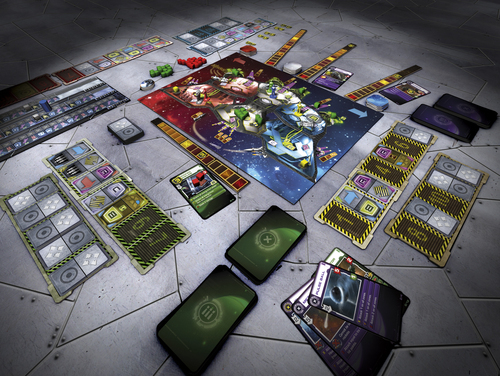
images @ Rio Grande Games



User Reviews (12)
Add a Review for "Space Alert"
You must be logged in to add a review.
- Themes
Science Fiction - Mechanics
Area Movement, Cooperative, Hand Management, Simultaneous Action Selection - Gamer Types
Avid Gamer, Casual Gamer, Power Gamer, Social Gamer, Strategy Gamer - Designers
Vlaada Chvatil - Official Game Site
🔍 Space Alert - Rulebook
🔍 See official rulebook - Price (MSRP)
$59.95
In Space Alert, you play as crew members of a Sitting Duck class spaceship that is sent through hyperspace to scan a sector of space for ten minutes and then jump back through hyperspace and report their findings. Sounds easy, right?
In your 10 minutes, you will be bombarded with threats, both from outside your ship and inside. The only way to keep these threats from quickly dismantling your ship is to work together. The key to this game is communication. All the crew members must quickly and clearly communicate what they intend to do and when they intend to do it so that they can make sure all the threats are taken care of.
So how do these threats appear? Here’s what makes this game unique. The game comes with a CD that has 8 mission tracks. You choose one of the tracks and hit play. The recording will then tell you when and where threats appear. You draw the threats from the appropriate deck and prepare for chaos.
Each crew members is given 12 spaces to play action cards. These spaces correspond to the 12 turns of the game, but the game doesn’t progress in turns like a normal game does. Everyone is scrambling to put down action cards as quickly as they can to take care of new threats as they appear. Each turn you can either move to an adjacent room or complete an action in the room you are in (anything from firing a laser to powering shields to launching rockets).
After 10 minutes, the recording ends and you’re done. Now you just have to figure out what happened. In the resolution round, you go through each turn step by step to see what the threats did and what the crew members did in response to the threats. Sometimes you thought you took care of a threat, but it turns out it still had one hit point left. Sometimes you thought that you knocked out that intruder, but it turns out it moved to a different room and you were fighting thin air. Sometimes you thought you fired a laser at a threat, but there was no power.
This game is fun, funny, and, above all, challenging.
Pros: Quick playtime, fun and funny theme, challenging gameplay, encourages teamwork and collaboration, plenty of replayability
Cons: Lots of rules to learn, theme is not for everyone, real-time gameplay can be overwhelming for some
Verdict: Space Alert is not an easy game. There are a lot of rules to learn and remember. Players must learn to coordinate their action quickly and efficiently. It is fast paced and can be overwhelming for your first several plays. However, for gamers looking for a unique, challenging, and, above all, fun experience, this game is for you. Space Alert offers a challenge that few other games can.
What is Space Alert about?
The game is about flying shoprt (10 min) missions in a spaceship. Each of you will be playing as one crewman of said ship. The game is divided into two parts – the Action Phase and the Resolution Phase.
In the Action Phase you plan your movement around the ship and the actions you will take. The soundtrack that comes with the game will tell you what is happening – mainly what kinds of trouble are you facing (and believe me, you will be facing ALL kinds of trouble – ranging from enemy spaceships, space monsters, intruders aboard your vessel, all the way to various systems malfunctions). All the actions you plan will have some effect, like shooting a laser cannon at the enemy, powering the main reactor, etc. After 10 minutes the soundtrack will annonce that the mission is over.
In the Resolution Phase, you will go through the mission again, this time without the soundtrack (no time pressure) and see what REALLY happened. You see, what you planned in the Action Phase and what did happen might not always be the same (and thats an understatement). Did you plan to shoot that cannon in round 7? Ok, you shot it, but someone else forgot to power the reactor earlier, so the gun had no energy to shoot with. Did you assume that frigate was destroyed in round 8? Well, you didn’t shoot the cannon in round 7, so no it wasn’t and it fried half of your ship in the process. That’s the kind of revelations you will see in the Resolution Phase. Of course there are times everything goes smoothly and you fly the mission without a scratch. Yes, I heard it can be done…
What is Space Alert REALLY about?
This game is about a lot of things, but mainly communication… your ability to stay focused and process information under severe time pressure… ability to prioritize and coordinate with your fellow crewmembers… and ultimately the ability to cope with failures in a productive way (yes, there will be failures, take my word on it). It is also about getting better with every single mission – after flying several times you will notice that you really are better, the missions go smoother (though you will still get killed – often) and you are coming together as a team.
Space Alert is balanced in such a way that there is almost always too little time and too much information to cover every angle. You will have to do the most important stuff and hope the rest won’t kill you. It is also an exercise in trust and delegating – you will definitely not have enough time to plan for other people (yes, alpha players, I’m looking at you) – so you will have to trust that they are doing their jobs and you can concentrate on doing yours.
Impressions
Have I mentioned that this is the best co-op game I’ve played? It’s absolutely amazing, it has truckloads of replay value (each mission takes roughly 30 minutes to set up, play and analyze) and even if you fail, you have great fun and want more. Last time we played, we flew 12 missions in one session (don’t ask for succes rate though, please) and we had a blast.
Aside from the gamer’s perspective, Space Alert has tons of real life value – it’s a great exercise in communication, problem solving, teamwork and interpersonal skills. A word of warning though – don’t play it with people you don’t come along with. A certain dose of forgiveness for each other’s mistakes is required in a game when a misstep of one player can ruin the whole flight.
Well, what would you like to know besides all the above… Components? Great and a lot of them. Instruction? Written in a clear way with lots of examples – and the story sections are hilarious. If I really had to nitpick, I would mention non-standard card sizes (I still haven’t found the right sleeves) but really, considering all the things this game does perfectly, card size is really a non-issue.
When they sent you to scout the fathomless deeps of space, they told you the process has been streamlined so well that it can be done in 10 minutes. Warp in, capture the data, warp out. What they didn’t tell you is that you will be warping smack-dab into the middle of hostile alien war fleets, giant meteoroids, and sundry space monster hunting grounds.
At its heart Space Alert is a cooperative Euro-style efficiency game, requiring players to work together defending their spaceship (the Sitting Duck) as effectively as possible with as few actions as possible. However, unlike a lot of Euro-games, the pacing is frantic and the theme vibrant.
Gameplay
The most distinguishing feature of Space Alert is that, start to finish, a game takes 10 minutes to play. It includes a CD containing several 10-minute mission soundtracks with audio cues indicating when threats appear, when players can draw or trade cards, and when the mission ends. During those 10 minutes, you plan a sequence of actions reacting to each new threat. At the end of the time limit, you set down your cards and walk through a resolution phase to see how your crew’s planning panned out.
For each mission, threats appear on several different trajectories, all aimed squarely at your Sitting Duck. If a dreadnought appears on the blue trajectory, players must react by moving to the blue zone of the ship, charging the blue reactor, and firing the blue lasers. Each player has a player board with a spot for 1 card on each of 12 turns. Every action — moving, charging, shooting, etc. — is performed by playing the corresponding card on the corresponding turn on the player’s board.
Winning
To win, survive for 10-minutes. Coordination is the real challenge of the game, demanding the active participation of every player. Addressing a single threat requires several players to perform a series of actions all on the same turn. While players are coordinating their efforts against one threat, another threat will appear, and then another. Against this onslaught, you simply do not have enough time for any one player to micromanage everyone else — and if one player plays the wrong card on the wrong turn, your Duck is cooked.
Theme
Even as Space Alert runs a player’s brain through its gauntlet of conflicting priorities and communication hurdles, it engages the imagination. The threats highlight the space combat theme brilliantly. Take, for example, the interstellar octopus: Shoot him, and you’ll only make him mad, but ignore him for too long? Well, this moon-size monster is on a collision course with your little ship.
Components
Plastic space cadet figures and wooden energy and damage cubes are easy to grab and move during fast-paced play. Large threat cards provide sufficient space for threat description text, and small player-action cards are easy to juggle.
Pros:
+ Frenetic pacing consistently tests your ability to triage threats and coordinate with teammates.
+ Randomly drawn, diverse threats create unique challenges every mission.
+ Yellow (and with the expansion, red) threats step up the difficulty but rarely, if ever, make a mission mathematically unwinnable.
+ Very short playtime and lively space combat theme never strain your attention span.
Cons:
– New players will feel lost amidst all the moving pieces until they have played a few games and had time to orient themselves.
– Mental gymnastics involved here will make a more deliberate (or indecisive) mind dizzy.
You’re on a ship, charting an unknown region. You only need to survive 10 minutes. There’s a good chance your team doesn’t make it, unless you can work together. Not only do I feel Space Alert is a great cooperative game, it’s one of the best board gaming experiences out there.
General Game Overview
Space Alert is a fully cooperative game (no traitors or hidden agendas) where everyone wins as a team. Gameplay takes only 10 minutes, enforced by an audio file that is played along with the game. During these very tense 10 minutes, the group will attempt to repel attacks and protect the ship. Players move around and interact with the game through cards, playing one per phase (12 total). Unlike most games, you don’t move your character around and take actions one at a time, instead, you set all of your actions over the 10 minutes of playtime, and then go through a Resolution Round to find out what happened. If you’ve limited damage to the ship, the team will win. Even when you lose, the experience can be very enjoyable.
Learning the Game
As with many of Vlaada Chvatil’s games (Galaxy Trucker, Dungeon Lords, Dungeon Petz, Mage Knight: The Board Game, and others) Space Alert has different levels of play, helping your learn the game in steps. It is difficult to jump into a full game with new players as the basics of playing the game, while not difficult, are better experienced than simply explained. As a training mission only takes 7 minutes, it’s often quicker to play through an entire round, showing how the game works, than it is to try and explain all of the rules. For a recommendation on what rules to introduce when, check out the “Game Tips” tab.
Game Play
NOTE: Space Alert generally requires a bit more pre-planning than other games, due to the need to play an audio CD. There are cards that can be used instead with someone reading prompts, but I wouldn’t recommend this method. Smartphone versions also exist.
At the start of a game the players will sit around a board depicting your ship. This ship is split into 6 sections (an upper and lower level each having three section, Red, White, and Blue). Each player will be dealt cards that will be used to denote their actions. These cards have a movement on the top, and an action on the bottom. When playing a card, the orientation you use shows whether you’ll be using it for its movement or action half. There will be 12 total actions taken per player (fewer in training missions). The set of actions are straightforward, movement is up/down/left/right, and actions are generally letters, A, B, and C (for the full game, some cards also show battlebots).
Each playing consists of two rounds, the Action Round, and the Resolution Round. The CD portion is the Action Round, where cards (and in essence, the game) will be played. Once these 10 minutes are up, you’re locked in, and the Resolution Round is used to find out how you did, no new decisions are made.
As the CD plays in the Action Round, threats will be announced as “T plus X” where X is from 1 to 8. This number tells you the phase in which that threat will appear. Generally, threats attack a given colored section of the ship (they come in on the left, middle, or right). The players will be playing their cards to attempt to deal with these threats. Much of the replayability of the game comes from these threats. They are drawn from a deck of cards, and varying difficulties can be chosen (External and Internal, Common and Serious).
Different sections of the ship have different abilities, based on which action letter is played. In general:
A = weapons
B = energy/shields
C = specialty action
To use most of the weapons (especially along the top level), energy will be needed. Energy is drawn from reactors on the lower level. If at any time a card is played that requires energy, and no energy is available, the action does not occur.
The lower level is primarily concerned with energy management. The lower-middle section has a reactor that can produce energy by feeding in fuel rods, though only a limited number exist. The left and right sections can then have energy drawn to them (by playing the B action in those sections).
This is where the teamwork aspect is vitally important in Space Alert. There are 6 sections. Energy needs to be moved around, weapons need to be fired, shields need to be charged, and since actions happen as specific times, everyone needs to stay in sync with each other. For instance, if one player wants to fire a laser cannon in Phase 4, but energy won’t be available until Phase 5, nothing will happen. In this way, the game plays out in real time.
While the players are setting their cards, enemies will advance. Most enemies (denoted by cards) have a speed that they will move with each phase. Tracks of varying number of spaces are setup at the start of each game, one for each colored section of the ship. When an enemy arrives, they start at the far end of this track, and move towards the ship. The tracks also have letters (X, Y, Z) at different distances. When an enemy passes one of these letters, they will attack based on their special abilities for that letter. Sometimes they do damage to a section, other times they change tactics. It’s yet another variable the players will need to keep track of, knowing when and where an enemy will exist.
Following the Action Round, player’s blood pressure returns to normal, while the cards are resolved one at a time. Enemies appear and move as indicated by their abilities, and players move their pieces around the board, and take the actions depicted on their cards. Again, you make no decisions at this point, you are simply finding how things actually played out.
If, at the end of the Resolution Round, no single section has taken more than 6 points of damage, you have survived the round. If a section takes more than 6 points, the ship is considered destroyed. A score can be determined based on enemies faced and damage taken.
My Thoughts
I don’t think a block of text describing the game play can adequately get across the “feel” of this game. It is unlike any other game I’ve played. What Vlaada has managed is a game where cooperation is absolutely key to the players winning. With 6 sections to interact with (and at most 5 players), players must communicate to win. The real time aspect of the game will ensure players can’t go off on their own and expect positive results.
Each action in the game depends on other actions having previously been taken. In some ways, this game is very unforgiving as one misstep can doom a mission. Players must be able to think and act quickly and decisively. The entire game will play out over 10 minutes; it is not possible for a player to take 5 minutes thinking through their move. It is amazing how quickly it feels those 10 minutes have passed.
Truth is, I have wanted to review this game for some time – mainly because I have been wanting to PLAY this game for some time: 10 months to be exact. Why did it take so long? Space Alert anyone?…anyone?…Beuller?
Well, I guess that says something right there. Ok, it’s not a “mainstream” game (No deck-building, no worker placement, resource management, etc.). It IS a “cooperative” game, so what gives? Maybe, I thought, it’s the fear of playing something uncomfortable and not easy to understand. There are many of games that fall into this category. You know the ones… “Yikes! Do I want to risk 4 hours of my life I will never get back?”
Well, to allay any fears, I would like to invite you to play one of the most unique, immersive, and yes, challenging games I have experienced.
Style/Components: (Fully functional)
The overall style of this game is good. It lacks a defining look and feel as some sci-fi genre games do – the development team didn’t create an extensive back-story or setting. There is some particularly gorgeous sci-fi artwork on the Threat cards. For the most part, it’s perfectly functional. This is important…
Gameplay: (Where no one has gone before…)
Game play is the game’s main appeal and challenge. So, let me see if I can demystify it a bit.
The game board is a spaceship (the “Sitting Duck”) and players are its crew.
There are two major phases of the game, the “Action Phase” which happens in “real time,” And the “Resolution Phase” when you see how your choices play out.
First, the “Action Phase.” In a nutshell, players start a CD soundtrack of a 10-minute space flight. The soundtrack plays a sort of ship’s computer voice announcing events: alien threats, chances to draw cards and especially when to start and end phases. During these 10 minutes, players program 12 actions for the entire spaceflight. The cool (and tension filled) part is everything happens simultaneously. As an action, players can, move about the ship and press systems buttons (A, B and C) that activate weapons, shields and power reactors and other cool spaceship stuff. Why are you all doing this? Survival. During this 10-minute soundtrack, alien threats appear very quickly to destroy your ship. If your ship takes too many hits… space dust. Survive and you win. See… easy!
Then the “Resolution Phase.” When the soundtrack ends and all the players have placed 12 action cards on their panels. Then the space flight is played out again, but in a slow, organized order using a Mission Steps Board. Players reveal their actions in player order and see how they resolve.
The mechanics for recreating a dangerous space flight – being forced to make decisions in a split second, then “rewinding and seeing what your actions have wrought ” are ingenious and irresistible.
Value: (Deep immersion for the Dollar)
At $59.99 the game is a great value and if you crave adventure and a unique game experience, you wont be disappointed. It’s out of print right now so copies are a bit pricier. ($90 or so) If you can find it for under $70… purchase it. Otherwise there may be a reprint? (Although there is currently an expansion: Space Alert: The New Frontier).
Audience: (Adventure seekers wanted!)
Avid and Power gamers will enjoy the feeling of being truly tested by a game. Casual players can enjoy it if they have the patience and friends to get through the first two simulations. The game does focus on organized and logical strategy so Strategic players may enjoy it as well. It is a truly challenging game, so those who see failure as a “growth experience” will enjoy this game.
Instructions (Effective and entertaining)
The instructions for Space Alert come in two parts: the rule book and a “How to become a Space Explorer Handbook.” You cannot learn the game from the rulebook. The “handbook” is necessary and if you have a group of players willing to walk through the first few simulations, reading through every page as you go, you will learn the game with ease – and be entertained as you do. The handbook is narrated by a sort of flight instructor who walks you through every step of the game. Again it takes patience – but you must learn this game by playing.
Overall Review: (Frantic, fantastic fun)
I love games that offer deep immersion and something different. This game is a blast, but it does come with challenges.
This game tests ones ability to think quickly and cooperate effectively. Communication is everything. It can bring out the best, and worst in people. If played with a group of players that doesn’t get along, things wont go well. At it’s most basic; it’s a test of logical thinking. The amazing part is, the game asks players to think logically and clearly in a timed situation. The real-time Action round is exhilarating – but some folks just don’t like having their feet in the fire.
In my games, we replayed each simulation – learning from our mistakes and trying to anticipate the dangers and…wait for it…we were overwhelmingly successful.
So, you see? Space flight can be fun! If you find the thought of boarding a space ship and exploring the vast unknown as irresistible as I do, suit up! If you’re like me, you won’t want to disembark.
This game was picked up by a friend and pitched to me as a “cooperative real-time strategy board game”. It turned out to be a combination of a heart attack and a stroke all bundled up in a science fiction theme.
The game is set to a sound track that acts as the the DM while the players try desperately to keep up and communicate. The players (while listening to a 10 minute audio file) lay down action cards and keep track of their prediction of what will happen on the board. After the audio is done, the board is reset and the actions are carried out to the demise of the players.
First things first: this game is hard. Very hard. So hard that a group of experienced gamers who usually enjoy a good challenge, barely made it through the tutorial missions. In time, it might get easier but the game mechanic is so different than anything we’ve played before that we had a tough time making heads or tails of what was going on the first couple rounds.
After playing this game several times, I can sort players into three types…
The Boss
This person is always captain and is “in control of the situation”. They give orders out like candy and are certain that they know what needs to be done. The problem is that no one ever knows exactly what needs to be done because it is simply too much information to keep track of at once.
Several times we had our version of “the boss” say that an enemy was dead several turns ago when it wasn’t or know that we had enough fuel when we didn’t.
The Perfectionist
This person usually ends up not playing because they couldn’t get all of the information they thought they needed to make a good decision. This is not a game for players with analysis paralysis! Or maybe you might prescribe this to one of your friends in order to solve his AP…
Either way, if you can’t eventually just say “screw it” and throw down some actions, you’ll spend a lot of time doing nothing and the ship will suffer for it.
The Quickster
This person has picked up his round three cards before round one has finished. The main issue with this person is that they don’t really realize that they are way ahead of the group. So when a player asks the quickster if he can go throw another fuel rod in, he says “sure” and ends up throwing it in five turns too late.
Gameplay
The game is quick and fun. It can cause fights when someone does something incredibly stupid, but odds are everyone will do something incredibly stupid, so it evens out.
The audio file aspect is really neat and adds some cool features (I especially like the radio silence parts). It is annoying, though, if someone speaks over an important bit and you miss something. If you get something wrong, you can end up placing a monster incorrectly or not even placing a monster at all. With no obvious way to cross-check what you heard short of replaying the audio file, I always worried that we were screwing up the game.
The Good
The audio file is a cool mechanic.
The attention to theme is really awesome, especially in the stories that can be read during the tutorial missions.
The table talk (arguments) followed by missions going all wrong makes for a great time.
The Bad
The audio file is a double edged sword…potential to screw up the way a mission is supposed to go because you miss something.
The game is really hard (but maybe we just suck).
The real time aspect of it stressed me out…but that’s a personal complaint and might be a good thing for other people.
Overall
This is a really solid game. It’s got tons of replay value and a cool new way to play board games. (It’s new for me…if there is something else out there like it, let me know). It makes for great table-talk and has a terrific theme…if you can get over the stress of playing it.
Most board games don’t set time limits. Players get all the time in the world to think about what they want to do. It is up to the players together to decide what is an acceptable time to think about their actions during their turns. This probably leads to shunning players with incurable ‘Analysis Paralysis’, because they slow down the game considerably. Everyone who plays board games knows there will be times when you just have to wait for another player to finish his or her turn.
Space Alert blows this traditional waiting-your-turn-gaming from the table. The game only lasts 10 minutes (yes, that’s right) during which you have no time to endlessly debate your actions or keep your fellow players waiting. Doing that you will almost certainly lose the game big time.
In Space Alert you and your fellow players are officers on a spaceship. You venture out into space and as usual you are attacked by aliens. These attacks are announced by an audio CD, which you play during the game. One player has to keep track of all the information given by the audio CD. Not doing so means missing the arrival of a hostile spaceship that may blow you out of the sky. So the role of the communications officer is vital!
All players can move around the spaceship (there are upper and lower levels and three rooms in each level) where they can power the shield or guns or shoot the guns. You put cards that you get at the start of the game on your action track to log your actions through the game. There are three phases in the game (so you get three stacks of cards), but once a phase is past you can no longer change the actions of that phase. When the audio CD ends the game is over and you check what actually happened to the ship. Did you fire the gun in time? And if you did, was it powered at the time? Those are the most important things to know if you want to survive this game.
Space Alert is frenzied! That would be the way of things if you were on a real spaceship under attack by hostile aliens. You need to confer with you fellow players, but you have to do it fast and efficiently. Endless debates are counterproductive as new aliens might arrive during that time. One player acts as captain, but he or she is more a manager and overseer than someone that bosses you around. There just is no time for that!
The game offers scenarios in various difficulty. You should start with the simplest one when new to the game. You might still lose that one, but it is a good way to learn and familiarize yourself with all aspects of the game. Then when you start winning the simplest scenarios it is time to move on to the next one. It does not get easier and adrenaline rushes are more frequent when you move up the ladder.
Space Alert is a very enjoyable game. The madness of getting it right in just 10 minutes is a welcome change from all other game concepts. You really need to work as a team, listen and plan, but within the time constraints. The joy of surviving a scenario is great. You really feel it’s an accomplishment. As cooperative games go this one comes highly recommended!
Because screensavers weren’t bugging you enough as it was.
Space Alert is unique brand of board games, which of late seem to have found their own genre. It is a time attack style game, where communication is the key while everybody rather would panic.
Academy of Red Shirts (Summary)
This game has quite an amount of rules which I won’t be covering. However it does have excellent tutorial booklet, which teaches you to play in fun and entertaining way. Game takes it easy on you for first few tutorial run and eases you gently on new game mechanics, such as internal threats or screensaver (which causes you to lose a turn if you forget to shake the mouse).
Game is best played with 4-5 players and you really don’t want to go below that, since it becomes extremely difficult to keep all the strings on your hand. First few games will be though for first timers, since they basically have no idea what is going and they will feel lost. Most will be able to bounce to top after few games.
Each game lasts about 10 minutes, divided in three segments, where you play cards to move your piece and do actions to defend your Sitting Duck-class exploration ship. With limited amount of cards available and constant new threats emerging while your ship decides to malfunction on you, you’re sure to feel stress levels rise.
Game comes with “Internal computer” which tells you what happens when and one player has to pay attention to this while conveying the info to others around the table. It is rather ingenuous idea, which is sure to increase stress levels even further, but at least one doesn’t have to be the Gamemaster.
After 10 minutes of panic game ends and you set the game pieces to starting places and start checking what have you done and how you handled the enemies, this determines if you made it to end alive or did you die while trying to fire the gun which didn’t have energy left.
I like the screensaver logo, no don’t take it away! (Components)
This game comes very nice player pieces and everything that is important for handling come as pieces too, instead of cardboard tokens. They are all color coded which makes it easy to spot during haste of the game and makes it easier to manage. Only downside is the energy cylinders used for refilling, which tend to be knocked down and roll around in middle of panic.
Games comes with CD, where you will find the internal computer, which tells you what happens and when. Now you can also get them as separate MP3’s from games homepage or as paper format if you don’t have player available. I personally found it best when you use it from phone, Android devices have own app for this and I would be shocked if Iphones didn’t have one. Additional speakers is a good idea since as standalone it is too faint for all to hear so one has to convey it all.
Art on board and in cards are pretty and thematic. Board is color segmented which makes it easier to tell which direction you want to go, reduces the mistakes which tend to surface in panic. Art on cards maintain seriousness in them, even with space octopus. Art keeps it together and it wont start feeling like Munchkin all of the sudden.
Uhhhh… What did this big red button do? (Learning curve)
Learning curve is rather hard for this, game is confusing in many ways, but normal player just needs to know the basics, like what cards do and how they work, how the power transfer works etc. However later you go in game more specialized tasks are required, so requirements get higher for players. We ended up playing first 3 times the same tutorial missions to get people more acquainted with their roles in game.
I would recommend that those that are in pivotal role should read the rulebook at least and I suggest you find good guide for newbies from BGG, it makes it easier for you to explain the game mechanics and point out the important things. I struggled first times I tried to explain this game, it is just so different from many other games.
Oh, everybody is dead? At least we got the ship back (Conclusion)
This game is full of dark humor from game itself to rulebook, which is great and sets really good atmosphere, you really feel that you’re expendable.
Game is fun to play and really tests your cooperation skill under stress, while giving funny incentives here and there, making it sure you won’t take it too serious. Never had a game where somebody would stand up after the game and start shouting others at their incompetence. Players take it as board game and fun, not as something serious, which is good. Game even goes to lengths to remind players that loosing is a big part of the game.
It is difficult to get a grip of this game, you need time to get your bearings and notable amount of players feel out in this game. I don’t remember a game where there would have been more players who didn’t want to bring it on table second time. When you get in to this and can stand the stress it brings you’re in for a treat, as time attack games go this top of that cast. Each game is short and everything you do has to count, every word you say must have some weight in them. You can’t divide your attention on this one, you simply don’t have the time for it. I think the biggest issue for most players is on this kind of stress game is that they don’t have sufficient amount of time to think their strategy.
The game is really fun if you can handle it, but it is better to make sure you can handle it. So go to youtube and check a playthrough or go to some event and have a go at it before getting it yourself.
I am in love with Space Alert. Everything from the art, to the general aesthetic, to the strategy, the social elements, the gameplay… the soundtrack!?!? What a whopping pile of awesome this game is. Lets break it down.
Artistically, this game looks great. The ship itself is not only pretty, but you can actually get gameplay cues from the layout of the ship… (you see where the reactors are, you see how the ancillary cannons have a different energy source, you see the elevators, etc.) All the threat cards are well illustrated and the graphic art makes sense. The tokens look and feel functionally great.
The gameplay is chaotic and just **** fun. Each round only takes about 10 minutes or so to complete, but wow what a ride. Stressful, yes. But always a great time, even when your ship gets blown to bits. The soundtrack really adds that extra element of chaos and seriously lights a fire under your ***. Its simple but effective.
The best part of this game is the co-op elements. Working together with your buddies in a “just believable enough” scenario to overcome the imbalanced odds of the game is great fun. Its just taxing enough to put any group of friends up to a serious challenge, but never so far out of reach that if you lost you couldn’t conceivably beat it with better communication and cooperation in another round.
My only complaint is that there is no indication of the difficulty of each soundtrack. But thats really it. I highly recommend picking this up if you have a group of friends that are willing to learn the rules (which takes a while) 10/10
This coop neatly circumvents the problem of experienced players directing newbies and telling them what to do–there simply isn’t time! I find Space Alert challenging and hilarious, as well as frustrating in a good way. It has brilliant components and mechanics.
The tutorial for Space Alert has the best writing I have ever seen in a board game manual–I make a point of reading it aloud whenever we play with new players instead of just teaching them the game, since it’s filled with absolutely hilarious flavor.
The game has a ton of different mechanics that get added in slowly. This is a double edged sword. On the one hand, it’s great not to get overwhelmed, but that there’s enough content for frequent players. On the other, I feel inferior since I have never gotten to play with all the mechanics.
Finally, however, the technical requirements can be a hassle. I don’t have a CD player on any of my devices, so I had to download the files and put them on my ipod. That worked great until I set it to shuffle and I transition from the Beatles to, “ALERT! ENEMY ACTIVITY DETECTED!”
This game is pretty much unique among boardgames. It plays for exactly ten minutes, and leaves you with your heart pounding. Cooperative play at its finest, this game prevent excessive coordination with its strict time limit, forcing your team to try and communicate during distractions in order to ensure the entire teams survival. Hilarious consequences nearly always result, and things rarely go as predicted. By far my personal favorite cooperative game, and darn close to my favorite game of any category.
The game is fun but it’s very different with an audio component involved. I’ve rated it middle of the road strictly because it’s one of a kind and I’ve played it only once.
It’s a team play and syncs with the audio track.
Our friend who has it, recommends moving the pieces as you work thru the scenarios, vs moving after the audio bit.
It’s fun but I wouldn’t recommend after a long day as it is a bit more draining than you might expect as you have to also focus on the audio track in addition to the board and what everyone else is doing.