
Jaipur
My kingdom for a camel
Work hard, earn more than your opponent and become the official merchant of the Maharaja.
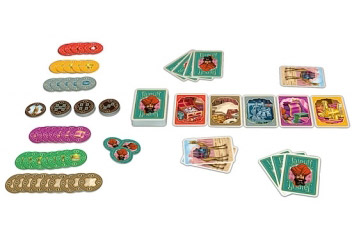
At the beginning of the game, three camel cards and two merchandise cards are on the table between the players, who already have five cards in hand. On your turn, you can take some cards or sell some. Each time that you take cards, you can take one or more, however if you decide to take more, then you will have to trade in the same amount of cards from your hand that you take. If you decide to take all camel cards, then they can be used later to trade. You can sell all the merchandise that you want, as long as they are all the same type. For each sale, you will receive tokens with various point values. At the end of the game, the player who has the majority of the camels also wins points.
At the end of each round, the richest merchant will receive a Seal of Excellence. The first player who receives two of the seals, wins the game.



User Reviews (17)
Add a Review for "Jaipur"
You must be logged in to add a review.
My wife and I enjoy 2 player games – Lost Cities and Qwirkle among them. I have found Jaipur to be another very good offering in this space.
The theme is yet another in the Mediterrean trading style, with players collecting sets of rubies, gold, silk, leather, etc. Players draw cards on their turns from a set of available cards to build sets of a single good. These sets are then turned in for tokens representing victory points. The player with the most victory points is the winner of the hand. The game is set up to be a best of 3, but you can certainly set up your own parameters.
There are a few interesting twists to the “set collecting” mechanic that makes this game interesting. The first is the “press your luck element”. There are a set amount of tokens for each good, and they decline in value, so there is a bit of a race to turn in sooner. To balance this, there are also bonus tokens for turning in larger sets of 3, 4 or 5 cards. So the question begins, “Do I cash in early or turn in a larger set for the bonus?”.
The other twist are the camels. There are numerous “camel” cards, which can be collected on turns and used as filler cards to make it possible to collect more goods on your turn without sacrificing your better cards (you have to give cards to get in most scenarios). Everyone I play with has a different strategy regarding camels – some try to collect them early, some avoid them like the plague, others try to hoard them to receive the 5 point bonus at the end.
Components are of good quality(thick cardboard cutouts), and I definitely would invest in a collector’s edition with wooden tokens if available. There is some set up involved, but it should only take a minute or two to set up each hand.
The game takes around 15 minutes per hand and play is lively. One of my pet peeves with other 2 player games is that it becomes solataire with 2 people. In Jaipur, there is actually reason to pay attention to the other player’s turn. There is a little question on balance (It can be challenging to win if you don’t get the rubies), but overall this game is a lot of fun. I would highly recommend Jaipur to anyone looking for a light, 2 player filler game.
I am not the biggest fan of games that revolve around trading or selling. It’s nothing against the genre itself, but rather that games of that nature don’t really strike a chord with me. This doesn’t mean that I can’t appreciate them, however. I recently got a chance to try Jaipur, and I was surprised at how simple the game was, but at the same time, how the game itself remained flexible and entertaining.
The basic premise of this game is to acquire goods and sell them efficiently so that you can gain Seals of Excellence. Gaining a seal means you won the round; there are three rounds of play, and winning two out of three rounds means you win the game.
There are 6 kinds of goods in the game. Cloth, Spice, Silk, Silver, Gold, and Diamonds. Cloth is the most common, and worth the least, while Diamonds are rare and are worth the most. There are also camel cards in the game. Camels are not goods (in the context of the game, at least – some would argue that point in general terms), and cannot be sold, but whoever has the most camels at the end of the round will earn 5 points.
The way the game works is this: You and your opponent are dealt 5 cards, and any camels that you draw are placed down in front of you (camels are never considered part of your actual hand, and you can have as many camels as you want). Three camels are placed in a trading pool to start the game, as well as two goods that are drawn from the card deck.
During a player’s turn, they may either trade cards or sell cards. When trading, a player can either take all the camels from the trading pool (if he or she does this, all of the taken cards are replaced with cards from the deck), take one good from the trading pool (it gets replaced by a card from the deck), or take more than one good from the trading pool. If a player takes more than one good from the pool, he or she must replace them with camels from their camel pool. In theory, a player who has five camels in their camel pool can collect any and all goods that are left in the trading pool. However, a player has a seven-card maximum hand size, so a player cannot trade cards if it would put them over that seven card limit.
To sell cards, a player must discard 1 or more goods of the same type from their hand. For cloth, spice, and silk, a player can sell 1 or more goods of that type, but because silver, gold, and diamonds are more valuable, a player must sell two or more at a time; selling just one gold is not allowed, for example.
When a player sells a good, they acquire a goods point token from the appropriate pile for each good they sold. these good tokens are ranked from most valuable to least valuable, and the most valuable is placed first, so the player who sells first for a particular good will get the point tokens that are worth the most. In addition, players who sell goods in bulk can get a bonus depending upon the number of goods they sell. There are mystery point tokens that are awarded for three goods sold at once, four goods sold at once, and five goods sold at once. The three-good mystery tokens are worth the least, and the five-good mystery goods are worth the most.
The round ends when all the cards from the deck have been drawn, or when three of the six good token piles are depleted. Once a round is over, players flip over all of their good points tokens that they acquired and tally up all the points that they accumulated, with the 5 point token going to the player that had the most camels at the end of the round. Whoever had the most points gets a Seal of Excellence, then the cards are shuffled back into the deck and the board is set up for the next round of play, with the player that lost the last round going first for the new round.
Because Jaipur is such a simple game, it might seem as if it might get boring after a few plays. However, the game is very fast, and it is easy to learn. Since Jaipur is played with two players, and the game itself consists of three rounds, players will be able to read their opponent’s tendencies before the game is out, and smart players will pay attention to their opponent’s trades to get an idea of their hands. Since there are no actual card effects that would make your opponent discard cards or get new ones, the game doesn’t play vindictively or get overly complicated.
After playing Jaipur, my opinion of this game is that it is a solid game that is worth looking into. It’s fast and play consists almost entirely of cards, so it can be picked up quickly by just about anyone. What keeps this game from being completely open as a play-anywhere game is the fact that you need to have the goods tokens in a specific order, and that the tokens themselves are small and numerous, so you have to spend extra set-up time making sure they are in order and in the proper piles. But the game itself is fluid, and quite worth the price tag that is associated with the game.
Jaipur
I do a lot of two player gaming and the biggest problem I have is that games get boring. You can help this by getting games that scale well with more than 2 players, my problem is that usually involves a longer setup and cleanup time and honestly games meant for 2 players tend to be better 2 player games. Jaipur doesn’t just back that statement up, it is the reason it exists. If there is a two player game I can’t get bored of it is Jaipur. Below I will cover how to play Jaipur, my thoughts on it and why it is my favourite two player.
To read the full review with a how to play and images go to
http://toddsboardgames.blogspot.ca/2014/01/jaipur.html
My Thoughts:
Okay, this might not seem like a masterpiece but you will only discover how great Jaipur is if you try it. Jaipur is not only my favourite 2 player game, but one of my favourite games overall. This is because I love games that take 5 minutes to learn but a lot longer to master, the rules in Jaipur present a pretty straightforward game heavily laced with luck. In fact one of the few criticizes I hear of Jaipur is that it is too luck dependent. Well I call ********, sure there is a lot of luck involved in Jaipur, but really the game is about minimizing the effects luck will have on you through clever timing.
You will do this by keeping a close eye on your opponent, paying as much attention to what cards they are collecting as what cards you are collecting. You will have to perfectly balance scoring points and screwing up your opponent, the only problem is that every decision you make will benefit your opponent or hinder yourself in some way shape or form. This is intensified by the fact that you can only do 1 action on your turn. You have to plan a few turns in advance but by that time so many things could have changed, your opponent could have sold some of that good, there could be better goods for sale, you could have acquired a better product in a move that was too good to pass up. Since each game is technically 2 or 3 plays I have probably played 100ish times and I can say that no more than 5 of those games have been lost outright due to luck. It can happen, but most likely you will lose to being outplayed or making a couple mistakes. Timing is the most important aspect of Jaipur, when you decide to do which action will determine who wins or loses.
Here is what I mean by benefiting your opponent or hindering yourself:
Taking: If you take just 1 card, a better card could be turned up for your opponent, you are also spending your entire turn to take just 1 card, good if its a high value card not so much if its a low value. Taking 1 low value card might be better than taking multiple camels in some cases.
Swapping: If you swap a cheap good such as leather for a better good you are making it easier for your opponent to get a bonus token and you are not gaining new cards this turn but rather upgrading in value or getting your own bonus token, this means that if your opponent spends less total actions swapping, they will have more cards than you.
Swapping: If you swap a medium priced good for a better good, you are making a decent option available for your opponent that might not have been before, this can really suck if there are still high value tokens of that good or they already have a couple of that particular good. Just like above, you are losing out on gaining more cards.
Taking Camels: If you take camels you must take them all, taking 1 or 2 camels is not really worth it in terms of getting the camel token or having significant trading power but taking 4 or 5 gives your opponents lots of new card options, keep in mind that they can trade a combination of their goods AND camels in order to get these newly available cards at the market. You are also taking something that is not worth physical points (you cant sell camels)
Using Camels: When you use your camels, you are lowering your chance of getting the camel token, you are giving up some of your ability to adapt and in the long run replenish your hand after you sell most of your cards. Make sure you have a few goods in your hand or you will not be able to take advantage of a fresh market if your opponent takes the camels after you use them.
Selling just 1 card: You are stopping your opponent from getting the higher valued token but giving up the opportunity for a bonus token yourself, you will never score double digit points this way and you are giving your opponent free pick of the market. This can either encourage your opponent to collect a set of that good or ditch any they had making it easier for you to collect a set, this can also force your opponent to take a card or camels leaving the market open for you. This becomes a significantly less “good” option later in the game unless lots of the expensive goods have already been sold.
Selling Multiple Cards: You have probably gained a sizable balance of points and maybe even a bonus token, but how many turns did it take total to gather and collect the store of goods, if you focus one collecting one type at a time you are vulnerable to your opponent sniping the high valued or gaining better cards themselves, they can also score lots of points while you are trying to collect a set, if you focus on two types you could be stuck in a situation where you have to make a set available at the market in order to finish your other set. When and how you decide to collect a set is very important.
Two things to keep in mind, one of them I mentioned before:
You can swap a combination of Camels AND Goods when acquiring new goods from the market.
You MUST swap 2 cards, you cannot swap 1 for 1.
Who would enjoy Jaipur?
Casual Gamers: The rules are simple enough to learn in a couple minutes and you can jump right into playing, because it is played out of 3 rounds it has an addicting feel. Jaipur is not too heavy and not too light and a must have two player, playing doesn’t take long and most importantly Jaipur is fun. You can teach Jaipur to just about anyone and the theme is fun, trading in gold and rubies is far more exciting than what most people do on the average day.
Gamer Gamers: For anyone that does serious two player gaming this is the perfect game for you, every turn matters and you can easily mess with someones plan. Jaipur is a great game if you are the type of person who enjoys keeping a close eye on your opponent and making tactical decisions. After a few plays you will start to really have fun with Jaipur, I am very impressed with the amount of different strategies compared to most other 2 player games.
This is going to be a slightly different review then most people are used to seeing. It will compare Jaipur to two other highly recommended two-player card games: Lost Cities and Battle Line. Mainly because fans of one of these games are fans of the others. Even though two of those games are designed by renowned game designer Reiner Knizia, Knizia probably wishes he had designed Jaipur, because it’s that good!
First let me review Jaipur. Jaipur is a game of trading goods and camels for rupees. The game is played in up to 3 rounds as a best of two of three match. Each round, the players take turns trading for goods in the market with items from their hand and camel herd or selling goods for rupees. Sounds simple and straightforward, but it is very subtle because of a limited hand, limited market, and limited amount of goods to be sold. All these have to be managed with skill, so that you can get the better payout then your opponent. The round ends when either three of the six goods sell out or the draw deck which supplies the market is depleted. The winner of each round is the one who bagged the most rupees.
The game is full of decisions that make you press your luck with each turn. Many times you are holding onto a set of goods, because you want to sell a bunch of the same good (3, 4, or 5) for a big bonus payout alongside the normal payout. The more you sell at the same time, the bigger the bonus. However, if you sell sooner then your opponent, you get a higher normal payout in the beginning, because each successive selling of the same good is less rewarding. Then there is the give and take of the market. If you take all the camels (if there’s a bunch) in the market into your herd, then you give your a opponent the first pick of the new items coming into the market. Yet, having the most camels gives you a five rupee bonus at the end of the round. You’re also exchanging other goods in the market with items in your hand, and that could give your opponent an advantage especially early in the game when you don’t know what they are collecting. The give and take aspect of this game is phenomenal in subtly delicious ways.
Now, how does Jaipur stack up to Lost Cities and Battle Line. Well, let’s start with the basics:
Component quality.
The quality of Jaipur components is outstanding even though the cards are a little thin, the tokens are superb. Battle Line will be next with it’s thick and hard-to-shuffle cards, then Lost Cities with the flimsy, big, easy-to-shuffle cards and thick almost useless board.
Fiddliness
Jaipur is easily the fiddliest of the three having so may tokens to setup each round and get in the correct order on top of shuffling the cards. Battle Line is the second fiddliest with having to setup the nine flags in a row at proper card width distance, then shuffle two decks. Last and best is Lost Cities where all you do is shuffle and go again.
Complexity
Both Jaipur and Lost Cities are heavy on the numbers. Lost Cities is probably the worst with having to both add and subtract, then multiply. Jaipur you just add your money, and Battle Line you rarely add. Jaipur has probably the most rules to start out, but the concepts are pretty simple. Battle Line is probably the simplest of all, but the tactic cards can complicate things.
Theme
Jaipur wins hands down, because you almost feel like you’re wheeling and dealing trying to make trades, selling goods, and collecting coins. The other two games can almost be played with a regular deck of cards if they had more suits.
Gameplay
Wow! They’re all great at giving you that “press your luck” and “am I making the right decision?” intensity you come to know and love. Most of the concepts are easy to pick up and games don’t last terribly long. They all have that “let’s play again” emotion that grabs you.
Overall
Just get all three and appreciate them for what they are. They are all worthy additions to your collection. I’ve heard some people get introduced to Lost Cities first, and if they like it, they then get Battle Line. If that goes well, then they move to Jaipur and don’t look back.
Anytime my wife says she likes it and asks for more, I know I have a hit. Jaipur is really a solid little two player game that should appeal to social and casual gamers plus a few avid gamers. If you like playing with your significant other who isn’t big into games, then you might try Jaipur.
Game Backstory
You are a trader in Jaipur trying to collect and trade commodities then sell them on the market for money. Make the most money and you will become the Maharaja’s personal trader.
Gameplay Summary
This 2-player card game takes place over 3 weeks (rounds).
Each round consists of players alternating turns taking one action per turn. The 3 possible player actions are:
1) Pick up 1 commodity card from the face-up tableau OR take ALL of the camel cards and place them in front of you.
2) Trade commodities from your hand and/or camels (which you leave on the table in front of you) to pick up cards from the tableau.
3) Sell commodities from your hand to obtain ‘coins’ from the market (there is one type of ‘coin’ for each type of commodity). The coin values are higher the earlier you sell. You also get bonus coins if the sets of commodities you sell equal 3 or more.
Once 3 rows of coins are gone the round is over. Highest amount of money earned wins the round! Come out ahead on 2 of the 3 rounds and you win!
My Impressions
At first the game seems very simple, especially once going through the rules. In reality, the RULES are simple, but the actual game play becomes slightly more complicated. The complications occur because you have a hand limit and you have to work around that limit juggling it with several aspects:
* When to sell your sets of commodities. Should you sell a set of 3 for a smaller bonus now but bigger initial payoff (and perhaps prevent the other player from doing the same) OR should you wait a bit longer and pick up one or two more cards to get a bigger bonus a bit later? But selling a set now will also free up space in your hand for more commodities later.
* When to trade out sort of good stuff in your hand for better stuff on the table. If you trade it out, the other player may pick up when you put out to get a nice set for themselves. But, you might also be able to get a better bonus or better coins.
* When to pick up camels versus doing something else. Camels are always good to have but taking a large set of them from the table brings out more cards for the other player to be able to select from. This may or may not be good depending on how close to the hand limit they are at (and how close you yourself are).
* When to pick up commodities that your opponent wants but you don’t really care about. Picking them up may muck up your hand, but it can also prevent a huge score for the other player. Can you wait out holding it until they finally play that commodity if you do pick it up? Is there something better to pick up instead and put you over the top instead?
These are the types of decisions you have to weigh and make, hoping that the cards you need come out and possibly being forced to change up your plans if something unexpected happens.
However, even though luck is definitely there (it IS a card game after all) there is a lot you can do to help mitigate the luck depending on how to react the situation and manage your hand.
Final Comments
I love how this game plays out with a lot of options. You have a lot of flexibility in what to do within the confines of what becomes available on the table. And, even with the hand limit that is imposed, the extension of your hand with your collected camels on the table cannot be underestimated.
The key to this game is timing and control – when to pick commodities up, when to sell them, when to pick up camels and even what to pick up something that might negatively affect the other player.
Final Verdict
This is actually a nice casual/social game – you can have a conversation while playing. However, you still must pay attention to what the other player is doing and manage your hand properly to be successful at it.
I always enjoy playing Jaipur and I don’t expect to get tired of it for a long time.
I give it a BG rating of ‘9’
When it comes to selecting games, I’m always on the lookout for games that my wife can get into. We enjoy games in our family but trying to get my wife to try something new can sometimes be difficult. If I came home with Twilight Imperium 3, I would be greeted with a look of wistful disdain followed by regret for buying yet another game my wife won’t play.
I recently watched Dan King (The Gameboy Geek) review Jaipur. His great review caused me to consider this game as a light evening alternative to Ticket to Ride for our evenings after the kids go to bed. However, it’s one thing to hope for a game she will enjoy, it can be something entirely different for her to actually enjoy it. What did we find out, did she enjoy the game or is this another dust collecting game? Let us share our experiences:
GAME PLAY
This game is a trading, set collection, hand management game. In this 2 player game, both parties compete to collect resources of varying value at the market place. These resources are purchased using commodities in the players hand and or camels in the players herds. The clever hand management mechanic ensure that players are not hoarding resources as they are restricted to 7 cards. Players are rewarded for being the first to purchase tokens or by purchasing multiple tokens in a single purchase.
The rules are very simple and the instruction book is very clear in its presentation. Learning time is very rapid and players will achieve moderate proficiency in a single round of play. This game can be taught to new players in about 5 minutes. Game play is fast and engaging.
ARTWORK COMPONENTS
Being that this is a card game, there is no board to speak of, components are restricted to cards and chips. The cards are an American Standard 2.5 x 3.5 cards. These cards are very colourful and are beautifully illustrated. I would recommend sleeving these cards as they will be shuffled and handled frequently.
The chips are approximately 1″ in diameter and are cardboard. They have 2 sides, one represents the purchased good, the other indicates it’s monetary value for scoring. The side with the depiction of the goods is very nicely illustrated, the monetary valuation side is very dull in appearance. I find this to be a non-issue as the number is large and clearly displayed.
OVERALL IMPRESSIONS
We have a winner here. My wife enjoyed this game very much and has been added to the list of games we can enjoy together. Game play is rapid, smooth, and free of conflict. The game sets up quickly and can be played in under 30 minutes. This game is definitely a keeper. Great game for husband and wife.
Jaipur is a beautifully done, fast paced card game for two players that has won a number of prestigious gaming awards. Even the pink box insert is exquisite, with the game’s name engraved inside engraved in a window with a distinctive architectural shape. I purchased Jaipur on a whim when browsing the shelves of a game store because I was enamoured with the game’s name and the artwork on the box. Jaipur is a city in Northern India nicknamed “the pink city” and the “Paris of India,” a perfect setting for the trading of exotic goods. (Jaipur has been on my travel bucket list since I visited India for a month during the summer of 2014.)
The object of the game is to become the Maharaja’s personal trader by being richer than your opponent at the end of each week (each round). In order to earn points, you must collect and/or exchange goods at the market and sell them for goods tokens (rupees). The tokens for each commodity decrease in value as the game goes on, so it’s important to sell as many goods as you can early in the game. If you sell three or more of the same good, you earn bonus tokens. Alternatively, if there happens to be any camels in the market, you can add all of them to your caravan of camels, but you can’t collect or sell goods during the same turn if you chose to take the camels. At the end of each round, which ever player has the most camels receives a bonus token worth five rupees.
The goods available at the market are leather, spice, cloth, silver, gold and diamonds. As the more expensive goods garner higher returns, they are attractive to collect. However, you need to have at least two of one of these higher priced items (gold, silver and diamonds) in order to sell them and they are not as plentiful as the other commodities. Whoever wins the round receives a seal of excellence. The first person to receive two seals of excellence wins the game and becomes the Maharaja’s personal trader.
The instructions are simple and the game is easy to learn. We were busily collecting and selling exotic goods after the first round. Despite the simplicity (or perhaps because of it), I missed an important instruction and ended up being puzzled by what I thought was a rather strange game mechanic. As mentioned earlier, whoever has the most camels at the end of the week receives a bonus token worth 5 rupees. At first, I tried to collect as many camels as possible just to get the bonus. After a few rounds, it started to feel like increasing my camel caravan was not really paying off, especially since I had to forgo collecting goods to obtain these camels that just sat there chewing their cud, doing nothing to help me amass wealth. My opponent also thought there was something strange about the camels so we had another look at the instructions. Lo and behold, there was the answer. You can use your camels to trade for goods at the market! This simple mechanic made a world of difference to the game! The only way to get more than one good at a time is to trade with the cards that you have in your hand, but then you have to give away goods to get goods…which can be a little counter productive. However, if you trade your camels, you don’t lose any goods and you have more to sell. Additionally, if you sell all of your goods, you can quickly replenish your hand by trading camels. If you have no camels to trade, you only get one good (card) each turn.
Jaipur is a terrific game for two and is perfect for when you don’t have much time, or as a filler between other games. If you have time and would like to have a gaming session that stays within the orientalist theme, I would suggest combining Jaipur with Five Tribes and/or Istanbul.
I have owned Jaipur about six months now, and my wife and I have played at least 40 games. I like the camels and markets theme, and the artwork on the cards and chips are first rate. Jaipur is easy to learn and to teach, as there are not many quirky rules. Setup takes a couple of minutes, as the six types of goods chips must be arranged in separate stacks in descending order of value. The setup is worth the effort, though, as it makes for great gameplay. Players must decide whether to buy early for the higher value chips, or wait and accumulate three or more cards for larger purchases and valuable bonus chips.
Jaipur has a near ideal mix of luck and strategy, and it is complex enough but never tedious. Even after dozens of plays, I still make time for Jaipur. I have yet to find a game that feels as fresh after 30+ plays as it did when new. Even the best games lose some of their luster after scores of repeated plays. Of the games I own, Jaipur has more plays than all but Love Letter. My wife is my primary gaming partner, and we love to play Jaipur.
So many games are about four or more players that it can be rough to find a one balanced for just two people. Jaipur finds that balance and keeps it well, never outstaying it’s welcome. You’ll be surprisingly invested in your hand and goods, and equally upset when the other player steals the cards you were going to grab in just another turn or two…
Is it Pretty?
The components look great. You have all the goods in little pieces that have nice weight and even better visuals, the cards are all colorful and a good size. It’s a simply designed game with great personality done with very little but you won’t be disappointed by what you see. And the box itself is great! So small yet effective!
Who’s it For?
Couples. People who are looking for a nice lunch game. Those of us without tens of friends available for games all the time. It’s also good for those familiar with card games like Phase 10 and Dutch Blitz. It really is a good two player, since the rounds go by so fast.
Why is it in My Collection?
Because I’m married. It’s not always easy to find a good game for just my wife and I, since many don’t play well with less than four. But Jaipur fills that gap and gives us something to play on random evenings. It’s not a bunch of pieces we have to clean up, it’s a simple card game that we play two out of three and enjoy our night. There’s strategy to it, but it easy to learn with just the two of you.
Jaipur has become a real favorite for my wife and I. It’s very easy to pick up and learn, set up is very quick, and you will get a meaty strategy game in about 20 minutes.
Components
I really enjoy Jaipur for the components and ease of scoring. The card art is very impressive, and the included scoring chips is a wonderful mechanic that isn’t usually included in small two player game. Scoring chips make counting points a snap and gives you a visual marker of what is happening in the game.
Gameplay
Players are scoring points by collecting sets of goods and selling those goods at a market. There is also a very interesting trading mechanic in the game, which is difficult to pull off in a two player experience. The mechanic I enjoy the most is how you much use what the cards are on the table. It will take players aback that you cannot draw from the deck as an option, but you come to enjoy how different this game is.
Overall
Jaipur offers a unique take on a two player card game. The tension in the game reminds me of Lost Cities, but the game plays much differently. The components are wonderful and unique, and any couple or pair of friends that play games together a lot will enjoy this game.
Jaipur’s production values are nice enough to be a selling point.The cards are divided into camels and 6 suits of goods (diamonds, gold, silver, cloth, spice, and leather)this suit is the only attribute on each card, and there are differing numbers of cards in each suit.Cards are added to and taken from a row of 5 face-up cards, which always begins the round with at least 3 camels. Each player starts with a hand of 5 cards.
There are sets of goods tokens for each of the 6 goods represented on the cards, the number of tokens varying proportionally with the number of cards in each corresponding suit. Each set of tokens has a different range of rupee values (1-4, 5-7, all 5, etc), and these are arranged from highest value to lowest value. There are also stacks of bonus tokens, awarded for selling 3, 4 or 5+ cards. Each of these stacks is shuffled. There is one camel bonus token. There are 3 “richer trader” tokens, used to mark the number of rounds won by a player.The bonus tokens can be quite valuable, making it a considerable sacrifice to small sets quickly.
Jaipur is a two-player card collecting game where you save up cards to purchase resource tokens. Different resources are worth different amounts of gold (i.e. victory points), and each resource provides diminishing returns. There are a few other details, but it’s very quick and easy to learn.
I thought this game was a lot of fun the first few times I played. Sometimes it’s still fun when I want a light game that doesn’t take much deep thinking.
But I found the depth of strategy in this game to be disappointing. Once both players work out the optimal strategy it’s pretty much down to chance. If you’re dealt three diamonds at the start, you’ve pretty much already won.
I think Jaipur is probably a great game for kids, but serious gamers will find it a bit simplistic.
Jaipur is a simple, yet elegant trading game for 2 players.
Replay Value: 3/5
I rated Jaipur as average when it comes to replay value. It is a great game to come back to periodically, but it gets a tad redundant if you play game after game, which you might want to do because it is a rather short game.
Components: 4/5
Nothing to special component-wise, but the art of the game is very nice.
Easy to Learn: 5/5
The rule book is laid out in a very intuitive and easy to learn way. The rules are quick to pick up on, but the strategy takes a little while to develop, which is a good thing.
The reason this quickly became one of my favourite 2 player games is because it is so small, compact and light, that it is one of the easiest 2 player games to bring on trips.
This game is fun, easy to learn, and unique. Since it’s so inexpensive and wonderful, I would highly recommend adding it to your games library!
This game is phenomenal. It’s easy to teach, beautiful to look at, and offers lots of strategic depth for two players. A great game in a small box.
Jaipur is an economic game for two players. I find it is easy to teach and learn, but has enough strategy to keep me coming back. I’m always happy to play a game of Jaipur.
This is a easy to learn and very enjoyable game for two, probably best for couples.
The game mechanics are easy to be taught/learn and it surprisingly has more depth than someone would expect. Many different tactics can lead to a victory. Although luck plays a role as in every card game, your strategy while have a real outcome on the game. The game is also really fast and easy to set up. Last but no least the components are of really good quality.
Jaipur is an easy to learn two player card game. Appeals to non-gamers too but personally i found a bit repetitive after some plays.
Works well with female gamers as well.