
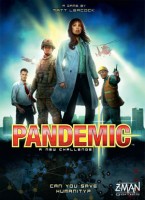
Pandemic
Pandemic 2nd Edition
After five years of Pandemic, hundreds of thousands of players have been contracted by the virus! To celebrate this milestone, Pandemic has been completely re-designed. With new artwork by Chris Quilliams (Clash of Cultures, Merchants & Marauders), Pandemic will now have a more modern look, inside and outside the box. With two new characters: the Contingency Planner and the Quarantine Specialist, face the game in ways you never thought possible. Brand new challenges are waiting for you!
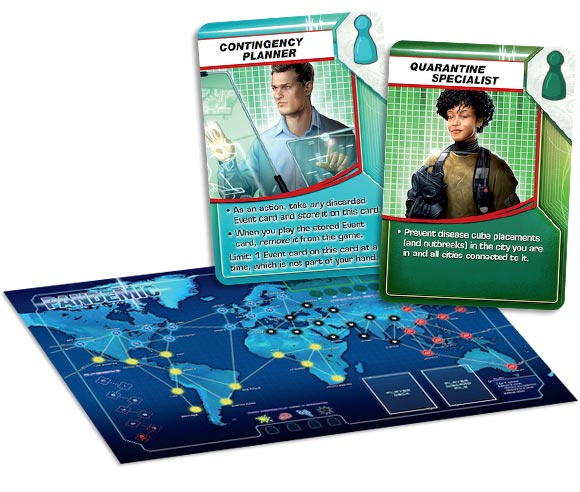
Game Overview
Four diseases have broken out in the world and it is up to a team of specialists in various fields to find cures for these diseases before mankind is wiped out.
Players must work together, playing to their characters' strengths and planning their strategy of eradication before the diseases overwhelm the world with ever-increasing outbreaks. For example, the Operation Specialist can build research stations, which are needed to find cures for the diseases. The Scientist needs only 4 cards of a particular disease to cure it instead of the normal 5.
But the diseases are outbreaking fast and time is running out: the team must try to stem the tide of infection in diseased areas while also towards cures.
A truly cooperative game where you all win or you all lose.




Add a Review for "Pandemic"
You must be logged in to add a review.
Strong Suits
– A game where everyone works together
– Very challenging yet fun
– You can change the difficulty level from easy to insanely hard
– Easy to teach to others
Weaknesses
– It can kill the fun if one person is telling everyone else what to do
– You will lose, especially on the higher difficulty levels (this may motivate rather than discourage, depending on the group you’re with)
– Certain “roles” may be more fun to play than others.
Suggestions
The key to enjoying this game as a group is to give the Dispatcher and Medic roles to the right people in your group! Sure you are “supposed” to hand them out at random, but I suggest you give the Dispatcher to the person in the group who is the most outspoken and most likes to control situations. I’d then give the Medic to the quietest person in the group, that might typically get overpowered in a collaborative situation.
The Dispatcher has extra abilities to move people around the board, which is great for a “leader” personality. The Medic has an awesome ability to go through and cure lots of diseases, which makes someone with a “follower” personality have a lot of fun and help out the group in a big way.
Summary
I love this game! The theme of viruses spreading over the globe, is one that almost any gamer or non gamer can enjoy. This is a big reason my wife likes this game as well, because it isn’t dragons or zombies or anything too fantastical.
If you’re looking for a game you can play with others instead of against them, this is a MUST HAVE for your game collection. You’ll find you’re communicating with everyone in your group the whole time, as opposed to other games where you might rarely say a word to anyone until the end of the game.
Overview: Pandemic is a cooperative game in which 2-4 players team up to contain and cure catastrophic diseases threatening the global population.
Gameplay: Each player is randomly assigned a role card which gives his character special abilities to use during his turn. Four different colors of wooden cubes, representing the diseases, are seeded on the board by drawing cards from the Infection deck
During your turn, you must choose four actions to take, including moving around the world, reducing disease buildup, and finding cures. Next, you will draw two cards from the player deck. These cards will usually be locations which can be used for faster travel and curing diseases. Also in the player deck are Epidemic cards. They will increase the rate of infection and reset the Infection deck, creating an unpredictable situation and hampering your current strategy. Lastly, you will draw cards from the Infection deck based on the current rate of infection. These will add infection cubes to the board and possibly force an outbreak during which an additional cube is placed on EVERY adjacent city!
The players win by discovering the cures for all four diseases. They can lose in three different ways: failing to prevent eight outbreaks, running out of cards in the player deck, and running out of infection cubes from any of the four colors.
Pros:
– Random roles and difficulty to win increase replay value.
– Innovative game mechanics.
– Takes about an hour to play, can be used as filler game.
– Excellent gateway game as players do not need to compete and can learn as they play.
– Difficulty can be customized by choosing amount of Epidemics
– Unpredictable Epidemic draws create tension because victory is never guaranteed.
Cons:
– Experienced players may dominate strategy discussion causing negative play.
– Unpredictable Epidemic draws create tension because victory is never guaranteed.
Historical Figure/ Fictional Character I’d Most Like to Play With: Louis Pasteur
Pandemic is one of the best cooperative games available. It combines quick, strategic gameplay with a random antagonistic game system to generate an entertaining experience.
This is a game where I love to loose. It is obvious by how quickly I want to reset the board and give it another go. We have played through Pandemic about a dozen times and I think I’ve only won about two times. But every time we lose it feels like you are so close and, “One more time!!!” is being shouted across the table.
GAME PLAY:
You are a team of researches out to cure several epidemics ravaging the world. Each player has a special ability that makes this a bit easier for them. On your turn you draw one infection card that puts a new disease marker on the board and you also draw a player card that will hopefully get you closer to curing the disease.
Curing a disease is done by gathering a number of like color cards and getting them to the research center on the board. For instance, five blue cards cure the blue disease. Get it to the a research center and you can start curing the people.
Does finding a cure save that region the disease spreading? NO! There are still people out there without the cure running around not washing their hands spreading their filth all over the place! In order to eradicate the disease you have to cure each city, wiping out the disease.
Do this with each of the five diseases and you can win. It’s a tall order, especially since there are a number of ways to lose. Running out of disease cubes, running out of infection cards, or too many outbreaks could all lose the game for you. You better like losing to play this game because it will chew you up and spit you out!
COMPONENTS:
Their nice, but nothing special. I think the board has nice art work. The pieces are more functional then a piece of stunning art.
PROS:
Great replay ability. It will have you coming back for more.
It has a short training time, making it easy to teach to new comers.
Decently short play time allows for multiple play thorughs
Good price point
CONS:
I think you’ll hear this over and over as you read through the reviews, and it pretty common with co-op games, but look out for the general. That one player who is always trying command the other players where to go and what to do. It’s not a con on the game, and just like most games, you have to have the right people to bring the best of the game out for all to enjoy.
OVERALL:
This is a fun game where the theme does a great job driving the game and making you feel the pressure that things are getting out of control and you are going to lose. One of the great things about this game it can often time be more fun to lose to than to beat. When you lose you feel like you were so close and you just needed on more move or break or card and you could have saved the world. Win or lose, this is a game that you will enjoy.
The Premise
Pandemic is a game about four disease control workers trying to stop four global Pandemics from eradicating the human race. It’s a race against the time, and the winner is determined by who is left on the face of the planet.
Out of the box
The board is thick and feels durable. There’s lots of cards too in there. Five different player pawns of unique color and some wooden houses representing research stations. There’s also a manual which seems well done, clear and informative. The colors on the pawns are a bit off though, they don’t represent the colors on the role cards very well (which determine your disease control worker’s unique skills). There’s also wooden cubes for the four different diseases.
Actual Gameplay
You have three different mechanics for failing. 1 You run out of player cards (which are used for travel and curing diseases, each player draws them from a deck during their turn), 2 you run out of disease cubes which you have to add to the game (representing the diseases spread) or 3 there’s too many outbreaks. You win only by curing all the four diseases.
You start in Atlanta, travelling the globe in search of information with which you can cure the diseases. It’s though, you have to really work with your team mates in order to save the planet.
Final words
The game is HARD. You will most likely lose first games you play. Don’t be but down by this: the game is very rewarding. The game feels a bit repetitive though without the expansion, but nothing that prevents you from playing again and again. One of the role cards is a bit underpowered, but it gets buffed in the expansion. Some of the disease cubes are a bit bad quality and the pawns have wrong shades of color on them, but otherwise the components are good.
So, if you are a sucker for co-op games and aren’t afraid of getting beaten by the board, get this. The gameplay isn’t deep, but keeps your entertained for sure. It will most likely get a lot of table time as well in your play group, so it’s a good purchase.
Disclaimer: The main goal of “Down to the Basics Reviews” is to show what the game is about, getting down to the basics, the bare minimum necessary to captivated the reader.
So, about Pandemic:
1) What it is?
A cooperative game where you have to discover cures for diseases to avoid the brutal human extinction.
2) How do you play?
Draw cards, move pawn, give cards, put cubes on board, remove cubes, shuffle cards, get cure tokens, build research stations, set the outbreak and infection rate levels. Cubes represent disease infection levels and are added to a city when an infection card of that city is drawn. There must be a maximum of three cubes of each color in a given city. If a fourth cube must be added, the disease spreads to the neighbour cities (outbreak). Players can remove one cube worth of a disease per action if the cure was not yet discovered or all cubes from a city per action otherwise. A cure is discovered when one player reaches a reasearch station in a city and he discards five cards of the same color.
Victory: all cures are discovered.
Defeat: there are no more cubes of a color when one is needed or there are no more player cards to draw or the eighth outbreak occurs.
3) What are the decisions that you make?
You have 4 action points to spent with the following actions:
– Where to move your pawn. You must move to remove cubes from a city (cure population), to reach a research station or to be in a better position to give or receive cards from other players. You may move direct to a neighbour city or to any other city using your cards.
– Give cards to players. Other players may have more of a certain diseade. You may give another card of the same color so they have a better chance to discover the cure. You can only give cards of the city where you are.
– Decide to build a research station. These are the only places where cures can be discovered.
– Each player has a different role with different powers. For instance, if you are a scientist you can cure a disease with only four cards.
– There are event cards that can be used at any point during the game. Such cards do not need action points.
4) What is good about it?
Variable player powers are really interesting because they require group thinking and a good dose of ingenuity to work. The game is simple, elegant and fun to play. You can even play solo using more than one role card.
5) What is not so good about it?
As a cooperative game there can be those moments when one player tries to command everyone. Also, you can adjust the difficulty level but after a number of plays the game may look repetitive. This can be corrected with the On the Brink expansion.
6) What it feels when you play it?
After a few rounds there will be tension in the air. There will be outbreaks? Will I be able to reach the research station on time? After a victory, a sense of relief. After a defeat, totally despair, the humanity is doomed.
This is a quick game to pick up. It can be a quick game to play. I’ve lost in five minutes before. But it’s a really great game to play. (I promise I have won a few times!)
I will be honest, if you have someone you play with that likes to control the game play, this is not the best game. The people that are new to the game will be stuck a little bit with the first few moves. A person that likes to control the action of the game can get a bit over involved early and may never give up that control.
I’ve said how much fun it is to lose, and that there is an issue with heavy handed gamers, now on to the good parts. This game is really, really fun. Yes, it’s really tough to win, but it is possible. When you do win the feeling you get is exhilaration – You’ve saved the planet from biological destruction! Even the feeling you get when you lose is quite exhilarating – “Ahhhhhh! Outbreaks.”
All the people that I’ve played with have really loved the idea of a cooperative game. They have also enjoyed the different roles that you take, and the way that you use those roles. The movement actions can be somewhat difficult to get at first, but within a round everyone usually has it. The whole removing a block for curing a virus usually takes about two rounds to figure out. Within that time hopefully you’ve managed the viruses well, because people have it now, and they are travelling around kicking virus butt.
There are just so many frustrating aspects to the gameplay (in a good way) that make this game really great. Shuffling cities back into your draw pile after an epidemic – maddening! Outbreaks – insanity! Disease spreading just after you have found the cure – ridiculous! It’s a great game because it creates a sense of panic to do the right thing, and even when you do the right thing, up pops another problem somewhere else.
Overall, a really great game. I find it’s good for people who are not competitive (against other people) but enjoy a challenge (and are ok with losing!)
Pandemic is one of those games that defies logic; it’s one of the few purely co-operative games out there — with no one set to turn coat and become a traitor later on — and it actually gets harder the more people you play with, not easier. Pandemic is the sort of rare game that appeals both to strategic/power gamers and social/party gamers. It’s relatively lightweight as boardgames go, and the rules for the game and the objective of play are both fairly straight forward.
The premise is simple: up to four diseases are spreading around the globe, infecting cities at a geometric rate, and players take on the role of one of a handful of biomedical doctors, researchers or support engineers in a race to outpace the spread of each disease. Each role has a unique ability that can be used in the fight to stop the spread of disease, to find a cure, or in the final eradication of each disease, but it’s only by working together, synergising each role’s effect that players will start to make inroads into the spread of the disease.
And that is where Pandemic shines. As a truly co-operative game that calls on players to very actively work together, Pandemic excels. A group of players each playing their own game — even experienced players — will never beat the epidemic, even at the game’s tamest setting (and yes, the game comes with three progressively more difficult settings of play), and part of the strategy of the game is learning to identify synergism between the abilities of the roles on offer to maximise their effectiveness.
The theme of the game both sets and suits the pace of play perfectly. As play progresses, the diseases spread from localised areas, using a nifty mechanic that both ratchets up the intensity of the spread of infection, and keeps the base of infection in localised hotspots. There is a minor ‘take that’ element to the game; players have a very limited pool of very special effects and events they can call on in emergencies … but the game effectively has these too, and the rate and pace it which throws out these curve-balls means players can rarely rest. Mechanically, the game does an excellent job of keeping the levels of anxiety high, and it’s usually only a matter of time before that spills over to panic as various outbreaks slowly yet inevitably get out of the player’s control … do you focus on one disease in one area, hoping to eradicate it from the game completely while a second rages out of control … or should you try and keep every disease fenced in, on the chance that a slight reprieve will give you the time to push for a cure?
The game board is pleasing to the eye, with little chrome (superfluous components or rules details added to a game to add a feeling of theme, usually at the expense of mechanical balance and efficiency), and a good level of iconography provides intuitive information without continually having to read detailed card effects, or seek rules interpretations, keeping the pace of play lively.
Co-operative games aren’t for everybody. People play boardgames for many reasons, and the direct competitive element is one of them. But while Pandemic is a co-op, at times it definitely feels like the board itself is playing against you, and players will come to dread the growing sense of anxiety that builds as the diseases start spreading faster than they can contain them.
Most cooperative games are meant to be fun. Most aren’t very hard, but just promote a sense of working together instead of competing. With Pandemic it’s different. This is a cooperative game that is hard, very hard. It is so from the first time you play it and when you grasp the basics, there are always higher levels of difficulty to try out. Teamwork and strategic thinking are essential to winning, for the diseases don’t wait…
In Pandemic you are a member of a disease-fighting team (part of the CDC – Center for Disease Control and Prevention) based in Atlanta. The world is on the brink of a global disaster, because of four diseases that have infected some cities already. You need to combat the diseases and find a cure for them before it’s too late. Every player will randomly get a card with a specific role (like Scientist, Dispatcher, etc.). Each role has a special ability that will be vital to winning the game.
Each player gets four actions which for instance allow him or her to move around the board (depicting the Earth with some major cities on each continent), treat diseases present in a city or try to help discover a cure for one of the diseases. Players can also use their special abilities (the Scientist for instance can more easily discover a cure).
For most actions you need cards. These cards are dealt to you at the start of the game and they might represent cities on the board or some special action that gives free stuff (like a free research center – you start with just the one in Atlanta).
After each player has done his or her best to limit the spread of the diseases, the infection phase starts. A deck of cards has been created at the start, containing some city cards. Depending on the infection rate (this increases when an Epidemic card is drawn) cards are drawn and disease spreads in the cities (add cubes of certain colors to the city). When a fourth cube would be added, there is an outbreak and the disease spreads to adjacent cities. This might trigger a chain of outbreaks, so players need to reduce the number of cubes in cities to prevent this. Too many outbreaks and the game will be over!
When the players find a cure for all four diseases they win. However, when there are no more cubes of one type of disease left to place or there is an eighth outbreak or the draw pile from which players draw two cards each turn is empty, it is over and the players lose.
At first glance Pandemic seems a straightforward game. At the start there is not that much disease on the board and you have a lot of actions to do something about it. This is deceptive, however. The board might quickly explode with disease rampant all over the place and you and your fellow players having a hard time even keeping a status quo. I remember my first games (at the easiest level) that all ended in losses (and big ones!). So you really need to learn and replay this game to get the hang of it. Some roles greatly interact and some don’t, so you need to talk a lot and try to plan ahead. Playing alone is no option. When one player decides to try something not agreed on, you will probably lose fast. In that sense this is a real cooperative game with no room for single glory. You win as a team or not at all!
Personally I think Pandemic is a smart take on the cooperative game genre. While some cooperative games are fun they are mostly not difficult or challenging enough. With Pandemic you are constantly challenged and at the edge of your seat when cards are drawn. Will there be an outbreak just where you hope there wouldn’t be one? How will get out of this new situation? You really need to think strategically and get all players to make their best effort. Otherwise the world is doomed and a global pandemic will crush humanity…
Pandemic is a coop-game where all players must work together to win the game, either that or all players loose the game. In Pandemic you are all part of a CDC team (Centers for Disease Control and Prevention) that must stop the world from being overrun by outbreaks of infectious diseases.
The game starts with the world being pretty badly infected in many randomly chosen cities and for each turn a player takes more infections happen and spread. Infections are symbolized by coloured markers on the board and there is a max number of three markers pr. city. If a infection is added to a city that already has three markers then a outbreak happens and all the neighbouring cities (cities connected to that city by red lines, can be across oceans) will also get additional infection markers, if any of these cities already have three markers then a chain reaction occurs and that city also has a outbreak. Players must stop outbreaks from happening by treating cities with infections, but this costs one action pr. infection marker and travelling to cities also costs actions, which you only get four of pr. turn. To win the game players must research cures for all four diseases, before the world is overrun off course.
The beauty and genius of the game lies in the mechanics of how infections are spread and added to the world map. The game starts by drawing 3+3+3 cities and infecting them with 3-2-1 markers each, then these cards are put in the infection discard pile, a very important pile. After that each player does the following on his or her turn:
1) Perform 4 actions – Move, Treat (remove a marker), Build research lab, find cure
2) Draw 2 cards from player card stack
3) Play the role of the infector
The infector part is crucial, the player draws cards from the infection stack equal to the current rate of infection (game starts at rate of 2). Each drawn card adds one infection marker to a city that is stated on the card and the card is put in the discard pile for infections. But when a player draws two cards from the player card stack and one of those card is a epidemic card, then the real problems start. The epidemic card causes a new city to be drawn from the bottom of the infection stack and that city is given three infection markers and is then discarded, then the infection rate increases by one, then comes intensification. Intensification means that all previously discarded infection cards are shuffled and put at the top of the infection stack. This means that every city that has gotten a infection will now get more infections, making any city with three markers pure time bombs for viral outbreaks, you will draw them again sooner or later, most likely sooner because the rate of infection is now also increased! Now you have to desperately travel to the cities with three markers and try to prevent more outbreaks from happening.
The game has three loosing conditions and only one winning condition. You loose if 1) 8 or more outbreaks happen 2) a disease color runs out of more markers to put on the map or 3) if the player draw stack is emptied. You only win by researching cures for all four diseases. To cure a disease you must gather five (or four if you are the researcher) similar coloured player cards, five red cards and you can research a cure for the red disease in a research lab, that you must build. These cards are used also for travel and building research labs. You can exchange cards by transfeer of knowledge, but then you have to meet up in the city that is on the card, two players in London may exchange the London card, nothing else.
To win this game cooperation is key and still the odds are not that great, bad luck may just loose you the game, just as in real life. The game has different difficulties to help make the game fun for beginners and more advanced players.
This was my first coop game and I loved it right from the start, me and my little brother have managed to save the world two times and lost it one time, however the game was fun even when you loose. A intense, challenging, cool and fun game to play.
Each game play will take 10-40 minutes. That is great because I have a hard time concentrating long enough to even write this review. You will lose, but if you feel bad losing why are you playing games to begin with? All you need to do is create 4 cures to win. Easy right?
Once you find a system that works for your team you will progressively get better. Just find a system and go with it. I am huge on rules when I play games I try to follow them exact and Pandemic has very clear rules so there isn’t a whole lot of room for arguing about them (unlike many other ‘strategy’ games). I have found that if you play your own role and don’t worry about other players the game is more enjoyable. It also helps to name the diseases even though it isn’t in the rule book.
I hope to get the expansion some day. I also hope I never get a cat. If given the choice between playing Pandemic and owning a cat I would always choose playing Pandemic unless, of course, I was fooled into owning the cat- like by an evil cat gifting villain.
PROs:
1 – game play is 10-50 minutes
2 – clear rules/objective
3 – nice game board and cards
4 – the game is co-op so you probably won’t leave hating your friends, unless you already hate your friends because they didn’t buy you this for Christmas and should have or some other extreme backstory
5 – very high replay value, you can easily adjust the difficulty with the epidemic cards
6 – game does not require a litter box unlike owning a cat
7 – there is only one Canadian city in the game so the ‘sorry jokes’ your dumb friends will make once Toronto creates an outbreak will be short lived
CONs:
1 – can be frustrating when you lose multiple games in a row while learning
2 – set up can take a while when you are still learning
3 – you will want the expansion once you win a few in a row and you may become cocky because you have a solid plan for when the end of world plagues are coming (as long as there are 4 or less diseases and 6 or less epidemics) but the expansion cost money and you call ZMan games giving them a sob story about how you could save the world if you had the nice petri dishes to hold your game pieces with extra role cards and learn how to counteract bio terrorist if only you had the expansion but because you are too cheap the spend the $26ish off Amazon to buy it yourself and you think that for some reason ZMan games should give it to you but they keep transferring you to customer service and by the time you talk to Vicki you want to hang up and go play the game without the expansion since you have been talking about it so long and replaying the conversation you were going to have with Mr. ZMan and he would same-day deliver the game with a pizza and mt. Dew but of course you aren’t clever enough to go through with it so your friends will tease you and you get stuck being a researcher and you really wanted to play as the medic but you act like you don’t care but deep down in your big-boy diary you write about it but it is coded and you hope no-one figures out the code because there isn’t a Pandemic expansion to teach you about technological disasters.
Breaking news! The world has been infected by not 1, not 2, but 4 deadly diseases, all over the world!
Well that’s bad news! I’m glad it’s not up to me to cure them!
Ah, didn’t I mention you’re an honorary disease control expert charged with saving the world?
No. You didn’t.
Welcome to Pandemic. Pandemic is a cooperative game in which you must cure the world of 4 diseases. Diseases are represented by little cubes in cities round the world represented on the board.
So how do I go about it then?
On your turn, you take 4 actions to help rid the world of disease. Then, you draw two cards from the player deck (nearly all of which will help you). Then the infections spread!
Ok, back up! What actions can I take?
The two simplest actions available to you are to move to an adjacent city on the board or to remove a cube of disease from the city you are in (or all cubes if the disease has been cured). You also have a hand of cards, most of which will show a colour-coded city, and these give you other actions you can take. If you discard a city card you can move directly to that city for an action. If you’ve got the city card and you’re already there, you can give that city card to any other player who is also in the city, or you could discard that card to either move to any other city you choose, or you can build a research station at the city you are in. If you have 5 cards of the same colour and you are in a city with a research station, you can discard them all to discover the cure for the disease of that colour.
And then I get more cards?
Yes, you take two cards from the player deck, and these will nearly always help you. Most of the cards are city cards. There are a few event cards, giving you one-off abilities that don’t count as actions. Finally there are a few, just a few epidemic cards to make your life a living ****. I’ll tell you about the epidemic card in a moment after I’ve told you about the infection phase, so you can fully appreciate how bad it is!
Why am I getting a sinking feeling?
So for the infection phase you draw cards from the infection deck (the exact number depends on how many epidemic cards you’ve drawn so far – the more epidemic cards, the more infections). For each city, add an infection cube to the city. If the city already has three cubes on it – outbreak! Infect all of the cities neighbours instead. If one of those cities also has three cubes – chain outbreak! The only exception here is if a disease has been cured and eradicated from the board, then you don’t have to infect those cities.
So what do these epidemic cards do?
When you draw an epidemic card you take the bottom city from the infection deck and give it 3 disease cubes. This is bad, because this will be a city you’ve not been concerning yourself with before is suddenly full of disease! Then, if that wasn’t bad enough, you take the discard pile for the infections deck, shuffle the cards and place them back on the top of the infection deck. That means the cities you’ve had before, the ones that are already infected, are all about to get infected again. That’s really bad.
OK I’ve got it, but surely I just keep going until I win?
If you run out of cards in the playing deck, you lose. If you have too many outbreaks, you lose. If you run out of disease cubes for any disease, you lose. More than likely, you will lose.
So why would I want to play?
Because it’s such a blast. It’s great working together towards a common win instead of trying to beat your opponents. It’s really tense, and involves the ritual chanting of “please don’t be an epidemic card, please don’t be an epidemic card” every turn of the player deck. And you will probably find that when you lose you’ll only just lose, and you’ll want to play again. And again. And again.
So, saving the world huh? It’s a tough job, but someone’s got to do it…
Yes, but thank goodness you’ve got some help!
Cubes, the Eurogamer’s go to object for all things gaming (scoring track markers, resources, workers, resources that you convert other resources into, space factories, resources that you convert other resources that you converted other resources into into, railroad shipments, etc.) take on a new challenge – diseases spreading around the globe. Your task (using an oversized pawn as your avatar) is to team up with your fellow gamers to fight against these advancing outbreaks, and discover the cardboard cures that will allow the abstracted gaming denizens to sleep soundly with their linen finished cards at night.
Pandemic is a pure cooperative game, all the players win and lose as a team. It’s a co-op where teamwork is vital, which can either lead to a wonderful gaming experience, or terrible one, depending on the personalities/leadership qualities of your group.
Gameplay
Pandemic uses the “players vs. the board” idea that really gained popularity after the success of Shadows Over Camelot, where players take their turn to do something “good” or beneficial, and then follow a predetermined script to play the role of the opposing side (here, the “infector”) making things worse. Difficulty can be increased or decreased based on player taste and experience.
Objective
The goal of the game is to work together to discover four cures (one for each disease). To win, these cures must be discovered before a certain number of outbreaks occur, one disease has overrun the board (more disease is needed than cubes available), or the draw deck has been exhausted. With many ways to lose, and one way to win, the game keeps a high level of tension as you battle many forces.
Player’s Turns – Play goes in clockwise order with each player performing four actions, followed by drawing cards and playing the infector (drawing cities that will gain disease cubes).
There are a number of actions available on a turn, with the most common involving movement across the map. Adjacent cities require one action to move between, while it’s possible to move farther if you discard the card of the city you’re standing on, or moving to. You can also setup research stations that can be moved between for an action, with one initially available on your start space, the Center for Disease Control (CDC) in Atlanta, Georgia, USA.
The other most common action is to remove disease cubes from the board. You can remove one cube in your current city for an action, and can take this (and any of the other actions) as many times per turn as your total actions allow.
The action you most want to use, but also the hardest to achieve, is to develop a cure by discarding five cards of the same color at a research station. If you accomplish this four times (one for each colored disease) your team will win the game.
In addition, your specific character’s role (each player gets one) may have a special ability, or increases the power of a normal action. Trading is also possible on a limited basis, really requiring teamwork to make work.
Player Cards
Each player will have cards in their hand, and will draw two more after their actions each turn. These cards come in three types, basic location, helpful items, and Epidemic cards (you are always hoping you won’t draw the latter).
Location cards have a color and a city (which match the colors on the board). There is one card for each city, and they can be used, as mentioned above, to help with movement, or towards a cure for disease. The game has a fine balance between using cards to get around the board, and using them for cures. Since the draw pile running out is an end-game (losing) condition, you need to be judicious in their use.
The helpful items are, well… helpful. They’ll tell you what they do, normally making your life easier, for a brief time.
The bane of a Pandemic player’s existence are the Epidemic cards. When these come out, you’ll make each subsequent infector step worse, and add disease to another city. These cards are seeded throughout the deck at the beginning (DON’T miss the rules on how to correctly seed them, doing so can lead to games ending before one player gets their 2nd turn – and said player never playing again). The number of Epidemic card in the deck determines the difficulty (more = harder).
Infector Step
After a player does their bit of good to save the world, things become more bleak and more disease enters the game. A second deck of cards exists, including a card for each city. During this step, a number of cards are drawn from the top of the deck equal to the Infection Rate (tracked on the map across Asia). A single cube is added to that city, which doesn’t sound scary, and often isn’t (remember, we like cubes in our Eurogames!).
The problem comes when four cubes of the same color exist in a city at the same time. When this happens, an outbreak occurs and a cube of that color is added to every adjacent city (too much of a good things truly is bad). Worse yet, an outbreak can cause the adjacent cities to outbreak if it adds the fourth cube. Each outbreak is tracked on the “Outbreaks” track on the left side of the board. If the marker hits the skull and crossbones, the games over and the cubes (err… diseases) have won.
Intensification
Remember those Epidemic cards that you’re hoping you’ll never see? They lead to one of the most interesting ideas in Pandemic. Not only do they bump up the Infection Rate, they also Intensify infection. To do this, they take the discard pile for the Infection cards, shuffle it, and put it back on top of the deck. This means that cities that already have had cubes added to them are now going to be drawn again (cubes really like having their friends over to visit). It’s a very clever (translation – evil) idea that ups the tension even more.
My Thoughts
With all joking about cubes a-“side” (all six of them), Pandemic is one of the go-to cooperative games in my collection. The cooperative nature allows it to be used as a gateway game even though there is more going on than in Ticket to Ride, Settlers of Catan, Carcassonne and the like. Since you’re working as a team, if a player gets lost or is overwhelmed by choices, the more experienced players can help guide them.
Unfortunately, it’s this “guiding” that can lead to the biggest issue with the game, the know-it-all-order-people-around-bully-gamer. Some gamers have a tendency to dominate such games and tell everyone what to do. This sucks the fun out of the game very quickly. There is a relatively fine line between helpful, and overbearing. Chances are, you know if a person in your group would fit this description. If so, it may be best to choose another game, as you’ll definitely wish you had halfway through after they move your pawn for you and turn the game into their personal solitaire adventure while you watch.
In a group that plays as a team, there can be a real sense of accomplishment when things go well, and tension as outbreaks are on the horizon. The shuffling of the infection discard deck is a fantastic mechanism that will keep gamers on the edge of their seat. The different roles are different enough to be meaningful without completely locking you into one strategy.
For casual, family, and enthusiastic gamers that play for fun, Pandemic can be a great time with a good amount of strategy and replay value. For the specific power gamers that need to be in control, looking elsewhere may be the way to go. Give Pandemic a try and keep those cubes from taking over the world.
Pandemic is a quite challenging cooperative board game, even for advanced players. It has this chaotic mechanic of cities being infected by diseases, so that it can take only two or three turns before taking you from “ok, we got this” to “OH MY GOD WHAT THE **** IS GOING ON?”. That way, even if you lose, the game leaves you with that urge to play it all over again. Very rare in most board games.
CONCEPT AND BASIC MECHANICS
The concept is that you and your friends are trying to deal with 4 different types of diseases spreading all over the world. The objective is finding a cure for all of them before your time runs out.
Each player will get a random role at the beginning of the game, which has a different skill (medic can easily remove diseases from a city, scientist can easily research a cure, etc). Since these roles affect a lot your decisions, they give Pandemic a lot of replayability, which is very very nice.
Now, in your turn, you may spend up to 4 actions, like building research centers, traveling, removing diseases, etc. So it becomes really important to discuss with the other players how to optimize your actions, specially because, at the end of your turn, you will be flipping cards from the infection deck, spreading diseases even more.
At the end of turn, you also get to draw cards that may be good (gives you mobility or are used to research a cure) or bad (epidemic cards). When an epidemic occurs, every infection card previously flipped will be shuffled and placed ON TOP of the infection deck. What that means? It means every infected city will be infected AGAIN and AGAIN and AGAIN, until one of them start an outbreak, which starts a chain reaction that leads to a real pandemic. By far one of the most intelligent mechanics I’ve ever seen in a board game.
After 8 outbreaks, the game ends and everybody loses. Yeah. Everyone.
CONCLUSION
Pandemic is probably the best modern co-op game out there, specially for non-gamers. The infection mechanics are really clever, cause it relies on randomness but allows the players to make strategic decisions based on their odds of succeeding.
The difficulty can be easily changed depending on how experienced the players are, and the role cards give Pandemic even more replay value.
I would never hesitate to recommend this game to a gamer, it’s a “must play”!
PROS
– Easy to learn, hard to master
– Incredibly clever mechanics, tons of emotions
– Good replayability
– Lose or win, there’s no way you’ll play this game only once
– Good components
CONS
– Like every co-op game, alpha gamers may ruin the experience of shy players, so choose well who’s playing with you.
Pandemic is a cooperative game where everyone wins or looses together. But don’t go thinking this means you will always be winning, Pandemic can pack a mean punch especially once you start playing at heroic levels.
The game works in two stages players turn and infection turns. Players each get a unique role (Scientist, Operations Expert, Dispatcher, etc) and can do four actions a turn like move, trade cards, cure diseases etc. The roles each give some special power (for instance the dispatcher can move other players). The goal for the players is to cure the four diseases which is done by collecting cards. This would be super easy if you didn’t have infection running rampant as it would appear this world has zero disease containment strategies and a whole lot of people who like contracting diseases. At first the cities are infected at random by drawing cards but as the game progresses the infected cities cards are reshuffled and put on top of the deck so the sick just keep getting sicker. The game seems to start off easy enough but if you don’t speed towards cures you’ll soon find yourself succumbing to small pox in Cairo.
Everyone will need to work together in order to ensure that Bobby can give Suzy the cure to Polio in Mexico City while Drake clears up the disease running rampant in Bangkok. This required cooperativity leads to the number one complaint people have this game which is that one person will become a loudmouth and take over the game. I have to say this doesn’t really happen with my friends and never with my family. Not because we aren’t loud and bossy but actually because we are all loud and bossy. So Pandemic becomes a fun game where everyone is yelling over each other about the best strategy and whoever’s turn it happens to be gets final say. However if you are a nice polite person who plays with nice polite people and you had the misfortune to have me present I could see how it might not be fun for you. Although I’d probably still have a good time, so that is why I like Pandemic. Alternatively people have house rules where no one is allowed to talk except when they are in the same city as someone else. That would also make the game WAY harder but maybe that’s your thing.
Next I want to mention replay value (or replayability if you like made up words). The base set comes with five different roles, so if you are often playing four players you would probably know them inside and out pretty soon. However which cities become infected can also affect your strategy. Also you can ramp up the number of “Epidemics” (infection deck reshuffling) to change the difficulty level. However if this is not enough for you there is also an amazing expansion that contains tons of new ways to die of your favourite disease.
Finally I will talk about theme. Overall its implemented well, the roles abilities make some sense with their names. You get to jet-set around the world like some awesome microbiologist superhero (side note: I took a course where we learnt that the doctors who went to Zaire to fight Ebola were called “Medical Cowboys”, so that’s what I call my friends and I when we play) curing disease. I guess I kinda wish that the players got some disease (like if you are in a city when an outbreak happens because it would keep the theme but really that’s just a geeky sub-complaint because I really do love this game and play it all the time.
I’d heard good things about this game from a coworker and my friend purchased it at GenCon 2012. After a few false starts caused by not reading through the rules very thoroughly in an effort to “just start playing” we had a great time. I’ve since played several enjoyable games with my wife. You can read about game mechanics elsewhere so I want to share the main points I think are so great about this game.
If you like a game where everyone is actively discussing and strategizing about how to best meet the goals – this is the game for you. The concept is simple enough so that discussions are lively and don’t get weighed down with wondering “what if we do this” and having to look it up in the rules. The game just flows.. Also, players don’t have their own goals so everything so sharing of information is uninhibited.
While we’ve had a game where we failed or won early, most of the games, if not won, have been enjoyable and we would end up trying to figure out how many turns we actually were away from winning. It’s surprising how many times it feels like a cliffhanger and even when you fail, you feel like you had a great game.
The roles all seem fairly balanced although having the Scientist along to cure diseases with only four cards seems to be the most helpful. So, everyone playing will feel that they have contributed to the outcome.
Finally, and I know this is a minor point, but the materials are all top quality. The box and board are solid, the cards are durable with a good weight and I’m a sucker for wooden components as in the case of the pawns and research stations.
So, if you’re looking for a fairly simple cooperative game which generates lively discussion and debate among the people playing Pandemic is the game for you. Either way, the world is worth saving.
This cooperative game differs from most board games in that players are all working together, rather than playing against each other. The players, as a team, must coordinate their actions to stop a global pandemic.
Components
96 wooden disease cubes, 5 player pawns, 6 wooden research stations, 6 little markers, 115 Cards (48 infection cards, 59 player cards, 4 role cards, and 4 quick reference cards), and one board depicting a map of the world with connections between cities.
Gameplay Summary
Players are each dealt a role, and place the appropriate pawn in Atlanta to start. Nine infection cards are revealed to populate the board with disease markers, and then the cards are placed in the discard pile. On your turn, you get four actions. An action can be moving to another city, removing a disease cube from your current city, building a research station in your current city, or curing one of the disease types.
After your four actions, you will draw two more cards, which will likely help you travel to different cities and cure diseases, but may be one of the dangerous EPIDEMIC cards that increase the infection rate. Once you have drawn your cards, you must reveal the top few cards of the infection deck, and add disease cubes to the cities revealed.
If a fourth disease cube would ever be added to a city, that city suffers an outbreak, spreading cubes to all adjacent cities. If eight outbreaks happen, or if too many cubes of one color are added to the board, the players lose the game. If the players manage to cure all four diseases before the draw pile runs out, the players win the game.
Good Stuff
As a cooperative game, Pandemic provides a refreshing change of pace from most board games. Rather than competing against each other, players all have to work together to try to defeat the game itself. This makes Pandemic a fantastic game for players who don’t like overly competitive games, or players who normally might not enjoy a board game because other players always beat them. In Pandemic, everyone can share in the victory.
Another side effect of the game being cooperative is that a lot more conversation and interaction between players goes on that in many other games. A game of Pandemic will have all the players discussing strategy and options together on almost every turn. As opposed to a game like Chess, where players can play silently for hours, Pandemic encourages players to talk with each other about the game while it is in progress.
Bad Stuff
Although players should work together evenly to solve this puzzle, there is the potential for one aggressive and outspoken player to essentially play the game single handedly and give orders to everyone else. If you let the most experienced player in your group make all the decisions, it won’t be very fun for the other players.
Also, since you are playing against the game instead of against other players, games of Pandemic may start to feel similar over time.
Conclusion
Pandemic provides a pretty interesting cooperative experience at a level that doesn’t take too long to learn or play. As long as you make sure that your players are working as a team, rather than one puppet-master and three minions, it should be fun for many plays.
This modern classic of a game will suit many types of gamers including relatively casual or novice gamers, family groups or strategy gamers. It is a short game, clocking in at under an hour for set up and play through and it has more depth than you would expect for that game length. (So more avid gamers might even use this as a filler.) However (like most co-op games) once you have a winning stratergy or two you will find the challenge dissipates without an expansion.
Thematically the game is simple to understand. There are diseases breaking out across the globe (which you are free to name – black is definitely the zombie plague!) and you have to cure them all before they spread too much, cause too many outbreaks, or before time runs out. You and your fellow gamers (each of whom has a different Role) can move around the board dealing with diseases and working towards cure and eradication.
Although there a different Roles thus is not a role playing game per say. You don’t need to and aren’t encouraged to get into character. Rather the Roles compliment each other so are a way of getting players to co-operate. The Dispatcher can move the Quarantine Specialist, for example, so that there are two critical areas that are defended in one round of play rather than one. The game wants players to talk to each other and to work as a unit; without this you won’t win.
This game can be susceptible to one player bossing the others, particularly if they know what to do, but that is a feature in all co-op games. The game tries to minimise this by keeping hands hidden, but in practice you have to communicate what is in your hand to the team as part of normal gameplay. The best plan to mitigate this is to grow into this game with others or to just be aware if you might know too much and so bite your tongue.
The tension in the game is great, and you will frequently find yourself dreading a particular card or cards which will lose the game for you. So it’s inherently exciting as a game and one that you want to play and want to beat!
Even once you have beaten the game once there are 3 difficulty levels and enough role card combinations to make you want to play through a few more times. Unfortunately, and it’s the biggest flaw of this polished and otherwise excellent game, once you get to that point you will be looking for an expansion to reignite the challenge because you will just keep winning. That said, it’s worth buying for the play throughs you will have!
TL;DR – You want to play this game, and beat it, and then get an expansion
My wife and I got this two years ago in Seattle. We spent 8 ours in the store playing Pandemic, Dominion, and Citadels to try them out. This was not my first choice to take home because I’m competitive by nature, and didn’t really think it would be fun if everybody wins, but I was wrong. This game will make you sweat as you work to eradicate the diseases.
I think one of the best things about this game is that it will never be the same, diseases will always spread differently, and those darn Epidemic cards will turn up just when you don’t want them. We once had two in a row and the next one came two turns later, which ended the game. Winning certainly isn’t easy, but the challenge is fun, and if you lose, you lose together.
After a few tries by ourselves, we decided to bring it out for others to play, too. Well, that didn’t work so well. The two of us, mostly me, ended up dominating the game, plotting out which way to go and what diseases to cure next. I don’t think our friends had too much fun that first time, since they haven’t played since.
What really makes the game fun, though, is when you play with 4 people that know the game. We played with two of our friends that are loud and outspoken, and there were a few arguments about the best way to proceed. Four opinions and five epidemic cards makes for a very fun game that often creates a stress level factor usually only seen at Defcon 5!
Pros:
– Tons of replay value
– Different levels of difficulty allow for more relaxed play
(especially if you have just been trounced by the black cubes!)
– Fun from the beginning, but increases with experience.
Cons:
– When playing with a mix of new and experienced players can lead to a game that is managed by one or two people.
– Can get a little aggravating when the diseases win 5 in a row!
Overall, this is a great game that gets better the more you play.
Gameplay
There are 4 diseases represented by different coloured cubes which spread their way across a map of the world and your job is to cure all 4 diseases. The basic gameplay consists of:
1) Players taking 4 actions from treating diseases to remove cubes, curing a disease using 5 cards of the corresponding colour, building research stations (used for curing and travelling), moving around the board and sharing knowledge (cards) between players.
2) Players draw 2 cards and resolve any epidemic cards which add more cubes to the board and adds already infected city cards back into the top of the infection deck.
3) At the end of each players’ go they then infect the board with the infection deck and add more cubes to the board.
Each player has an assigned role which has their own unique special abilities. Outbreaks occur if the city limit of 3 cubes of the same colour is broken; cubes of that colour then spread to all connecting cities. Players lose the game if there are no more cards left to draw, 8 outbreaks occur or there are no more disease cubes left when needed to add to the board. The difficulty level of the game can be changed by the number of epidemic cards added to the deck.
Who is it for?
This is essentially a cooperative logic puzzle game. It is about working out the best strategy together, so is good for people who are new to board games or who don’t want to play anything too competitive but is still enjoyable for more avid gamers.
Pros
– Easy to learn
– Different difficulty levels
– Short gameplay of roughly 45 minutes regardless of the number of players
– Great for people new to board gaming because it is easy to learn, quick and isn’t competitive
Cons
– Replayability is low, if you lose then you will want to play over and over and over… but if you win you will probably wait a good while until you want to play this again. Having said that the expansion “On the Brink” is definitely the cure for this ailment (sorry couldn’t help myself!).
Should you own this game?
If you like cooperative games, want to try out a cooperative game or want a game that non-competitive friends will enjoy then I would recommend trying this game. Yes, the replayability is low but the expansion “On the Brink” really does improve on this and I would actually recommend buying this expansion as soon as you know you like the base game. “On the Brink” adds more roles and three different scenarios (including a traitor scenario) which increase the variety and difficulty of gameplay.
Pandemic is a great co-op game where you and your teammates race around the world trying to stop epidemics and hold off rampant outbreaks of disease. Each player gets a different occupation with various abilities and the the team uses these abilities and special cards they draw to control the spread and find cures.
The main strategy is to cooperatively maximize the application of the tools and abilities you have at your disposal on a turn by turn basis with your eye on the ultimate prize to find cures before time runs out.
Tension is generally fairly high and it’s a great game for a group of problem solvers. Note that it can suffer from bullys who decide all the actions for the group or if new players sit back and let others tell them what to do — in such cases the game can be tedious for those not actively engaged.
Co-op games can also suffer when we’ve figured out the basic strategy and the theme evaporates into the metagame. With some games we’re left feeling that winning is just about luck. But think about it, any co-op game has to have a good deal of luck involved or it would be winnable almost every time. The key for designing a good co-op game is to add enough player options and interaction to at least make it *appear* that the players’ actions and strategies make a big difference.
Pandemic gets this down well. If the cards aren’t with you, you can’t win, but you can try…. stretch yourselves to the limit. You’ll still lose, but the experience can still be a blast!
This isn’t to say one loses at Pandemic often, but like most good co-op games you can adjust the challenge to make it difficult — making a win very satisfying.