
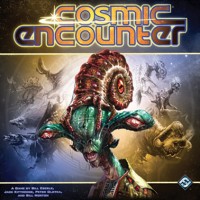
Cosmic Encounter
Build a galactic empire…
In the depths of space, the alien races of the Cosmos vie with each other for control of the universe. Alliances form and shift from moment to moment, while cataclysmic battles send starships screaming into the warp.
Players choose from dozens of alien races, each with its own unique power to further its efforts to build an empire that spans the galaxy. Many classic aliens from earlier editions of this beloved game return, such as the Oracle, the Loser, and the Clone. Newly discovered aliens also join the fray, including Remora, Mite, and Tick-Tock.
This classic game of alien politics returns from the warp once more. It features 50 alien races, flare cards to boost their powers, 100 plastic ships, a host of premium components, and all-new tech cards that let players research and build extraordinary technological marvels!
No two games are the same!
Originally published in 1977 by Eon Games, the classic game returned in 2008 from FFG.



Add a Review for "Cosmic Encounter"
You must be logged in to add a review.
Easy to learn :
Cosmic encounter is pretty easy to understand “mechanic” wise, the challenge will come in understanding all the different powers , flares , and cards that come up … ( ill talk more about those Powers and cards later… ) just know , that in its essence its easy, it sometime feels a little like a game of Poker….
Who is this for ? :
If you are not into sci fi or some of your group aren’t , i doubt this game will be a success …you might want play something else instead…
while other sci fi games work well with Not So Geek friends , i find this one harder to digest for most casual not too geek gamers.. in how it plays it could be casual , its not even that long , but i can tell you right now in my experience , the couple of time I’ve played it , it was very dependant of the group , a lot of the fun in the game is the interaction between players , and this interaction will not happen if some people find it akward or weird…
Replay:
huge replay potential … you have a lot and a lot of different races , with different powers , tons of cards that are all different , lot of things to do.
But this is where i think this game could not work for you , a lot of cards , or races are very overpowered … wich in turn kind of break the all “strategic” part of the game… even if you don’t play those races you ll probably end up with some cards or flares pretty powerful that suddenly breaks the strategies of some other player … that is why it becomes more a pocker game than a real strategic game at the end… but ! there is no dice , and you can still plot your path and strategy with the card you have and how you decide to move your ships , wich make it , in its core a very interesting game.
Component :
well the cards are great, the new edition had a better feel to it , wich give justice to all those races … the rest of game is solid , but nothing spectacular …
mechanics:
like i said, It is simple mechanics … you send your ships and you bet how many you want to attack with, and you hope the cards you have in hand are powerful enough to get you ur victory … you also hope some of your friend will help you out … and this is when the fun begins ! it can be very funny to support or defend with other friends , but it also can be to some friend something they hate ( especially if they are too serious ) …
another fun thing is that depending on your race , this game is played very differently , wich is really interesting .. but then it can also be a bummer if you feel your race is lame comparing to some others … they are all interesting , but there is balance issues for sure…. maybe if you check at some home rule you can make it work best.
Conclusions:
So i may have been a little harsh with my review , i hope i don’t hurt some feelings … this game is a classic , it is a really great , and interesting game … but i would advice you to try it before you buy it , see if the balance system don’t bother you and to make sure it works with you group ( since its a fairly expensive game ) . I feel that this game is ton of fun if you are with the right people , but also can be a game never played if you misjudge it.
i ll copy my Youtube friend “JeremyJahns” on this one and give it the award : ” great fun , no alcohol required” .. with the right people.
Cosmic Encounter was first released in 1977 and has since been released serveral times in different editions. The last edition, the one I have reviewed here, was published in 2008 by Fantasy Flight Games. Cosmic Encounter is a game for 3 – 5 players for the ages of 12 and up.
Now that we are done with the pleasantries lets get down to the meat and potatoes of the game. Cosmic Encounter can best be described as a poker game with space ships.
The basics of the game are quite simple; each player begins the game with 20 space ships, which are shaped like old-school saucers designed to stack, divided evenly amongst the players 5 home planets. Each players also begin the game with a hand of 8 cards, most of which are encounter cards and some of which are special action cards.
A game round begins with the active player drawing a card from the destiny deck. This deck contains 3 cards of each player colour currently in the game and some wild cards. The colour of the drawn card tells you which player you have to attack that round. The player has no choice in this, he must attack the player of the colour drawn from the destiny deck. This is a genius design of the game. Since you must attack a player and the choice of who to attack is random the game will not break down into a bash the leader game. Since there’s also an even distribution of the colours in the destiny deck every player will be attacked an equal ammount of times during the game.
The attacker then selects the planet he wants to attack amongst the home planets of the player drawn from the destiny deck. He then takes 1 to 4 of his space ships and places them on the hyperspace gate and points it at the target planet. The defender must defend with all of the space ships he currently has on that planet, or none if he has no space ships present.
Now this is where the fun part of the game begins. After the launch phase we come to the alliance phase. This is where the attacker and defender try to get the other players to ally themselves with them. The reason you want to ally yourself with an attacking or defending player is not because you’re a nice person and want to help them or because you have struck a previous alliance. The reason you want to help a player is because you want to get rewarded. By helping the attacking player and winning the battle you will gain a colony on the defending planet together with the attacking player. This is important because the player who first gets 5 colonies on 5 different enemy planets wins the game. The reward for helping the defending player is first and foremost in stopping the other players from gaining colonies and thereby getting closer to victory. The other reason is that if the defense wins the defending allies get to draw new cards from the deck and put them in their hand. This is important since this is the only way of gaining new cards other then drawing a new hand after you have played all your cards.
When all the players have decided on who, if at all, they will ally themselves with we come to the planning phase. The attacking player and the defending player each select and place face down on the table one card each from their hand. Usually this will be an encounter card with a number on it. Each player them simultaneously reveals their card. The winner of the battle is the player with highest numbered card pluss the number of space ships he attacked with pluss the number of space ships his allies decided to commit to the battle. There are other cards to be played here, like the negotiation card which admits defeat but gives the losing player compensation. However the negotiate card screws over his allies as they lose the battle as well but they do not collect compensation. This really gives the game a lot of oppertunity for bluffing and sticking it to the other players. Hence why it’s been likened to a game of poker.
If the attacker won he’s allowed to take a second turn immediately if he so desires. The round then goes to the next player and the game continues in this fashion untill one player can claim victory by having 5 colonies on foreign planets.
This is the very basics of the game. The cards you get will alter gameplay drastically as they bend the rules of the game. But the thing that really makes this game shine are the alien races. There are 50 different races in the game. Each race has their own special abilities which change the rules of the game. Some of the races only changes the rules slightly, such as the Humans who get a +4 bonus to their revealed encounter card. Then there are races who dramatically changes the rules of the game, such as the Anti-Matter which wins battles if he has the lowest number revealed. These racial abilities makes the game different every time you play it and is what really makes this game so much fun.
So what do I think of Cosmic Encounter? I think it’s one of the greates board games ever made. It’s awsome gathering a few friends around the table and trying to bluff them into playing the card that will spell their certain doom. Having a cold drink while fiddeling with you space ships like they where poker chips pondering how to best make your opponent believe that the sole card you are holding is a 30 and not the measly 3 that it really is. There is almost constant player interaction in this game because of the alliance system and because the cards in your hand can still affect the game even when it’s not your turn. If you enjoy games with random setup, the alien race abilities, and a space theme with a healthy dose of bluffing then this is the game for you. There is only one game in my collection I have played more then Cosmic Encounter and that is Bang! But this is only because we play Bang! about 5 times or more every time we sit down to play it. So I would encourage everyone to atleast try to play Cosmic Encounter once. I promise you that you will want to play it again.
3 – 5 players, 6 with expansion, the more the better.
About an hour to play, five minutes to teach, can be played casual, but is very strategic.
First printed in 1977, Cosmic Encounter is a classic (it even influenced the creation of Magic: The Gathering) that only gets better with time. While the mechanics are simple (a “destiny” deck randomly determines your opponent for the turn, you choose one of their planets to attack, the player with the most ships wins the encounter), the game has several components to make it infinitely replayable.
First, each player has a race. Race cards each break the rules in different ways — one might let you stack the destiny deck, another might allow you to cheat your way into an encounter, another might let you multiply as a disease to spread over multiple planets. There are 50 of these cards in the base game, and the expansion (which also gives you a 6th player) provides 20 more. Since each player only chooses one race per game, you easily have billions of different combinations you could play with.
Second, each player chooses their race between two cards they see at the beginning of the game. These are the “flare” cards, which will end up in the deck before the game starts. For example, I might have the choice between the Grudge and the Humans (mostly harmless), but no matter which I pick, both of those flares will end up in the deck. Each player will have a hand of cards from the deck that they use for different things — from adding ships to their encounter, to zapping another player’s power, to recovering ships from the Warp. Most of these cards are discarded when played, but if you have a Flare in your hand, you can play it and still keep it around for another pass. Flares double the number of race-related powers you see each game.
Third, the game includes a Tech deck, providing cards you can research over time to give yourself Real Ultimate Power(TM), like destroying a planet. Each player only sees one Tech card per game.
EDIT: As noted in the comments, you get to choose Tech cards like starting races — draw several, choose one. Also, if you succeed in your first encounter, you can either take a second encounter or a Tech card; of course, a second encounter is extremely powerful in a game that only goes to five “VPs” (foreign colonies), so I’d expect that you’d still see very few Tech cards. Thanks to the commenters!
With all this madness, each game is significantly different. Some races seem flat-out bad, until you realize you can use their powers in very interesting ways. My dad played as the Philanthropist one game, who is allowed to give encounter cards (that add or remove ships to an encounter, or attempt to negotiate) to a player in an encounter. He couldn’t figure out how to make this help him until halfway through the game, when he started unloading terrible encounter cards (-10 ships? take it, go ahead) to his opponents. Since you must play an encounter card each turn, and you can’t reload your hand ’til you run out of encounter cards, all of these terrible cards would need to be used by his … beneficiaries.
One race allows you to join an encounter even if the main players (the offense, whose turn it is, and the defense, whose card was drawn from the destiny deck) didn’t ask you to do so. Normally, players must ask for allies, because an ally on the offense gets a colony if the offense wins, and five foreign colonies wins the game. In the endgame, people will often choose their allies very carefully, depending on who’s close to winning. This race can tag along for the win.
Cosmic Encounter is the highest-rated game in my collection, and I’ll always suggest it when I have an hour and a few friends around. Highly recommended for players interested in political, strategic games. If you buy it, get the recent Fantasy Flight printing and expansion, it’s the best printing yet.
The number 1 thing that I would say about this game is that after I had read over the rulebook once, explained the rules to the other players, and gone through 1 round of turns we never had to open the rule book again.
I am the gamer in my group who introduces most of the other gamers to new games. I am also the one that is in charge of learning the rules of games and teaching the other players. This game is one that was very easy to explain and I even feel that the players that I taught could run the game. This is a big boon and a huge positive.
The replay value of this game is definitely huge.
The balance of all of the alien races is not the best, but since this game revolves around alliances and a variance of card values, it is not a ruining factor. Some of the alien races, like my favorite (The Gambler), have abilities that rely on your bluffing skills. This makes the game not just one for people who like card management and strategy, but also for people that like to play mind games.
It was quite fun to role-play the aliens that we each had as we went along.
3-5 players Unlike many of the reviews on here, I would have to say that the game was just fine with 3 players. Larger games were an equal amount of fun. The games with fewer players went very quickly. This meant that if you got beat up early and didn’t do well, you didn’t have to sit by in agony for very long. 12+ seems like a pretty good age range for the game. I could see the amount of reading being intimidating or challenging for a tween or early teenager. 60+ minutes for a single game is very accurate. Some games even take less than 60 minutes. Even our first game only took just shy of 2 hours. Each other game played out in just about 60 minutes. The game length isn’t quite predictable enough to be a lunch break game at work, but it can certainly be played in a evening filled with putting children to bed and cleaning.
Tech Cards
One of the optional rules adds technology cards. In a half a dozen plays of the game, 5 of which used these cards, only one ever got deployed. And it was the cheapest technology in the game. It was game changing, but the tech option seems to be a bit overpriced. These games were not maximum player, so perhaps that explains why.
Conclusion:
This is a very fun game. I will definitely play this one a bunch more. It will probably replace some of my other games that I would throw into this category. (The category of not 2 player games that are a little more advanced than say Ticket to Ride) Strategic gamers may not enjoy this one as much, but avid gamers and gamers just looking to have a laugh and a good time will be right at home. There is just enough of a mix of Euro Game and Ameritrash with your fun little flying saucer ships that the game can suit people of multiple backgrounds of gaming.
1. A game of conflict. Destiny cards can have people fighting their friends even if they don’t want to. In many cases, you must use the power of persuasion to encourage other players to come to your aid.
2. A game of colonization. Players defend planets and colonize opponents planets. The goal is to populate lots of planets. Allying with offenders will offer the potential to colonize a new planet.
3. A game of roles with special abilities. Players have special abilities that give them a great advantage based on an alien race that they choose. (i.e. – ships never go into the warp area). These abilities can be taken away if they lose some of their home planets. Some cards have additional effects if the player is of a specific alien race. This helps make each play of the game different.
4. Strategic battles. The way that cards and abilities are played, a conflict with an obvious outcome can be turned around before you realize it. In some cases, you want allies to come to your aid to increase the chances of success in battles. In some situations, it will be to your advantage to limit who you ask to assist you, or simply go at it alone.
5. Negotiations. Work out your problems through negotiation. Be careful because if one of the players isn’t expecting to negotiate, then the attacker prevails. Assists can get a bad deal when negotiations come into play.
6. Ouch! Some cards when played are just amazingly awesome if played rite. Players around the table will feel the victims pain and wince when they read some of the cards details, but still be congratulating the person who just played the card – especially if it is to their own advantage.
Play:
In general it took us about 5 minutes to setup the table and about 10 minutes for the owner to explain the game to us. The main focus was on how battles work, and the different types of cards. Each alien card that each player had shows the different phases of a turn, which helped us follow along. One thing that you will need is a timer. Any encounter that results in negotiations needs to be 1 minute or less. We used a timer on one of our phones, but a simple hour-glass style timer would probably be simpler to work with. A lot of time was spent trying to count up points on each side of the battle and determining what to play in order to win the battles. One player was always trying to make sure they would lose by 10 points or more if it looked like they would lose based on their races special ability. The end of the game gets pretty interesting because everyone starts trying to make sure the one in the lead can’t get another point. Some players are no longer included in the request for allies. Others start attacking that players outposts if they can, or try to take away their powers. Towards the end, all four of us were one point away from winning. An encounter commenced and the end result was that two players won the game. The game took roughly 2 hours to play.
Considerations:
a. Pieces are different only by color.
b. Alien race cards are gigantic. Hard to shuffle and a bit awkward. Not really a bother during game play.
The Precursor’s explored the galaxy, and they found no one. They were powerful. They were lonely. They were BORED. So, like the factory computer in Robo Rally, they created the seeds of life. In their case, they sent them onto planets throughout the galaxy. They then left them easter eggs to find at the outer rim of their respective solar systems so they could rapidly advance their technology and find their parents and siblings.
Except the parents were gone, no trace of them was found. So, once again, like the robots in the factory, naturally the species making up the Precursor’s legacy decided that the best way to deal with other species was conquest.
Premise
Cosmic Encounter is a game for 3-5 players. A game takes 1-2 hours to play. Players take control of one of 50 alien races, each with their own special ability or power. As leader of the race of your choosing, your goal is to expand your sphere of influence throughout the galaxy through combat or diplomacy. The game relies heavily on misdirection and shrewd alliances and, to a lesser extent, resource management. The goal in the game is to establish five colonies on planets outside of your own system.
Components
There is no board used in this game. Instead the play area is dominated by modular heavy cardboard planets and the like. Your spaceships are standard 1960’s UFO fare, made of plastic that stack. The stacking is nice, since you will have 20 of these suckers to manage, and multiple players can have multiple ships on the same planet. There is a whole mess of cards used in this game, including large cards depicting the alien race you have chosen to play this game and much smaller gameplay cards. I haven’t seen anything fall apart, so it seems well constructed.
Setup
Setup involves passing around the alien race cards for each player to choose from, putting five cardboard planets in front of you horizontally and placing your twenty ships on them, four apiece. That covers the players area. The communal area in the middle will contain the warp, which does double duty as a holding area for defeated ships and the score track. Player tokens are notched to accommodate several on the same number, which is good, since they will all start at zero. Find a place to put the hypergate and cards where everyone can reach them. Remove all the cards depicting player colors not being used and deal everyone gets 8 cosmic cards. You are now ready to go. This should just take a few minutes.
Gameplay
The first thing to do is familiarize everyone with the various phases to a turn. This is important because many alien powers can only be used during a certain phase. To further complicate things, some powers might happen at the beginning of a phase or at the end of the phase, such as before encounter cards are flipped or after they are flipped. Some aliens have powers that are mandatory to use each turn, some are passive and some can only be used when a main player (offense or defense in an encounter) or offense or defense only. Some of the alien powers are more complicated than others, and there are colored lamps in the upper left and right corners that inform players how complicated. Green are good for beginners, yellow for more seasoned players and red for experts.
Look at the cosmic cards you have been dealt. Of the eight, you must have at least one “encounter” card. This would be an attack, negotiate or morph. If you do not, show your cards, discard them and draw 8 more. In addition to encounter cards, you will find reinforcements, flare and artifact cards. These additional cards can change the tide of battle or otherwise further your agenda. Flare cards are special in that they return to your hand after use, at least until you need to discard your hand and draw a new one. If, at the beginning of your turn, you have no encounter cards at the beginning of your turn, you play or discard all cards in your hand and draw 8 new ones.
Once you have your race and cards sorted out, the first player draws a card from the destiny deck. This will determine who they will have and “encounter” with. If you draw a colored card, you have a confrontation with the player of that color. There are some cards with specific rules, such as requiring you to confront the player with the fewest or most ships, and some cards are wild cards, letting you choose who to face. However you opponent this turn is chosen, take the hyperspace gate and point it at one of their planets. You will be trying to establish a colony there, and the defense will be trying to stop you or limit the damage. The offense will place one to four ships on the hypergate.
Now, each player will choose whether to ask any other players to ally with them. The offense first states which players they would like to help them, followed by the defense. Players choose whether or not to ally with one of the parties who asked them. Allying with another player entails committing one to four of your ships to either side. If at this point, the defense has no encounter cards, they must show their hand, discard all held cards and draw 8 new ones. Then the main players, the offense and defense (not allies), place an encounter card face down. Once this is done, and all powers and cards that can be played during the planning phase have resolved, both players reveal their cards.
If both players reveal attack cards, then each player will take the value of the attack card, add the number of ships, their own and their allies to that amount and compare the total to their opponent. Reinforcement cards can be played by all players involved at this point, along with flare or artifact cards that can be played at the reveal stage. The player with the highest total wins the encounter. Should the offense win, all defending ships are sent to the warp, and all offense players, allies included, place all the ships committed to the battle onto the planet in question, establishing a colony upon that planet. In addition, if the offense wins, they may play a second encounter if they choose. If the defense wins, all offense ships go into the warp. Defending ally ships go home, but get to take cards from the cosmic deck or ships from the warp of their color equal to the number of ships committed to the defense in any combination. This is how a player can retrieve ships lost in battle.
Should both players play a negotiate card, the allies no longer factor into the decision. The offense and defense now have one minute (an hourglass timer would have made sense here) to come to a deal. This deal can include establishing a colony on this planet and/or trading cards. Something must change hands, however. Should the players fail to come to a deal, all main player ships committed to the battle are lost to the warp.
If one player plays a negotiate card and the other an attack, the attacking player wins by default. However, the player with the negotiate card gets to take a random card from the hand of the attacking player for each ship they lost.
Stratagy, Summary and Thoughts
As mentioned previously, the object of the game is to gain five colonies outside of your system. Choosing whether to ally or whom to ally with, or whether to ask a certain player in the first place, is an important part of controlling the game. Having assistance is great on an attack, for instance, unless taking this colony will place the ally in the lead. Committing ships to defense can get you more cards or more ships back, but can go disastrously wrong if you lose. Managing your ships is important so you can defend the territory you hold and enable you to take more. Cards are not refreshed until all encounter cards are gone, so hand management is important. Wasting cards can also lead to you losing a good flare card when discarding. Managing your resources and proposing saavy alliances are very important in this game. The alien powers often break game rules, so players have to keep in mind how their opponent does this and incorporate this into their plans. Once all players are playing with red aliens, the game can get very complicated, especially if the optional technology rules and cards are used.
My Verdict
I never say no to a game of Cosmic Encounter. I enjoy the strategy and player interaction, and the multitude of alien races makes sure every game is different and fresh. The path to victory is never certain. I feel this is best played with 4-5 players. This game is also a good one to play with your buddy who is terrible at planning a turn in advance, since it is very hard to do that anyway in this game since you have no idea who you will be against next round. I find Cosmic Encounter to be a good time, and if your group is into strategy and resource management, it has a place in your collection.
I’ve heard people recommend Cosmic Encounter as a gateway game, and I’ve introduced it to people who were knew to gaming. The game itself is pretty basic to play as each player starts with 5 planets and 20 ships with the intention of being the first to colonize 5 planets outside your home system.
During your turn you pick a card from the destiny deck–which will tell you who you will be attacking for your turn (so there is no “he’s picking on me” to deal with)–choose a planet in the defending players home system, commit ships to attack (no more than 4 chosen from anywhere you have them), and then it becomes a straight up numbers game. You have encounter cards in your hand that have attack values. Add the value of the attack card you play to the number of ships you committed and match it up to the number of ships defending to the number on the defender’s attack card, and whomever has the biggest overall number wins. Offense places ships and gets a new colony if he or she wins and if the defense wins he or she has fended off the attack.
Where Cosmic Encounter gets complicated is in the alien powers. You see, at the beginning of the game everyone randomly draws 2 aliens from a nice thick stack of alien cards and chooses which alien race they’ll be representing during the game. Each alien has a power that breaks rules of the game, and it’s in these powers that the complications can arise. There is an attempt to mitigate the complication by color-coding the aliens from green (easy with little chance of misinterpretation) to yellow (things start getting a little tricky in how you interpret the use of the powers) to red (expect some complications). A game turn progresses over a series of phases and much of the powers of the aliens kick in during specific phases, so as players learn you need to make sure you are carefully calling out each phase so people have the time to react accordingly (especially since some powers are mandatory and others are not).
The underlying excellence in Cosmic Encounter comes from the interplay between participants. This is a negotiation game. As the attacker and the defender you are allowed to invite other players to join your cause, with spoils for the victors and destruction for the vanquished. It is possible to have all players achieve victory in this game, and novice players may find themselves finishing the game quickly and wondering “is that it?” The key is to make sure you make, or break, alliances as they best suit your own march towards victory. It is too simple to simply invite everyone along to help when in fact you need to be particular about who you are allying yourself with or you might be handing the win over to someone else. Repeated plays open up the nuances of this game built on some very simple mechanics.
The space theme might turn some people off, but I haven’t found this to be a real issue. The real issues stem from the group you play with. As mentioned earlier it is a negotiation game and you are often making deals that you might not want to see through to the end. Some people struggle with this. Don’t play Cosmic Encounter with them. However if you have a group that digs the social interplay that this game can offer, then I can’t recommend it highly enough.
I love this game. Like loooove it! Like want to marry it and have its little Cosmic Babies kind of love. Why you ask? Here’s some of my favourite things about this sexy beast of a game.
It’s easy to learn!
I’m definitely the most hardcore gamer in my group of friends. I do exhaustive amounts of research, buy the games, teach the games and host the games nights. Other than my partner and one good friend, the rest of my gang aren’t regular gamers, so I have to be careful what I present them with. CE seems pretty complex when you first bring it out, but people catch on so quickly that it only takes 1/2 a game for everyone to “get” it. I always leave out the flare cards for the first run through and add them in for Game #2. There is ALWAYS a game #2 after the learning game.
No down time!
This is a rarity in games. You are always engaged, whether it’s your turn or not. Even if you aren’t a main player, you might get asked to help with the defense or the offense. Or you may just decide to play a card to shaft people just because.
Infinite replay value!
OK, it’s not infinite. That would require a box full of aliens that would be so massive it would create a black hole on my gaming shelf. Math was never my strong suit. But with 50 aliens in the base game alone there is a remarkable amount of replay value. The way the different alien powers interact with each other changes depending on which ones are included. I keep thinking I have a “favourite” alien until I play again and have a new favourite.
It doesn’t overstay its welcome!
I love a meaty, epic, hours long game as much as the next guy….unfortunately the “next guy” isn’t in my gaming circle. This is not an epic game by any means, and sometimes is over really quickly, which just means we get to play more than one run through every time it hits the table.
It embraces silliness and chaos!
If you are a heavy strategy gamer who likes to plan out their entire game and then just apply your decisions, this is NOT the game for you. If you’re in the mood to be silly, to laugh and backstab and generally have a ridiculous time, this is MUST buy. There’s plenty of “serious” games out there…this is not one of them.
No ganging up on one player!
This is why all the chaos is so much fun…who you attack on your turn is determined by a deck of cards. It’s not personal (OK, so maybe it’s a little personal, and there are wild cards so you can seek revenge) which makes everyone loosen up a bit. It really helps get into the fun when the newb you’re playing with doesn’t feel like everyone is taking advantage of them.
If you like fun, screaming, laughter, “how could you DO that?!” and a hefty amount of silliness in your gaming, I highly recommend that you give it a try. I’m truly obsessed with this gem, and I haven’t even gone down the expansion rabbit hole yet!
Gamers who graduate from the Monopoly and Sorry phase tend to share a similar preference with one another. They tend to look for games that have the layout changed each game. They also want games that force them to make tough decisions, yet have rules that are simple enough to fit into one page. The biggest feature they want, or lack of it, is luck. In fact, having a game that has a roll and move mechanic in these great times is a legal reason to commit arson. This doesn’t mean luck doesn’t exist in these modern board games, but it’s not longer the dominating factor on whether or not you win.
When Fantasy Flight Games, the boys behind the most overproduced games in existence, announced a reprint of Cosmic Encounter, I was expecting the very reality I know to collapse. After all, we’re hardcore gamers now and things like luck-based games are beneath us.
So why didn’t the world end? Because gamers actually wanted this game. These same gamers that love Settlers of Catan, Ticket to Ride, and Carcassone are suddenly interested in a game that is entirely driven by the heart of the cards. You can’t even choose your own target when it is your turn to attack; it’s all done by the Destiny deck which tells you who you are going to strike. In other words, don’t get friendly with your “allies”, because you might be forced to vaporize their entire race with your death cannons because the cards told you too.
But why would you vaporize your friends, you may ask? Because the entire point of this game is to get 5 foreign colonies and you can do this in a diplomatic fashion or by committing several genocide attempts. Since this game does take place in Space, you have alien powers to work with. These alien powers have a way to break the game apart and cause problems for both you and your “friends.” For example, those Zombies? They can’t die. What about that Loser? He wins by losing the fight. Everyone gets one alien power that does all sorts of wackiness and there are fifty alien powers that come with this game.
As for the game play itself, it’s quite simple. Each turn, you draw from the destiny deck and it will tell you who your target is. So you pick a planet to invade, throw in 1 to 4 ships, and ask people to come join in the invading party. The victim asks for allies as well, in attempts to save his hide. The other players then decide who they want join by sending 1 to 4 ships, or they can just say “screw you guys, I’m going home.” Once everyone has decided who to join or bow out, both the offensive and defensive player put an Encounter card face down. These cards have a fancy big black number on it and once both sides put the cards face down, they are revealed. The winner is the side who has the bigger number after adding all the ships on their side plus the Encounter card.
That’s pretty much the game right there. There are other cards, like Artifact cards that fudge the rules even further and Reinforcement cards that can change the outcome of close battles. Otherwise, the game is literally just “draw a card for your target, throw in ships, invite allies, and get the highest number.” Why does this work?
Because the entire game is about diplomacy. There are many ways to screw around with your neighbor’s heads and with the alien powers in play, people might either ignore, hate, or like you. In fact, being a game made in the 70s, Cosmic Encounter is a very good early example of abusing the metagame.
The other key factor of Cosmic Encounter’s greatness is the opportunity cost and decision making. Your encounter cards, much like the rest of the game, is entirely random. Sometimes you need to figure out on whether or not you should play your strongest card, and get into your opponent’s head if they have strong cards as well. Sometimes you might not even think about your opponent at all, since you have a terrible hand but must use these cards. You can try to take advantage of your terrible cards by inviting allies and sabotage them, but they’ll hold a grudge for the rest of the game. Do you do it, or just play it safe?
It’s these type of diplomatic situations and bluffing that makes Cosmic Encounter such a great game. It’s quite easy to learn if you are a veteran gamer (especially if you are from hail from the CCG) and the alien powers make the game have an incredible amount of replayability. The base game alone comes with fifty alien, which is more than enough to keep you occupied for a very long time.
Pros:
– Nice artwork
– Easy to learn rules
– Tons of replayability
– Screwing over your friends is encouraged
Cons:
– Don’t play this with three people
– You will hate this game if you loathe luck
Wow what a game! A Riotous, crazy, barnstorming laugh of a game that deserves to immediately go onto everyones shelf. We have only played this two nights and we all agree that this is excellent and we will all be playing this for years to come.
The mechanics are simple to learn and master,. but the alien powers make every game unique. You could be in the middle of using an ability, one you have cultivated and waited for this moment to use, a smug look of satisfaction on your face and suddenly someone stops you using that power! Not because they were defending but just because! And you’re not even annoyed that it happened. You just laugh, as does everyone else! This game brings people together in the way that board games were intended to be used. A sociable night of entertainment for everyone. Gamers and non gamers alike. Get it!
Replay Value: With the powers and flash cards, every game will be different, none can ever be the same and the madness will be ever present. We wanted to keep going but realized we had to sleep!
Components: Perfect, No Board (This is a card game) But the cardboard planets are solid, the aliens ships are perfect, feel like poker chips and they are shaped to stack on each other. Everything has a purpose here and it is used excellently. Special mention to the artwork! It is wildly imaginative.
Easy To Learn: A lot to take in in game one, A lot of rules, my advice is to introduce them slowly a round at a time add each new element and by game two you will be playing like pro’s and laughing like lunatics.
Think Dominion is like multiplayer solitaire? Feel like your choices aren’t having any real impact on the game? Look no further than Cosmic Encounter. This sci-fi game is loaded with bluffing, conspiring, diplomacy, and “Take That!”
Each player starts with 20 ships, divided evenly amongst 5 home planets. It is each players goal to be the first person with ships on five planets owned by other players. To do so, players will have to either make a successful attack or deal with their opponent for the turn, determined by a Destiny deck. This brilliant mechanics ensures players never feel bad about attacking other players, and grudges to be inexcusable.
Each player is assigned a special alien power, that alters how certain mechanics of the game work. Some of these powers are generally better than others, but thankfully each time a player has an encounter with another, players can ally themselves with offense or defense. In this way, players can gang up on a winning player, keeping everyone even.
Cosmic Encounter is simply a great game. No two games ever feel the same, with 50 different alien powers, and no two players having the same play style. One complaint: The game supports 3-5 players, but playing with three is a real drag. It can be moderately fun, but it often feels like players are too much at the whim of the luck of the draw. This is diminished when playing with more people.
There are very few board game genres out there that elicit feelings of seething hatred and wanton destruction as those that include “diplomacy” or “negotiation”. There’s just something about a game that forces you to make tough decisions that WILL affect your friends at the table that can cause things to get ugly. Fun, but oh-so-ugly.
At any given point in the game you may be allied with everyone at the table, joined at the hip to stop the malicious onslaught of the evil “Mutant” horde or “Clone” flotilla. Before you know it you’re ready to jump across the table and stab one of your former “allies” in the neck with a pencil for blatantly drop kicking you in the sack, “with authora-tah”. Alliances of convenience, unabashed betrayal, and sneakery of the highest order…such is the game of Cosmic Encounter.
This game has been around in various iterations since the Seventies, which should speak to its staying power. It has been printed by no less than ten publishers, the best and most recent being the venerable Fantasy Flight Games. This latest version is loaded with high-quality cardboard bits, 100 stack-able plastic UFOs, and a slew of cards and “race sheets”. The game takes about an hour and a half to play, and seats three to five players at a time, which is a good thing because odd numbered crowds generally make people think twice before starting a brawl. In my experience, four to five players are optimum as three player games end up having two team up and bash the third to death. There can be shared wins in this game, meaning that if two players simultaneously meet the victory condition, they both win.
The concept of this game is really quite simple: you are a space-faring race in possession of five colonies in your home system. The object is to use diplomacy, negotiation, or sheer unrelenting force to expand into five foreign colonies. It sounds simple, but this actually as hard as cutting a bad tooth out of a rottweiler with a broken beer bottle. Which happens to be all fun and games until someone gets bit.
Once all the players’ races have been selected, the gameplay consists of several sequential phases that indicate the who, how, and what you get to do during a turn. First, a player will draw a colored card from the “Destiny Deck”, which indicates the color of the foreign race they’ll be assaulting next. That’s right, you don’t get to decide who you attack, it’s decided for you; which can make alliances very tricky. Next, you will indicate which foreign colony of the chosen color you’ll be invading, and how many ships you’ll commit to the fray by placing them on the stargate board.
Now that you’ve established the who and how many, the true fun of the game begins! At this point, the two players about to engage in battle can ask any number of players at the table to ally with them. Common tactics for asking include pleading, offering cards or use of special powers to help the allies. It can also include things like offering to get up and mix a Tom Collins for all allied players. Trust me, I’ve offered that, and worse.
Once the allies are selected, the attacker and defender both choose a card from their hand to play, and reveal them simultaneously. Generally, the higher card wins. There are some specific cards and powers that can change the outcome, such as reinforcement cards that any player may play to help one side or another. Once all cards and powers have been resolved, the winner takes their spoils, and the losers take their devastated forces to the proverbial “sin bin” of Cosmic Encounter, “The Warp”.
There is also a negotiation aspect to the game when it comes to the battle itself. If both the attacker and defender play a “Negotiate” card when they flip their cards, all allies go back to their home systems and the two parties have one minute to strike a deal of any kind, provided something changes hands. If no deal can be reached, they both lose three ships to “The Warp”. The rules specifically state that deals can be anything, so offering a ten dollar bill is not out of the question.
The spoils for the attacker’s side is that you take the planet as a colony; your allies may join you on the devastated planet bringing them closer to the five victory points needed to win. If the defender and their allies win, the defender gets to keep their planet and the allies get to draw some cards from the draw deck. With little exception, the only way to get new cards is to ally with a defending player – which is crucial. The opposing problem with that is that the only way to get victory points, meaning foreign colonies, is to either defeat a planet alone, or to ally with an attacker.
This is truly one of my all-time favorite games, and if you enjoy games that involve planning, tough decisions, trickery, and potentially having your wife tell you, “That’s SO messed up, Pete, you’re SO not getting any tonight”, this is certainly the game for you. If your wife is calling you Pete, and your name is NOT Pete, then it seems that you should not be playing games at all, and perhaps should seek council from a licensed therapist. That, and I am NOT the Pete she called you, I swear.
Things I liked:
*Great gameplay mechanics, quite a fluid experience
*No downtime as everyone is doing something
*High production values and extraordinary art, even for Fantasy Flight Games
*Incredible replayability, and an expansion set, “Cosmic Incursion” to boot
Things I detested:
*$59.99 MSRP is just too bloody high. There’s lots of bits, but this is not Descent: Journeys in the Dark
*The Fantasy Flight Games version is not truly compatible with other publishers’ versions
Overall:
This is an outstanding game for three to five players, and every person who likes player vs. player games should absolutely, unequivocally own this game.
Rating:
5/5 Stars
You can read how to play this many times over on this site alone; what you have to know, what you have to experience for yourself, is just how much fun it is.
It’s devious, compelling and laugh out loud funny. It lets you – forces you to – be backstabbing, diplomatic, panicked and teary with laughter. Haven’t even begun to explore the possible combinations of alien races/tactics/powers yet. The theme is marvellous, the artwork is magnificent, the components lovely and tactile.
It’s got the great bluffing element of poker. That feeling of cheeky empowerment you get from Netrunner as you destroy or steal an opponent’s hand. The fragile alliances and treachery of Game of Thrones. But it’s accessible, instant. Strategic but not so much that it saps the life out of the interactions, funny and random but not so much that you get frustrated.
I can’t recommend this masterpiece highly enough. It is a well-loved favourite, sure; but it should be in everyone’s collection, **** Monopoly.
This is my very first board game. From the first time I played it, I loved it! I love the fact that there are a lot of characters to play as. Every game is always different because you never know who you will get, nor who your opponents will have. This allows for an exciting game play as finding strategic ways to win the game is always different each time.
With that, the game can get a little repetitive a times, if you play multiple games in a row. I see that alliances from previous games gets carried over to new games and it no longer become as fun. Not only that, but depending on who you play with, there are those who may get frustrated feeling as if they’re always getting picked on.
But overall, great game! The artwork is great and it is an easy game to pick up and learn. Hopefully I will get to play with the expansions one day.
Played this for first time two nights ago. Some elements were withheld, apparently because they give some players too much power. Without those cards or elements, we still had one player with an advantage – Parasite. He could aid in the attack every turn. Once you have advanced to five additional worlds you win – it’s possible to lose a gained world but this didn’t happen in our game. So once he got to 4 of 5, the rest of the game became joining up against him to make sure he didn’t win in another attack. Of course he didn’t want to state his intention each turn til others did, and vice versa. The best we (I) could do in the end is go for a three-way victory, myself, another 4-pointer, and the Parasite. Would like to play more and see some of the other aliens and their powers. One player had it bad off through the whole game so that probably wasn’t too fun.
My first game of Cosmic Encounter was a 6 player game. And it rocked. It felt a little bit like Munchkin. First everybody is helping you but as soon as somebody seems to win the game tides change and everybody will go against the “winning” player.
In Cosmic Encounter your goals is to own settlements on other players planets. The main way of getting these settlements is by force, meaning invasion. Because of the limited amount of spaceships you can use for invasions you always rely on the favor of other players. That being said the game only seems to be average. What the game really makes it shine are the special abilities your player race has. Most of them can change the game in an instant. The most fun is to surprise players with your special abilities when they think all is won.
If you like battling other players and have a bigger group of players (4+) then you should try out this game. The ridiculous amount of different races (about 100) makes no game as the one before.
This is a unique game by far in the way it plays. Having a different race to draw each game provides you with different ‘cheats’ giving you unique ways to modify the rules during your turn. The negotiation process in battles where you have to convince others to help you or not (in exchange for a chance at the spoils) is also fairly unique.
So you think this would mean each game is unique. I have found this not to be the case. Partly because of the imbalance provided by the luck of the draw, your strength cards in battle can vary wildly. This can give you little chance to win anything until you draw better cards. You will also need to play with gamers who get into the whole space alien race theme and who are creative with their approach to see much variety. I have played some games with gamers who try the same approach no matter who they get and it really breaks the system. Maybe part of the reason for my lower rating of a supposedly classic game is the fact that I don’t enjoy negotiation games where the negotiations always seem to come down to the same question; in this case, “Do you want to help me pound on this person, or not?” Playing with more risk-takers could make this game more fun, I guess.
Fun in the right situations, but not something I play unless the options are limited.
Caveat: My low scores regarding components are based on an older addition to this game.
Cosmic Encounter is a game of alliances, back stabbing and piling on. Everyone is dealt a different alien with it’s own unique power to start the game. Each turn a player draws a card which indicates who’ll they will have an encounter with. Alliances on either said may be formed, cards are played to determine the winner, while alien powers activate and change the course of the game. “Strong” power don’t always win as alliances can be formed to stop them. “Weak” power usually have a wonderfully subtle effect that, if played well, can win. Part party game, part cut throat conflict, with deal making and breaking mixed in.
Every game is different and every game is fun.
An extremely easy to learn game. Go out there and capture 5 planets! But each subsequent game can add a new mechanic into the wheel that is cosmic encounter. Now artifacts, now technologies, now flare cards.
“So TheBrokenTrees, in what way is this game like a Wheel” I hear you ask!
Because the rules are constantly changing with each game. You can never guarantee which 5 aliens will be picked, nor which players will aid who in the coming conflicts. Even player alliances cannot hinder the Wheel that is Cosmic Encounter, which just rolls right over them. Red and Green have stoically aided one another in the previous two battles? Too bad, this turn the game has set them against one another and they will have to come to blows. I can happily say that I have never played a game of this that become tedious because it mirrored a previous game.
I would have given this game a 6/5 on the ‘Replay Value’ scale if boardgaming.com would have let me.
I can find no fault with the game length either, which, in a manner that is perfect for a gateway game, comes in usually at 60 – 90 minutes. Just writing this review makes me want to invite you over and play this game with you!
As a last note, I’m not one that usually subscribes to the buying of expansions. Why bother when you can buy a whole new game? But I’d give these ones a look if you enjoy the main game.
Many versions of this game exist. I have played since the original Eon days, and own the Mayfair version. (Somewhere I have the West End Games version as well…tiddly winks!)
This game has great replayability in that no two games are a like. There are many ways of incorporating “house rules” to change the game further, many of which became optional rules in expansions (such as Mayfair’s More Cosmic Encounters).
This game also acted as an inspiration for many other games, most notably Magic The Gathering. (Which in turn started CCGs and the like.)
Classic game, for sure.