
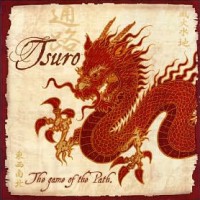
Tsuro
2-8
8+
15+
Create your own journey with Tsuro... the Game of the Path.
Place a tile and slide your stone along the path created, but take care! Other players’ paths can lead you in the wrong direction—or off the board entirely! Find your way wisely to succeed.
The rules are simple: you place a tile to build the next step for your stone to follow. Paths will cross and connect, and the choices you make affect all the journey across the board.
Stay the path—your journey begins here.
images © Calliope Games




Add a Review for "Tsuro"
You must be logged in to add a review.
Hello my little Dragons and Dragonettes,
Today we are going to discuss a little game called Tsuro. This game is perfect for all ages (my 4 year old to my wife’s grandfather have played), requires only a few minutes to teach, and has never failed to please. Let’s take a closer look…
How to Play…
Tsuro is a beautiful tile laying path game for 2 to 8 players (I will add the solo variant at a later date). Each player starts with a stone at the edge of the board and 3 tiles to lay. You lay a tile next to your stone, follow the path with your stone, and pick another tile from the draw pile. That’s it.
No wait. Tsuro is all about staying on the board and/or knocking the other players off the board. It can be as offensive or defensive as you like, but the only way to win is to be the last stone standing. This makes Tsuro a purely tactical game, because you are constantly reacting to what tiles other players have laid. You do not want to end up on a path that takes you off the board or crashes you into another player… so you hope you have the tile in your hand (luck of the draw) to keep you alive.
My Conclusion…
A game like this would get boring if it lasted longer than 15 minutes, but it usually doesn’t. It’s a quick game that’s great to start off a game night, or just get some family time in before the kids go to bed. I can count on one hand the games that can play 8 in 15 minutes, and Tsuro is one of them. This makes Tsuro a very valuable game in my closet.
Is Tsuro right for everyone? Well, no game is the be-all and end-all. If you don’t like tactical games with little strategy and an element of luck… you will not like Tsuro. However, if you like tactical games, have an occasional need for a game that can handle a larger group, or a quick filler for game night… this game is a winner. Not to mention, it’s beautifully designed. I’d say it’s worth a look.
Side Note: I’ve had this game for about 4 years now, and it’s probably come out as often or more often than most of my “great” games. It’s a very flexible “good” game.
Tsuro (Calliope Games) is a easy to learn strategy game that consists of nothing more than laying a lined tile down on the game board, then taking your token and following the path on the tile onto other tiles until the path ends. The goal is to keep your token on the board and while trying to cause other players token to follow a path off the board. The last token on the board wins.
Number of Players: 2 – 8 players
Average Game Length: 20 minutes
Gameplay:
Tsuro is game that can be taught and played in a matter of minutes. It’s very easy to understand the rules thus making it a great game for children and those who don’t want to spent a lot of time learning games with 40 page rule books (like Starcraft: The Board Game). Because there are so few game pieces and games are quick, it’s a good game for pulling out of the closet and playing at a moments notice. There is downtime between turns, but the pace of the game moves pretty quickly so you won’t spend too much time waiting on others to make their move.
Hardcore Score: 5
This game is good in short bursts, but it’s not something a hardcore gamer is going to play hours upon hours. There isn’t a lot of strategy involved and your best plans can be thwarted by someone throwing down a random tile and totally messing up your path.
Wifecore Score: 7
Due to the quick setup and easy to follow rules, this is a very good casual game. In addition, my wife likes it because its a great social interaction. You don’t have to spend a lot of time planning out your next move so during your downtime you can chit-chat with everyone around the table.
Kidcore Score: 9
Of all the games I’ve played, this is by far one of the most kid-friendly. Probably anyone ages 5 and up can play because there are so few rules, no reading is needed, and you don’t have to hold many tiles in your hand. Now a 5 year old may not be able to plan their moves in advance. But it’s easy to understand that your piece follows the path until it can’t go any further. Highly recommended for kids.
Back in 2005, Tsuro: The Game of the Path was an odd release. It was the first board game to come from WizKids, a company better known for its CMGs or Collectible Miniatures Games such as MechWarrior: Dark Age and Heroclix, and their CSGs or Constructable Strategy Games like Pirates of the Caribbean and Rocketmen: Axis of Evil. Tsuro: The Game of the Pathwas a step away from all that, a complete and self-contained game that matched the European model in terms of quality, and matched its simplicity of concept with a simplicity of play. For a while it has been out of print, but now it has a new publisher.
The concept is that the Dragon and the Phoenix share the guardianship of the paths of life, maintaining a careful equilibrium between the two forces of luck and destiny. Only by finding a balance between the two, can you find the path to enlightenment. In Tsuro, this is reflected in the players having to find their way across the board, but curiously not to the other side. Indeed, a player does not want to find a path to the other or edge of the board, but rather he wants his opponents to do so. This will lose them the game, and if he can force this to happen by putting a path in front of them in front of an opponent — which he must take — then so much the better.
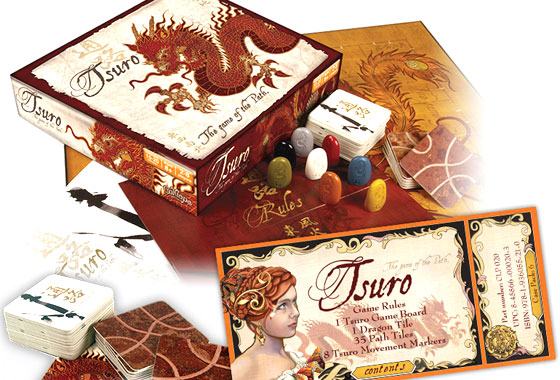
What strikes you first about Tsuro are the quality of its components, and the obvious thought that has gone into both its look and feel, all done in rich earthy shades of brown and following an Oriental theme. The rules are beautifully presented on a fold out card sheet, a cover sheet sits below that on top of the fully mounted board, and below that are the nicely shaped playing markers, and the glossy, hardy tiles. The only downside to the components are the plainly presented rules given in Dutch, French, German, Italian, Portuguese, and Spanish, and the playing markers. These eight, each in a different colour and with a dragon motif stamped into them, are of cheap plastic. They just do not feel as if they match the quality of the rest of the game.
The board consists of a six-by-six grid of 2½-inch squares, the same size as the tiles. Each of the edge squares is marked with a pair of starting marks on the very edge. These starting marks align with the lines or paths that run across the tiles. Each tile is marked with four of these lines running to the sides of a tile to create a total of eight entry and exit points. Although the paths cross, they never connect across a tile, only from one tile to the next. The effect, as the tiles are laid out on the board, is to create a series of separate paths, on which the players will never meet unless their paths are connected. It is important to note that each of the 35 tiles is different, but that they can all be laid out on the board to create a variety of paths and patterns. The 36th tile is an exception. The Dragon tile is used to indicate who draws the first after the draw pile is reshuffled.
Designed for two to eight players, a game begins with each player placing his marker on a starting mark and receiving a hand of three tiles. On his turn, a player selects one of these three and puts the tile down on a square next to his marker so that it increases the length of the path his marker is on. He then moves his marker along the new section of path to its open end. If another player has his marker on a path that is connected to and extended by the addition of this newly placed tile, then the marker is also moved along the path to its open end. In doing so, should a player’s marker be connected to a path that leads all the way off the board, then he must still follow it to the end. When his marker leaves the board, a player also leaves the game. The aim of the game then, is to force your opponents’ markers off the board, whilst you try to stay on.
And that really is it. To win you must be the last player with a marker on the board. It is possible to have two winners, but only if everyone else has been eliminated and all of the tiles have been placed. There are enough tiles to fill the board bar a single square. Players can also be eliminated simultaneously, when their respective paths are connected, forcing their markers to follow each other’s path back to the starting point and off the board. Of course, a player does not have to play a tile that will force him from the board unless no other move is possible, but when players’ paths grow closer, it is highly probable. It is possible for there to be no winner, having played games in which every player is eliminated on a single turn leaving the board empty. This is more common with only a few players.
Tsuro is both easy to learn and understand. Although two can play, it is definitely a better game the more players are involved as there are more opportunities for rival paths to connect. A greater number of players also increases the playing time, but to no more than half an hour. Nor is it an easy game to win despite the simplicity. Rather it is an easier game to lose than it is to win, and to be fair, Tsuro is very, very light in terms of strategy. Which probably makes it too light for more than an occasional play by the serious gamer, being more of a side dish than a main course, making it better suited to a family audience. Even so, Tsuro: The Game of the Path is an enjoyable attractive game that has been ably executed from concept to completion.
Once upon a time, I thought that Tsuro was a silly, simple game of avoidance. Then, I played somebody who knew what they were doing. It absolutely blew my mind – and still managed to play in under 15 minutes. Thus began my love affair with Tsuro, which continues to this day.
How does it look?: Tsuro is gorgeous. It may well be my favorite game to just casually look over after a round. The board is beautiful, and as it is filled up with winding path tiles the patterns formed are captivating. Cracking open the box for those who’ve never played is a pleasure.
All of the components are thick and sturdy. My tiles are good as new after a few years of heavy play, and the player pieces are unscratched. The choice of colors for the playing pieces isn’t particularly exciting, but I think that the mute tones fit quite well thematically.
How does it play?: At its core, Tsuro is a very simple game. Each player has a hand of tiles. On your turn, you play one tile in front of your piece and follow the path that it creates. If you have not been eliminated by colliding with another player or moving off the board, then draw a new tile to replace the played one.
The easiest strategy to grasp is one of avoidance. If I can stay far, far away from you, I can move about freely, make some pretty patterns, and eventually people will start running out of space and losing. Whoever used their space best wins, yay! But that’s just the start of it.
As you get familiar with the game and the tiles, some much riskier but stronger moves make themselves apparent. Aggressive players can wall off other players and choke their options. Crafty players thinking several moves ahead can make the most of limited space, creating an emergency path that will lead them back to open space. The rules are simple, but the strategies made possible by truly learning the game are deep and elegant.
Overall Impression: Tsuro is a really wonderful game. It does involve player elimination and the discomfort that can cause with some players, but a game should not take more than 15 minutes to play.
Tsuro’s pace makes it great to play between other games, but it also truly deserves some play for its own merit. Each game is different enough that I am not against marathon play. I would recommend it to anyone who likes to play and think.
BUY. THIS. GAME!
*ahem* Sorry about the outburst, I’ll get into it before I gush too much.
The Overview: This game is a knock-down, drag-out fight to the death between a number of Dragons! The object of the game is to be the last Dragon flying by weaving a winding path through the mountains to confuse and trip up your enemies while staying alive yourself. The principle of the game is incredibly simple, you outwit and outlast your opponents. This game has been fun from the very first playthrough. Funny note, it is possible for each player to lose the game. Should the last tile to be placed run all the Dragons off the board, then everyone loses!
The Rules: The rules for this game are also incredibly simple, which is sort of the theme here. You begin by choosing a colored figure to represent your dragon, then you shuffle the game tiles and each person takes three of them. Randomly decide who goes first. On your turn you will place a single tile, then draw a new tile. When you place a tile, every dragon touching an edge of that tile will move to the end of their newly created line. If two dragons collide, both die. If a dragon is forced off of the board, they die. Game continues until all of the tiles have been placed. Once the final tile has been placed on the board the game ends and the last dragon standing emerges victorious. If there are multiple dragons left, then they tie. Very simple rules.
The Art: This game looks very intricate, with an ornate dragon on the board and on the tiles. The tiles themselves are sturdy, easy to shuffle and durable. They also look pretty good, time was take to design the aesthetic of this game and it shows in a very positive way. The player tokens are plastic figures with neat designs imprinted in them, they are reminiscent of colored stones and have a similar feel. Everything is very satisfying to touch and manipulate.
The Gameplay: Is amazing. Just, I have no other words. It is simply fun. Game takes no more than 15 minutes to play, even with maximum number of players. The turns are quick and there is always interaction, so you never find yourself just waiting. There is not much to manipulate, but, every player action can affect every other player in ways that are unexpected and exciting. I have seen one tile placed that killed five dragons, including the dragon that laid the tile! It flows very well, is very fast paced and game resets are a snap as all you have to do is just reshuffle the tiles. This game plays like a game should play.
The Opinion: I say again: BUY THIS GAME!! It is a perfect addition to game nights because it is very easy to learn, but has enough strategy to keep even veteran players interested and coming back for more. Games are a breeze to set up and play, it is the definition of a starter game. This is the game you play first, before you bust out Talisman. It is also the game you play before you switch genres, so after you’ve played Chaos in the Old World and you want to move to say, Clue, play a round of Tsuro in between to reset your gaming mind. This game is great in all phases and I absolutely love it. I highly recommend it for anyone who enjoys a casual, high-paced game that is light on strategy but does require some tactical thought.
On a continued note from some of my other reviews, really good Kickstarter games are starting to become more and more prevalent and I honestly like that trend. Indie game developers have some of the most interesting and unique game ideas. *steps off soapbox*
At first glance, you might be tempted to pass this game up as being overpriced and too simplistic. When you open up the box, there’s not much but a series of tiles and some token pieces to be used on the board. Well, there might not be much to the game, but that doesn’t mean that this game isn’t highly entertaining.
The game follows one simple principle/rule: Follow the Path. It could not be explained any more simply. However, some addition explanation helps. The tiles in the game have lines drawn on them to represent four different paths (2 entry points on each side of the tile). To start the game, you select a token and place down a starting tile on the edge of a playing stage. You then put your token on any one of the two paths on the edge of the board. From that point on, your token will follow whatever path you initially chose. You then place tiles (in turn sequence with your opponent), and each tile you place extends the length of your path. The object is to not run your piece off of the edge of the playing field where the path would end. If your piece collides with another player’s piece, both of your pieces are also removed from the game. Simple, right?
Well, here’s where things get tricky. The tile paths are often twisty, turny affairs. They will form complicated paths, and since you can’t jump paths, your token’s fate is tied to whatever path you create for it. Eventually, your tile path will intersect with another player’s tiles, and then your token is in for a WILD ride. Just remember…stay on the path!
This game is a game that can be played with a multiple number of players, and once you start playing in the open, you WILL get more players. Tsuro is like the call of a siren: once you start playing, it draws people in. The virtue of this game is that it can easily be understood just by watching it, so new players can jump in and not feel like they will slow the game down by learning it. And once people start to play, they’ll want to play again. The game is artistic in itself, feeling more like a creative exercise than a game, and it is entertaining for that virtue alone. I recommend this game for anyone who enjoys playing a game for the sheer sake of playing.
Tsuro is very simple to play and can easily play with more than four players. Most or our games run under 30 minutes and some are done in less than 15.
1. Play a tile
2. Move your marker
3. Draw a tile
The game ends when the last person has a marker on the board.
Even though the game is simple to play it is difficult to master. Just when you think you have the best strategy in mind, an opponent plays a tile, and you are out of the game. Not to worry, the games don’t take too long and you will be back in again.
Once I convinced several people who “don’t play those kind of games” to play Tsuro they were hooked. The game appeals to strategy gamers, but you don’t have to be a strategist to play well. It’s great when a six year old totally destroys the chessmaster.
Each tile that you play has a different design of lines that once placed will create a wide variety of paths. If a marker is on one of these paths, the marker will be moved forward until it 1) can’t move any farther because it’s at the edge of a tile 2) moves off the board (that player is out of the game) 3) runs into another player (both are out of the game).
There is a Dragon Tile that helps you keep track of who’s turn it is to draw and will help determine the winner. It comes into play when tiles are not available and a player needs to draw – they would instead draw the Dragon Tile. If another player is eliminated their tiles become available and the Dragon Tile holder gets to draw the first tile. They then set aside the Dragon Tile for the next player unable to draw a tile.
It is possible to have a tie, but we don’t run into it very often.
Tsuro is a game for almost every taste…
The dragon and the phoenix guard the paths of life for all who play the game. Will you choose your destiny, or let fate decide if for you?
Tsuro is a very straightforward game that is easy to learn and easy to play, but has a bit under its surface.
COMPONENTS:
Tsuro is a beautiful game. Everything about it, from the board to its pieces, is great to look at. The players’ pieces are some of my favorite that I have encountered in a board game. Coupled with a flaming phoenix on the board, this game has a lot going for it visually.
The path cards look great with unique paths for each card. But because the grid printed on the board is so light, placement can be an issue. A small issue, but still annoying.
GAMEPLAY:
This game is simple, simple, simple. Stay on the board longer than the other people. This is accomplished by laying path cards on the board, and moving your piece to the end of path. If your path leads to the edge or into another player, you are out of the game.
There are a few strategies that can evolve during the game. There are people who try and go around the edge and leave a lot of space for later, and then there are those that are aggressive and try to send other people off of the board. Both have advantages and disadvantages.
CONCLUSION:
Tsuro is a beautiful and relatively cheap filler game that can be played two or three times in a row. You’ll have a lot of fun, but it isn’t a strong game to carry a game night. With the ability to play with 2-8 players, it is very adaptable to different situations. Enjoy your flight!
Among many games that offer increasingly rich and complex mechanics, Tsuro stands out in its’ almost meditative, austere simplicity. It always remains faithful to its simplicity, yet in the process provides a satisfying, quick and surprisingly interactive experience that serves as a perfect introduction to board games.
The game can be explained within minutes – there is a board with a six by six grid on it (and a gorgeous phoenix artwork). Players take turns placing tiles with intertwining paths (each has a hand of three to pick from) and moves their piece along the path these are on. Each plastic piece represents a standing stone with a stylized dragon carved into it. Any piece that ventures off the board is out of the game and a collision of two pieces eliminates both.
The game accommodates 2-8 players and the more the merrier. Smaller games allow more room to manoeuvre and prepare, while more players means more proximity and proximity always leads to attempts to get your opponent off the board with a well-placed tile.
Tsuro is easy to explain to children (and is a hit with younger audiences in my experience) and most games are finished within 15 minutes. It can, however, be as complex as you want to make it – one could potentially plan out the exact routes that get formed in the endless entangling lines, but planning too far in advance requires lots of spatial reasoning and might make the game drag.
It works best as a filler game, a break between heftier offerings or as a first game you show to those new to the hobby. The components are all visually appealing and the tactile sensation of moving your smooth piece along the curved lines rewarding in itself (until you realize you just got yourself into a dead end at least!).
Tsuro aims low but delivers everything it promises and would be a great fit in any gaming collection.
Play this Game:
-If you are in the mood for a quick game (under 10 minutes)
-like simple easy to learn mechanics
-You want a good board game for families of all ages, casual players, people new to board games
-if you enjoy elegant illustrations
-love labyrinths
-enjoy the concept of being a high flying dragon following a path that you and other players lay down (don’t crash!)
Not so great:
-if you play several times in a row you may easily tire of the game
-if you want a more challenging game (perhaps try Tsuro of the High Seas)
Tsuro is a simple game with a very simple concept. Each player starts on the edge of the play board. Players each take turns placing tiles on the game board. Each of these tiles has multiple paths for the player to follow. There are only two rules when placing tiles:
1) The tile must advance the players pawn.
2) A player cannot lose by placing his or her tile unless there is no other choice.
Players lose by completing a path that connects to two edges of the game board (meaning it is impossible for the player to continue to place tiles to advance his or her piece). Players can use tile placement to their advantage; tiles can be used to advance other players so long as the player continues to follow the 2 rules above. This can be used to knock other players off the board. The last player standing is the winner.
The game is really fun no matter how many players are playing. In a 2-4 player game, there is a decent bit of strategy in how you place your tiles. The game only takes 15 minutes or so. In a 5-8 player game, it’s pure chaos, but still a lot of fun. Players will quickly fall, but the game will still only take up to 15 minutes.
I love pulling this game out at parties. It’s simple, takes less than a minute to teach, and very entertaining to drunk people. That simplicity also makes it great game for new gamers, such as children.
All in all, I give it a personal 10/10 just for how much use I’ve gotten out of it. It is easily one of my most well loved games.
I was first turned on to Tsuro on Wil Wheaton’s Tabletop series on Geek & Sundry (YouTube) and I immediately knew it Had to be in my collection. An elegant, easy to learn game of sweet sophistication!
And, it really couldn’t be more simple! Each round players play a single tile from their hand of three and then have to move their dragon play piece all along the path that is made. The pathways become twisted and when a new tile links to other paths, you have to continue down these paths until you go off the board (lose), run into another player (lose) or go to an empty space. It kind of reminds you of the Tron race game in which players can try to block each other, forcing them to run off board.
To say it’s an easy game to learn is an understatement! Small children should be able to grasp this game without trouble. On the other hand, the game is simply elegant and a lot of fun to play! Since you only have 3 tiles in hand and never know what tile you will draw in the future, your strategy needs to be as fluid as possible to make up for bad tile draws.
And here is one of the best aspects of the game: Although it’s really easy to lose, it’s even more rewarding to win. Even if you do lose, chances are you’ll want a rematch! And then another one! Then maybe best out of 5, or 7! Before you know it, your players are throwing down all sorts of blocks, avoidance plays or accidental blunders, all of which result in fun, fun and more fun!
Sure, it’s not the kind of game that many hard core gamers would be over eager to play, but when you want a light game of whimsy or have only a limited amount of time to play this is one of the best 15 minute games you’ll find!
Tsuro is a great filler game for 2-8 players, and it’s very easy to learn.
Setup is really easy. Lay out the board, choose your marker, and deal 3 tiles to each player. Starting with the oldest player (according to the rules, but you can always change this if you want) and then going clockwise around the table, choose your starting place on the board.
To play, place a tile on the square next to your marker, then move your marker (and any others that are next to the new tile), and draw a new tile. Players are out of the game if a new tile is played that causes their marker to go off the board or run into another marker. Continue placing new tiles until only one marker remains on the board. The last person on the board is the winner.
Thoughts
This game is best with more players. I’ve played with just 2 people, and it’s not as exciting. Mostly we stayed on opposite sides of the board, laying tiles that only affected our own markers, and the winner didn’t come until the last tile or two. When playing with more people (I played a couple games with 6), there is a lot more interaction between players.
Overall, this game is really easy to learn and fun to play. It’s great as a filler between more involved games, works well with a large group of people, is quick, and also works for a wide range of ages.
In Tsuro, you take on the role of a flying dragon – how awesome is that?! The board is a beautiful backdrop of Asian art with space for 36 square tiles. Dragons start on the sides of the board and lay one tile per turn (from their hand of 3 tiles), then follow the path that the tile creates to its end. Each tile has 2 paths on each of its four sides, and you will find yourself executing loops, sharp turns, gentle curves, and straight lines. Dragons are eliminated when they are forced off the edge of the board or when they crash into each other. The last dragon flying wins!
Tsuro is elegant in its simplicity: lay tile, follow path. Anyone can pick it up and play instantly, but it takes cunning and foresight to move your dragon into an advantageous position while spoiling your opponents’. It’s not long before your tiles begin to interface with other players’, and you will cheer as you steer two players’ dragons into each other with a well-laid tile, then groan as the next dragon’s tile sends you careening off of the board. While it’s very possible to push yourself to disaster — either inadvertently or working your way into a corner with no escape — your demise will usually be brought about by another player.
Tsuro is an excellent game to play in short bursts, but it’s not the kind of game you can sit around the table with and spend an entire afternoon on. Excellent for light, quick fun, but not a game you can sit and play over and over for hours on end.
The game goes very quickly, and functions very well as a palate cleanser between bigger, longer games. While enjoyable to play and beautiful in its presentation, Tsuro is somewhat limited by its simplicity, and players looking for more in-depth gameplay may leave unsatisfied.
I don’t own this game, but it shows up now and again at my game group’s weekly meetings or special events.
You get two tiles with paths on them at the start of the game and lay yours down at the edge of the board to enter play with your stone. You chose a path and move your stone along it to the edge of the tile. You get another card and the next player plays and so on.
Each turn you choose another tile to place and follow the path to the edge of the tile again with your stone. You must follow the path all the way until you can’t move any more because you run into the edge of a tile. If your path leads you off the board, you lose. If your path leads you into another player’s stone on a path, you both lose.
Play keeps going until their is only one player remaining.
The great thing about this game is that it is quick, though the last game I played we used just about every single tile before there was only one winner. Tsuro also accommodates up to 8 players, so this and the quick play time makes it ideal for a filler game at any point during a game day where you can have a decent variety of number of players and want to get a quick game in.
This is an awesome addition to any serious gamers collection for many reasons.
1. It has beautiful components – everyone who sees the board is impressed with the asian art. The quality of the card stock is top notch and the pawn colors are easily distinguishable and complement the board art.
2. Relatively inexpensive- in a time when hobbyist board games cost upwards of 50 dollars this at 30 is a steal.
3. Easy and I mean EASY to learn
4. Even easier to teach…This is my filler and GO TO game for new gamers. You don’t want to bore them with lengthy rules explanations or intimidate during play with rules lawyering. Helps to promote the hobby
5. A good mix of luck (random draw of cards) and simple strategy (advance card play planning).
6. Quick game play usually leads to many repeated plays.
One variation on game play I like to introduce after a newer players are comfortable with the rules is once per game allow the placement of a tile on another players pawn.(Payback on the next game is usually the next course of action.)
Own this game you won’t be sorry.
When I first saw this game played on a video, I was instantly sold.
I loved that it was such an easy game to learn. As a matter of fact, I thought the video tutorial did such a good job in talking about how to play the game and I only had to read the instructions once and then I was set.
You know how typically feel bad about being killed? Well, this game isn’t that game even though sabotaging your friends or family members will eventually happen. It doesn’t feel as bad because this game plays so quick that the opportunity to exact revenge is always there. I think the longest game was 20 minutes at the very most and even then it felt quick because it was still such a fast moving game even with 8 players.
What makes this game move so fast is that once your friends understand the concept, they are already planning their next move before their turn. This is something that, as gamers, we always like because it helps keep the game moving along.
I number one thing that I love about this game is that, even thought it is about survival, you can still plant a move (tile) that can save yourself but screw up your fellow game players in a single move. I love that!!
Tsuro is definitely a game that I like to bring out very often because of its accessibility as well the fact that there is quite a bit of strategy involved even for such a simple game.
Must buy!
My mom is not really a board game person but I got her to play this one time and now she asks me for it every time I come over. Even my dad who hates games likes this one. It’s quick and easy to learn. You can play this game over and over and nothing will be the same. I play this game as a starter to board game nights or in between ‘heavier’ games. It gets the juices flowing or it can be used to wind down a night. Just stay on the board as long as you can. No two people will play the same way with the same tiles.
After seeing this episode of Wil Wheaton’s TableTop, I had to get a copy of Tsuro for myself. I drove down to my FLGS, picked up a copy and immediately got it to the table.
First thing I noticed was that the components are beautiful. You are definitely getting your money’s worth out of this game. Next, the rules were only a single page — that’s a welcomed sight for the casual gamer. Finally, this thing scales exceptionally well. It can accomodate 2-8 players, and it really just works all around. (Yes, the strategy changes when only 2-4 people are playing versus 5-8, but it’s still fun either way.)
One more thing — this thing is light. If boardgames were food, Tsuro is kale chips or seaweed in broth. I can’t emphasize how light and easy this game is to play or set up.
If you’re a casual gamer looking for a quick filler game, you can’t go wrong. If you’re on the fence I highly recommend checking out Episode 3 of TableTop to see the game in action. If you’re more into the heavier stuff, and are not interested in a lighter than light boardgame, I’d say pass.
Tsuro is an abstract strategy game for 2 to 8 players. Really. It scales so well that it is interesting and challenging for any number of participants within this range. In fact solitaire variants are also possible.
At the beginning of the game each player places his or her “stone” at the edge on the board. Then the players start to lay tiles on the board, so each tile is placed next to the active player’s stone. Each of the tiles has a different configuration of paths. After laying a tile all the stones that were standing next to it are being moved along their paths. The aim of the game is being the last player with one’s own stone on the board: If a path leads a stone off the board or two stones “collide”, their owners are eliminated. There’s a bonus for eliminating opponents: the active player may swap their own tiles with the tiles of kicked off adversaries.
The rules are simple and intuitive (yet the rule leaflet explains them not too easily) and the gameplay is fast, however it requires careful planning based on something that can be called “geometrical imagination”. For skilled players one game of Tsuro may take 10 minutes or even less if they agree to play a blitz game.
The design of the game based on far eastern motives is stunningly beautiful. It’s a real aesthetic pleasure to play this game! The board features a drawing of a phoenix, the colorful stones have dragons engraved on them and the tiles look like made of reddish stone. For sure Tsuro is worth a try!