
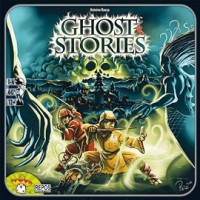
Ghost Stories
The Lord of Nine Hells walks the earth.
Wu-Feng, the Lord of Nine Hells, has discovered the village hiding the funeral urn containing his ashes. Four Taoist priests protect the village, as hordes of ghosts and demons descend on the town to reclaim the remains of their evil overlord. Can you hold out against the forces of eternal darkness, or will Wu-Feng recover his ashes and destroy everything in his path?
In Ghost Stories, the players work together as the Taoist priests attempting to turn back the tide of evil and save the doomed village. With mystical powers and ancient martial arts, the heroes will battle wave after wave of ghosts and demons until Wu-Feng himself rises to claim his remains. Working together is your only hope, as the ghosts increase in number and force the Taoist priests to sacrifice resources, time and even their very lives in this desperate battle against the hordes of Hell.
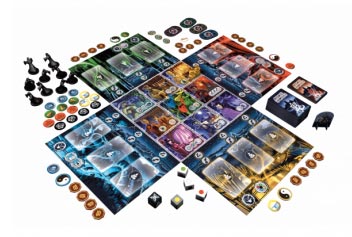
Ghost Stories is a cooperative game for one to four players. With modular playing tiles and a randomized deck of ghastly foes, no two games will be alike. The cards and tiles boast fantastic illustrations inspired by kung-fu legends, and a variety of excellent plastic playing pieces will draw you into the game. Gather your forces and battle the Lord of Nine Hells in the ultimate battle of good versus evil!



Add a Review for "Ghost Stories"
You must be logged in to add a review.
A funny (at least to me) note about the title to the review: I was planning on reviewing Ghost Stories for the past several weeks, and I was going to title the review “The Definitive Horror Board Game”… but a few weeks back @Hokken titled his review of Eldritch Horror nearly identically. I haven’t played Eldritch Horror (I’m pretty burnt out on anything Lovecraftian), but I’ve played every other horror-themed board game I’ve gotten my hands on… and Ghost Stories is the pinnacle for me.
Observed Set-Up and Play Time
Ghost Stories has two huge benefits going for it when you open the box: there is only a few sheets of cardboard to punch (and many of the punched pieces are large), and the rulebook is incredibly concise. Game play is by no means simple, but I’ve noticed that Antoine Bauza has a real penchant for being able to explain a unique (and sometimes complicated) game in a 4- to 8- page, easy to read rulebook (Takenoko and Tokaido being other examples). You can start your first game 30 to 45 minutes after opening the box – a fraction of the time needed for other immersive horror games like Arkham Horror, Mansions of Madness, Zombicide or Zpocalypse, and right in line with less-immersive games like Elder Sign. My first game took 2 hours (and it was a relatively “quick” defeat, judging by the number of cards left in the deck when we died), and I’ve never been able to finish Ghost Stories in less than an hour and a half, let alone the publisher’s advertised time of 1 hour. It may play faster as a solo game… I have yet to try it this way.
My Learning Curve and Teach Time
To tackle the easy one first, teach time is pretty reasonable. The movement and action mechanics take no time at all to comprehend, and the special rules regarding Haunters and Tormentors are easy to grasp. But you will have to spend a chunk of time explaining all of the symbols. The game board and cards are entirely symbols-based (AWESOME if you want to teach the game to a pre-reader, although the graphic card images might scare them), and there are a bunch of different ones. It shouldn’t take longer than 30 minutes to teach this to a newcomer. Learning curve is much more difficult to assess… You’ll have movement and attack mechanics, as well as the general flow of the game, down after one play; but it takes an eternity to eliminate mistakes from your decisions. And it’s really hard to assess how much you’re improving when every single game results in defeat. I’ve beat this game twice in 25 to 30 attempts. Both wins were 4-player games, so it may be a balance issue with fewer players, but even the two 4-player wins were VERY close to defeats. Arkham Horror (or any other co-op I’ve played) is easy to win in comparison. My litmus test for co-op difficulty has been to compare a game’s “beatableness” to trying to beat the Chairman (with advanced rules) in Sentinels of the Multiverse… this is the only game I’ve found that’s harder.
Group Sizes and Dynamics
Unlike Bauza’s other games, I can get anybody in my group to sit down for Ghost Stories (their loss on the others, as every game I’ve tried from him has been fantastic). The board is beautiful, mechanics unique and cards graphic… it has something for everybody. And one great equalizer among those I play games with is that we’re all suckers for co-ops that make you EARN your win. People who don’t like horror themes enjoy it, as do people who don’t like co-ops or those that prefer hardcore Euros. A very easy game to get to the table, and without the time restrictions of the aforementioned immersive horror games.
Objectionable Material
This one is tough. If Ghost Stories were a movie, it would be PG-13… but we’ve had a lot of PG-13 horror movies in the last decade that would keep pre-teens awake at night staring at their closet doors (if any of you saw Mama… Mama was horrifying… and targeted children to boot!) There are no guns (or weapons of any kind save the batons held by the miniatures) in the game, and no violence. The work your monks are doing to rid the city of ghosts is akin to the containment boxes used by Peter Venkman and his crew. But the cartoon images on the cards are straight out of J-Horror nightmares… there’s otherworldly demons, messed-up looking children, seductive women, re-animated corpses… nearly every card image would be scary to anybody who hasn’t been desensitized to it. While much of the game could be appreciated by a younger gamer, I doubt I’ll let my son get to this one before he’s 12 or so.
Comparable Titles
I’ve already listed a handful of games that either fit the theme or feature the same designer (and this definitely feels like a Bauza game). But more than those games, Ghost Stories bears a strong resemblance to co-op classics Pandemic and Forbidden Island, as the point of the game is to get to the locations ghosts appear at and deal with them before things get out of control (you even flip board tiles that become haunted much like Island’s sunken tiles). If you are a fan of Bauza’s other games, Pandemic or Arkham Horror, Ghost Stories has a great chance of becoming one of your favorites.
So why is Ghost Stories the best horror game (to me) out there? It has all the elegance of a rich Euro game… with component quality beyond wooden meeples. It has one of the most popular themes among board gamers… without the occasional “clunkiness” and time consumption other immersive horror games exhibit. It’s a co-op game that can appeal to the harshest strategists and tacticians due to its insane difficulty. Every corner is rounded; every surface smoothed. You will lose, but you won’t be punished or frustrated by it. A game everyone should try, and my new litmus test for cooperative games.
Ghost Stories is a medium-weight cooperative game for 1-4 players in which the players take the role of Taoist monks defending a village from the minions of Wu-Feng. The monks can request aid from the various villagers and use their own special powers to help exorcise the ghosts and, ultimately, the incarnations of Wu-Feng himself before the village is overrun and Wu-Feng is resurrected.
Gameplay Summary
Ghost Stories is a difficult game to sum up briefly, so this summary is intended only as a general overview for review purposes and not an exhaustive breakdown of the game.
The village is created by shuffling the village tiles and randomly placing them into a square. The ghost deck is shuffled, as are the incarnations, which are much tougher than normal ghosts, and a number of incarnations appropriate to the number of players and the difficulty level are seeded into the shuffled ghost deck at fixed intervals. Players choose a monk and one of two abilities, and then receive a number of various tokens appropriate for the difficulty level of the game.
At the start of a typical turn, a ghost is drawn and placed on one of the player boards in accordance with its color. Some ghosts perform certain abilities upon arrival, and some do so at the start of each turn of the board on which they were placed. Each monk is then able to move and either request help from a villager, which can provide them benefits like extra Tao tokens or removing a ghost from play, or attempt to exorcise one or more ghosts adjacent to their current village tile. Ghosts have a strength called resistance, and a ghost can be exorcised by equaling the ghost’s resistance through some combination of rolling the ghost’s color on Tao dice, spending Tao tokens or leveraging certain abilities gained from village tiles. Although there are plenty of other options, these are the basics.
The players win by exorcising all incarnations of Wu-Feng before 3 village tiles become haunted (a special ghost ability), the ghost deck is exhausted with an incarnation in play, or all monks perish. Victory requires constant management of the ghosts and their effects through teamwork and optimal use of special abilities, village tiles and special tokens.
Gameplay Features
• Fully cooperative play
• Possible player elimination
• Four adjustable difficulty levels
• Randomized modular game board
• Four possible players with variable powers
• Solo game mode
Components and Theme
The production quality of the game is superb. It comes with a number of detailed plastic figures, ghost cards, and sturdy tokens, tiles and player boards, all adorned with fantastic and thematic art. The ghost card material is the weakest point, being less sturdy than a Dominion card and possessing black edges that tend to show any wear clearly. The cards are shuffled only once per game, so it will only be an issue for frequent players of the game, who can easily sleeve the cards. There is also a beautiful full color rulebook and reference sheet included.
This game is dripping with a Chinese ghost story theme, represented in not only the artwork and figures, but also naming, terminology and abilities.
Ease of Adoption
This game has a sharp learning curve, largely due to the heavy use of terminology and symbology, the variety of possible actions and its overall uniqueness. The rule book, although beautiful and full of information, does not succeed at explaining what is a relatively simple base rule set. For example, the 1-3 player setup rules are separate from the primary setup section, which focuses on 4 player setup and does not reference where to find setup for other player configurations. A turn walkthrough or a few more visual rules examples would have helped to clarify some of the concepts. I feel that the game is best learned from someone familiar with it or playing the solo game prior to attempting to teach others.
Ghost Stories is a difficult game, even at the lowest difficulty levels. Mastery of the concepts will take multiple plays depending on player experience and is not easy to achieve.
There is no conflict between players built into the game, so this game will appeal to players who do not like conflict. However, like all cooperative games, one or more dominant players can attempt to dictate the moves of others, which could affect the enjoyment of the other players.
Setup and Play Times
Setup is relatively easy and will take 10-15 minutes for inexperienced players and considerably less for repeat players, as although the 1, 2 and 3 player rules are disjointed from the 4 player rules, setup of the environment is clearly spelled out in the rule book.
Gameplay typically takes 45-60 minutes. Each turn is relatively short, which eliminates long delays between turns, especially when each player can always be involved in planning.
Gameplay is fully cooperative, but, unlike most cooperative games, individual players can be removed from the game due to the death of their monk. Players still in the game can resurrect fallen monks, but, depending on the current game state, this may not be possible. However, even if a player is no longer in the game, if the active players triumph, the ousted players share in the victory. Regardless, this means that individual players could sit idle for indeterminate amounts of time during the game.
Luck Factor
Players can choose their monks and their special powers, but every other element of the setup is random and subject to poor draws like other cooperative games. Since most exorcisms will be accomplished by rolling the Tao dice, repeated poor rolls can also contribute to ultimate defeat. The multitude of available actions does allow players to reduce the impact of luck, so luck is balanced well when players take full advantage of their options.
Fun Factor
Perhaps due to mixture of challenge and theme, the game is a lot of fun even when it is lost. Players cheer for victories and bemoan defeats in equal measure.
Replay Value
Nearly every element of the game is randomized. With four difficulty levels, variable player powers and a varied selection of incarnations, even frequent players should constantly find challenge and replayability. The ability to play the game solo is also a huge benefit and makes for an excellent way to learn the game.
Although not part of the scope of this review, there are two expansions available that significantly modify the flow of the base game, as well as several available promos to add more variety.
Suggested Audience
This game is perfect for casual and experienced gamers who enjoy a challenge or to those who enjoy cooperative games. I would not suggest this game for non-gamers or those new to cooperative games, as the steep learning curve and the fact that most groups will lose more than they succeed may turn off these players. Players who do not enjoy a significant luck factor in their games or who do not like losing will probably want to pass.
Conclusion
Overall, I find Ghost Stories to be an extremely fun, theme-heavy and well-designed game that I can play even after a tough loss. It is a great game and one that will continue to see plenty of play in my gaming circles for a long time to come.
Ghost Stories, I want to start out by saying, is a very fun game. Its a game, however, that you have to play an expect that you will very well lose!
Ghost Stories is a co-op board game where players assume control of different Taoist monks, each one with a little bit of a different ability. Each turn, new ghosts will enter the field of play and cause all sorts of different mischief – from haunting the villagers to making you lose life points to cursing you to locking you out from additional abilities, etc. etc. The object of the game is to defeat the final ghost, Wu-Feng, and while you the players have one way to achieve victory – the game provides several ways for you to lose the game – so the game itself is very stacked against you. In a way, I think that the game being against you is a good flavor of good against evil in a way – but that would be for a different kind of writing.
The games components are fantastic and very crisp. The art work on for the pieces is very nice and better than what I’d have expected for a game like this. As you could probably imagine, the game is based around an Asian art style and imagery. The gameplay is easy to pick up – I would say you can understand the basic rules quickly, but it’d take a couple of games to really get the feel for what you can do and what you shouldn’t do. Gameplay is fairly quick, and by quick I mean that the ghosts will probably eat you alive very quickly! When you try to defeat a ghost you will roll some dice. Each ghost has a different value that you need to roll – and the dice work by matching the colors to that colored ghost. Combat is actually pretty intuitive and easy to understand, actually, but it sucks when dice hate you.
Overall, I enjoy the game even though I’m a loser and haven’t beaten it yet. I have only played the solitaire version, however, as I haven’t gotten a chance to get my wife into the game (she says it looks a little scary). Its one of those games that continually beats me so I have found it to be my quest to force myself to beat the game somehow and someway.
Who would like this game? Well, the solitaire play is very good and strong – its very challenging, which is something I think solitaire games lack at times. So, if you play by yourself often – that’s a possibility. If you enjoy an asian theme in your games, or in general, you may enjoy the theme of this game. However, I think its strongest aspect is that its very co-op driven and that the challenge value of the game is amazing is one of the best features for it. Who would not like it? I know some people may be turned off by it being a co-op game. I know several players who want to play against others players and not WITH other players. It may be a bit too difficult, so the people who don’t like to lose may be turned off by it as well. Finally, combat is somewhat luck driven as its resolved with dice – so if you don’t like luck driven games or games that use any form of luck, then it may not be for you.
Ultimately – I love this game and I am playing it very often at the moment. Give it a try, its a very solid game that offers challenging gameplay that will be rewarding once you finally are able to beat it!
Antoine Bauza. The name conjures to mind such fascinating and eclectic games as 7 Wonders and Takenoko. I’ve heard Hanabi is interesting, too. How is it, I must wonder, that one game designer can come up with so many unique, abstract concepts for games that are each so individually different in mechanics and theme, while all being so much fun?
I was recently invited to try Ghost Stories with three friends. It was already late — the tail end of a long game night, and most of the other guests had gone home. But I’d heard great things about the demon-slaying monks of Antoine’s abstract little village, and steeled myself for a few more hours of snack-munching, beverage-swilling, and cooperative gaming.
Spoiler: I was not disappointed.
The Premise, the Goal, and the Summary
A new review format? Oh, yes I am. I’ve watched too many videos where the reviewer told me the mechanics of the game for 12 minutes without telling me the goal or victory conditions of the game. Let’s get that out of the way first, along with a little exposition on the game’s theme.
Ghost Stories is a game wherein the players take on the roles of mystical monks, who are defending a village from the onslaught of a powerful demon and its horde of vicious minions. The powerful demon is hoping to defeat the defending monks and retrieve an even more powerful demon‘s ashes from the burning, plundered wreckage of the village. After that, the big, bad demon is resurrected and plunges the world into eternal darkness.
Your goal, as the village’s defenders, is to fight off wave after wave of demon and ghost and creepy crawly, enduring the onslaught with the help of your companions and a few stalwart villagers. If you and your companions, or even just one of you, can outlast the forces of darkness, then victory is yours and it’s time to buy the first expansion!
That’s right. This is a fight-’til-the-end survival game. And it puts Castle Panic to shame.
When it comes down to it, this is a very difficult game for the players to defeat — and that’s something I personally love in a cooperative. Without teamwork, without planning your strategy a few moves ahead, and without making the most of your resources, your monks will fall in a brilliant blaze of glory. And then you’ll want to set it all up and play again.
There are two- and three-player rules, but I have found Ghost Stories really lacking if the full compliment of four players aren’t gathered around the modular board, cheering each other on and biting their nails at every unlucky roll of the dice. With so much going on (and there’s a lot going on) it’s difficult enough to keep track of your own monk.
An absolute must-have for cooperative gamers. Just don’t let the dreaded Alpha Gamer take over.
Okay, Enough Exposition! Let’s Set This Puppy Up!
Are you ready for one of the most modular, non-dungeon crawl cooperatives you’ve ever laid eyes on? There are so many setup options in Ghost Stories that while laying down the board and passing out tokens won’t take you forever, you’ll be hemming and hawing for a bit over which Ultra Cool Power to utilize this time.
The Village is a lovely little place, with an apothecary, a shrine, and other friendly villagers and vendors to aid in your battle against the legion of demons descending upon you. Nine tiles in total, these get laid out in a random arrangement prior to play, and then surrounded by each monk’s player board.
Player boards themselves are two-sided. Will you choose the power of Flight this time, or perhaps the ability to produce any magical token you’d like each turn? Or select the power of immunity to curses. Each power is useful in its own way, and will be very important at some point during the game.
Finally, pass out health tokens, combat bonus tokens of each monk’s appropriate color, and then shuffle up the Deck of Demons — making sure to place the Big Boss Demon within 10 cards of the bottom of the pile. You’ll need some preparation time before you take him on!
Draw your first demon and you’re ready to go.
Nobody Likes Nine Paragraphs of Rules Explanation
You’ll have a rulebook to tell you how to play, but here’s the cliff notes.
On each monk’s turn, a demon is drawn from the deck and placed on the board of the player whose color it matches — i.e. a red demon goes on the red monk’s board. If that player’s board is full, he loses health, but no new demon appears.
Some demons have special abilities that trigger, like tormentors that apply curses or haunting ghosts that advance toward the village and, if they reach it, destroy the villagers and any assistance they can provide you. These villagers and their resources are essential to victory, so letting the haunts get through is a no-no!
Each ghost has a color-coded number of dots on his corner. Monks can attempt to exorcise the demons by rolling four custom dice and matching the number of dots on the demon — supplementing those rolls with colored tokens, earned by defeating tougher demons or gained via special abilities and villagers.
Players choose whether to take their turn exorcising demons, or rushing across the village to acquire special resources such as Buddha statues, which can be used as “land mines” to destroy ghosts that appear in their board space.
Turns continue in this fashion until either the demons or the monks are the last man standing. Usually it’s the former — so there’s good reason to celebrate if the monks win the day.
A Box Full of Demons, Kinda Like Pandora’s
The component list for Ghost Stories isn’t the kind you’ll drool over, but it’s on par with some great board games. You get multi-colored monks in day-glo plastic as your avatar pawn, creepy black wraith miniatures to show the position of moving haunts, a set of custom dice to roll for curses and exorcisms — and then a half-hour’s punching worth of cardboard!
With cardboard tiles for each lovely, scenic village location and evocatively-neon player boards, and tokens for a slew of mechanics not covered in this review, you’ll be buying a box of snack-sized sandwich bags just to keep it all sorted.
My favorite component, however, is the deck of demon cards. Each demon card is eerily beautiful in its creepy illustrations, and should probably not be stared at for too long, just for sanity’s sake.
Should You Buy It?
I really feel like Ghost Stories scratches a lot of gamer itches: it’s got very solid cooperative play, is awesome for strategy gamers, and can be played in just about 90 minutes on your first attempt — then the advertised 60 minutes once you’ve got the hang of the rules.
Great for small parties of four looking to blend it with a night of Wiz-War, Settlers of Catan, and Survive for a four-player extravaganza. Just make sure to get a few other games in first, because once Ghost Stories hits the table you’ll find yourselves determined to defeat those demons — or pass out face-first in the onion dip at 3:00 AM while trying.
Definitely worth a buy, and up the alley of every gamer I’ve ever shared a table with.
This game has an exceedingly simple setup, which can be randomized for replay value. Each of the location tiles has a an ability which a player can activate for a cost. Some times the cost is one of your resources, sometimes it the cost is adding more enemies to the board.
Likewise, the 4 player boards (1 for each of 4 different monks) each have two sides allowing a different ability. You chose (randomly, if you like) which side and have the ability displayed on that side for the duration of the game. Different combinations of the various player’s abilities add more replay value, and allow for customizable team strategies. The abilities include enhanced movement, extra actions, protection for enemy effects and the like.
In addition to the aforementioned components are the combat dice, the curse die, ‘Qi’ tokens, colored spirit tokens, power tokens (in games with fewer than 4 players) and yin-yang tokens.
The combat die show various colours on each of their faces, corresponding to the various colors of enemies.
The curse die shows various effects (or, if your lucky, non-effects) on each face. This die can cause you to lose ‘Qi’, spirit tokens and can add enemies to the board–or do nothing at all (if a blank face comes up).
The ‘Qi’ tokens are the life of your monk. These can be taken by curses, being overwhelmed by enemies, or can be spent to achieve effects at certain board locations.
The colored spirt tokens allow you to add power to your attacks and to damage certain otherwise invincible enemies.
The power tokens allow you to use the powers of passive player boards.
The yin yang tokens are primarily spent to revive board locations rendered unusable by enemy abilities.
You can play with as few as 1 player and as many as 4. When not using all possible players, it is possible to activate the abilities of unused player boards by paying a cost: thus, the strategic benefits of other board’s abilities are never unavailable.
The game itself is difficult, even using the easiest rules. The game features rules for up to 3 levels of difficulty. On any difficulty, the game is challenging to win and requires close attention and careful planning (and possibly co-operation, when playing with multiple players).
The object is deafeat one or more “boss” ghosts before the the board is overrun, all players are eliminated, or the last enemy card is reached. Enemies have various immunities, vulnerabilities and abilities which add variety to combat. For instance, some enemies cannot be killed with die rolls, but must be vanquished with tokens (which can be gained by defeating enemies, and at some board locations). Yet other enemies will subtract from the number of die you can roll against enemies, and so forth.
Combat is done by attempting to exorcise ghosts from a location. Usually, this is achieved by rolling dice and getting sufficient dice of the necessary color to vanquish a ghost. You can automatically add to your number of successes with the color tokens mentioned early: so keeping a strategic supply of these is key. Some enemies can only be exorcised by spending these tokens.
The game is fairly easy to learn, be very difficult to master. However, improving and eventually succeeding in defeating a boss is gratifying.
Initial impressions: When you first get Ghost Stories, anticipate being overwhelmed with an abundance of icons. A lot of games are going this way to defeat language dependence and translation problems and it adds some difficulty to your first few plays.
Translation problems appear to be in the manual as it fails to explain some key areas. This game is absolutely easier to learn if download a sequence cheat-sheet, watch a “how to play” video, and THEN read the rules.
Game play: Once you work through learning the game, the game play is really something that you have to experience to fully understand. The game starts and seem like it will be manageable, but very, very quickly you find yourself making chains of complex decisions in an increasingly hostile gaming environment.
The players quickly become surrounded by ghosts – and these ghost take away your options and hinder your ability to combat them. Things often go from bad to worse and priorities are always shifting.
Pros: Challenging game play, with a sweet mix of luck and non-luck blending to make a game that most players can enjoy.
Grade A components. The miniatures are nicely rendered and the game tiles are very heavy and solid.
I cannot think of a game that is similar in game play and very few exert the amount of pressure that Ghost Stories exerts so easily.
Cons: Occasionally a player, blue in particular, can get tapped to constantly perform the same task over and over.
The game can be very difficult and perhaps feel too much like how I survived Ghost Stories rather than how I beat Ghost Stories.
Rule book isn’t the best – getting cheat sheets and FAQs are mandatory.
Summary: Ghost Stories makes games like Flash Point and Pandemic seem friendly and almost cuddly by comparison. This game can be beaten, but you inevitably come away feeling like you and your friends just barely pulled off a magnificent victory.
I personally have never finished a victory alive, and I have won three times, but always find myself taking one for the team. My current record is 4 losses and 3 wins.
In terms of solo play, you can get this game for Vassal or as an iOS app – sorry, no Android app yet :(. I’ve never won a solo game, but it does have a set of rules for doing it.
Ghost Stories is a fully cooperative game in which you control Taoist monks defending a village from an onslaught of ghosts and try to prevent the return of Wu-Feng, Lord of the Nine *****. Players move about the village, fight ghosts, and call upon special abilities of the villagers. The game prominently features variable player powers and winning requires careful balancing of conflicting goals.
This game is a tightly-woven ball of simple but beautiful mechanics. The combat rules reward you with improved efficiency when you take your time to prepare for a fight, but the ghosts instill urgency with a variety of abilities that punish you for ignoring them, requiring constant re-evaluation of your priorities. The ability to exorcise two ghosts at once in a corner space is a great boon, but the corners offer the fewest movement options, so taking full advantage of them requires careful planning. The Taoists all have powerful, game-changing abilities.
The game offers a satisfying variety of options, and every single one of them will save the day in one situation or another. There are times you must band together and times you must split up. There are times you will spend your entire turn just setting up the next player for a key exorcism. There are times you must throw yourself into the jaws of death in a desperate gambit, and times when you must force yourself to sit calmly in the tea house while all the ghosts of **** howl around you.
But for all that, you can teach the rules to a new player in about five minutes. Learning from the rulebook is a bit harder (it’s translated), but once one person understands the game, you can easily play this with a novice gamer (as long as they don’t mind losing).
The game seems impossibly hard until you grasp the importance of tao tokens; after that, it’s merely hard.
I would encourage anyone who thinks they might be interested in cooperative board games to give Ghost Stories a try.
Because Wu Feng is coming to town, and he is not a happy camper…
Intro:
In Ghost Stories each player takes on the role of a Taoist monk who protects a village from a ghostly attack by an entity known as Wu Feng. Ghost Stories is one of the hardest coop games to win at, and that is why love it.
Setup:
The village is set up by 9 tiles in a random 3*3 pattern and the 4 player boards making a frame around it. Each player select one monk to play and places that figure on the middle tile of the village. In addition you may choose which side to play as each player board has two sides with different abilities and some are clearly better.
Yellow: Gain a Tao token at the start of your turn or weaken a ghost
Green: Roll 4 dice & ignore curse die or may reroll
Blue: May use village tile / attack twice or may use village tile and attack
Red: Move twice or may move another monk one step
Each player receives a given number of life points (Qi), a Yin Yang token and a Tao token in the color of his/hers monk.
Prepare the ghost deck by removing 5 random ghosts for each monk not taking part in the game. Separate the bottom ten cards and add a random incarnation of Wu Feng on top of it. If playing on impossible 1 or 2 mode repeat until 4 incarnations are added to the deck.
Gameplay:
You win by banishing every incarnation of Wu Feng, simple as that. You lose if all monks are killed, a set number of village tiles become haunted (3 or 4 depending on difficulty level) or you are unable to draw a ghost.
Your turn consists of a Yin and a Yang phase.
Yin phase
Roll a curse die for each Tormentor on your board and move all haunters one step closer to the village. If a haunter reaches the village haunt (turn over) the closest tile and replace the haunter figure on the ghost card.
Then draw the topmost ghost card and place it on the matching color player board, if it is a black ghost place it on your board. Each ghost may have a comes into play ability, a permanent ability and an ability (or reward) activated when it is defeated.
If however your board is already full of ghosts at the start of your turn you skip the draw phase and lose one Qi.
Yang phase
During your yang phase a monk may move one step (including diagonal) and then either perform the village tile action or make an attack on the ghost(s) on the neighboring player boards orthogonal on the village tile you are currently standing on. In best case scenarios you’ll be able to eliminate two ghosts in one attack which is why you should keep the simpler monsters on the outside location of player boards.
Each regular ghost will have between 1-4 dots of a color which is how many hits you need to defeat it. After rolling dice you can add Tao tokens to the result from your pool or any other monks present on your tile to banish the ghost. One token = one hit.
So the basis of the game is keeping ghosts at bay until you find and banish the Wu Feng incarnation(s). While defeating the bad guy can be anti climatic the few times you win it really is all about the fight getting there in the first place.
Yin Yang token
This is one of your best weapons in the game. You may use at any time to either unhaunt a village tile or use the favor of a villager without being on that location. Often, you will try to use it before facing a ghost which gives it back to you as a reward.
Conclusion:
Ghost stories is hard, very hard, but so rewarding when you’re able to pull out a win. There will be games where it will be near impossible to win as the curse die and flow of ghosts will just overwhelm you. This is a game of playing the probabilities with each die usually having ⅓ chance of a hit (color + a joker side).
This game really is for any fan of coop games who won’t mind if the game smacks you a few rounds, chews you up a bit, spits you out, stomps on you and finally runs you through the meat grinder. .
Ghost Stories is an incredibly difficult game. It is by far the most challenging co-op I’ve ever played, hands down. Pandemic, amped up to the max, is a cake walk through a primrose path in which the Mormon Tabernacle Choir sings lovely Disney music as you eat birthday cake. That’s how easy Pandemic is when compared to Ghost Stories. There is a constant, unceasing cacophony of brutal banshees, ghosts, zombies, harlots, and demons swarming the gates of your poor village.
If you need a game that has an optimal strategy where you have a guaranteed path to win, don’t pick up this game. You will lose most of the time, and there is nothing you can do. The waves are just too much. But you can optimize your strategy at the margins, and this will allow you to win those games within that VERY narrow margin and give you a million thrills a minute.
The theme comes through, but not in an individual sense (the monsters are unique in their names and qualities, but completely interchangeable). Rather, you think about yourselves as defenders of the walls against a horde of enemies. Who will die? Who will take the hit points? Who will get the rewards? These decisions will push you to the edge, and it will provide hours of entertainment.
Ghost Stories is a cooperative game where each player is a Taoist monk, with their own special abilities, who are fighting against ghosts that are attacking their village. The village consists of nine tiles in the center of the board with the four Taoist monk player boards provides a place for the ghosts to start their journey towards the village.
Each turn the player can move and activate a tile or exorcise an adjacent ghost. At this point the different abilities, chits and other things that you have collected can be used to add to what you collect/do or make it easier to exorcise the ghosts.
Exorcising the ghost (and some actions) is the only time where this game might make some people not want to play this game online. In order to exorcise ghosts you have to roll the dice to see if you have enough of the specific color needed to defeat that/those ghosts. People like to roll their own dice so this could bother some people. My friends came up with a great idea where they assigned the colors on the Ghost Stories die to the numbers on a d6. This way I could roll the dice myself and report the results to my friends.
I have never played Ghost Stories at a normal table, but I don’t feel like I missed out on anything in regards to the experience of the game. The game flowed smoothly, with only a few questions of what the spaces do again, or what my powers did, but those were minor and would be non-issues as soon as I had gotten more plays of the game in.
Originally posted on Whose Turn is it Anyway
By far, the best co-operative game on the market. Just perfect. Just enough randomness to make the game somewhat unpredictable with a significant amount of replay value from the various village tiles being changed. However, this game definitely plays better with 3 to 4 players. With only 2 players, the games various other player mechanisms work okay, but it just isn’t the same. I haven’t had ac hance to try the various expansions yet though, the base game by itself has more than kept me busy.
One of the hardest game I have ever played. Worth trying to win, but be prepared to loose some times. Unfortunately, the manual is terrible and does not cover all possibilities, but in case of doubt consider what would be the worst… This is probably what the designers of the game would consider as right.
Regarding the characters, you can select one of two different powers, but there are some powers kind of useless. Even though, we can see the designers put a lot of efforts on being loyal to the thematic of each character, in which one can “move more”, while the other can “fight better”.
The way you set up the villages (randomly) will define a lot of the future. When you start bringing ghosts to the table, you might think that you are OK and the game is not as hard as people say, but this feeling will last no more than 3 rounds. The ghosts start to enter the game very fast and it is “easy” to lose control of it. It is impossible to feel relaxed as the pressure will increase, on top of the fact it is quite impossible to define a long term strategy. Even if you have the best strategy for the future, you will probably find yourself changing it as a new encounter will force you to do so.
If you like a REAL challenge, this game is amazing. Worth playing and get to know the mechanic of the game.
Bought this game specifically to play solo and after spending a a few hours learning the rules, (yes it takes awhile to learn), it did end up being a lot fun. The play is pretty straight forward and after you get a hang of the Yin-Yang phases and all of the attributes of the players and tiles it flows nicely. The game jumps right into action and never slows down so it does require a bit of strategy. The best part for all you solo players out there, is there are two ways you can play solo making the replay-ability very high. It gives you the option to play a single Taoist, or you can play all of them which keeps your focus spread out a little more. Considering that, as well as all the other variables I think this game will keep me busy for a long time to come.
A great variation on the tower defense formula, steeped in the asian folklore.
Be it as a solo endeavor or as a full fledged 4 players game, ‘Ghost Stories’ is tense, flexible in its strategies and fair in its challenge. Keep an eye on those black ghosts though: they creep ever onward and before you know it, your village is over run.
A great presentation (very colourfule, which alleviate somewhat the subject matter), short set-up time and rules that are fairly easy to understande let you play quickly. But be patient: winning your first match may take a while…
The biggest initial challenge is the rule book. A rule book has two goals– to instruct on how to play the game and act as a reference during a game. The rule book is pretty bad on both ends.
Once that hurdle is passed, the actual game experience is very good. The components are top notch and the art is beautiful. It is a very difficult game. It isn’t hard to lose early in the game, and I can think of few solid victories. Most wins are done by the skin of my teeth, but that leads to the most tension and fun.
The variable setup of the board and the many different bosses provide a good amount of variability.
I love this game but its getting dust on forgotten gaming shelf. I tried this game with different group of players and they were done after only 1 game. I tried it a few times solo but its too hard for me to handle…
Beautiful game, beautiful components but too hard for my own good.
If you like hard cooperative game this one is for you but I have a psycological limit of getting my butt kicked
This might be the hardest co-op game out there.
It has good pieces and good cardboard.
It is somewhat simple to play. Maybe because it is really hard to win. You really need 4 players for this game. 1, 2, and 3 are not the best, 4 is. The more players you have the better.
The replay is great because there are like 10 leaders. and you use one per game. Sometimes you don’t even get to them. (You lose before you get to him/her)
Great game but HARD!
It is true – without all the compliments for being a really good co-op game, this one should also earn huge points for the massively great SOLO player experience. It is very difficult to win in this game, and that makes it even more interesting, more competitive!
In the co-op ladder if games, this is probably the game that require most co-op of them all to be able to beat the game.
We only win anout 1 game out of 5, and that is playing on the novice level. But somehow it doesn’t matter. Most other co-op games turns boring when things starts to fall apart. Not this one, it’s fun, tense and positivly frustrating up to the point of failure.
Simply put; it’s a great game. To not play it is a shame.
I tried several coop games until I bumped on this. Since then I sold or traded all my other coop games but this. It really shines in its mechanic. Its hard with option to take even harder levels of play. Its easy to teach to play, but hard to master. It doesnt eat half a day to play. It has lot of bosses, each with unique way to defeat it. Its ghostbusters in Japan 😀