
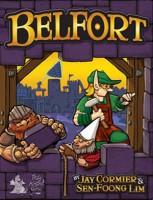
Belfort

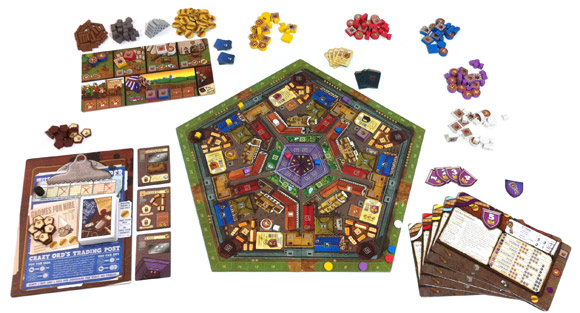
Put your Elves, Dwarves and Gnomes to work in the Village and Guilds of Belfort to collect resources and build up the city!
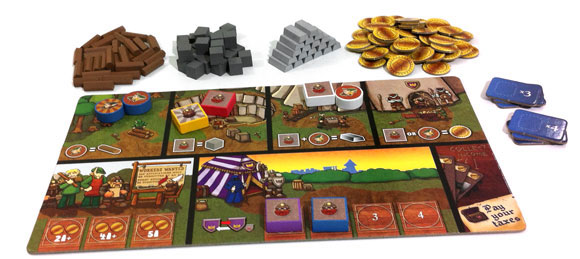
Elves collect wood from the forest while Dwarves collect stone from the quarry. An Elf and a Dwarf together can collect Metal from the mines, and either one can collect Gold. Build buildings in the 5 districts of the pentagonal city and hire Gnomes to run them to gain their special abilities.
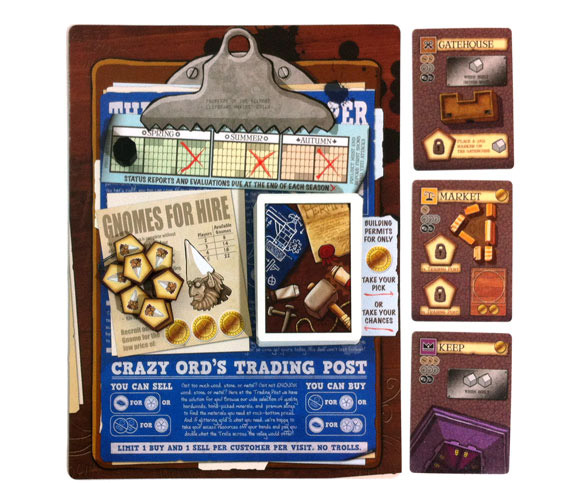
Belfort is a Worker Placement game with Area Majority scoring in each district as well as for each type of worker. Buildings give you influence in the districts as well as income, but taxes increase based on your score so the winning players will have to pay more than those behind! Manage your resources and gold well, choose your buildings wisely, and help build the city of Belfort!



User Reviews (8)
Add a Review for "Belfort"
You must be logged in to add a review.
I must say that I am impressed. Quite simply, this is a really good game. In a way it is the Inception version of a worker placement, a worker placement inside a worker placement game. Really it is more area control, but it feels something like worker placement inside worker placement.
Game Play
You start the game with blue prints that you are going to build to manage the areas you want to control. When you have the resources that you need you can use these blue prints and build the buildings to place on the board, each one offering a benefit of some kind. The board is broken up into five identical districts and victory points are awarded for how many buildings you control in a certain district.
There are three types of workers that you can use to collect the resources that you need for your buildings. Elves are going to collect wood for you, dwarfs stone, and gnomes are special. They are like house elves from Harry Potter residing in the one building you place them in never to leave. But they will work in your building for different benefits.
Other then wood and stone there are other resources that you can collect. Either of the two can collect gold to make purchases. And both together can mine for ore. There are also guilds that you can place on IN the city you are working to control that will give you an extra benefit above and beyond the work of a normal worker. But these are limited and usually go first in the round. Your own personal buildings that you build will also give you resource benefits and the last place you can collect resources is at the trader. At the trader you can swap a resource or two for another at a set ratio depending on what you want to trade.
Mechanics I Enjoyed
Taxes are a neat mechanic in the game. Depending on the total victory points you have earned you will have to pay a certain amount of taxes once a round. It adds a little part where you have to be prepared for what is coming in the future. I think of it as in Agricola when you have to feed your family. Although failure is not as destructive in Belfort
Turn order is a big deal in Belfort as it is in most worker placement games; you want that one spot before anyone else gets there. But there are some benefits that I think I will get to in the tips page.
You can also create Super Elves and Dwarfs that will work twice as hard and bring you double the normal resources then a normal worker.
Pros
• Great artwork that I enjoyed. A new style of art that was fun, bright, and inviting. Art is always a big deal for me. Also the components are very nice and thick cardboard
• The game offers some replayability by having different guilds that you can switch in and out to mix it up or add more interaction.
• The game offers a deep level of play with diverse strategy.
Overall, This is not the game that you would play with your family or new gamers. It is going to be for avid to power gamers, which is most likely what appeals to me. I like that the game is deep enough that you can really sink your teeth into it. Just from what I have seen there are different paths that you can take and focus on that will lead you toward victory, and I really like that in a game.
“What the ….?” The lumber yard is bustling more than ever as you look upon scores of elves picking up wood for whatever project they are working on. “What is going on?” you ask the yard foreman. “Seems that the King has requested a lot of building to be done.” he replies. “What? I was given the license to build for the city. I won that job!” Hastily making your purchase you take your load to the job site where currently underway, you have a tower going up.
As you walk towards the site, a dwarf runs up to you handing you a letter. Reading the apology sent by the Assistant Deputy of the Assistant Deputy, it states the King has decided that because of a clerical error, many master architects have been hired to build for the city. When building season ends, the King will hand the Key to the City to the one master architect who truly deserves it. “I can’t believe this!” you scream. “Grunt! Get over here!” A dwarf red of hair, stout of build and covered in dust and dirt from the morning work ambles up to you. “Yes sir, what do you need?” he grumbles as if he is to busy to be bothered. “Hire, all the help you can, elves and dwarves alike! Get as many gnomes as we can muster and get to building as many building as we planning all at once. Make sure you are first to the quarries, lumber yards and gold mine. We need to be ahead and better than everyone else. Well don’t just stand there! Move!” you shout. “Yes sir!” Grunt starts yelling at workers, giving them orders and point in directions for them to go. Then he scurries off to attend to his mission.
Shaking your head, you mind reals from all the work, long nights and personalities that will create issues you will now have to deal with. “It’s always something” you mutter to yourself. You set your mouth in grim determination and your mind to make sure that you will have that Key to the City at the end of building season and no one is going to stop you.
Publisher: Tasty Minstrel Games
Released: 2011
Game Designer: Jay Cormier, Sen-Foong Lim
Artwork: Joshua Cappel
Players: 2 – 5
Ages: 13 to adult
Playing Time: 90 – 120 Minutes
Game Mechanics: Worker placement, Area Control/Influence, Card Drafting, Hand Management
Contents: 5 Game board districts, key to the city, calendar board, collection board, 50 property cards, 5 turn order crests, 1 calendar marker, 5 player boards, 12 guild tiles, 30 wood logs, 30 stone blocks, 20 metal bricks, 46 gold coins, 6 multiplier chips, 35 dwarves, 35 elves, 22 gnomes, 60 property markers and 5 scoring markers.
Suggested Retail Price: $59.99
Parental Advisory: Safe for kids
In Belfort, each player is sending their loyal crew of Elves and Dwarves to the tasks of gathering resources, gold and constructing various buildings that have unique abilities for increasing influence in the city. Hiring Gnomes as staff for the building thereby, activating many of the special abilities and helping the player achieve success. Likewise, players can hire guilds to help along the way.
As each player is building in the five districts, their influence grows and knowing what and when to build can be critical to their success. According to the calendar, the scoring will be done three times throughout the building season. This will based on each players influence in each of the five districts as well as the size of their workforce of Elves, Dwarves and Gnomes. By the end of the seven rounds, the player who has earned the most points wins the Key to the City!
First let me state that Belfort is an amazing worker placement game. It is very well thought out and offers plenty of strategy while it is still simple to learn and understand. With all the worker placement games out there (and there are tons of them,) this one to me stands hands above most of them. With the popularity of gateway games of the genre like Lords of Waterdeep, Belfort brings much more to the table. The theme stands out to me immensely. I am not sure why exactly but it probably is a combination of many things such as the artwork, story and feel of the game. Many games of this style have themes that are just pasted on such as Lords of Waterdeep and have really no effect on the game. The mechanics of cube pushing are really all that matter in providing the character of the game at this point.
Belfort somehow manages to incorporate their theme into the overall experience and make it absolutely critical to the experience. The strategy of the game is quite deep and yet only feels like a medium weight game. If the players are familiar with euro style games, they will pick this up very easily and a great game will be born every time you play it. Yet as stated before, it is a good game for new gamers to learn and pick up quickly. This also serves very well as a family game as there is nothing for adults to have to worry about theme wise.
The artwork of Belfort is top notch and really, really adds a lot of flavor to the gaming experience. The components are some of the best yet for a euro game. The boards, guilds and other pieces are thick and colorful. There was no warping whatsoever in my copy. Everything is easy to read and understand. The cards are of good stock, weight and good artwork. A little assembly is required as you need to put stickers on the different colored playing pieces when breaking open the game.
My only complaint may be that player boards might have been a bit better as you need a lot of room to play this game. The building costs are on the player board and on the cards again. I have yet to see anyone use the board to determine the cost of building. Some space may have been saved here and there, with the calendar board, resource board and player boards and a little better planning, but this is a very minor complaint. As over all this game is awesome.
Belfort has become my go to game in worker placement genre. I have to play anything of this weight that is this fun, deep and easy to learn. While there are many great games out there, Belfort should be a table favorite for a long time to come. You don’t shelve great games and Belfort is a GREAT game.
I am giving Belfort 8.5 out 10 stars.
This game is Club Fantasci Certified!
Club Fantasci Certified
Note: A review copy of this game was provided to me.
If you like what we bring you, please vote for us here: http://www.boardgamelinks.com/links/sites
Club Fantasci on Facebook: http://www.facebook.clubfantasci
Club Fantasci on Twitter: http://www.twitter.com/clubfantasci
Played my first game of this tonight.
Components: The components of the game are nice. Everything is printed on fairly thick cardboard and the game pieces are painted wood instead of the usual plastic pieces. It adds a nice touch.
Basics: The basics of the game were fairly easy to learn. This game is a resource management and building game. Play is turn based with each player first placing there workers in various places on the board or on previously built structures,to gain abilities, gold, or resources. Players first choose, turnwise, which abilities to use by placing workers (elves or dwarves) onto the various ability markers and paying any costs associated with them. After all the players have chosen these, players then choose how much of what resources (wood, stone, or metal) to go after with their remaining workers. Play then progresses through each players turn as they harvest resources, activate their chosen abilities, or build buildings.
Strategy: While the basic concept is fairly easy to grasp, strategy and long term thinking are key to winning this game. From the very first moment after choosing who goes first, strategy comes into play. Knowing which buildings to build, which guilds to use, and how to build on the board itself to generate the highest score is a must.
Overall: Overall this game is easy to pick up but should provide enough depth of strategy to make it a long running favorite.
About
I’ve played this game over a dozen times and it never gets old. I just love the theme and art, mechanics and verisimilitude, and my wife enjoys it to boot!
Pros
> Worker placement melds really well with area control here (or vice versa).
> Decisions aren’t always easy (there’s never one obvious move like in some games) but mistakes won’t usually ruin you.
> The art is some of my favorite in any game ever (The fantasy setting definitely doesn’t hurt)
> Game concepts are simple enough to grasp that you can teach the game in the time it takes to set it up.
Cons
> The game takes a long time to play (it doesn’t feel that long, but it can creep past the 2 hour mark with the full complement of 5 players)
> Players prone to AP can be in trouble here (especially if you take games too seriously)
> There can be some downtime if you have those AP players, but their decisions will affect yours so you will be paying attention.
Expansion
Plays great without the expansion, but the expansion does help with replay-ability and makes it even more complex. It removes a season from game play so it doesn’t add any time either.
Players are given starting resources and building cards as well as a few workers each as the gnome and resource markets and the board are set up.
Each round has three phases where the players will 1) place their workers, 2) take any resources their workers are collecting, earn income and pay taxes then 3) remove any remaining workers and take any necessary actions.
The action phase is where the majority of the game is played with players gaining extra workers and resources, building their building cards, buying gnomes, taking additional building cards etc.
Each time a building is built a player gets to place one of their house tokens on that building’s symbol in one of the five identical districts.
Scoring takes place 3 times throughout the game with players scoring majority and minority house/district control as well as for the number of accumulated workers and the player with the highest score at the end of the game wins.
This might get me clobbered here, but I have to admit, I’m not much into resource collecting games. It’s just not my thing.
So why do I like Belfort so much? A big part has to be the way in which the different races are intertwined and represented. That part just clicked with me. I had flashbacks to 8-bit adventure games for some reason – cute and logical.
I only got to play a few rounds at Gen Con, but I put this on my wishlist. Maybe it’ll change my mind about the whole game type.
A really enjoyable game which combines multiple mechanics seamlessly to create a challenging and rewarding experience. The worker placement aspect is slight, and generally gives you somewhere to go which is strategically advantageous, the area control is challenging, especially with the point loss for ties, it can require careful consideration to find the optimal placement for yourself while still considering your opponents. It doesn’t seem to play as well with 2 as it becomes far less challenging overall – especially in the worker placement.
not much to say but it’s a good solid game for both none gamers and gamers…. good art works … cute enough to trick my wife to play with me all the time love this game…