
Dominion
You are a monarch, like your parents before you, a ruler of a small pleasant kingdom of rivers and evergreens. Unlike your parents, however, you have hopes and dreams! You want a bigger and more pleasant kingdom, with more rivers and a wider variety of trees. You want a Dominion! In all directions lie fiefs, freeholds, and feodums. All are small bits of land, controlled by petty lords and verging on anarchy. You will bring civilization to these people, uniting them under your banner.
But wait! It must be something in the air; several other monarchs have had the exact same idea. You must race to get as much of the unclaimed land as possible, fending them off along the way. To do this you will hire minions, construct buildings, spruce up your castle, and fill the coffers of your treasury. Your parents wouldn’t be proud, but your grandparents, would be delighted.




Add a Review for "Dominion"
You must be logged in to add a review.
- Themes
Medieval - Mechanics
Card Drafting, Deck Building, Hand Management - Gamer Types
Avid Gamer, Casual Gamer, Family Gamer, Power Gamer, Social Gamer, Strategy Gamer - Designers
Donald X. Vaccarino - Game Families
Dominion, Mensa Select, Spiel des Jahres Winner - Official Game Site
🔍 Dominion - Rulebook
🔍 See official rulebook - Price (MSRP)
$44.95
Have you ever dreamed of ruling your own kingdom? Building markets, villages, gardens, and establishing a militia to crush your opposition? Well game maker Donald X. Vaccarino had the same dream and ended up creating Dominion, a deck building game that puts you in control of building your own domain. Dominion, distributed by Rio Grande Games, is best suited for 2-4 players and has a 30 minute playtime.
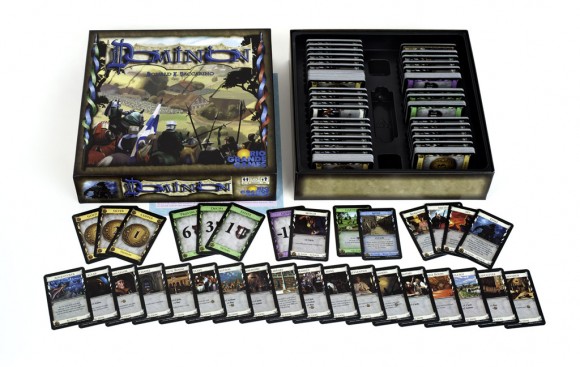
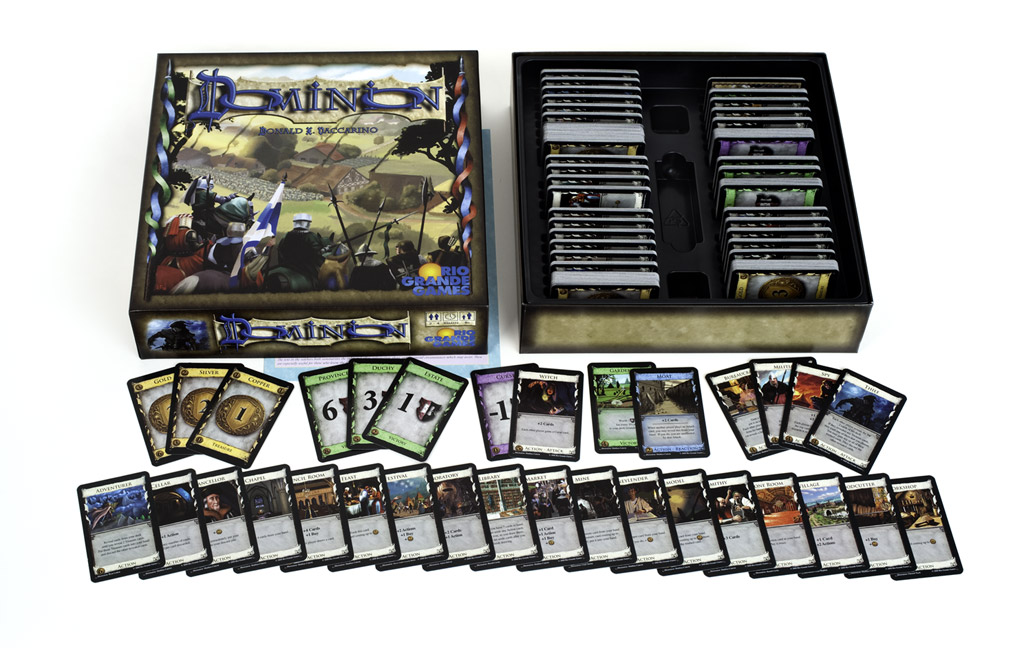
Dominion comes with 500 cards, a storage tray, and a rulebook. It is a deck building game in which you buy cards off of the table to build your exclusive deck. Cards range from action cards, to treasure, to Victory Points. It is only through a harmonious mixture of these three types that you will be able to have a successful deck. Have too many action cards and you won’t be able to buy much. Have too much gold and your turns won’t be very long. Each turn you can perform one action and are allowed to buy one thing off of the table. Each card is labeled with a coin value ranging from free to eight coins. As you buy more cards, your turns will become more productive, allowing you to perform more than one action or buy at a time, as well as being as being able to buy more expensive items. For example, if you play a Market card you get to draw an additional card, receive an additional action, another buy, and one treasure. This is a great card to have and if you have more than one in your deck, all the better. Each action card has a different effect so it is important to get a good mixture of cards in your deck as well.
The game is over when three piles of cards have been depleted. This can be any combination of actions, treasures, or Victory Points. In the many times that I have played Dominion, the game has ended rather abruptly making it hard to gauge when you should start obsessively buying Victory Points. The best tip would be to buy the “Province” cards whenever you can because those are worth six Victory points. After a third pile has been depleted everyone tallies up their Victory Points and the winner is declared. Depending on which cards you chose to play with, other aspects, such as how many cards you have in your deck, may also factor into your total Victory Points.
Just because you are building and working with your own deck doesn’t mean that you won’t be able to mess with the other players. There are several “Action-Attack” cards which you can include in your game such as “Militia”, which forces your opponents to discard their hands down to three cards, or the “Witch” which forces players to pick up a “Curse” card that gives them a negative Victory Point. To counteract these offensive cards, players can buy “Moat” cards which protect them from the other player’s card, but only if they have the Moat in their hand when an attack card is played.
The organization of Dominion is amazing. The storage tray inside the box is labeled in alphabetical order and color coded so it is easy to setup and return the cards to the box. This also makes it easy to pick which cards you want to play with because their monetary value is also listed on the tray as well. The instructions are clear and easy to read, and there are even suggestions as far as which cards you can play with to make the game different every time. Since there are so many cards, you won’t be playing with every pile, so the time Vaccarino spent on figuring out which cards go well together is appreciated. You don’t have to follow the suggested setups though, and can feel free to experiment with your favorite cards, making the replay of this game off the charts.
The only gripe I have with the game is the fact that turns can take a long time as the game gets near the end. Players will play more and more cards that give them additional actions and cards, making their turn last minutes on end. There will be turns where players have ten cards down on the table at a single time! This is part of the strategy though and figuring out how to best combine your cards to get you the most bang for your buck is key to the game.
Dominion is one of those games that doesn’t look very strategic from the outside, but once you get playing and your taste for victory becomes insatiable, you will truly understand how complex of a game it can be. Currently there are eight expansions and stand-alone versions of the game and that number will continue to grow as this game matures. Dominion has won many awards, namely the 2009 Spiel des Jahres (Game of the Year), the 2009 Golden Geek Award, and the 2009 Origin Award for “Best Card Game”. If you are looking for a fun strategic game to play with the family, or are just looking for something to play with your spouse on a quiet night in, then it’s time to pick up your crown and rule over Dominion! Game on!
This may not have been the first Deckbuilder game, but it certainly put them on the map and made the term common in the gaming lexicon. Dominion certainly may have its faults, but it has sold ridiculous amounts of copies and sits in many a gamers closet, and for good reason.
Not familiar with a deckbuilding game? Put on some sunscreen and come out from under that rock there and I will try and fill you in 🙂 Knowing what Dominion is and how it plays will pretty much define the genre for you.
Lets look in the box. There is a rulebook and some cards. 500 to be exact. There isn’t much else to the game. The cards are all nicely separated by type. Setup is a breeze, cleanup a little less so.
The game states it plays 2-4. I suppose it could support more, but the card stock is going to dwindle pretty fast. 3-4 is optimal, but two is really not out of the question. Figure on 45 minutes to an hour to play. Start off by putting each of the Treasure cards, Victory cards, Curse cards and Trash card into their separate piles. These are always out for every game, although the Curse cards are not always used.
In addition to these cards, there are 25 different Kingdom card decks. Of these, you are going to place out 10. These can be random or agreed upon by the players. This is what gives Dominion, and other deckbuilders, a unique feel to every game.
Each player is going to get 7 Copper cards and 3 Estates. So, what are these for? Every card has a value in the lower left corner. That value can be paid for by the treasure cards, represented at the beginning of the game by the copper cards received, and then used to build your deck throughout the game. The Estate cards, on the other hand, represent the ultimate goal of the game. These are worth victory points, 1 each in this case. At the end of the game, the player with the most victory points wins. There is a downside to these cards, however…
You have your 10 cards. Now you will shuffle them and pick 5. You may end up with 5 copper, enabling you to purchase one card to add to your deck worth up to 5. On the other hand, you may end up with 3 Estates and 2 copper. The Estates, while providing Victory Points to tally up at the end of the game do nothing at all until then except clog up your deck and give you useless cards in your hand. Any purchased cards go into your discard pile, along with played cards and those remaining in your hand at the end of your turn. Then you draw a fresh hand of 5 and await your next turn. Once your draw pile is exhausted, you will shuffle the discard pile to create a new draw pile.
Once you have some new shiny cards, your order of play is to play an action, if you wish/can, buy a card and clean up, where you discard and draw anew. The Kingdom cards generally provide actions of some type that you can enact. These could allow you to draw additional cards, give you additional money this turn to buy new cards, give you additional actions, allow you to purchase more than one card or even cause some kind of harm to your opponents. Your action phase ends when you cannot legally play any further cards. Some of the Kingdom cards are defensive as well, allowing you to counter a negative effect attempted by an opponent.
During the course of the game you will be, in addition to purchasing Kingdom cards, buying higher values of treasure cards as well as Victory Points. It may get to the point that those copper are causing more harm than good, or you want to get rid of some of those Estates because you feel you have better Victory Point cards in your hand and the smaller ones are just causing problems. In that case, some of the Kingdom cards allow you to trash certain cards. When you place a card in the trash, it no longer is available to draw. While a copper card, which costs 0 to buy, may be tempting to get every turn you can purchase nothing else, you need to keep in mind that if you have too many of any card, you will be seeing those cards pop up more than others. It gets to a point where you will want to have more chains of action cards played, which is impossible if you end up with one action card and 4 copper in your hand.
There is a good bit of strategy involved here, deciding what cards to buy, what cards to trash and when, how long to hold off purchasing victory point cards in favor of action cards and that sort of thing. You are on the clock, so you cannot wait forever. Once all of the Province cards (a type of Victory Point card) or any of the 3 supply piles of purchasable cards are gone, the game ends. The player with the most victory points in their deck wins.
As to the downsides, not everyone is going to enjoy the randomness involved with what cards you get every turn, although this really is mitigated somewhat by smart purchases. Some of the cards are not going to be favorites, and you really ought to be careful that you don’t end up with attack cards available in a game that defensive cards are not.
That being said, in my experience, the game is a good time. It is not hard to learn, doesn’t take that much time to play and presents a pretty different game every time. There are tons of expansions to this thing, so should you get tired of the base game and want more variety is is generally your favorite game store and $20 away. This is another one of those games that I think fits well in any gamers closet, unless they just cannot stand the game for some reason. Even if you have someone over who hasn’t gamed past Monopoly, chances are they will have a good time, although the Victory Point concept might throw them a bit the first time. If nothing else, I really think this is a no brainer when your local game store has it on sale. Pick it up and give it a try. I think you will like it.
There is no local game store near me, and none of my friends play games. Anything I learned about games I had to read here. That being said I was very excited about Dominion because of the rave reviews. Plus I’m a very light gamer and it looked like a game I could learn quickly.
This is my first deck building game. Deck building games are not about remodeling homes to accommodate decks. They are about gaining cards to add to your (you guessed it) deck. The better your deck, the more you can do. You can string actions together and buy multiple cards and mess with the people you are playing with and all sorts of other things worth writing a fragmented sentence about.
Dumbed Down How To…
You start with 10 cards, 7 coins and 3 victory points. You use your coins to buy additional cards such as Action, Victory Points, more Coins, or Curse Cards (don’t buy these dummy).
Dominion is as easy to learn as A, B, C, D. You first play your Action, next Buy, Clean-up, and finally Discard your hand. It is a simple concept once you start playing. The better cards you have, the better chance you have of “doubling up” or “chain actions”. One action card may lead to more cards, and more actions or more coins and buys to use on your turn. Once you build a solid deck, you start buying victory cards…but they will come up in your hand and they are useless during game play. You need to weigh all that in while playing.
The replay value on this game is very high because of the number of possibilities, and the option to purchase expansion packs.
Pros:
– Easy to Learn
– High replay value (even without the expansions)
– Game play is less than an hour, and the more you play the quicker the games could go (I have a short attention span)
– Set up becomes quick once you figure it out
– Lots and lots of cards (with pretty art work)
– The more you play, the better you get (just like violin… I can’t play violin)
– Lots of shuffling (Who doesn’t like shuffling?)
– Kingdom themes are also cool
Cons:
– Putting the game away isn’t very fun…so many cards
– Not a lot of interaction between players, almost feels like multi-player solitaire (This is the biggest downside)
– The cost of expansions, big turn off because I could buy a new game for the price of the expansion
– Lots of shuffling (My wife apparently doesn’t like shuffling.)
Summory
Overall I would say the game is worth it. GO BUY IT.
What Is It About? – An Overview of the Game
Dominion is the patriarch of the deck-building genre, moving what was once “preparation” of modern card games into the game itself. From humble beginnings of a few estates and a pocketful of copper coins, you build your great Dominion.
The game is played from 2 to 4 players. Players take turns playing cards from their hands for actions and money to purchase more cards from a common supply. The game ends when 3 supply decks or the Province supply deck are exhausted. The player with the most VPs in their deck wins.
What Do I Get? – The Components in the Box
Opening the box may come as a surprise since it is a standard 12” x 12” game box but contains only 500 cards. However, the plastic insert is perfectly designed to organize and hold all the cards by type. Even sleeved cards, with some slight rearranging, can fit in the insert with little problem.
Cards are divided into the “basic supply” of coins, victory point cards, curses, and the trash indicator. These are used in every game. The “kingdom cards” make up most of the balance of the cards and are divided into 25 sets. In any given game, only 10 of these sets will be used. Sets can be selected randomly or with a pre-determined “scenarios” that highlight certain combos. The remaining cards are “randomizers” that can be used in selecting the sets. Be careful though: they look exactly like the real cards but have a slight change of color on their back.
What Do I Do? – Playing the Game
The game is extremely simple in terms of sequence of play. Easy as ABC! Players start with a hand of 5 cards. They may play one card for their Action. The Action is then fully resolved. They may then play as many Treasure cards from their hand to generate purchasing power for the Buy phase. Again, they may Buy 1 card up to their Treasure amount, placing it in their discard. Finally, they Clean-up there play area by placing all cards played (including any remaining cards in hand) into their discard pile. They finish their turn by drawing 5 new cards, reshuffling their discard to replenish their deck if needing to draw more cards. Play then continues to the player on your left.
The complexity comes from using the Action cards to generate more Actions, more Buys, more Coins, more Draws from their deck, or the “Event” on their cards that allows something to happen. The goal should be to build an efficient engine of card combos that lets you build up to the expensive Province card (8 coins) and drive the game to its conclusion.
The disadvantage of buying Victory cards is that they offer no Action and no Coin. In other words, they clog your deck and prevent your hand from having lots of options. A balance must be found when to switch from building your engine to buying your points. The game will end at the end of any player’s turn when the Province supply (8 cards in games with 2 players or 12 cards with 3-4) is exhausted or any three other supplies are exhausted. Victory cards are counted whether in hand, in your deck, or in your discard pile. The player with the most VPs wins.
What Do I Think? – Final Thoughts
As a former crack addict (and by crack, I mean the cardboard kind), I have wanted a good card game that wouldn’t drain my wallet with a rarity structure. Dominion has scratched that itch. The variety of combinations of Kingdom cards is vast with only 10 of 25 being used in any game.
The game plays very quick and is fairly easy to teach. The cards are text heavy though use standardized phrases to keep it as simple as possible. It is easy to introduce to new players, though it will take them some time to get familiar with all the cards. Games with experienced players go very fast as they know what they want and can play their turn lightening fast.
This game has held up for me, having first played it in 2008. I continue to play it daily on my Droid, getting anywhere from 3-5 plays in a day.
The only drawback with just the base set is that it can lack a lot of interaction between players. There are only 4 Action cards that allow direct conflict with other players and so if these are missing, it is just a race to the finish. However, there is always the possibility of buying a card away from someone before they have a chance to get it themselves before the game ends. This is mostly addressed with the expansions.
What Next? – Other Recommendations for this Game
Though not a collectible game, the expansions for this game continue to churn out at a decent clip. The most recent expansion, Dark Ages, is slated to be the penultimate addition to the game. Each of the expansions offers “more of the same” giving even more kingdom cards (almost to 200) making the combinations near limitless. However, each introduces one or more new mechanics that spices up the game without changing the fundamentals. I would rank the expansions as follows (click on the titles to see my review of those expansions):
Prosperity – Expands the game with bigger money (that does stuff) and bigger victory cards.
Hinterlands – Allowing you to do stuff when you gain the card.
Seaside – Introducing duration cards that last for two rounds, effectively increasing your hand size.
Cornucopia – Rewarding diverse decks over efficient ones.
Intrigue – A second version of the base game offering more interaction between players.
Alchemy – This is a strange bird that is more a standalone expansion given its dependence on a special Treasure (the Potion) but includes some very unique and powerful cards.
Dark Ages – TBD! This expansion offers more Kingdom cards than any other expansion and introduces quite a few new mechanics. This looks like a promising addition that will eventually top the list.
Dominion is a card game for 2 to 4 players. It typically takes an hour to play and is relatively quick to set up. Thematically the game has players taking the role of feudal lords who are expanding their kingdom by acquiring lands. This theme adds flavour to the cards but it isn’t binding; this game could easily be about space pirates or building a badger sett. The first thing to note about Dominion is the remarkable level of presentation. The cards are good quality, full coloured and the artwork is well done. There are a few cards where the artwork is a bit off but you’ve got to look closely to notice. What really stands out however, is the packaging. Taking pride of place in the box is a simple piece of vacuum formed plastic and a coloured reference card that keeps the entire game organised. It’s so simple but it’s so nice to see that Rio Grande Games have considered what you do when you’re not playing.
The supply
A game of Dominion uses 17 piles of cards, typically referred to as the supply. This is made up of three types of treasure cards, three types of victory cards, one pile of curse cards and ten piles of kingdom cards. The treasure and victory cards are the same in every game but the kingdom cards can be chosen randomly, selected by the players or taken from a suggested list of cards. Kingdom cards are mostly actions but can include defensive options and victory point modifiers. There are 25 different kingdom cards in the base game, with ten different cards drawn each game this leads over three million different combinations of cards. This means that every game of Dominion is different but you may find a couple of key cards can end up taking over any game in which they appear.
The mechanics
The mechanics of Dominion are simple to the point of genius; each player starts with a deck of 10 cards from which they deal themselves a hand of 5 cards. Each turn a player can play one action card and buy one card for their deck. They then discard the rest of their hand and draw a new hand of 5 cards. The game ends when either the supply of province cards (the most valuable of victory cards) or three other supply piles are used up. Whoever has the most victory points in their deck at the end of the game is the winner. That’s it, Dominion is that simple.
Where Dominion’s interest and complexity lies is in the action cards. Each pile of cards in the supply has a different effect. Some give you a second action or allow you to buy two cards in one turn. Some actions remove cards from the game or give bonuses to other cards. Some directly affect your opponent by making them discard cards from their hand or take a curse; a special form of card that gives the player -1 victory points. As the game progresses your deck grows and so do your options. Later in the game it is possible to string together a long list of actions. Any card that directly affects the other players is identified as an attack card, to counteract this there is also a defence card that gives players a chance to react to an opposing attack.
I need more treasure!
Dominion is a game all about management. The most crucial behaviour is that of managing your deck to make it as optimised as possible and to work against your opponents decks. A good example is the victory point cards. These are necessary to win the game but during the game they do nothing, they are just empty cards clogging up your hand with useless baggage. Too many victory cards too early in the game and your deck will be crippled, buy too late and all the high point cards may already be gone. You could buy ‘Cellar’ that allow you to discard cards in exchange for drawing more from your deck or you could buy the ‘Chapel’ so you can trash the low victory point cards and lean down you deck into just the high value cards. These methods change in every game depending on the supply available.
The Original and Best Deckbuilder
Those with mild OCD will love keeping their cards neat and organised.
There are some that criticise Dominions’ deck building mechanic, accusing it of being little more than multiplayer solitaire. This is certainly an issue if the supply cards chosen don’t include any attack cards but this can be remedied by players making sure at least one attack card is used in every game. For some players this may still not be enough. Hardcore gamers or those that thrive on direct combat may be better off looking into alternative deck builders such as Nightfall or Ascension.
There’s a reason why Dominion won Spiel Des Jahres in 2009 and why it currently sits at the top spot of the Dice Tower People’s Choice and that’s because it’s wonderful. It is true that many other deck builders have come along since to try and steal Dominion’s crown but it’s easy to learn rules, smooth gameplay and fun but light player interaction make it a winner. Gamers who are in love with heavy theme or complicated gameplay may take a dislike to Dominion; it’s a game that works because of its simplicity and light theme. These combine to make a game that is easy to learn, fun to master and the combination of cards available means you’re never going to have the same game twice.
After first playing Dominion a few years ago, I couldn’t stop thinking about it on the drive home. Or the next day. Or the following. As I think back, this was due to Dominion exciting the part of my brain that was formerly excited by playing a number of different collectible card games (CCGs).
I played Magic from ~’94-’00 and for a few years after off-and-on, much of that time focusing on tournaments. The two main features I enjoyed with Magic were: (1) figuring out how cards worked together, then building and refining a deck, and (2) analyzing in-game positions and adjusting to what your opponents are doing.
Many games currently on the market address the latter for me, but Dominion was the first to non-CCG to address the former.
My friends and I would spend time basing decks around individual cards. We’d typically take cards that others deemed “worthless”, and design a strategy around it. Dominion allows for this sort of thinking.
With 25 kingdom cards in the base set (you use 10 per game), you have many different strategies you can develop, and practice pairing cards together. You’re not only adapting to your opponents, but you’re adapting to what the game makes available as well. While everyone starts with the same 10 cards, by the end, player’s decks can look very different.
This is a place where the popularity of Dominion may currently serve as a detriment. Initially, people were experimenting and trying many combinations. Over time, certain strategies emerged, and through the internet, a base of knowledge was formed. Now, instead of players learning all of this information for themselves, they can go and read what others have found. Instead of trying to “learn” what cards go together through play and testing, they “learn” from what others tell them, often without experimentation and verification.
As the internet became more prevalent in the mid-late ’90s, I saw the same thing happen with Magic, which in part led to my leaving the game.
If you like learning about strategy for yourself, Dominion can be a great game; if you have a like-minded group. Such a person may do well to avoid either highly experienced players that only care about “optimum” play, or groups that want to skip the learning curve and be told what the best/worst cards are (a problem I also see with Puerto Rico).
A major bonus of the game is how easy it is to learn, once you see how the deck building aspect works. From my experience, many newer players have a hard time grasping the concept when explained to them, but as soon as they see two or three mock turns, it makes perfect sense (something I’ve also seen in Killer Bunnies, and 7 Wonders).
I’d recommend initially limiting yourself to the base set until you’ve tried the cards, and then slowly adding one expansion at a time (if you’re looking for more challenge/strategy). In my opinion, trying to jump into a multiple expansion game (or teach a new player this way), while it may work, is more likely to limit your/their enjoyment of the game.
Dominion has become a cheaper (depending on how many expansions you buy!) way to scratch the itch of a former CCG deck builder, while also offering enjoyment to both experienced and novice game players. If you don’t mind the relative lack of interaction with your opponents, Dominion should be on your list of games to try!
Dominion’s massive success has lead to an explosion of similar games copycatting this ‘deckbuilding’ mechanic. Since Dominion first hit the market there have been countless of these ‘deckbuilders’, many of them also have shared Dominion’s success while others have been complete flops. With Dominion consistently on top of some many game recommendation lists, I’ve decided to give my take on this revolutionary game.
If you want a better laid out review, complete with full sized images go to: http://toddsboardgames.blogspot.ca/2013/02/dominion.html
Objective: To be the player with the most victory points when either 3 stacks of cards have run out or the province cards have all been depleted.
Hold on hold on stacks of cards? Province cards? What does any of this mean? Let me try my best to explain, in order for this review to make sense you must first properly understand what a deckbuilder is. Essentially, you start with a small supply of very limited cards, some of these cards are used as currency to purchase additional cards. The cards you purchase will assist in acquiring more cards, you will need to acquire more valuable currency and other kingdom cards to improve your deck so that you can afford the valuable victory point cards. Perfecting your deck means finding a balance of cards without increasing the physical size of your deck by too much, while making sure that as you add victory point cards you do not cripple the mechanics of your deck.
Lets now talk about the different card types.
Victory Point Cards: These cards are the Province, Estate and Duchy. They will be used in every game of Dominion, the player who has the highest total value of these cards when the game ends will be the winner. The problem with these cards is that they go into your deck like every other card when purchased, but serve no benefit when drawn into your hand.
Treasure Cards: These are Gold, Silver and Copper. They will be used in every game, the point to having higher valued treasure cards is simple, are the game progresses the number of cards you draw is still limited and you do not want to clog up your deck with piles of crumby copper.
Action Cards: You are limited to playing one of these cards a turn…unless that card happens to give you bonus actions in which case you will be able to play additional cards. Kingdom, or Action cards exist to strengthen your turn by providing you with additional spending money, actions, cards and buy actions.
Playing a Turn:
Every turn is broken down into 3 parts.
Part 1: Action Phase – Every turn you are given 1 action, that means you can play 1 Kingdom (Action) Card from your hand. For every + Action on cards you play, you will be able to play more Kingdom cards. The point to playing action cards is to enhance the next phase, or in some (rare) cases to cripple your opponents’ turns.
Part 2: Buy Phase – This is the important part of Dominion, selecting what to buy. On every turn you begin with just 1 buy action, which means that regardless the amount of your treasure, you can still only purchase 1 card. This is where the thought and customization come in, this is where you build your deck, you need to have a plan, you will need to buy cards that complement each other and cards that help you buy more cards and eventually you will need to buy Victory Cards.
Part 3: Discard Phase – During this phase you will discard everything, all cards you played, all cards you bought and all cards you did not use. Then you will draw 5 new cards, it is important that you draw at the end of your turn and not wait to the beginning like you would in most other card games. When you do not have enough cards left in your deck to draw from, you simply reshuffle your discard pile and this becomes your new draw pile.
Components: Even for a game that is entirely card based I’ve always found the components for Dominion to be lacking. There really is no theme and boring art work. At least the game box comes with an awesome way to organize your cards and keep them separated to easily select them when you play a game. In addition to treasure and victory cards the base game also comes with 24 different Kingdom cards. You only use 10 in every game so this leaves room for a fair amount of replay, and of course there are a number of different expansions for Dominion so if you enjoy playing you can always expand your game.
Dominion’s flow is unmatched, the game works in such a beautiful way that it is no wonder the amount of copycat games out there. It is one of those games you have to really try to get, reading about it might interest you, watching a video on it or listening to someone talk about it might make you want to play, but in order to fully understand and appreciate the flawless execution of mechanics and the depth of all the possible combinations and strategies you must play Dominion. It shouldn’t be hard, at least half the people at the games night I go to have a copy, next time you have a chance to play, take it and prepare to be in awe.
The plastic insert is great for organizing your cards, although if you want to store all your games in 1 box you are best making your own box. If you want to see a custom box, or how to make one you can take this link.
Recommended for:
Casual Gamers: Because the mechanics are simple, and you can select cards that are more ‘friendly’ to new players, it is very easy to get into and learn Dominion. Because of the large following it is easy to find someone to walk you through a game, and to try it before you buy it. Quick to play, easy to learn, multiple ways to win, games are different every time, random luck factor, quickish play time. These all help Dominion cater well to casual gamers. Also learning to play Dominion will teach you mechanics that are now used in so many other games, so learning Dominion can bridge you to some theme heavier or more combat driven deckbuilders.
Gamer Gamers: Since every card has multiple uses when combined with other cards, and there are several different effective strategies to constructing your deck, Dominion can be played over and over and almost always leaves you wanting to play again. Multiple ways to win, players can determine when the game ends, deep strategy customizable to your specific playstyle/plans, multiple expansions, lots of replay and a big enough following that you can sit down and play without having to explain the rules to everyone. These all combined with the brilliant game mechanics all add up to make Dominion a great gamer game.
The mechanics of Dominion have been well documented elsewhere, and far more thoroughly and elegantly than I could manage, so I will just quickly summarise. Basically, this is a card game where you start with only a few cards available to you and steadily build up your personal deck of cards by buying cards that give you either more buying power, the ability to take actions, or victory points. The victory points are essential, but buy them too early and you may find it difficult to get anything done in the game as they stay in your deck and can clog your hand up.
As has also been reported elsewhere, the theme of the game is pretty thin. In the core set (I have no experience of the expansions) most of the cards have pretty abstract effects like drawing extra cards or being able to play or buy more cards than your basic allowance. The artwork is variable and there is no flavour text on the cards, which may have been good for adding to the feel of things.
A set of 10 types of “kingdom card” is selected (from 25 available) for each game and depending on this selection (the number of possible combinations is in the millions) the game may end up being a near-solitaire race for the finish line or a vicious game of trying to stuff your opponents. My experience is that some of the attack cards (the Witch comes to mind mainly) can just make the game grind slower and slower, actually detracting from the fun rather than making for a good “take that” game.
So far I have been sounding a bit on the negative side, but I do really like playing Dominion. The cards mostly have simple effects, but can sometimes be combined to make powerful plays. The game has a lot of the fun of collectable card games but can be played from the box without having to construct decks, as you do this during play. The selection of cards available (not to mention the expansions!) mean that no two games will be the same (unless you want them to be). And my young daughter has enough of a handle on the game that we can have a fun game together.
I’ll probably end up getting an expansion sooner or later, but for now, this box has a lot of play left in it, making for great value in my mind.
Maybe it’s just me, but I’m in the few that don’t enjoy this game quite as much as everyone else. The game is incredibly easy to learn and it’s actually a great way to get new people to think outside of the box for boardgaming:
“What do you mean there are no dice?”
“Where is the board?”
So let’s break this down a little bit and give it a brief review:
Components – The cards are fairly thick and will take quite a bit of abuse before you either need to sleeve them or purchase a new copy. Personally I sleeve everything and Dominion is no exception. I do have a buddy that plays this game quite often and over time his Estates have become worn down as well as the copper cards. It’s not a problem most of the time, but people do mention that you do have a slight advantage if you know it’s a copper or an estate on the top of your deck.
The insert is fairly nice and it allows the cards to be put back in a mostly coherent way. It fits the cards sleeved [mostly] but it simple does not allow any room for expansions to be placed in the box.
Gameplay – The gameplay is broken down into 3 phases. I won’t be going into much detail on this, but I will run over it briefly. The first phase is the action phase. This is where the meat of the game is. You can play an action card from your hand which allows you to do various things such as draw more cards, give you more actions so you can play other action cards from your hands or finally simply give you a way to get additional money. There are others, but for the sake of keeping this short I’ll leave that be. This is where my negative feeling of the game comes into play. Essentially you sit back and let the other player do what he can with his hand. There is simply no way to stop what he’s doing. Now normally I don’t have a problem with these type of games, but with this game you can run into a substantial amount of downtime if they end up filtering through their deck, playing more actions, putting cards back into the deck in a certain way, etc. This is only amplified with 4 players.
The next phase is the buy phase. You can purchase from 10 randomly chosen piles from the common area. You use any money you’ve accumulated from either action cards or any copper/silver/gold cards you’ve just played. This also can take a while for some people to sit and read each card or debate whether they want this card now or later. This becomes less of a problem as players learn the cards, but it still exists when players work out which cards work together and which don’t each time a new set of cards comes out.
Replayabiltiy – The base game has a good amount of replayability for a while, but there is only so far 25 different action cards can go. That’s where I both love and loathe this game. It already has 5 expansions and supposedly it will stop at around 8. If Rio Grande can do anything about it, it will probably continue producing more. The fun part of the game is finding fun combos with the expansions/base game. Getting cards to synergize together is great and really gives this game a strategic feel. I really only feel like I need 1 or 2 expansions for the base game since getting any more is a hassle to try to mix and match cards.
Overall Impressions In the end I won’t turn down a game of Dominion, but it’s not exactly something I would grab for while choosing a game. It’s got a soft spot in my heart since it’s the game that brought me into this hobby. I just can’t overlook it’s flaws any more and have found other deck building games that fill what I’m looking for better [Nightfall for direct confrontation or Thunderstone for a sense of theme and accomplishment]. I feel that Dominion also has a pasted on theme. It really could have been anything and still played the same. Overall I recommend this game to people new to the hobby or people who are looking for something with very low confrontation in a game.
So, I’ve finally done it. I’ve finally been able to play several rounds of the father of all deck building games. While I think the game is fun, I have some relatively big problems with the game which prevents me from enjoying the game fully.
First off, let me introduce the game for those new to this. Dominion, and all of its expansions, are a deck building game. As such, players will be buying cards from the a shared card pool to add to their deck. The objective of the game is pretty simple, have the most Points at the end of the game. You score points by buying pieces of land and playing certain cards throughout the game. During your turn, you can play 1 action card and buy 1 card from the center. With that said, the cards from the shared bank will allow you to draw more cards, play more cards, buy more cards or mess up your opponents strategy in some form or fashion. The deck building choices are pretty limitless, and you can focus your deck on any number of different things. Another unique part is that when you buy points, the points go into your deck and act as dead cards – if you buy too many small points then you load your deck with lots of dead stuff. So being able to build a deck that works well and functions smoothly is a key part of the games strategy.
The art of the game is ok, pretty standard flavor in my opinion. Its not bad, per se, but its not something that I find incredibly breath taking either. The card designs are really easy to look at and fairly intuitive to understand when you get the core of the game down as well. The rules o the game are incredibly simple too, making it easy for people of all ages and gaming backgrounds to pick up quickly and move on with.
Before I get into what I dislike about the game, I want to say what I enjoyed. First off, I love all the strategic options when it comes to building your deck. I have found that working all the angles of the game, you can really customize a deck to fit your needs and general play style fairly easily and comfortably. I also like how winning is also loosing in a sense, by adding the points to your deck. This makes the choices you make in buying points all the more important and makes it advantageous to buy appropriately instead of buying just to score more and more points. I also really enjoy the multi-player format, especially with an attack heavy set of cards in the center. The chaos that comes from it makes for a lot of exciting games really.
One of my problems with Dominion is that its really not much of an ‘interactive’ game. Sure, you could develop some of the center cards to involve more of an interactive quality, but a lot of the cards just don’t seem to encourage it – at least with the variations that I’ve tried. This makes the game feel like a solitaire game against the clock, at least to me. I’ve found the replay value to, while being heavy, not be as impressive as other deck building games I’ve played because of it. The lack of a ‘in your face’ mode may appeal to some gamers, but I tend to enjoy games where I am interacting with my opponent, at least a little bit.
I’ve played the game in both a 2 player and a 4 player mode, and the 2 player mode (while fun) seems to be lacking where the 4 player mode is more fun, even with the solitaire feel of the game. When you put a lot of heavy attack cards in the bank, you really start to feel chaos with a 4 player mode – where you are just waiting to be screwed over somehow. However, with that said, it places more value on certain cards in the 4 player mode than they have in 2 player mode. Moat, a card which protects you from attacks and allows you to draw 2 cards, is essential to buy early if you have it available in your bank in a 4 player game, whereas in a 2 player game you don’t really need it as much.
The last thing that I disliked about the game, is also one of its strengths. The game has many turns where you can just end up with simply having the most dead hands imaginable. Sure this can happen with other games of its genre, and its something that happens in almost every card game I’ve ever played, but something about the lack of real interactiveness of the game itself makes for these dead hands to be even more painful and boring than in other games, at least in my opinion.
With that all said, the game does possess a lot of replay value. I’ve played the game a lot of the past few days, and while I find the game fun, I don’t personally find it to be the next best thing to sliced bread. I feel that the lack of heavy interactive qualities make the game less than it could be, and I feel that for this game to really thrive you need to play it in the multi-player format. Its a fantastic game for fans of deck building games, I think, as well as new gamers or gamers who enjoy a less brutal approach to their games. It offers enough strategy and tactics to make more veteran gamers to continue enjoying the game over and over and I can genuinely see why many people keep coming back to the game, and comparing other games to it, on a regular basis.
I sat down to play this game for the first time at SynDCon 2011 (which was a fun up and coming con by the way). I have got to say that Dominion just about single-handedly has gotten me interested in card games (and to some extent) board games again. I used to only play Magic the Gathering (aka Crack), but stopped from fatigue of finances and the power creep of cards.
The gist of the game:
Collect Victory point cards before the game ends by purchasing kingdom cards that help you get enough money to grab the victory cards.
Replay Value:
This game can be fun to play over and over and over again. Games play out so quickly that it feels satisfying right away. The variety of cards that can be used together is effectively limitless. Although, once you have played with the base set a number of times, you may get bored with the basic nature of the cards. Also, there are a few cards (ala Witch, Laboratory, Chapel) that you pretty much have to play with if they are on the board.
Components:
I gave the game a 4/5 because the cards really need protectors to last for a long time. The amount of shuffling really does a number on the cards. The box (with insert) is excellent for keeping the cards organized. Also, the cards are high quality, they just don’t last from the amount you will play it!
Easy to Learn:
With the basic set, this game is very easy to teach. Action, Buy, Clean up. That is a pretty easy turn and the lack of massive text on cards makes it very easy to get into.
2-4 players 2 player games make attack cards much less useful and the game becomes pretty straight forward. 3 players is the sweet spot. 5 players is possible with a few house rules, but the game slows down a lot. 8+ is probably about right. If you play with 8 year olds, it is probably best to put the more verbose cards aside (Library). 30 minutes The game length listed is probably for more experienced players. If you get some new players and some more verbose cards, the game could last as much as 2 hours, which I have witnessed.
Conclusion:
It has already been said. This is a great game. I think there are ways it could be made better with house rules. There is a reason why this game has pretty much by itself created a new style of game that every game company is buying into (deck building).
Dominion is one of those games that comes out and completely wows people by doing something in a completely new way.
In Dominion’s case, this would be the competitive card game with the customized deck. Magic: the Gathering is where most of the world looks to see where this game type started, but MtG does one of the things that I hate with a fiery, red-hot passion: blind purchase.
You just never knew what you were going to get and had to spend a bunch of money if you liked to get complete sets (like I used to) or if you wanted to build a very specific deck. This is the classic definition of a money sink. You pour money in and the hole never seems to fill.
Dominion did away with that in a great way by giving you a bunch of each card, some great rules to govern game play, and you knew exactly what you were getting when you bought the game.
It was wonderful! You get that MtG style competitive play without having to forget that your wallet is for holding money and not just a scrap of leather you like to keep in your pocket.
And the game was made so well! You had a tray inside that box that holds everything perfectly organized and the cards are great quality. There’s just nothing really lacking with this game.
Except…
Well, each game you’re putting 10 cards out there that you and your fellow players will be able to acquire over the course of the game to build your deck. There’s the always available victory point cards and money cards too, but the 10 kingdom cards are largely what you’ll use to win the game.
They let you pull off neat combos and screw over your friends and all sorts of fun stuff that help you out. You win by having the most victory points at the end of the game, but the kingdom cards provide all your special options.
But that’s where things start going a bit off. 10 cards per game means you could see every card that comes with the set within three games (there’s 25 kingdom cards in a set). Eventually you’ll want a few more options just to keep things fresh and to keep things from being solvable (i.e. having only one course to victory with the winner being the first one to take that course of action).
So you buy the next release, and it’s awesome too! In fact, from what I’ve read only one Dominion expansion has been received with anything less than enthusiasm from the fans of this game. And really, it just sounds like it’s an expansion that doesn’t get mixed in with everything else as easily is all. Not really a big deal for me.
What is a big deal is that although Dominion is an absolutely great game, it’s near impossible to be perfectly happy playing just the base set. It gets repetetive after some time and so new cards are needed to keep things engaging.
And that’s where the game starts to lose me. I really enjoy the game, and haven’t had a bad game yet, but the idea of NEEDING to expand a game to keep it worthwhile has always turned me off. I like games where being played out just means I’ve been playing too much of it lately – that I just need to take a break from it and when the break is over, the game is back to being fun again.
That’s just not the case with Dominion, which means it’s a money sink just like Magic: the Gathering is, just at a much slower sink. If you’re alright with that, BUY THIS GAME IMMEDIATELY. Seriously. It’s a great game, and if you’re not like me, it’s going to cost you about $30 every three to five months.
If you are like me and you want expansions to be additional options, not required to keep the game good, stay away. Play your buddy’s copy every now and again, but find a game that’s got better longevity with a single purchase.
The High Points:
Very Well Made (the rules, the components, even the box storage)
Good Fun
Lots of Choices to Be Made
Easy to Find
Not Very Expensive
Plenty of People Who Play
Dominion is a deck-building game that plays in 20-45 minutes. It is centered around the purchasing of cards available to everyone; some of which are cards that give you more actions or money, and some of which are victory point cards. Whoever has the most victory points when one of the game ending conditions is met, wins.
In Dominion, all players start with the same deck: 3 estates (which are worth 1 VP), and 7 copper (worth 1 currency). Each turn you draw 5 cards, and with the drawn cards you will do actions that will hopefully allow you to buy cards. Each card has a certain value, and initially, some cards will be out of reach of your measly 5 copper hand (at best). But thats where the action cards come into play; some cards you can buy will give you either additional actions, additional money, additional cards to draw, or other benefits — and often a mixture of the above. When you need to draw cards and your deck is empty, you shuffle your discard pile and start all over again.
The fun comes from finding the balance between buying up action cards (which will hopefully help you get victory points), and buying up victory point cards (which offer you nothing during the game, and in fact hinder you often, but may get you the win in the end). Each card you add to your deck changes the balance of the deck, so finding the perfect balance is difficult, but incredibly satisfying.
The game does have problems, however. You shuffle your cards constantly throughout the game, which both slows the game down marginally and wears out the cards a little faster than normal. This can be addressed with sleeving the cards, however. But what there isn’t a simple fix for is that the game often feels like you’re playing a solitaire game with friends. Most of the cards don’t affect the others, and the ones that do can be fixed by other cards that don’t make you interact. For instance, the Witch gives minus VP’s to players; This adds interaction, but you can mitigate that with any of the cards that allow you to trash (remove from your deck) cards.
If you enjoy quick, deep games with plenty of replay, then you should try Dominion. If you are looking for a highly interactive game, then maybe Dominion isn’t for you.
Dominion was the first deck-building game, and when I first tried it I was really fascinated by the innovative way to construct a game. It’s no surprise that so many other games have borrowed the mechanics to lesser or greater extent.
I really like this game and every time I play it I’m thrilled to examine the options and combinations available. There’s quite a few tutorials out there, but in case anyone is new I’ll make a quick summary:
1. The object of the game is to gather cards with assigned victory points (mainly Provinces, Duchies and Estates), but the problem is that the cool cards with lots of vp cost a lot of money.
2. Each game you get a selection of 10 sets of cards available for purchase (there are 25 sets in the base game so the number of combinations makes the replay value very high). There are also certain base cards that are always available (copper, silver and gold and the vp cards)
3. Each turn you get a hand of 5 cards, and you begin the game with a base deck of 3 estates (worth 1 vp each) and 7 coppers (worth 1 money-unit each). You simply cannot afford the cool stuff.
3. When you buy stuff you don’t lose your money, but rather discards it. Therefore, if you use three coppers to buy a silver (worth 2 instead of the 1 a copper is worth), the silver goes in your deck and can be used on later turns when it shows up in your hand to pay for things. Obviously, since a province cost 8 and you only get 5 cards you could never buy that with coppers alone. But, grabbing some silver may allow you to eventually buy gold, and all of a sudden you can afford the cool cards (if you’re lucky enoguh the correct money cards show up in your current hand).
4. The basic rule is that each turn you can do one action (described below) and then buy one new card with the money in your hand.
5. To spice things up you can buy action cards. These allow you to do things like drawing more cards, gain other cards for free or discount the card/s you buy. Some of them even give you more actions, making it possible to play several cards in a row. The goal is to accumulate as much money as possible during your turn to be able to buy more good cards that will improve your hand and your options even more. This is really the core of the game, playing your hand is often quite straight forward, it’s the buying that is the difference between winning and losing. You want to balance money, cards that give you more actions and cards that let you draw more cards (and perhaps even cards that allow you to do sneaky things to your opponents).
6. The game ends when any three card piles are completely sold out or when someone buys the last province. Whoever managed to get the most vp wins!
Now, there are a couple of things that can be said as critisism of this game:
1) The theme is VERY losely draped on top of a beautiful game mechanic. When you play you don’t feel like a monarch expanding your Dominion. You feel like a geek trying to optimize your current hand. For most of the cards there’s no connection whatsoever between the title of the card and what it actually does. I can live with this, but some people get really annoyed with the lack of believable theme.
2) It’s more or less a solitaire. There are some cards that affect other players (stealing cards, making them discard cards from their hand etc.) but for the most part it’s you and your cards. Player interaction is not strong, and it’s more a race to be able to buy the nifty cards before anyone else.
3) Card chains can be silly. Players can keep playing cards that allow them to draw new cards and play even more cards… and before you know it there is 15-20 cards on the table. While some people may think this is one of the charms of the game it’s the one thing that creates downtime.
4) There are other deck building games out there that have developed the mechanic further. This is the first one to my knowledge, so many people find for instance Thunderstone or Nightfall to be more interesting and eveloped. This is not to say that Dominion is a bad game, only that other games may be the first choice if you like the genre.
So, back to good stuff about this game:
1) It plays quite quickly, and even when people play the really long chains of cards you only wait a minute or so.
2) It works EXCELLENT as a two player game, in fact I think I prefer it with fewer players.
3) The game components are really nice, beautiful artwork on the cards, and the box have individual slots for all the cards to make it easy to find the right card sets. There are also randomizer cards that can be used to determine what cards to use.
4) The vp cards themselves tend to balance the game, for they are what you need to win, but at the same time they dilute your deck so that it’s harder to get more cool stuff.
5) The rules are very easy to learn, and although one or two of the cards can be a bit confusing at first, you are up and running in less than 15 minutes even if you’ve never seen the game before.
All in all, this is a great game, and I really really recommend it. It has survived well over time, and I think it gives the offspring games a good run for their money. I own every expansion released of Thunderstone, but I still play Dominion as well.
For a father that turned 40 with not so much time to play games AFK I can tip you about boardgamearena:
http://en.boardgamearena.com/#!welcome
where you can play the game for free (including the expansion Intrigue). You will quickly see if the game is in your taste and it’s always nice to have another big box in the game collection. I know I have one.
Like Magic the Gathering, its inspirational forebear before it, Donald X. Vaccarino’s Dominion has established and defined a brand new genre of game. In Dominion’s case, it is the Deck Building Game and it has inspired a host of other games with its engaging formula. However unlike Magic, whose early competition tended to be fairly weak games in comparison, Dominion has seen competition in what is arguably a much stronger hobby games market than 20 years ago both from a game design and market size standpoint. Many of Dominion’s successors are arguably tussling for the position of the Number 1 Deck Building Game. So how well does Dominion stand up to its fairly fierce competition?
Dominion is as a game brilliant in both its conception and execution. It’s a simple idea really. Everyone starts with the same basic deck and then proceeds to customize it into an efficient victory point reaping engine by buying new cards from a common pool and adding them to their deck. With the current game’s pool being made up of only 10 different types out of a total range of 25 types in the initial Dominion set you’re guaranteed of having a different experience every time you play. Unless of course you decide to replay that favourite set of cards. Dominion rewards players with the ability to look at a given set of cards and work out the best combinations and ratios to put into their deck. The way Mr. Vaccarino has taken the idea of Magic the Gathering’s deck-building meta game and crafted it into a game in its own right is genius. It’s one of those ideas that you later scratch your head and wonder why no one had thought of it sooner.
On the whole, Rio Grande Games have done an excellent job of the production. Notably the insert, at least at the time, was a work of extremely considerate genius as it made sorting and accessing the various types of cards much easier and I won’t hold the fact that it doesn’t work quite as well when the cards have been sleeved against them. And while these days I would perhaps lean more towards the Thunderstone option of having a number of deep wells and card dividers for sorting the cards, the original design is still extremely functional.
Sadly, the art on the cards does leave me a little cold. While each piece does match up with the title of the card reasonably well, the style overall does nothing for me. For the most part they’re just a bit too blocky and simplistic (although some pieces do have a lot more detail). What I will commend Rio Grande Games on however is maintaining a fairly consistent style amongst the eight artists who have contributed art to this set of cards.
Now, I’m personally a very thematically oriented game player. I love seeing game mechanisms which make sense and are well integrated with the theme of the game. The more a game tends towards the abstract, the less likely it is that the game will work for me. And this is where Dominion should by all rights fall flat for me. I quite like the rather tongue in cheek humour used for the theme and I totally get the connections between the different titles of the cards and their respective mechanics. They make sense. I even like the odd bit of mechanical humour on cards like Feast. But when I’m playing the game I really don’t feel any of it. I don’t feel like a monarch expanding my realm through the use of bureaucracy or woodcutters or whatever. I feel like I’m trying to create a deck that can string together a bunch of different actions so I can get a fistful of money cards to buy me a Province and win the game. The gameplay just feels totally mechanical to me. I think that games like Thunderstone, Rune Age and others have done a better job of creating a game that conveys its theme while you play.
But ironically, I still like Dominion more. A lot more.
There is just something undeniably brilliant about Dominion’s design. It just works perfectly. Even after you’ve mixed lots of expansions in, the game still rarely misses a beat. This has a lot to do I suspect with the fact that Dominion as a complete product (the base game and almost all of its expansions) had been designed and play-tested before the first game ever went on sale. This is something that those who have followed haven’t had the advantage of doing in their rush to market.
And ultimately for me, Dominion plays fast. Experienced players will knock out a game easily in 20-30 minutes. Other games like Thunderstone and Rune Age take a lot longer. And there is just something really satisfying about being able to play through several quick and varied games of Dominion in the time that I would have spent playing one of those more thematic games.
Dominion: Arguably Bland. Undeniably Brilliant.
Premise:
Dominion is the first ever (to my knowledge) deck-building card game. That’s not a game where you build a deck and then play (Magic: The Gathering); that’s a game where building the deck is the goal of the game, and the bulk of every turn. Each turn, you will use 5 of the cards in your deck as your hand, and play the “Action” cards among them to extract whatever effects they have. They might provide more card draws to use, more options for playing cards, or the power to mess with your opponents’ decks, or more coinage to spend in the next step. After those actions, you play the treasures you have in hand, and you buy new cards to add to your deck. The new cards you buy go first into your discard pile, and you will have to wait for your deck to empty before you can shuffle them up and make your new deck, including whatever card’s you’ve purchased and whatever you had already. The self-improving nature of dominion decks means that there are always choices to be made as to what might be better for your deck, what is good to deprive opponents of, and when might be the right time to start the final rush for points toward the end of the game.
Learning:
The mechanics of dominion are so elegantly simple that they take less than a minute to explain.
The goal is a bit more ethereal, as new players often have a hard time grasping what they should buy, or what sort of approach to the game should be taken. Not to say it’s difficult to learn though, just toughing it through the first game will get almost everyone into the right mindset and introduce them to the flow enough to play decently game 2.
Length:
Dominion takes no more than half an hour in almost all circumstances. First game might be a bit slow, as the new players will be asking questions every turn, but after that, gameplay is smooth, snappy and uninterrupted. You can get into circumstances where turns take quite a while, because of cards that chain one another until you’ve played your whole deck every turn. This is easily avoidable, by simply realizing it’s not the way to win, and by selecting cards that avoid the phenomenon.
Depth:
The base set of Dominion comes with 25 “Kingdom” cards which are the meat of the game. In a given game, you’ll select 10 of these (randomly or arbitrarily) and use those exclusive for the duration of the game. This variety and variation means that there are endless new combinations of cards and mechanics in each game, so the strategy doesn’t go stale quickly.
Strategy:
The best player will win 70% (approximately, by rough observation) of the time. Bad draws can kill a game for a player, but it is normally bad choices that lead to those draws. If you buy cards to put in your deck, and later regret drawing them, you most likely bought the wrong cards, or bought them in a bad proportion. Skilled players will know what sorts of cards their deck needs and what sorts it has enough of, which will minimize greatly the occurrence of dead draws.
Expansions:
There are (as of writing this) six expansions for Dominion, each of which adds between 12 and 26 new Kingdom cards to the base set, and some of which add other new components and ideas also. A full set of Dominion means 142 different Kingdom cards (not counting hard-to-find promotional cards) and 664 226 242 466 073 different possible sets of ten (thanks wolfram alpha). I have played all of the expansions, and I have enjoyed them all.
Conclusion:
Dominion is one of the best, smoothest, most replayable boardgames ever to see cardboard. Buy it. Play it. Love it.
With the release of Dominion deck building games began their rise in popularity. Nowadays there are numerous games that use this format, but Dominion was the first one that became well known.
Before the game starts you select the kind of cards to use. There are recommendations about the cards that work well together, but you could select them randomly and see what happens. Every player receives five cards (3 copper cards and 2 estate cards [worth 1 point each]). Every turn you draw five cards. You can buy cards according to the amount of money in your hand and you are allowed to play one action card (at the start of the game you have none – you have to buy them first). After your turn finishes your discard the cards you did not use and draw five new cards. This may mean shuffling the discard pile and starting your deck anew. This happens frequently in a game of Dominion.
The action cards allow drawing of extra cards, playing extra action cards or have other effects on your deck and your hand. So you have to buy wisely in order to make your deck work better than that of your opponents.
You can also buy money cards (silver and gold) that make it possible to buy more expensive cards. After some time getting rid of you copper cards may be a good strategy as your deck grows in size. A good deck is not necessarily one with many cards, but one with a lot of synergy.
Dominion is a smart game in which strategic thinking is important. Randomly buying cards will not make your deck better, so you have to think which cards you need and how many. The only drawback is the lack of interaction between players. Everyone is trying to build his own deck, but what the others do doesn’t really influence your deck. Some of the expansions fix this.
The game ends when two piles of cards are gone (all bought) or the duchies have all been bought. The one with the most points wins!
Personally I rather play Dominion with some of the expansions (like Intrigue), because you can do something about a person going too well. However, I have noticed not all players like this kind of interaction, so if you prefer no one being able to touch your deck or influence your strategy; stick to Dominion. Otherwise, pick up one of the expansions (like Intrigue), which adds more flavor to the game!
The godfather of deckbuilders, yes it’s fun to play, yes it’s easy to teach, yes it’s a good introduction to gaming in general and deckbuilders in particular.
The idea in this game, like in other deckbuilders that came later, is the game play is divided into your deck, your opponent’s deck, and a central pool of cards. In Dominion, the central pool of cards is divided into ten separate piles of Kingdom cards, Victory cards, and coin cards. When the game starts your deck is only ten cards, seven coins and three Victory cards. The game ends when three piles of cards from the central pool are empty, or when the one pile of Provinces – the highest value Kingdom cards – is empty.
On your turn you take your hand of five cards and acquire cards from the central play area; at the end of your turn you take what’s left of your hand and everything you’ve acquired and put it all in your discard. Then you deal yourself a new hand. When your deck runs out, you take your discard, which now includes various goodies you’ve acquired from the central play area, and deal yourself a new hand.
The cards in the central play area are selected, at random if you choose, from a larger number of available Kingdom cards that come with the base set. The Woodcutter gives you the opportunity to make a second ‘buy’ on your turn and a couple extra coins to do it with; the Village lets you play two extra actions and gives you an extra card; the Thief gives you an opportunity to steal a coin from the other players. And so on.
Like chess, it appears to me Dominion can be reduced to an almost scientific right/wrong way to play, particularly if you’re working with just the base game. Or not, if you make the choice not to work your brain too hard; it can be a fun casual game for people happy to play fun and casual.
In chess, you *can* open the game as white with pushing the King’s Pawn up two spaces, and you may even win that way sometimes, but there are better and weaker opening plays. The same holds true with Dominion, particularly when playing without the expansions. With any set of Kingdom cards, some will be *right*, and most of them will be *wrong.*
So it can get tiring to replay, because, for me at least, it’s not a huge amount of replayability. Again, with just the base set. There are a host of expansions; we have Dominion: Intrigue also, and that adds a lot to the base game.
It plays fast, it’s easy to understand and to teach, it’s fun to play. My 11 year old is very good at it and I have complete confidence I could teach my 8 year old if she was interested, which she’s not.
Works best for two or three players; it handles four. Five is too many.
I’m not saying this is a bad game. I’m really not. It’s a good game and we enjoy it, particularly with people who are relatively new to gaming. Plus it plays fast, which is a big advantage sometimes.
But it’s not my favorite.
Two to four players, plays well with any number.
Half-an-hour to play with experience.
Dominion is a modern classic. Easy to explain, elegant mechanics, and practically infinite replay value make it the game to play with two to four.
The mechanic here is a draft. Each turn you have one action and one “buy,” which you use to add a card to your deck. Treasure cards in your hand (copper for 1, silver 2, gold 3) limit your purchase, but you can increase your income by acquiring more treasure.
Your goal: have the most VPs at the end of the game. However, VP cards generally just sit in your deck wasting space otherwise: they aren’t usually actions, and they don’t generally have a treasure value, so they’re a dead draw. This provides the main source of tension in the game.
The game ends when either three piles are gone (you start with ten randomly assorted piles of ten, three victory point piles, three treasure piles, and a curse pile), or when the Province pile is empty (the most efficient VP card). As the clock ticks down towards the end, you need to determine when to shift into acquiring VP cards — too early, and you’ve got a bunch of dead hands. Too late, and you don’t have enough to pull out the win.
Dominion isn’t a CCG. While it shares some aspects (especially that of multiple expansions and customizable “decks”), it’s much more like Fantasy Flight’s new line of “Living Card Games,” where the purchase of a set gives you all the cards in it. This means that it avoids being a temptation of a money sink (because buying duplicates of a set makes no sense), but still can release loads of expansions.
You start with seven copper and three estates. This hammers home the “VPs are worthless ’til the end” point right at the beginning of the game. Gold costs six, and since you start with copper (only worth one), no actions, and draw a hand of five, you won’t be able to purchase gold until the third turn (two turns and a shuffle to get new cards into your deck). These combine to make the opening of Dominion an interesting affair: deciding what deck to build with the cards available, how to defend against any potential attack cards, how fast the game will move in general, and so forth.
Dominion’s story arc is actually very well-defined. The opening pulls your deck in a particular direction, and gives you a chance to see what other people will be going for. The midgame either sees your deck increase to the point where you can actually shuffle it, or decrease (with cards like the Chapel) to an efficient purchasing machine. The endgame has everyone rushing for VPs in their own deck-specific way.
The interaction in Dominion is limited, but fun. The main form of interaction is indirect: Will my opponent take the last Village? How fast is that deck going to move? Do I need to shift my own into VP gear? The other form of interaction is the “Attack” card type. These generally touch all your opponents, with the Bureaucrat forcing them to discard and waste a draw, the Thief giving you your opponents’ treasures, and the Witch giving your opponents negative VPs.
The base game is simple. Low-key and easy to understand most strategies, it’s a good introduction to the game. While you can randomly determine a set of ten cards to use in your game, it comes with several predetermined sets you should probably use for your first few games. After these, you can shuffle the 25 cards in the base game for 3,268,760 different combinations (25 choose 10).
Dominion’s a great light game, better with expansions (Seaside is my favorite so far). My wife brought it out of the closet just last week after the game churn in our household pushed it out of my working memory. It hasn’t gotten put back yet.
Pros: expandable, classic, great mechanics, easy to set up, fast, elegant, complex in its simplicity
Cons: dry, lacking in interaction, lacking in theme, too simple compared to its expansions
You’ll like it: if you like deck building, if you enjoy elegant mechanics, if you like puzzles, if you have never played Dominion before
You won’t like it: if you have played the expansions, if you seek direct interaction, if you don’t like games that make you think, if you hate cards
Difficulty: Dominion is one of those easy-to-learn hard-to-master games that can get you thinking for days about strategies and combos. It can be taught in five to ten minutes and it’s really easy to grasp. A few core mechanics, together with the variability of a random setup and the different interactions among an ever-increasing number of cards, unfold in a complex, brainy experience that, more often than not, will make you feel like a freaking genius when you manage to develop your very own winning engine.
Theme: You are supposed to be some medieval lord struggling to develop your kingdom by amassing riches and expanding your land. But nor the art nor the mechanics help to convey that feeling. Ultimately, you feel like a player devising strategies, buying and playing cards. That’s not a bad thing per se, and it could be argued that the real theme in Dominion is deck building itself. Further expansions, with improved and more focused artwork, can give a somewhat better thematic experience.
Mechanics: There is much written about Dominion’s mechanics. They are simple, effective and innovative. Each turn, you can play one action card and any number of treasure cards to buy just one new card. The goal is to amass more points than the opponent(s) before the game ends. Point cards are otherwise useless, so they just clutter your deck. There is, then, a trade-off: at the beginning of the game, buying the cards that would allow you to win is the best path to losing. You must first buy different action and treasure cards that might allow you to do better and more significant purchases. Each game, there will be, at least, 3 kinds of point cards and 3 kinds of treasure cards to buy; plus 10 random cards that are usually action cards. These action cards allow you to do different things, by giving you extra buys, coins or actions, or allowing you to throw useless cards from your deck or to add useless cards to you opponent(s) deck. It’s through the complex interactions between those kingdom cards that the game emerges: all players start the game in the same condition and are offered the same choices, so the first one in finding the best and fastest interactions will, most likely, be the winner (although the randomness of the card draw might have a say in the final result).
Interaction: Dominion has been termed a “multiplayer solitaire”. Although this is quite an exaggeration, it is true that the base game lacks in player interaction. Still, there are attack cards that offer direct conflict by allowing you to mess with you opponent(s) decks; while, at the same time, the game ending when certain card piles are depleted is an indirect, ever-present way of influencing other player’s gameplay and forcing them to reconsider their strategies. Still, if you are seeking for a more dynamic interaction among players, you’d do better by purchasing Dominion: Intrigue or getting the base cards plus some other expansion.
Closing thoughts: Dominion is a modern classic that has gotten better with each expansion. Sadly, those improvements have ended up making the base game appear stale and lacking. If you have never played a deck building game, you will still find the experience interesting and it will grant you endless hours of enjoyment. But, if you have the chance, it would be probably better to get yourself the base cards plus Prosperity or Hinterlands. These expansions are complex and interesting enough, while at the same time retaining the simplicity and elegance of the core mechanics that can be found in the base game. Or, if you are a few bucks short and can deal with a few mind-blowingly ugly cards, you could opt for the standalone expansion Dominion: Intrigue.