
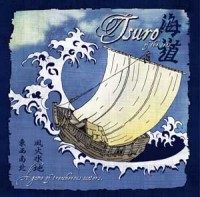
Tsuro of the Seas
The basic game play of Tsuro of the Seas resembles that of Tom McMurchie's Tsuro: Players each have a ship that they want to sail — that is, keep on the game board — as long as possible. Whoever stays on the board the longest wins the game.
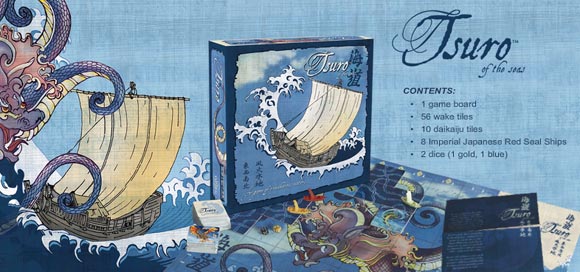
Each turn players add "wake" tiles to the 7×7 game board; each tile has two "wake connections" on each edge, and as the tiles are placed on the board, they create a connected network of paths. If a wake is placed in front of a ship, that ship then sails to the end of the wake. If the ship goes off the board, that player is out of the game.
What's new in Tsuro of the Seas are daikaiju tiles, representing sea monsters and other creatures of the deep. On the active player's turn, he rolls two six-sided dice; on a sum of 6, 7, or 8, the daikaiju will move, while on any other sum they'll stay in place.If a daikaiju tile hits a wake tile, a ship, or another daikaiju tile, the object hit is removed from the game. Another way to be ousted! The more daikaiju tiles on the game board, the faster players will find themselves trying to breathe water...



User Reviews (8)
Add a Review for "Tsuro of the Seas"
You must be logged in to add a review.
A swift opinion:
*Great additions that add great tactical layers to the original without complicating it.
*Easy to entice newcomers with great components and veterans thanks to familiar gameplay.
*A welcome addition to those who fancy more dramatic games of Tsuro, but a slightly harder sell for those on the edge, considering the retail price.
A wordy opinion:
Despite its threats of dragons crashing into each other and falling of the face of the Earth, Tsuro is a surprisingly calming game. What it needs is more drama, more danger, more fury in the eyes of the dragons and hunger in their bellies. And that’s where Tsuro of the Seas comes in.
Tsuro of the Seas is the sequel to the charming ‘Game of the Path’, and plays in very similar ways. Each player captains a ship trying to make it out of some particularly treacherous seas, all of whom have a hand of cards, or ‘Wake Tiles’ with several pathways on them. On their turn, they’ll place one of these directly in front of their ship and be forced into following the track they’ve made for themselves. If they collide with another ship, they sink. If they fall off the map, then those alive prior to the 17th century were apparently correct in thinking the Earth was flat as the ship falls to oblivion and that player loses. Or, if a ship comes into contact with the jaws of a new addition, then they’ll have a rather grim demise.
Where are the dragons in this game? Well, they’re not your pals this time around. Instead, they are fierce Daikaiju, beasts with quite the appetite for ships. Maybe they enjoy the idea of having splinters in their mouths. Anyway, as soon as the game begins an army of these creatures plague the board, and with each passing turn, will threaten the safety of everyone trying to survive. Before a turn, players roll dice to determine whether the Daikaiju makes a move. With a 6,7 or 8, the creatures navigate their way around the board, attempting to consume the poor seafarers who have enough on their plate to deal with. If any come into contact with a ship, it’s lunch time.
Despite its additions, Tsuro of the Seas still remains as brief and enjoyable 20 minute battle royale. The game’s swift pace means that the addition of the Daikaiju feels in no way malicious as the game ends quickly, and chances are you’ll be eager to dive in again. In any other game, these additions could be seen as dastardly and cruel, but as its playtime is almost as swift as its rules explanation, it’s not that huge a penalty to endure.
Tsuro of the Seas may add another layer of gameplay to the original, but it in no way complicates it, making it just as accessible and enjoyable as its older sibling. Whether it’s an essential purchase depends on how much spice you want to add to proceedings. If you’re content with everything Tsuro offers you, then it’s a hard sell at full retail price. If however, you’ve played the original so much that you think it needs a little more drama, a little more spice and an environment more dynamically dangerous than anything you’re expecting, Tsuro of the Seas is well worth diving into.
Tsuro of the Seas is the latest iteration of the Game of the Path. And while the game mechanics are virtually the same, but what changes have been made render this a much more satisfying experience.
If you have never experienced the joy that is Tsuro, here are the basics: There are a stack of tiles, each with a series of paths printed on them. You hold three tiles in you your hand, choosing one of them to place on the board. Your piece then moves along that path until it reaches the end of the tile. If that end happens to go to the edge of the board, you exit the board and lose. If the end of the path causes you to run into another player, you both lose. And, if an opponent lays down a tile that adds to your path, you have to move as well. The object: Be the last player on the board. It’s a game of spacial recognition and planning, plotting your course to avoid the other players and the edge of the board while forcing the competition to do exactly that. It’s an easy game. A quick game. A perfect introduction of gaming to non-gamers.
Tsuro of the Seas takes that concept and adds an added hiccup – Sea monsters. Sea monsters are placed on the board based on the roll of two dice. Each sea monster tile has numbers as well that come into play at the beginning of each turn. The player rolls a die for each sea monster one at a time. Depending on the number, the sea monster will move or rotate in place. If the monster goes off the board, it’s gone off the edge of the world never to be seen again. If it moves in your direction, you could be eaten. It’s a brilliant, simple addition that adds even more strategy to the game.
Tsuro of the Seas is a must-have. If you own Tsuro, you still should get Tsuro of the Seas; you will end up putting Tsuro away and probably never opening it again. Why? Because once the sea monsters are gone, Tsuro of the Seas becomes Tsuro. If you don’t have Tsuro, purchase Tsuro of the Seas. It’s actually a better game.
I’ve played the original Tsuro a number of times and I find that in a single gaming session, you can probably play it 3 times at the most before it starts getting too repetitive and then you need to switch to another game. And then you need to wait for another gaming night before you should break it out again.
That is where Tsuro of the Seas comes in. This game makes the original Tsuro so much better!! And what you are really getting is a bigger board and also big monsters that can kill you. The bigger board is definitely a great thing because it gives us a little more time before we start getting killed and that is always a good thing. Nobody wants to die too soon.
However, with the Daikaijus added into the mix, it really adds that thematic element to the game where we not only are focussing on our survival but it makes us want to avoid these really dangerous parts of the seas where these hostile monsters are flying around us.
I love that element about this new version of the game. While it does add a bit of randomness to it, it actually increases the intensity of the game to a new level. One of my players on my gaming night even called this game quite stressful because it was too intense for her Haha!! That isn’t necessarily a bad thing. It just means that all the players are invested in the game because we all want to survive.
Tsuro of the Seas is definitely a game that original Tsuro owners should get especially if you enjoyed the first one. If you enjoyed the first one, you will love the sequel even more.
After playing the old Tsuro in a large group and loving it, I found when playing in a smaller group or just a 2 player it was lacking up until the board became quite full of tiles. The Daikaiju that Tsuro of the sea throw in to the mix makes smaller games much more challenging and in turn much more fun!
If you are on the fence over which version of Tsuro to buy I would recomend this version as it has enough wake tiles so it can be played as a standard game of Tsuro or if you want more of a challege you have the choice to add in the Daikaiju.
The expension to this game Tsuro Veterans of the Sea, although does not add many diffrent types of cards (4) several Cannons, a tidal wave, a magic portal and a wirlpool. It does adds further variation through expansion to the game for great replay value.
If you have played the regular Tsuro and are looking for a new challenge this might be the version for you. The basic rules are the same, place a tile and then trace your piece or others affected by the play from where they are on their pathway to where the path now ends. As in the base game if you hit the outer edge or another player the pieces are eliminated. Now though, there are sea monsters on the board which may or may not move after you finish moving. There is an element of randomness in when and where they move that is difficult to plan for. Add in the fact that more can be generated in the game and you have a game that is more perilous and in many cases shorter than the original game.
This one is always a hit at our game days. It only takes 30 minutes to play through, supports a large number of players and effectively has 2 game modes – the original Tsuro or the Seas mode (which adds the dragons). Each game is different, though I guess it could get boring after a few plays as the game doesn’t change – just the cards you draw and how the dragons move.
Looking to get a friend into board gaming? This is a good simple choice – I’ve had a number of people play who don’t frequently play games and they’ve all really enjoyed the simplicity.
Being a college gamer I am always on the lookout for easy to learn game that people enjoy and can laugh about. This game definitely filled that criteria. 8 people were able to learn this game in a matter of seconds. (Literally seconds)
Tsuro is a game of survival that all you need to do is stay on the board. Played with easy rules and quick turns everyone was able to have a blast while still stopping to think on real consequential choices. If nothing else this game is worth getting for the low cost and the beautifully designed simplicity that this game capitalizes on.
Looking for a game that you can play in the short time before dinner or several times in an hour? GET THIS!
Tsuro of the Sea is great for all level of gamers. I can bring it out for people who are new to table top games and avid players also enjoy it.
It’s simple enough that multiple games can be played in short period of time.This simplicity also makes it attractive to the more causal player which is great. I love that I can easily explain the rules in about 5 minutes. The game has beautiful art and all pieces are made well.