
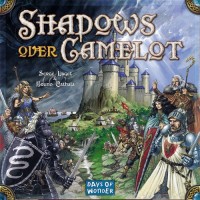
Shadows over Camelot
3-7
10+
60+

Shadows over Camelot is a unique collaborative game featuring a malevolent twist! As the incarnation of the Knights of the Round Table, you join forces against the game itself in an attempt to protect Camelot.
Your victory hinges on the successful completion of legendary Quests, such as the search for Excalibur, the Holy Grail, or Lancelot's Armor; the tournament against the Black Knight; and numerous wars against the Saxons and Picts.
But beware... all is not as it seems among these noble Knights. One of your number might yet turn out to be a traitor-in-waiting, biding his time while sowing havoc and destruction from the Shadows!
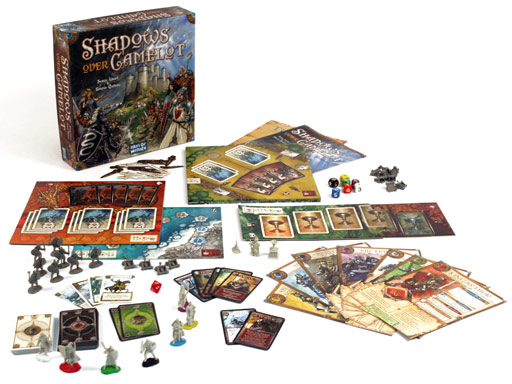
images © Days of Wonder



Add a Review for "Shadows over Camelot"
You must be logged in to add a review.
Luck
Strategy
Complexity
- Themes
Medieval, War - Mechanics
Cooperative, Deduction, Hand Management, Trading, Variable Player Powers - Gamer Types
Avid Gamer, Casual Gamer, Power Gamer, Social Gamer, Strategy Gamer - Designers
Bruno Cathala, Serge Laget - Game Families
Shadows over Camelot - Official Game Site
🔍 Shadows over Camelot - Rulebook
🔍 See official rulebook - Price (MSRP)
$60.00
One of my favorite board games, not only within the co-op genre but just overall. Love the theme, love the components and I find the gameplay to be both thrilling and intriguing. It’s actually quite easy to feel safe right off the start, but things can quickly get out of hand if people doesn’t fully cooperate and are ready to make huge sacrifices on their end to keep the game from overwhelming everyone with all the threats that are posed.
The game comes with four different boards that all have one or more questing areas and while these are all beautifully designed and have that wonderful colorfulness and level of detail about them that one can always expect from any Days of Wonder product, they could also feel somewhat intimidating to newcomers – especially if you’re not an experienced board gamer but more used to what games looked (and played) like back in the 80’s and 90’s. Still, I’d say that Shadows over Camelot is still a good place to start off for those curious about co-op board games because of how easy it is to get into – despite the size of the playing area.
One of the greater aspects of the game is how each turn, the players all need to do one good deed, which feels pretty natural for a Knight of the Round Table, but also one evil – something that will actually help the very same darkness that you are all trying to prevent from overthrowing Camelot. This is no easy task and the decision on what kind of evil act will hurt the least will only become harder to make the closer to the end you get. Because all progress that is made, be it stopping the Black Knight from winning a tournament to keeping the sword Excalibur from getting into the wrong hands, or letting yourself be overthrown by ravaging Saxons and Picts just so that you can make it to another quest somewhere else on the boards, moves the game forward and the further you get the less options you have that will actually help you make a stand and overcome the evil that is the game itself.
And even then, when the game is finally over, when there are no more battles to be fought at the shores or walls crumbling due to catapults to worry about… there’s always the possibility of one of you so called brave Knights revealing his true face – that of a traitor. And suddenly, everything that the rest of you have fought for turns into dust and you are nothing but losers, prone to deception, betrayal and defeat.
I really enjoy co-op games, and SoC is a great one in my opinion. There’s also a neat mechanic that sets the mood for the game. Before the game starts everyone draws a secret loyalty card to see if they are a traitor or not. The cool thing is that you mix one traitor card in with as many loyal cards as there are players. This means there will be one card left when everyone got one, so noone knows for sure if the traitor is in play or not. The suspicion and monitoring of the other players as well as accusations are really great parts of the experience. All players pick a knight (either randomly or by choice), and each knight carry a special ability.
The rules are simple, the game board consist of several areas, and ecah of them (part from Camelot that acts as a draw card location) contain a quest of some sort. It can be stopping the saxons or the picts from invading or defeating the black knight or retreiving the graal or Excalibur. There are two decks of cards, white (good stuff) and black (bad stuff). Every turn the player can do some good stuff (called theire heroic action) but they must also add a little more evil to the world, most often by playing a black card.
The cards themselves feed the different quests from both ends, some of the black cards will add more invaders, others will pull Excalibur further from the players. The white cards are played by the heroes to complete the different quests, most often by completing different poker hands. This may sound strange, but among the white card you have combat cards numbered 1-5. To beat the black knight you must play a 2 pair (for instance two combat-4 and two combat-3), and if the sum of your cards are greater than the sum of the black cards played on the black knight you win. To stop invaders you must play 1-5 in the correct order, so it may help to be more than one player on those quests.
So, how can the traitor stay hidden? They solved this by playing all black cards face down (so only play with people you trust will not cheat…). For instance, some black cards tell you to add a saxon, other cards will tell you to add a pict. In those cases you have no choice, but some cards give you the choice to place either a saxon or a pict, and the traitor will of course make the worst choice for the heroes. Since noone knows if the placing was voluntarily or not they cannot know for sure if it was a treacherous move or not. Quite smart mechanic I think.
For each quest completed the players will get some rewards, most importantly white swords to place in Camelot. For each failed quest they will get black swords instead. The basic idea is to get more white swords than black ones at the end of the game, but there are a few other ways to lose as well. For instance, one way to progress the evil is to place catapults in Camelots courtyard, and if the number of catapults reach 12 the game is lost.
When at it’s best the players are torn between different quests that all needs some attention, and timing is really important. You don’t want to stop the invasions until the very last minute or you will loose momentum. The two decks are fairly balanced, so it’s hard to know what to do.
After some play it is possible to accuse people of being the traitor, and they must then show their loyalty card. Beware, if falsely accused you gain black swords. If the traitor is found he/she will flee Camelot and play the rest of the game hidden away but still taking their turn and spreading the evil.
With a cunning traitor it can be really hard to win this game, and some of the special cards in the black deck are really nasty. But it is a fun game, and it also really fun to roleplay. The knights, saxons, picts and catapults are gray plastic pieces, well suited for painting, the gameboard and cards are really nice. As with most games from DoW the finish is great. I really recommend this game, though I think it shouldn’t be played to often.
Shadows Over Camelot is a co-op board game where the knights of the round table face many difficult and arduous quests to defend Camelot. By completing quests, knights acquire white swords for the round table, and by failing quests, knights acquire black swords for the round table. Once the table has 12 swords, if the majority are white, the good knights win. Otherwise, they all lose. The knights also lose if all knights die or if 12 siege engines accumulate outside of Camelot.
A turn goes as follows:
-Progress evil by either adding a siege engine, losing 1 health, or drawing and resolving a black card. Black cards usually go towards harming the knights in completing their quests, but they can also have more dire effects as well.
-Take a heroic action, which can be moving to a new location, playing a ‘good’ white card from their hand, typically towards the completion of a quest, or drawing two white cards if they’re at Camelot.
-Doing a second different heroic action at the cost of 1 life point.
-At any time during a player’s turn, he can use his character’s special ability.
Some of the quests that can be completed include retrieving Excalibur from the lake, finding the Holy Grail, defeating the black knight, fighting saxons, and more.
Shadows Over Camelot also adds a traitor aspect where the game may or may not have a traitor in the game. This player is trying to sabotage the quests and make the knights lose the game. When the progression of evil is bad enough, players can accuse others of being the traitor, scoring either white swords for being correct, or black swords for being incorrect. Throughout the game, opportunities arise where the traitor can oust himself in order to do something terrible to the other knights. Then, for the rest of the game, the traitor hinders the knights by either discarding their white cards or adding siege engines.
Overall, I think this game is a lot of fun. It’s a good co-op game that is fairly resistant to a single player trying to reign control of all of the other players due to not being allowed to say what’s in your hand. Somebody can still play dominantly to a small extent though.
The components are amazing. They have color-coded dice for each knight to represent health, and fully designed miniatures for each knight, saxons, quest rewards, and more. The board is designed with beautiful artwork and clear designated locations for each character that can be placed at every quest. The box also has great storage for all of the pieces, which is always hard to come by in a game.
Pros:
-Turns are simple
-Excellent components and artwork
-Great replayability
-Fun theme
Cons:
-The game starts to feel easy after a lot of play. The traitor helps to balance this to some extent.
-Some rules can be a little confusing
First, I must say: I thought about doing some version of the cheesy newspaper title for this review (something like “A shadow hangs over this game”), but I decided to just give you the “straight dope” and just tell you instead of annoying you with headlines that make one roll their eyes. The straight dope is that the game has what I consider a huge flaw.
Before I expound on that design flaw, I feel the need to point out the good things about the game. First, I could be wrong (I haven’t researched it), but I believe it was one of the first games to introduce the traitor element, and it is that traitor element that endears it to most people that like it. Full disclosure: the traitor mechanic does nothing for me, but others would say that it is a good aspect of the game.
In my humble opinion, the best element is the theme. It is implemented by allowing you to play as the knights of the round table, giving you little figurines for your character and everything. The pieces are well made and the artwork is great.
Given that theme, the game looks to be a lot of fun when I first opened the box. However, as I started to play, I found that the mini-games were fun but not great. Another way to say it is that they are not bad, but they are well… meh. Meh is probably the best descriptor if you are familiar with that adjective expressing something’s unexceptional nature.
After playing through the mini-games and finishing the game a few times, I found that the game was extremely difficult. This is where the major design flaw was eventually discovered. I started reading forums on boardgamegeek.com, discussing the difficulty as well as the strategies to beat the game. What I found was that there seems to be one main way to beat the game.
Let me back up for a moment. When you play the game, you move your characters to the mini-games of your choice; so, the order you go to each mini-game is up to you. You can even go back and forth from mini-games, switching even in the middle of playing one of them. So, it seems, at first, that there are a plethora of permutations one could follow to achieve victory.
However, that is not the case. There seems to be one (or maybe two) best sequences to follow. If you follow that sequence, you have a good chance of winning. If you try any other order on those mini-games, you will almost certainly lose. One familiar with strategy games should see the problem here: One does not adapt their strategy much during the game. Moreover, there really is no reason to try different strategies from game to game. Instead, the players just do the same actions in the order every time. One familiar with Shadows Over Camelot might say: “But you add in the traitor, and there is great tension.” That tension does not matter if the team’s strategy must proceed in the same order every play-through in order to have a chance to win.
Sorry, Days Of Wonder, I am willing to try a co-op game with a traitor, but if the strategy is the same every time, that is going to bore me regardless of a traitor. Design a game where my team’s strategy can change as the game progresses (in reaction to the events of that particular session); then get back to me.
Shadows over Camelot is a coop game set, SURPRISE! in Arthurian legend.
By the way, I just learned that “Arthurian” is a word recognized by spell check. That is how important it is!
I cannot stress enough the team dynamic required in this game. You will not be able to win if everyone goes off to save Camelot on their own. It just isn’t happening.
This game also has a (optional)traitor aspect, so when in use, one player is trying to undermine the good of the whole. Like any good traitor dynamic, no one knows who they are, or even if there is one, which can add to the tension in the game.
So, lets look in the box. You get 1 gameboard with the round table and a couple of quest locations, three other boards with quest locations, 16 swords of the round table, 168 cards, 7 Knight character cards, 7 six-sided dice used to track life and 1 eight sided die, two rulebooks and 30 miniatures. Nothing seems overly cheap.
The game plays 3-7. Each player is going to pick a random knight from the character cards. Each Knight has a special ability unique to them, such as being able to play extra cards, get extra cards, gain extra life, etc. If using the traitor, the 8 loyalty cards are shuffled and handed out randomly. Only one is a traitor card, so there is no telling who they are or if a traitor even exists.
Your overall goal is to fill the Round Table with more white swords than black. You do this by completing quests. Everyone gets 5 white cards and a Merlin card. You are supposed to each take a card from your hand and put it face up in front of you at the beginning of the game and discuss who gets them in what the rules call a gesture of collaboration. Someone may choose to take none, and the group may decide to give several to one player. After this, you start departing for quests. You can discuss in general terms what the cards in your hand may be useful for, but you can never give values, such as saying “I have three Grail cards, so I can help with that quest” Some quests, such as the Grail and Excalibur, can have several knights working the quest at once, and some, like the Black Knight and Lancelot, can only have one knight doing them at a time.
On your turn, you have several things to choose from. You can either
Move to a new quest or Camelot
Perform a quest action
Play a special white card
Heal yourself of a hit point
Make an accusation of a suspected traitor (when allowed)
In addition, when in Camelot, you can choose from
Draw two white cards
Fight a Siege Engine
Movement consists of “I am going to do this quest” and going there. Generally, you can play one card a turn, and specific white cards are used for specific quests. This is the quest action.
Special white cards have implications and beneficial abilities beyond just playing a card on a quest action. To heal oneself, you discard three cards of the same type and get a hit point back (bad idea, by the way)
Each knight can only accuse someone of being the traitor once per game, and only when 6 siege engines are placed or 6 swords. The traitor can accuse someone falsely just to add a black sword.
Every player on their turn must draw a black card, which represents the forces of the world working against you. These cards populate the various quests on the board that you are endeavoring to complete.
For instance, to complete the Excalibur quest, you discard a white card to move the sword closer to the knights side of the lake. However, if a black Excalibur card is chosen, it moves the other direction. Ignoring the quest will cause the sword to fall to the forces of darkness and two black swords will be added to the table.
The grail is similar. The knights in this case must place specific grail cards on the track and fill it with 7 white cards. However, there are different kinds black cards that can fill the grail track, and some require a white grail card to just remove them, requiring two cards to fill the slot that black card sat on. Should the darkness take the grail, you get three black swords.
There are also quests to take on the Black Knight, where you need to take fight cards, a type of white card that has a number, 1-5 assigned, and create a full house, turn by turn. Only one knight can participate. There are Black Knight cards with values that accumulate, and the first party, the Black Knight or the player, gets five cards, then the totals are tallied. The highest value wins. A white sword is one or a black sword is given, then the quest resets.
There are also Saxtons and Picts to fight. Knights can lay down fight cards in a straight. Should a straight be laid before four of that type of enemy appears (caused, once again, by certain black cards)yet another white sword is won and then that quest resets again. A loss gets a black sword on the table and 2 siege engines.
Oh, yeah, siege engines. Get enough of these puppies (12) and the game is over. Here’s the thing. Quests that do not reset, such as Excalibur and the grail, those cards still show up. Should they do so, a siege engine gets laid down outside Camelot since that effect cannot take place.
The Merlin cards mentioned before are used to counter a black card when drawn. It takes three to get rid of the nasty ones, so three players will need to agree to part with the cards. The only way to get more of the standard white cards is to spend a turn in Camelot (netting two cards) and do nothing else, or complete quests. There is a bit more, but that should be sufficient to give you an idea of what you are up against. You can choose to, instead of picking a black card, give up a life point or lay a siege engine. This gives a bit of risk/reward to the strategy. I have seen several games where someone had to die to make sure the game kept going. Once the 12th sword is laid down, the most swords, white or black, wins, tie to evil. The traitor wins if present if darkness descends.
OK, so how do I feel about this game? There is a great deal of tension created by the fact the game is constantly giving you fires to put out. This is not necessarily bad, and I enjoy the concept in games like Red November. Forcing the players to work together is a good concept as far as I am concerned as well.
The problem is I really do not care for this game, and I really cannot tell you why. When my friends and family pull it out to play, I play, but I don’t get a great deal of joy out of it. I tend to feel a sense of foreboding when playing caused by the progression of evil and a sense of urgency to deal with the problems it causes, but I would assume that was intended. If cornered and asked, I would say my biggest issue is that there is a certain formula to winning the game that just puts me off. If you fail the grail and Excalibur, the game is pretty much written off. Should you succeed at those, victory is almost assured. To make the comparison again, in Red November, when things start going wrong, they are random. The consequences to ignoring certain things is pretty much equal. That isn’t the case in Shadows over Camelot. In addition, in Red November, failure, with the right group anyway, is humorous. Imagining your drunk gnome passing out has an amusing bent to it. Games that I have lost in Shadows tend to end up in arguments about who could have done what. It isn’t light hearted at all. In addition to that, I really don’t understand what the end game here is. What am I fighting for? If I get 7 white swords, the Picts and Saxtons are just going to leave Camelot alone forever? The Dragon is just going to fly off with the Black Knight? These are really all minor quibbles, but they seem to pile up for me and give me a sense of “meh” when playing.
So, take my opinion for what it is worth. Lots of people like this game, and I hope I gave you enough unbiased information aside from my opinion to be able to tell if this is right for you and your group. For me, I would rather play something else, but I will play when asked.
Shadows Over Camelot is something of the elder statesmen of board games, its now the ripe old age of 9, which for board games whose ageing works something like that of a Pekingese makes it in about 98 by human years. So its a bit long in the tooth and by rights should probably be consigned to the composter, after all with all the new innovative games hitting what can this grand old codger teach us?
Well, Shadows is responsible for birthing many now commonplace mechanics and ideas into the board game universe like some teenage council estate single mother, although Shadows brood is bit more well behaved, and less likely to knock your wing mirrors off your car or spray paint a badly spelled expletive on your front door.
So what makes this so great then, well for starters the board and its components are just some of the best looking yummy stuff still even by today’s hi-def standards, there is a lot in this box and being a days of wonder release all of it is tasty gravy. It was also one of the first co-op games to come out from a big publisher and gets right a lot of the elements that subsequent games haven’t. Whilst its a co-op each player still has the freedom to control their destiny and make decisions which effect them as well as the group. Too often of late some of these newer co-ops just make you feel like a cog in some monstrous machine, with you just hanging around to hit the button at the right time.
And it also added a serpent in the mix that has become quite popular and an element I do love in games, the dreaded traitor mechanic. One of the cool things about how Camelot uses it, is the potential that if playing with less than the full 7 players then there may well not even be a traitor. But the prospect of one lurking and all the decisions that this game throws at you (most of them bad) means that even without the traitor, everyone is still going to suspect everyone else.
So whats all this Camelot stuff about then? Well each player is a knight hanging out at Arthur’s round table and you get to go out and do a variety of quests, everything from searching for the Grail, to fetching Excalibur from some watery tart to battling the evil Black Knight. Every turn a player must do two things one is bad the other good. The bad will be anything from losing a life, putting siege engines on the board or taking a card from the dreaded deck of dreaded cards of dread. The good stuff will be going questing, using cards, having a nap (healing yourself) or pointing at another player and accusing them of being the traitor.
This is a great place to start with anyone interested in co-op games or traitor games, the basic mechanics of all the quest’s are really just set collecting and making poker hands, so its easy to explain and get people playing. Whilst there is a lot options and initially it can appear a bit daunting after a round of turns everyone should grasp whats happening. For something to slap on the table and get going pretty quickly this is it and once set up it looks stunning. Sort of like the board game equivalent of a **** or is that a Cougar.
I’ll tell you another mechanic that this introduced that I don’t think I’ve seen in any other games is the option for somebody to just sit down and join in. Even if the game is underway and there is a space you can just deal them in and off you go, how cool is that.
The only bad mark I’m going to throw at this is its rule books, yes there are two of them. This frankly seems a bit overkill, they look lovely but splitting the quests into a second book is a bit strange especially when some rules are in one and not in the other, however its not a deal breaker and once you get a hang on whats happening you won’t even need them again, here’s a tip though, make sure you explain the traitors rules very well, because it can be a bit of a giveaway if somebody suddenly needs to study the rules mid game.
So this being a co-op obviously its you against the game, and boy this thing is as evil as anything that has come along since, then you throw in the possibility of a traitor and it really goes off the rails. So you all need to be working together and the game cleverly with a few very simple rules does its best to make you all look like your the bad guy. Take for example the Black Knight quest, if you draw a bad card for this quest it has to be played down on the board for the BK but the player has the option of putting it face down to gain a white card. This offers up such a tasty quandary if the player is good then they gain the card which is really useful, and now here is a thing, you can’t say what the exact power of these or any cards are. You would state something like “Tis a puny naive that I have placed down” i.e. a power 1 card, which of course doing this also helps the traitor disguise his actions because he can be lying through his teeth whilst putting down nasty cards or stockpiling other good cards in his hand. Pretty soon the most innocuous move can have all eyes on the table scowling at you.
You can out a traitor if you so wish, there are a few rules. There needs to be at least 6 siege engines down and 6 swords, and this is a one time deal so you want to be sure. Because if your wrong than a white sword switches to black, of course there is nothing stopping the traitor from accusing fellow knights as well. Once the evil traitor is discovered than he can cause all sorts of mayhem by taking cards from players and placing siege engines or playing black cards from the deck.
So losing well that is achieved a few ways, if the siege engines fill up to twelve than you’ve had it, if there are more black swords around the table at the end then you’ve lost, and if everyone dies you lose. The win condition is simple put down all twelve swords you need to have more shiny white swords around the table than black otherwise that mean old traitor wins. The swords are placed upon completing or failing quests and some quests also come with extra perks that can help you along the way such as the Grail or Excalibur.
So summing up, this is a lot of fun but **** its hard. As an introduction to some now much used mechanics alone its worth a grab, as I’ve already said you are getting a handsome game with some neat components. I’ve not even covered all the quests or the fact that some of the quest boards are reversible adding even more carnage to the game. There are deeper and more thematic versions of this style of game out there now, but this old lady still has some tricks up her sleeve. And if you throw on Monty Python in the back ground than this can turn into a riot, I can’t play the game these days without thinking about the stupidity of the film, maybe that’s what we need a Holy Grail licensed re-theme?
So for me and the gang we’re off to Camelot!
Or was it other way around? But in this game it’s more of kingdom for more cards. This game revolves around getting things done with help of different set of cards, with King Arthur theme. So let’s see if Merlin is really an old coot as everybody claims.
Looking for Excalibur or? (Summary of gameplay)
Camelot is under attack and it’s up to you to save the kingdom. You assume the role of knight of round table, each having their special skill, giving some variation to characters. Alas one of you might be a traitor. As I said, might be, there is no certainty that there is a traitor (one traitor card in deck and rest are loyal).
Game runs through turn to turn, where you do an evil thing, such as drawing evil (black) card, take damage or place catapult (12 catapults ends the game). Then you get to do your good deed, moving, getting more cards, removing catapults or playing cards.
Mechanics itself are simple, however there are multiple quests ongoing same time and managing them is difficult on lower amount of players. Quests vary to some degree from each others and explaining them might require some time and people will be asking on first gameplays about them frequently.
All quests have fail and success trigger which benefits or harms players in said quest, also on lost quests you tend to get additional catapults in front of Camelot.
As this is a game that has traitor element, many things will be done in secret. You can’t show or tell what cards you have, even though multiple cards are played face up on table you might also do it face down to gain additional ones.
All you need to do is to collect some swords on the round table, how hard it can be?
Walk though the armory (Components)
Art is the usual good quality we expect from Days of Wonder. Art is pretty and has kinda comic feel on them, and I mean it in good way.
One thing stands out above all on components are the high quality player pieces, such as knights, catapults, enemies and quest rewards. Figure painters will be having a blast with these and as plus side weapons that stick out of torso are soft, so they won’t break off that easy.
How do I swing this thing? (Learning curve)
Multiple quests and their individual mechanics might be difficult to some and there are decent amount of things to remember, even though the board does all it can to remind players how things function. Everything should be clear to all players after first game or even by halfway of the first game.
Cards are fairly easy to explain and special cards state what they can do.
Drive them to the sea! (Conclusion)
This game can be really difficult and as the rulebook warns might be that you even play against yourselves. The separate quest mechanic is good and gives freedom of selection (at least in beginning) to players and some of quest rewards are good and helpful for rest of game. It is fun to play and has potential to make you talk with others for common goal, such as Battlestar Galactica or Pandemic.
However I find that this game scales poorly to amount of players, you almost must have the full compliment of players in order to win, otherwise you get swarmed by recurring quests and catapults. Other thing I am not so fond of is the might-be-traitor, it works nicely again on 6-7 player game, but on lower amounts not so well. Generally I find Battlestar Galactica be better game on all parts and more worth of my time (and my player group agrees), still this is a good game and fun to play if you can collect right amount of players around the table. Theme is there and it has good atmosphere, but somehow it feels that they could have gotten more out of it.
Enjoyable game, but the true shadow over Camelot is the one Battlestar Galactica casts.
The story of King Arthur is deeply ingrained in to geek culture. From The Sword In the Stone, to Monty Python, this is a theme that everybody knows, and most love. In Shadow Over Camelot, you and your friends go on quests to defeat the game. But the game has a few tricks up it’s board. One of which may involve one of your own.
Components
If you have never played a game by Days of Wonder, one thing you need to know is they make REALLY nice looking games. And, Shadows Over Camelot does not break this trend. Included in the box are 1 Master game board, 3 Double-sided Quests, 16 Swords of the Round Table, 68 Character/Event/Loyalty cards, and 1 special 8-sided die. Oh, and 30 Miniatures. As much as I love small, bang for your buck games like Avalon, there is something great about a game with gorgeous game boards and miniatures to get you right in to the theme.
Set-Up
Unlike smaller games, there is a little bit more to setting up the game.
First, you’ll need to position the master game board and 3 double sided quest boards in the center of the table. Next, place the miniatures of Excalibur, the Holy Grail and Lancelot’s Armor on their respective spots on these quest boards. Once this is done, give each player a Coat of Arms and it’s matching miniature. You also have the option of giving out a loyalty card to each player. Keep in mind that if you do, one of the player’s MAY end up as a traitor, and will work in secret to defeat the other players. Once this is done, divide the white and black cards in to separate piles and place the piles on the master game board. Next, deal one Merlin card to each player, as well as 5 random white cards to each player.
The last part of the setup is to have each player play a white card face up on the round table. The cards are then dived amongst the players as they see fit.
If any player is playing as King Arthur, then he will start the game. Otherwise, the youngest player will go first.
Game Play – Basics
The game play of Shadows can be summed up very simply. A bad thing happens, and then a good thing happens.
For the bad things, players can choose to either:
– Draw a black card from the black draw pile (and apply its effect)
– Add a Siege Engine around Camelot
– Or Lose a Life point
Keep in mind that the bad things are really bad. Give up too many life points and you will be dead, and out of the game. Fill up the 12 Siege spot, and the game wins. As for the black cards? They have different effects on the game. Some will cause the game to take control of a quest, others will cause all players to take some type of penalty.
Survive the bad stuff, and you get to do the good stuff. The heroic actions available are:
– Move to a new Quest
– Perform an action related to the Quest you are on
– Play a Special White Card
– Heal yourself
– Accuse another Knight of being the traitor
Play continues clock wise until one of the end game conditions is met.
The game (and traitor) win if:
– 12 Siege Engines surrounding Camelot
– 7 or more Black Swords on the Round Table
– All the Loyal Knights are dead
The game also ends if the 12th sword is played on the round table. If this is done, the game wins if the majority of swords are black.
The only way for the forces of good (the players) to win is by having 7 or more white swords on the round table.
And keep in mind, while the game is a co-op game, players must not reveal which white cards they have in their hands. This, plus the threat of a traitor, makes for a fun yet challenging experience.
Game Play – Advanced Tactics
One of the great things about Shadows Over Camelot is the Quests themselves.
The Quest are made up of The Black Knight, Lancelot & the Dragon’s Quests; The Quest for Excalibur; The Quest for the Holy Grail; and finally The Saxon and Pict Wars.
Each Quest has a different win and lose condition. If the quest is won, all players currently on the quest receive rewards. If the quest is failed, the game gets rewards. This is the main way that players and the game will add swords to the round table.
The Tournament against the Black Knight, the Quest for Lancelot’s Armor and the Dragon’s Quest are Combat Quests. When on one of these quests, a player may play a single white Fight card on any empty card spot on the Knights’ side. The cards you play must eventually form a specific combination (2 pairs of distinct values in the Black Knight’s Tournament, a full house in the Quest for Lancelot, and 3 three-of-a-kinds in the Dragon’s Quest). A Combat Quest ends the moment its last White or Black empty spot is filled. The sum of all White cards played on the Quest is compared to the sum of the Black cards played there. If the White Fight cards have the greater total value, the Quest is won; otherwise it is lost.
To win the Holy Grail, you must cover every single spot on this Quest with a Grail card by playing a single Grail card on the first empty spot closest to the Holy Grail. If all the spots are filled, remove the closest Despair (or possibly Desolation) card instead, and discard both cards. If you lay the 7th Grail card on the last spot on the board, the Quest is won, and rewards are handed out.
To fight the Saxons or Picts, play a Fight card on the first available card spot in that War. The cards must be placed in order from 1 to 5 forming a “straight” of increasing values. Playing the fifth and final Fight card in a War wins that Quest. The quest is lost if four Saxon or Pict figures are placed on the battlefield before you play the fifth white Fight card.
In addition to this, there are other “mini quests” to perform. These include fighting off a Siege Engine, or drawing two white cards. Keep in mind that while these quest may seem mini, they have big repercussions on the game. Allows the field to fill up with Siege Engines will result in losing the game. And, if you don’t have any white cards, you will not be able to defeat the other quests.
There is one final quest you can do. While in Camelot, you may officially accuse a player of being the traitor. Guess right, and the traitor must reveal his identity. Why is this important? Well besides knowing who is trying to screw you over, if the traitor is not known when the 12th sword is played, 2 of the white swords must be flipped over to black. And keep in mind, if there are 7 black sword, evil (the game) wins.
Theme
One basic truth of gaming, is that miniatures add to theme. The artwork and tiny little figures helps create a feeling of place and time. And that holds true for Shadows. And really, the fact that you are playing as either Arthur or a member of the round table is really and easy theme to get in to. Additionally, the special white and black cards read very thematically, creating a great game environment.
One final thought on the theme…the game can get really silly if you or your friends over do the Monty Python jokes. It’s up to you if that is a good or bad thing.
Replay Value
The value of this game really depends on your group. While the game can be played by 3 players, it really does suffer. But, if your group has 4-7 players, this is a game that you will play over and over again. The quests, are varied enough that they never feel repetitive, and the fact that a bad thing happens on every turn really cranks up the tension.
Over All Impression.
Shadows Over Camelot is really a game where the whole is much greater than the parts.
Playing mini poker games would get old fast without the theme and evil actions. And it avoids one of the big traps of most co-op games. Because of the possibility of the traitor, and having to play the game without revealing your hand, you and you alone are in control of your actions. Yes, you need to read the room and pay attention to how others are playing, but the choices you make are your own. That alone creates a unique experience.
Add in the easy to learn game mechanics, gorgeous components, and great theme and this is easily a must play. And if you have have a larger game group, it is a must buy.
Just remember to look up the air-speed velocity of an unladen swallow before you play.
Shadows over Camelot is a coop game set in the medieval time of Camelot, King Arthur, and his knights of the round table.
The game starts with the choosing of the different knights each player will play with. Each knight has a special ability that is unique to them makes them better suited for different parts of the game. Along with choosing of the knights each player is given a loyalty card, someone among the group is a traitor!!!! But who? What is their role? And how did this knife get in my back?
Components
Shadows over Camelot comes with several boards with this game, all featuring a different quest that the knights can go on to complete. Set in the theme of Camelot there is a quest for Excalibur, the Holy Grail, fighting a dragon, and a few others.
Game Play
On your turn you have two phases, an evil phase and a good phase. Evil is up first and you can choose from three different actions. You can cause your knight to lose a life point, play a siege engine against Camelot, or draw a black/evil card and perform action the card tells you to do. Drawing a black card will usually have an action that will strengthen an opposing army such as the Sax or move Excalibur against you. These effects are manageable and expected. But be careful! There are other cards, very powerful cards of dark magic and treachery in there that can greatly damage your knights.
As a knight of the round table you are trying to manage these evil effects against Camelot, but as the traitor you are trying to cause the most damage without being caught.
Along with the evil phase there is also a good phase on your turn that will benefit the knights. Through the good phase you can gain a life point, accuse a traitor, move to a quest, or play the also good white cards you will be collecting.
As knights complete different quest they receive the treasure from that quest. The usually consist of life points gained, extra cards into your hand, special goods such as armor or Excalibur itself. But most important are the white swords added to the round table. This is how the game is actually won. If you are able to fill the table with swords and have the majority as white then you are able to win. However, there are multiple ways to lose. Your knight can lose all their life points and die. Camelot can be overcome by siege engines. You can lose also lose too many quest resulting in too many black swards, or “evil influence” in Camelot.
Setting Itself Apart
The thing two things that do set it apart are the quest, I feel like they overcome the “Alpha Gamer” in a way, allowing you to do more you want instead of being managed by one player. The second is the traitor. This can be a lot of fun, but the Pandemic expansion also allows for this somewhat, and it seems the traitor can easily thrash you without much to stop him.
In Conclusion
Overall, this isn’t a game we break out too often. Some of the quest are a little daunting, such as the grail. And for some reason it just doesn’t have that much of a “fun” level. Whenever I lose at Pandemic, I want to get back in there and give it another go. When I lose at Camelot, I’m just like, “Oh, that stinks! What’s next?” It’s not the best coop game I’ve played, but it’s not the worst. It’s nice to breakout once in a while and blow the dust off of.
Shadows over Camelot is a cooperative game, meaning players work together to “beat” the board. This is made interesting with the inclusion of a potential traitor who is trying to foil the plans of the Knights and cause them to lose. This keeps players a little on edge, unsure of what kinds of things they can trust their fellow knights to do. All this takes place on an stunningly attractive board. The components of this game really make it. The amount of nice looking cardboard and plastic that comes with this is great.
The actual mechanics of the game are a little boring, and the game is balanced very different depending on how many people are playing. Less than 5 players? The traitor is going to have an easy time winning? More than 5 players? The traitor is going to have a difficult time. Furthermore, the number of ways a traitor has to make an impact on the outcome is limited. The only major mechanic a traitor has is to play evil quest cards face down and lie about the severity of the value, or to play quest cards where they are not needed. Of course, the Traitor can always accuse other players of being a traitor, sewing doubt.
In short, Shadows over Camelot is a fun game, but is not without its flaws. For a similar game that does “Coop with a hidden bad-guy” better, check out Battlestar Galactica.
Shadows Over Camelot is a semi-cooperative game where the players are knights of the Round Table; there is a chance that one of the players is a traitor, working against the Round Table, but it is by no means guaranteed. Each turn the players may take 1 free action or may sacrifice a life point and take 2 actions, but they must always draw a card from the black deck which represents the opposition’s actions. The knights must complete quests thereby winning white swords, but if any quests are lost they gain black swords. At the end of the game if there are more white than black swords the loyal knights win, otherwise the traitor and/or the game wins.
Since the role of the opposition is played out via a deck of cards the players must coordinate their actions in order to win the game. Many quests will ebb and flow, and this will add great tension to the decisions. A wasted decision can spell disaster. On their turns the players must choose to move to a quest, or play a card from their hand on their current quest location, but if they cannot play a card on their current quest they must move. Players must think ahead as moving can be a tiresome waste. Players may also accuse someone of being the traitor, but they are penalized if they get it wrong, however if there is a traitor and he is undiscovered he may convert 2 white swords to black and thus tip the scales.
This is a great cooperative game that has seen many a knight die, a few traitors win, and required active participation by all players.
Quick and easy to learn and play.
Hard to win!
Each round you choose something bad to do by design!
You just have to stave off the evil long enough to complete the missions.
The mini game concept is super fun though and it is almost as fun to watch evil win!
I’m suprised to not see it tagged as family friendly.
The artwork is illustrative and light hearted.
Even the Dragon artwork is fun.
The mechanics make it pretty easy to teach to kids, though if the kids are sore losers or get frustrated easily, you may want to pass.
Overview: Shadows Over Camelot is a cooperative game for 3 to 7 players who attempt to protect Camelot despite a possible traitor amongst them.
Gameplay: Players begin the game by drawing a Loyalty card and keeping it secret from the others. Seven cards will declare them loyal knights of Arthur and one will confirm them as the traitor. Throughout the game, knights attempt to complete various heroic quests. Success will add white swords to the Round Table, which can hold up to twelve. Failure will add black swords instead. After all spaces are full, loyal knights win if more than half the swords are white. Otherwise, they lose and the traitor wins. The knights also lose immediately if there are seven black swords in play, all loyal knights are dead or twelve siege engines surround Camelot.
To start their turn, a player chooses to progress evil in one of three ways. They can sacrifice one of their meager points of life, add a siege engine outside of Camelot, or draw from a deck of evil cards which will randomly cause havoc to a quest in the game. Then they are able to perform a heroic action such as drawing cards, healing, attacking a siege engine, moving to new quest or performing a specific function to advance a quest towards victory. The quests include searching for the Holy Grail or Excalibur, defending against Pict or Saxon invasion, and combat quests against the Black Knight or the Dragon. Each quest has unique rewards or penalties based on its outcome. The method of accomplishing each quest is varied also, usually involving discarding cards or playing numerical cards to the table in different patterns and sequences. A separate rulebook is provided as a reference for the quests to speed play.
The traitor begins the game pretending to be loyal and must work their treacherous schemes in a subtle manner that does not attract attention. At game’s end, a concealed traitor may switch two white swords to black, helping his cause greatly. Eventually the loyal knights may attempt to discover the traitor by accusing knights who have made questionable actions. If they are correct, the traitor is revealed and continues to progress evil on his turn, but loses his ability to sabotage Arthur’s plans from inside. An incorrect accusation will cause a white sword to convert into a black sword, so care must be taken to not blindly charge others.
The game provides many difficult choices for players to make, and brews an atmosphere of suspicion and doubt. The mechanics of the game are not complicated in isolation, but the traitor dynamic is what supplies the game its depth.
Pros:
– Gorgeous components including highly detailed plastic miniatures and colorfully illustrated boards and cards.
– The Camelot theme is well known and makes it easy to introduce players to the game.
– The mostly cooperative nature of the game enables new players to join in almost immediately, learning as they play with assistance from more experienced players.
– Hard choices create situations that breed suspicion and amplify the traitor dynamic.
Cons:
– Some players may become bored while waiting for their turn if they do not actively join in the search for the traitor by paying attention during others’ turns.
– Traitor assignment is random, and this role may not appeal to all players, especially those that don’t want to be opposing the group.
Historical Figure/ Fictional Character I’d Most Like to Play With: Arthur Pendragon
Shadows Over Camelot provides a challenging game system to defeat. The addition of a possible traitor expands the threat and creates an experience loaded with intrigue.
The game really is easily learned and is playable by both casual and avid players. I have now played it in groups of 5 and 7. We found that the game was a little more difficult for the traitor with 7 people as opposed to 5 people because there is 2 more people to thwart the traitors actions. After trying the “squire” alternative start, we still found the game to be difficult for the traitor. After reducing every knight’s life to 3 instead of the recommended 4 lives at the start we found the traitor had a much better chance.
Love the game!!! everyone I have exposed the game to did the same thing I did, rushed out to secure a copy of the game for themselves.
I won’t delve into the rules, Dolus did a great job, already! 🙂 However I want to mention a few things..:
This is a fine introductory semi co-op/traitor-involved game and it would appeal to non-gamers or new ones. The gameplay is light, the Arthurian theme is beautiful, the quality of components is excellent (rarely have I seen a game’s plastic insert to take into account the size of [u]sleeved[/u] cards).
In my opinion, the game has a medium replay value (rather simple for my taste). There are some options, though:
a) You could pump it up with the new ‘Days of Wonder’ expansion ‘Merlin’s Company’ which adds new Knights, Merlin himself, new bad guys, and Travel (event) cards.
b) You could consider it as a necessary (learning) step, and get Battlestar Galactica which is a more complicated and heavy semi co-op game.
Personally, I would go straight to Battlestar Galactica 🙂
i just ‘love’ this game
it’s beautiful and despite the lot of boards, cards and pieces … it’s an easy to learn and a very good game . especially the ‘traitor’ -role is so good that unmasking himor her could even let you win or loose the game , same as when the traitor reveales it’s identity …
i! played it maybe thirty times now and always was the tension there till the last minutes of play … will we succeed to protect camelot or not ? …. 9/10 !
This game is one of the best out there as interesting twists can be added to the
social aspect of the overall game. Played it three times one night till 3:00 am and still did not want to stop. Highly recommended.
Great play, fast action, and I love those tough choices. Is someone a traitor? Are you being played? Why did you put that siege engine in front of our castle?
The more I played this, the less fun it became for me. The alpha gamers always want to drive the game and it feels like you are just collecting poker hands. Some of the quests are pointless and if the traitor is a new(ish) player, they might be overwhelmed and isolated. Playing it without a traitor is even less fun. I happily traded away my copy.
This game is probably the most fun accessible coop board game on Earth. I like the fact that someone could possibly be a traitor, (Something Pandemic lacks). Games with hidden traitors are just generally more fun and tense because accusations are flying wildly around the table. This game is more fun when you really get into it and play with a bunch of players that aren’t afraid to use silly voices. Shadows over Camelot is easy to teach, and would be a great gateway game.