
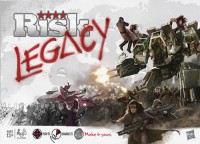
Risk: Legacy
3-5
13+
75
How will you shape your world?
In Risk: Legacy, every game you play will change every future game. A decision you make in Game 1 could come back to haunt you in Game 10. The risks you take in Risk Legacy are not like those in any other board game. You and the other players will shape how your world evolves: its history, its cities, even its factions and how they fight. Cards and stickers will come into play. Cards will go out of play forever. You don't forget past betrayals – and neither does the game.
Unlock new rules and watch events unfold as you play more games. No two games will EVER be the same.
Play your game. Write your history.



User Reviews (17)
Add a Review for "Risk: Legacy"
You must be logged in to add a review.
**This review does not contain game spoilers**
Your copy of Risk Legacy has a unique serial number on the board. This represents YOUR world, a clone of Earth created by scientists in an effort to finally end war by giving everyone a new place to live. Of course, this doesn’t work and the various factions start fighting soon after they arrive on their new planet. The point is that THIS world will end up very different from every other world.
It’s essentially classic Risk with a customization layer added. One of the first things you’ll do is choose special abilities for the five factions. The abilities are on stickers and you’ll apply the stickers to each faction. Already, your game is different from many others. During the first game, each player will get cards that allow them to alter the board. PERMANENTLY. In the beginning there are only two types of cards (you can add a bunker to a territory and make it easier to defend or make a territory short of supplies and harder to defend) but in later games, more option will pop up. At the end of the game, the winner can alter the game in one of six ways (the most popular being the ability to name a continent), and those that weren’t wiped out also get a minor alteration.
There are also six pockets in the box. These “unlock” as certain requirements are met, such as placing the ninth minor city on the board. The unlocked pockets add new features.
My copy has been played nine times. This is important as when the 15th game is played, it can no longer be modified by the winner (though the pockets and other cards can still add things to the board). The player that has won the most in 15 games gets to name the world!
Other online reviews state that it’s best to play with a set group to ensure maximum fun and balance, but I’ve played with three different groups and no one has complained. While I can’t say if it’s balanced in the end (for example, I get the option of starting with 4 missiles since I won for times), I CAN say the fun I’ve had was well worth the price tag. Buy it!
This game blew me away from the minute I read an advertisement for it. “A decision you make in Game 1 could come back to haunt you in Game 10.” That whole concept is very, very cool.. and to seemed very indie, and very forward-thinking for a company like Hasbro.
In Risk Legacy you modify the game as you play. You choose a faction and add stickers with special abilities. After winning the game, you can name continents and get bonuses if you hold that entire continent in a later game. You can found and name cities, give countries scar stickers (which modify that country in a bad or good way), and everyone’s favorite/least favorite.. tear up cards. The game is permanently modified when you throw out the Mongolia card. It will never show up again, so someone that took over Mongolia has less of a chance to earn bonuses and victory points. The strategy in this game goes well beyond the end of your session, and feels much like an RPG. But the joy of it, is that anyone can jump in and out because the story is all right in front of you on the board. If you miss a session, you can see the winner, and the losers, and the results of that session.
There are a few other reasons why this game is so great. The first being that they improved on the Risk model. Not just by customization, but also by making the sessions last just an hour each. Instead of world domination, you start out in one country and work your way outwards. If you hit 4 victory points (obtained through various methods) you win the game.
This was by far my game of the year, and I hope it’s a business model that starts off a whole new type of campaign games, where previous actions effect future games. Just the idea gets my head spinning.. in a very good way.
Let me preface this review by saying that I was never a Risk fan. I detested the game as a kid. Now an adult, I haven’t played Risk in well over 20 years. It is one of the few games that I would unequivocally refuse to play.
I was intrigued by Risk: Legacy’s premise when I first heard of it; and after watching a few reviews, I put out the money to purchase a copy. Now, nearly a year later, it has finally made it to the table.
How Were the Components?
Without going into a listing of the individual components, let me just say that they are, typical of most modern Risk games, pretty good. Each faction, of which there are five, has unique troop figures representing 1-pont and 3-point armies in addition to a headquarters piece. The figures nicely represent the unique flavor of each faction.
The game board and side board are sturdy and of good quality. The artwork is clean and unimposing, and suits the overall theme and storyline of the game.
The dice are dice… though the rationale behind using black for attack and red for defense eludes me.
The territory/resource cards are okay. Simple and Spartan. Not of great stock, so I expect they will begin to show wear and tear soon enough if I do not sleeve them, but not so flimsy as to make me feel they are of inferior production.
There are also a number of stickers that come with the game which, as the game progresses, are meant to be applied to the game board, faction cards, and resource cards. Here is my main beef with the game’s components. One 8×11-ish sheet of stickers is included with a number stickers to be used before and/or after each game. These are fine. The stickers peel off easily and, when applied, adhere well to the board. However, a number of other stickers come on cardboard cards to be used at various times when certain events occur within the game. These stickers – at least in my copy of the game – were terrible. In all but one instance, none of them would peel away from the card. Instead, the “label” portion of the sticker simple ripped off the back of the “sticky” part of the sticker. Fortunately it did it with such consistency that the labels didn’t tear. I resorted to taping them to the board or faction cards and plan to glue them down later.
How Was the Game Play?
On the one hand, this is still Risk. Place your troops. Move your troops. Roll your dice. Rinse and repeat. The simplicity of Risk’s mechanics is a strong factor influencing my distaste for the game. That aspect, in Risk Legacy, is no better or worse than it is in previous iterations. On the other hand, the overall game play objective has changed significantly… and this is definitely for the better!
The ‘Total Annihilation, Last Man Standing’ drudgery of classic Risk is gone; replaced by a victory point system which manifests in the form of Red Stars. Your faction need merely acquire four of these Red Star VPs to claim immediately victory. This system drastically changes the dynamic and flow of the game, and the fact that everyone starts each game with one or two Red Stars just adds fuel to the fire. This mechanism leads to more dramatic and intensive conflict, and much quicker victory; victory which can be achieved without player elimination or faction annihilation – though, let’s face it, the latter is so much more fun.
Okay, So What Else is Different?
Risk: Legacy has a few additional rules that alter the gaming experience from that of classic Risk, but not in significant ways. Troop recruitment is more streamlined. Resource cards do not have to be matched in sets. Though some have differing values – denoted by coin icons – when you turn in cards, you merely count the total number of coins and collect a specified allocation of troops. Players that have won previous games receive missiles in lieu of a bonus Red Star. These missiles are one-off abilities which permit the player to influence a single die result in any combat. Factions may rejoin the war effort if all troops are lost but a valid start location still remains available on the game board.
Then What’s the Big Deal?
Okay, to the meat of the matter… the “legacy” in Risk: Legacy. This is awesome! The ability to change and shape the game in permanent ways is just plain cool. Though my players were initially reluctant to put stickers on the board or to rip up cards, we soon overcame such reservations and began to look forward to the next great revelation the game had to offer. Each new rules addition… each new faction power… opens new realms of tactical and strategic thought for future games and as imminent defeat draws near, one finds oneself already contemplating different choices in the next game.
What’s the Verdict?
With a full complement of five players, we played two games in quick succession and only the late hour and parental commitments broke the group up before a third. With the exception of one player, who played the sour pus and merely fortified all of his troops to his home territory and strive for a “held on” outcome (versus “eliminated”), we all had a blast playing. The game is fun… actually fun. The shortened duration of the games avoids boredom and drudgery. An eliminated player may possibly rejoin the war, or, if not, it will probably be over soon anyway, so he will be able to play again in the next one. In Risk: Legacy, you look forward to unraveling the mysteries hidden within the sealed envelopes. You look forward to your next game. At no time did I feel the old desire to claw my own eyes out, a desire so prevalent during my yonder days of classic Risk.
For me the original Risk is an enjoyable light war game, when my group began playing on a semi-regular basis again this and its Lord Of The Rings variant saw plenty of time at the table. Sitting back in my armchair some years later having now devoured my fill of what modern board game design has brought to the gaming banquet its easy to dismiss the simple pleasures of Risk. You see Risk’s biggest strengths and subsequent weakness is its a fun and easily grasped game, making it the go to gateway for armchair generals in training who will move onto bigger and deeper things as their hunger for a more strategic experience takes hold. My biggest issue’s with Risk in all its iterations be it Star Wars or the countless other licenses that have been applied, sometimes sensibly other times less so is that games will often rattle on for hours past where anyone really cared who won or lost anymore. And then there’s the randomness and luck driven nature of the combat. Whatever the grand tactic that you will embrace that evening and no matter how many troops you have mustered to your cause over long periods of stockpiling and trying not to get noticed, all of this posturing can quickly unravel before your eyes in a series of terrible dice rolls that leave your blitzkrieg across Europe stuttering just outside Paris. Its painful and the agony is further extended when one of your opponents then sweeps through your undefended lands to sink a flag in the swiftly cooling remains of your empire, don’t you wish you had some way of getting back at them, I mean you’ll remember that, why shouldn’t the game?
Well now it does. So the first thing to get out the way straight off is that Risk Legacy while not reinventing the wheel has gone some way to making it all a much smoother ride, it also includes one incredible feature the Legacy mechanism.
Legacy is something that should be applauded and its a shocker that it has taken three loong years for it to be even contemplated as happening again, the brain child of Rob Daviau its a mechanism that see’s not just the rules, but the board and the components being altered or removed completely from the game. All of your actions and decisions can have ramifications for the rest of the life of your copy of the game. For me the invention of this system is probably the single biggest development to happen to board games since dice.
As soon as you open the box a decision in itself (there’s a big label there to make sure you are aware of the enormity of whats coming) and begin playing you have further decisions to make after which your version of Risk legacy will be the only copy like it. To prove this point the first action you should take will be a ceremonial signing of the plate attached to the rear of the board, that’s another thing if you are intending to play this game through with a group, make sure everyone is in for the ride, because trust me no-body is going to want to miss whats coming.
Upon opening the box you are faced with sealed compartments and envelopes, its like being in some gamer’s Aladdin’s cave of possibility’s. At this point you need to exert self control and leave these mysterious artifacts alone or you’ll ruin what makes playing this so unique.
The more you play the game the more it changes and you will only open the envelopes or compartments when the game dictates, it may be within a game or two or maybe five or six. The thing is every time you open a box or envelope it changes things maybe some simple rules tweak or possibly an option to penalize a foe, whatever it is you will want more. Your mind will start to spin with what else could be concealed away awaiting to delight, and trust me there are some stand up and push the chair aside, mouth slackening moments of gaming joy in this box. Opening the sacred artifacts becomes a moment that your’e group will treasure for years, it can turn a bunch of old and jaded gamer’s into a gaggle of dizzy seven year old’s on Christmas morning, if you could bottle this stuff it would be illegal in most countries.
Now i don’t want to ruin the surprise here, and word of warning if you’ve not played yet, don’t go seeking spoilers or you’ll rob yourself of probably one of this gaming generations most amazing experiences, but just to tantalize. The main rules will be significantly altered throughout the whole campaign it will allow you to upgrade the games factions, you can also track those factions wins and loses on the card. You will write on the board, tear up cards, city’s will be built and destroyed you can even name continents giving you a perk. By the time you have run through the fifteen game campaign your board will be a unique one of a kind artifact, something to gaze upon and tell of mighty clashes and sad stories of battles fought and lost. An experience that you shared with good friends that no-one else will ever repeat, something to treasure.
If you’ve not ordered this already then there is probably very little more I can do to convince you. For me I feel sadness that you are robbing yourself of a one of a kind unrepeatable experience. And if its because its a Risk game then more fool you.
So to sum up, yes its still Risk but with some great new twists, its easy to teach and you can be up and playing in a short period of time. If you are new to the hobby or looking to convert some non-gamer’s then this may very well be the single greatest decision you can make. And you are getting in at the ground floor because Rob Daviau is as we speak, right now, designing two new legacy games. Seafall is a game completely of his own design that will encompass the Legacy system and Pandemic Legacy which will work similar to Risk did by layering the mechanism on an existing game system. These are exciting times people and whilst Risk Legacy maybe didn’t make the splash that by all rights it should have these next two are going to change things forever.
Times they are a changing people and very soon so will our games.
We could throw around words like “classic” and rehash the rules for RISK — but you’re on BoardGaming.com right now. That means you’re very familiar with the tried-and-true (and, let’s face it, often boring) board game known as RISK.
RISK: LEGACY, though? That’s a whole new animal — and a delicious one at that. Sorry, vegetarians.
Let’s focus on what’s new and exciting in the world of RISK, and how you and your friends can invoke a devastating war that changes a world forever.
If you haven’t read my reviews yet, I like to sum it up first
That’s my format. It saves all the typing of “TL;DR” or what-have-you.
RISK: LEGACY brings a brand new play style to an aging and decrepit board game. It is a bridge between classic board gamers that cleave to the dusty old boxes on their shelves, and the modern age gamers that want something a little more fluid and interesting.
In this sealed, component-packed box you’re getting a finite number of sessions of fun, but each of those sessions has potential to be very, very entertaining. You’ll trigger events that change the composition and setup of the world from game to game, and find yourself with available options in later games that you didn’t have to start out.
Basically this is a customizable game of RISK that evolves and adapts as you play. If you like RISK and enjoy campaign-style games, pick it up!
Setup and How do you play it?
…combined into one traditional nutshell flavor.
Just like RISK. Really. You place your armies in mostly-randomly-selected territories, and then roll dice — now able to be enhanced with bombs that you acquire during play — to duke it out in hopes of World Domination™. Whoever wipes out everyone else (or fulfills their missions first) wins the round.
Unlike classic RISK, you get multiple armies to select from; from the barbaric, savage tribesmen to the power suit wearing techno-soldiers. Each army gets a cool ability, which selected from TWO abilities available during the first game. Basically, it’s all about options AND choices. When you make a choice in RISK: LEGACY, there’s almost never any going back.
Certain occurrences in the game have special effects that alter the game board or play style completely, and these occurrences come in small envelopes that add new cards and stickers to the game, or large, sealed compartments that add BIG surprises and options to your campaign (no spoilers, I promise).
Whoever wins the majority of games in 12 sessions is the winner, and ruler of your world!
What kind of components did they stuff in that heavy box?
So many. I love this box. You don’t even get to see everything right away — you have to earn a lot of the components and upgrades to your game. You might finish all 12 games in your campaign, and never open some of the envelopes or compartments! Don’t worry, though; you and your friends will engineer that “use three bombs in one battle” just to find out what’s tucked away under that strip of cardboard. It’s irresistible.
Each of the armies has it’s own plastic units, and the game comes with a plethora of stickers, cards, and tokens to customize your world. Overall, a box packed full of really quality materials.
Should You Buy It?
Listen. Here’s the thing: Do you and your friends like playing RISK? Can you convince four of them to get together and play this regularly? Would they each be willing to throw in $10.00 (or your local equivalent) for several gaming sessions worth of fun?
Yes, yes, and yes? Do it. Pick it up, or order it online, and commence the struggle for World Domination™.
If you don’t like competitive games where the rewards for winning carry over from one session to the next, aren’t a fan of war games where you mercilessly wipe out your friends or make deals to kill them last, or just don’t want to play a game that lasts for more than an hour, you’ll probably want to skip this one.
Epilogue
I’ve got three copies. Two of them are complete. My name isn’t on the victory line of either. Still love it.
Somehow I had four guys ripe for adversarial board games at my work, and I didn’t even know it. My work buddies, guys that I’ve had drinks with, I had no idea were board game geeks lurking underneath. Maybe they didn’t even know it. All four were jumping at the chance to play this new version of Risk. The smack talking began two weeks before we had even played the game.
I had read the rules several times before our first play, so I was pretty versed in what needed to get the game rolling.
I will say, this game played with the right group of players is one of the best times I’ve had playing board games EVER. By now you know the flavor of the game. What I didn’t expect from this group was the perfect mixture of passionate play, held grudges, abandoned treaties, consistent trash talking, grand and fatal tactical errors and “unrelenting Blitzkriegs with the power of 10,000 suns” (words actually spoken during play). This game provides the perfect theater for all involved.
What I didn’t expect to happen was the after action replay the next day at work. Emails flying back and forth, smack talking in the hallways, the promise of revenge, and the reliving of the battlefield exploits. Everyone was champing at the bit as to when the next battle would take place. I must say, we are all a little addicted to concept of playing the game again, and opening the packs to see what lies before us.
IF you have the right group of friends, complete buy-in the complete nerdiness of this concept, this is a GREAT social game / light war / gateway game.
I know that someday, I’ll look back at this time now and think of how lucky I am to have all the packs in front of me, unopened. The battles yet to be fought.
A word of apology to begin with . . . . If this review is a bit lacking in detail, it’s because the greatest plus of the game is the surprise element and I wouldn’t spoil that for you.
Everyone knows how to play Risk, and obviously this is basically the same – but if I gave the original game 7 out of 10, this would certainly have to rate a couple of points higher. Why? Well, for a start, instead of just being a colour, you have individual miniature armies. Not the most fantastic play pieces you will ever see, but it gives the game a lot more flavour as your army is genuinely different from your opponents. If you do well in a game or win it, you may feel inclined to choose the same faction next game too. If you utterly fail, you likely go for another group. You don’t get that element when your choosing red, blue or black!
The replayability element is further and strongly enhanced by the modifications that come into play when the new envelopes and boxes are opened. The desire to get to these ‘secrets’ actually influences play and strategy because you will find occasionally that you would rather do something that triggers a new opening rather than just bash your neighbour again.
The fact that once a decision is made, there’s no going back is a great plus for the game. OK, you can’t pass on or sell the game when your done, but by the time you’ve played, say, 9 or 10 games I think you will feel you’ve had your money worth.
The board is pretty much the standard world Risk map, but the customisation and personalisation of it as the game progresses from match to match is another of the very satisfying elements to the game.
Risk Legacy is easy to learn – again it’s just basically Risk – but the alterations gradually accrue over time, and the physical addition of new rules is inventive and really makes you want to try another game using the adapted rules.
Downside? Well, without going into specifics, in later games you can sometimes have several amendments and new rules occurring at the same time, so that dice rolls are first ‘plus one’ then ‘minus one’ then ‘plus one’ again. This perhaps is slightly tedious but RPG enthusiasts will have no problem with this, and it certainly wouldn’t stop me from recommending it.
Risk Legacy is quite an old game now, but if you haven’t heard the spoilers I would give it a try.
Originally posted at menwithdice.com – used with permission.
I’m an admitted snob about certain things. I’m the guy who only buys whole bean coffee, grinds it myself, and brews it in my french press. I’m the one at the party who will drink water before touching anything that’s been cold brewed in the Rockies (whatever that means). I listen to music that most people have never heard and read stuff that’s equally obscure. And, of course, I play hobby board games. My wife calls them, dismissively, “your board games” – by which she means ones that nobody has ever heard of, that have a rulebook the size of a small magazine, and that can’t be picked up in a store with a name ending in “-mart”. And I’m ok with that.
There’s a difference between being a snob and being elitist, though. I’d like to think I’m the former without being the latter, by which I mean I’m not under any illusion that what I like makes me in some way a better specimen of humanity than anyone else. Some folks like Folgers, and while I don’t get why anyone would drink that swill, I’ll probably complain about it while watching a movie with more explosions than dialogue with my hand stuck in a bag of Chex Mix.
The world of hobby boardgaming has certain memes that can come across as both snobby and elitist – why Monopoly sucks, for example, or the more recent variant, why Settlers sucks. Or one that I’ve started to find particularly irritating: Hasborg. I get it – Hasbro puts out a bunch of **** and dominates the market. Stuff like Twilightopoly or My Little Pony Uno is a travesty and there’s nothing wrong with saying it. But Hasbro has actually put out some pretty **** good stuff over the past decade. Heroscape, for example, was a fabulous system that’s attracted a great community of fans and, yes, you could buy it in those “-mart” stores. Other notables include Epic Duels, Nexus Ops, Betrayal at House on the Hill, and Battleship Galaxies. They have some great designers putting out some great stuff, even if it doesn’t get the same kind of exposure as their more mainstream fare.
So when a game comes along that’s particularly innovative, the first assumption of most hobby gamers isn’t that it’s going to come from Hasbro. And when they do find out that it’s a Hasbro game and shares a common lineage with one of those downtrodden mainstream titles, immediately cynicism starts to take over. But let the game challenge some of the norms of hobby gaming and the gloves will come off. Destroying components? Writing on the board? Stickers? Permanent changes? Words like “gimmicky” and “disposable” and “bad product design” and “cynical cash-grab” will be among the kinder things said; people who find the premise intriguing will be called “morons” or worse. It’s like watching Comic Book Guy berate a fan who actually reads Radioactive Man #1.
Risk Legacy is the game, and those words are pulled from some of the comments on significant websites. Some people are calling it the game of the year, others are calling it the beginning of the end of hobby gaming as we know it. It’s easily the most polarizing game of the past several years, if not the last decade. And, yes, it’s a Risk game – but it’s not your daddy’s Risk. This version evolves over time. The map will change. You’ll write on the board. You’ll put down stickers, open hidden packets, reveal secret changes, tear up cards, and name continents after your favorite Italian restaurant (yes, this actually happened on my copy – thanks, Paul). You’ll make irrevocable alterations to your copy, and at the end, when all of the packets are open, all of the stickers are used up, and the ink in your marker has run dry, your copy will be completely unique. The board is even stamped with a unique id, just for effect – mine happens to be Earth #6698.
A lot of people are dismissing this as just another version of Risk, which isn’t exactly hailed as a paragon of game design. And, yes, it does start out that way, albeit with some significant changes for the better. The core combat mechanic is the same: attacker rolls three dice, defender rolls two, compare highest results to determine victor with ties going to the defender. You’re still not going to get unit differentiation or terrain modifiers or anything like that. The map is still the same, Australia and all – at least to begin with. But even right out of the box the game messes with the classic formula in some small but substantive ways. Personally, I’ve always thought that the real problem with classic Risk was never the combat, it was the victory condition. Complete world domination requires an unreal investment of time that far outlives the interesting decisions in the game. It encourages certain degenerate strategies like turtling and creates a game that lasts hours too long for what it is. This is compounded by two factors: the starting territory placement allows too many cards to be earned too quickly, and the escalating rewards for turning in cards encourages players to be the last to cash in. This creates a situation where players pick off weak territories while turtling in strongholds, waiting for the big payoff.
Legacy tweaks the formula by changing the victory condition from eliminating all other players to capturing stars. Each player controls a Headquarters piece that is worth one star. In addition, turning in four cards will earn a player one star, and players that have not yet signed the board signifying a victory also receive a star at the beginning of the game. Controlling four stars at the end of a turn will result in a victory; because each player begins with at least one star, two if they haven’t yet won a game, the focus shifts from turtling to aggressive strikes on opposing HQs. Cards are more difficult to earn in Legacy as well – although they’re still a reward for winning a battle, players do not begin the game spread across the map, but rather each player will place eight troops plus the HQ in a single territory from which they expand. This often allows several turns of maneuvering before forces come into conflict. Finally, because the rewards for turning in cards are static, and because cards can be used for either troops or stars, the valuation of holding or turning in cards changes significantly. Gaining more troops means delaying the opportunity for a guaranteed star, which creates interesting decision points throughout the game as short- and long-term goals are placed in tension. Add in variable faction powers and components that are top-notch, and the result is a fun, light, aggressive game that retains the classic version’s table talk and diplomacy while stripping away a lot of the elements that caused sessions to bog down. Our group’s first four games ran about 45 minutes each, resulting in back-to-back sessions in the course of an evening.
All of this would mean little more than another interesting Risk variant, except for the signature trait of Legacy – permanent, game-altering customizations to the components. This is the part of this review where I’m more limited than I’d like to be, because I don’t want to reveal any spoilers at this point for players who aren’t as far along in their game as we are. First, there’s the obvious stuff that’s available out of the gate – scars and rewards. Scars are stickers that alter a territory permanently by doing things such as adding or subtracting from a defender’s die rolls. They’re played at the beginning of combat, providing an element of surprise, but then remain in the territory in perpetuity. Rewards happen at the end of a game and constitute bigger changes to the map. They include changes such as city stickers that increase the population of a territory, coin stickers that change the value of cards, and the option to alter continent bonuses, for example. After five games, our map plays nothing like the first play. The changes are subtle but meaningful, and really shape the strategy and valuations of territories.
Then there’s the…other stuff. I’m not spoiling anything by telling you that the game contains a number of packets of hidden material that are opened and added to the game when certain conditions are met, such as a person signing the board for a second time or placing all of the Minor City stickers on the board. What’s in the packets? …Stuff. Game changing stuff. New cards and new stickers and, I think, new plastic – but I’m not sure because I haven’t opened that bin yet. New scars will come out (that’s in the rulebook), new card types will be introduced (that’s in the rulebook too), and new faction powers will be made available (also in the rules). New rules will be introduced, old rules will be superseded and the rulebook itself will be altered. The game will get more complex – it remains to be seen by exactly how much – and new options will present themselves. And it’s all done in a way that’s meaningful, not gimmicky. The players control their own destinies. You’ll earn the right to name a continent or found a city. You’ll earn the additional faction powers. You’ll uncover more paths to victory and you’ll learn not to let any one person get too powerful. And every decision you make will go on the board in a flurry of glue and ink, set down in permanence for everyone who comes after you to see and to rue. And for my money, that is a truly significant decision.
I understand that this game messes with the established tropes of boardgaming. It does things that are off the wall, outside the box, and against the norm. I get why people want a reset button or why some are trying to find a way to avoid the shockingly obvious conclusion that the design works best when it’s played as intended. But in practice it’s the difference between playing poker for M&Ms or playing it for money – while technically it’s the same game, it doesn’t work nearly as well when it’s not played for keeps. What changes? Well, for one, there’s so much going on that trying to track it in a way that allows do-overs just seems to me like so much extra busy work for not a lot of payoff. But more to the point, one thing that I think is commonly misunderstood about Risk is that it’s a game that happens primarily above the table. It’s not the mechanics that make a game of Risk enjoyable – it’s the metagame. It’s the trash talking and dealmaking and alliance breaking and bluffing and all that comes with it that makes the game fun. Playing for keeps – making the changes permanent – really elevates the game above the table. Not only does it raise the stakes, it creates situations where the game will enshrine those outcomes for future games. If you can take it back, then it loses something – something that may be hard to put into words, but something that’s still very tangible in-game. It loses gravitas.
Will everyone like this? Not a chance. For some, the game goes too far against established norms to be really enjoyable. For others, the core mechanics aren’t significantly different enough from a game that they’ve long since dismissed. And for others, the fact that it’s a game that depends highly on vibrant play above the table will be a dealbreaker. But in my group, I have three guys who haven’t played a game of Risk in years and one, my son, who’s cutting his teeth on a game that owes a lot to something I played when I was his age, all throwing dice, laughing, jeering, trash-talking, shouting, and on the edge of their seat waiting to see what happens when the battles are resolved or the packets are opened. And we’re recording the history that will form the world of Earth #6698 in a way that we can always come back to and revisit. Why would I want to reset that? Wiping out the history of a shared narrative seems far more destructive to me than writing it down and replaying it for years to come.
This game is awesome!
I’ve rated it the highest replay value despite the board being physically altered each game. This is because your strategy will change each game if even only by a little sometimes.
I won’t go into much detail because the game comes blank with everything under wraps to be revealed as you go. You could easily find the answers online, but I’m not going spoiler alert here on you!
Rules come out of left field.
Abilities could be upgraded, downgraded.
Board could be upgraded, downgraded.
You get the idea.
I will say, it plays a bit faster.
Your goal is to take four/five capitals, that’s it.
No grace, no quarter nothing. You get the fifth, you win!
It opens up the door for sneak attacks.
————————————————————–
Pro’s –
Easy to play/learn. Rules are largely based on the original.
New game each play thru.
Changes could be small.
Changes could be drastic.
————————————————————
Con’s –
Changes are handled with stickers. I would think velcro but hey, it’s still fun and at 35.00 bucks you can buy another easy enough.
I’ve heard by and large they are the same. A rotation of say three random versions could be a really cool concept off the shelf.
————————————————————-
Overall, this game is a ton of fun! It’s a great twist on a great classic!
Risk has always been a staple game placed in the same shelves as Monopoly or Life. This version of Risk just doesn’t add a fancy gimmick or use a pop culture license to try and make the game “different”. This game really is as different as it gets.
At its core this is still Risk, but barley. You still are a general maneuvering your troops through different territories trying to claim the world and wipe out the other armies in your way. However, most of the similarities stop there. This risk adds the victory point system brought on in other variants and even uses the tweaked resource card system as well, but also brings life to the board you are playing on.
Every game will be different for every copy of the game. Each gaming group will customize or “grow” their personal game board and factions to make the game completely unique. This is done by marking the board with different modifiers that change your die roll for good or bad, Destroying cards a player thinks is too powerful, adding powers and weaknesses to the waring factions, and finally by evolving a loose “quest line” that lets you open mini expansions that are part of the base game. If the game is played per the rules and as intended, the balance will work out throughout. Especially since you have options to counter most effects.
For Risk fans this is a great break from the constant rehash of the game. If you are not a fan of Risk, still give a try, the massive differences this has from base Risk may be appealing as this wont feel like classic Risk. Great game, highly recommend a try.
Risk: Legacy is unlike other Risk variants in the sense that every game is unique. You will create your own game board while playing the game and the decisions you and you fellow players make will shape the future games. Bad decisions will haunt you and good ones will reward you many times over.
Because the game evolves a lot, it’s hard to give a spoiler free overview and still give information. Suffice it to say that the way the game starts (everyone rolls a die and the highest first selects one of the factions) will not be the same the whole game. I quite like the way the selection of factions and other things evolves during the game.
Another feature is the changing game board. At first there are no cities and the continents are nameless. By winning a game you may put a major city on the board (and name it) or name a continent. This gives extra bonuses (only you may start in a territory with a major city in it and occupying a continent gives an extra army each turn). The losers of the game also get a chance to found cities or to add coins to territory cards (yes, they may be exchanged for a lot of armies during the game, just like in regular Risk).
There is also the usual Risk game turn. At the start you get armies from occupied territories, continents and other possible sources and you can attack adjacent territories or move into unoccupied territories. Personally I experienced a lot of strategy in this version of Risk. Usually Risk is just a dice nightmare. A great battle plan can fail because of constantly throwing 1s. In Risk: Legacy strategy and tactics play a greater role. The right faction with the right bonus chosen at the right time can change the game considerably for you. And if all else fails: use your missiles (changes one die rolled to a 6)!
Yes, me and my friends had a lot of fun playing on two game boards. Only trouble with the game? After 15 games each we never played it again. I would like to try another board, though…
This review is just on the components of Risk Legacy as I have not had a chance to play the game yet. Once I play I will post a indepth review, but that could be awhile as I want to get several plays in first.
The game comes in a briefcase style box. It opens up like a briefcase and has a nice handle. The artwork is new and very nice. Hasbro has created 5 distinct armies in this version of Risk. Each one has it’s own special abilities, unique miniatures, and own artwork. The game also comes with a slew of stickers and envelopes that you open once someone has accomplished something in the game. I have not opened these yet, but I am sure they have new cards, stickers, missions, and goals of some sort in them. There is a cloud of mystery over even the components that makes you want to play right away. The board is of a good stock, and looks like it will be easy to write on. Yes I said write on, and no it’s not dry erase.
The rulebook is also very nice. It is a full color manual. It gives you an overview of how Risk Legacy is different from other Risk games. Then it goes over the components of the game. Finally, it goes into the rules. There are several examples on each page. There are also spots to add new rules later in the game.
Overall, the components of this game are very nice. From what I can see they warrant the $60 price tag on this game. I also think that new components and gameplay may revive this classic game. The only complaint I have on the components is the cards. They are small and feel glossy. I would give the components a 4 out 5.
I won’t cover the rules as that’s likely been covered in every other review here.
I will say that the game is really cool as it evolves as you play in a very exciting way. It’s really really neat.
But A problem my group encountered was that one player won most of the games we played.
When you win you get to add cities to the board that benefit you and you get to write on the board and name continents and all sorts of neat stuff.
When it’s the same guy doing that every time, it starts to become his game.
The layout of the board starts to favor him.
Rich get richer sort of game flaw…
If you have a player who is very good at war games and very competitive, I would recommend avoiding this game.
There’s no undoing things in this game.
One bad apple can ruin this game for everyone, and it’s not a game you can just start over.
Be sure to consider your group carefully before starting this game.
I think that Risk Legacy deserves more attention than it has received. Pandemic Legacy Season 1 claimed the BGG number one spot and started the fashion for attaching a legacy element to every game for the next 12 months. I would argue that so far the two most effective and satisfying games to employ the legacy format are Risk and Pandemic Season 1, and I wouldn’t swear to which is the most effective. Despite this every gaming shop I’ve been in for the last few years has copies of both Pandemic seasons, Seafall and Charterstone, while few or none of them have copies of Risk Legacy.
I don’t know if this is due to childhood nightmares of never ending struggles over Europe, a dislike of modern gamers towards traditional family favourites or something more fundamental. I will say though that the game play in modern versions of Risk has been heavily overhauled. Unlike re-skins of Cluedo and Monopoly new versions of Risk are newer, better games worth looking at by any modern gamer.
Risk as a game makes the most sense of almost any to have the legacy format applied, after all few events are more likely to permanently change the face of the world map than international war. Cities being founded and nuclear weapons dropped leading to fundamental changes makes absolute sense. Furthermore, in the excellent Pandemic Legacy series the scars and alterations effecting the map are largely caused by non-player directed actions, they mark more often than not the places where players failed. In Risk Legacy every change and mark is the direct result of a player action not reaction or inaction, every change is someone’s choice.
I know more people who own Pandemic Legacy Season 2 than Risk Legacy, which considering that Risk is cheaper and has been available for longer is peculiar to say the very least. If your hoping for Pandemic Season 3 or desperate to see Betrayal Legacy and don’t yet own Risk Legacy I strongly suggest you seek it out.
Friends and I own two copies of this game. Different results and both play completely different. Great to see a game that forges itself. Love the new concept. Hope many other games come out like this.
I love the customization aspect of Risk Legacy. It does suffer from a “rich get richer” aspect as players that win the game get increasing advantages. After 15 games the customization stops, which could be a big downfall.
I love this reworking of the classic RISK game. I thought that 2210AD was the best re-working of the RISK game but this is even better! And if you open packets before your friends who have the game, please try no to spoil the surprise!