
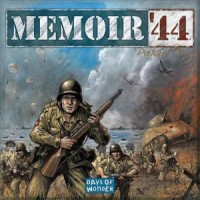
Memoir ’44
Overview
Memoir ’44 brings history to life on your tabletop. Players take the reins of either the Allied or the Axis forces and fight scenarios based on actual battles of World War II. This concept, while not new, has never been presented in a way that is so fun and so accessible to any level of gamer. Why? Because it’s not a wargame; it’s a board game about war.
Gameplay & Components
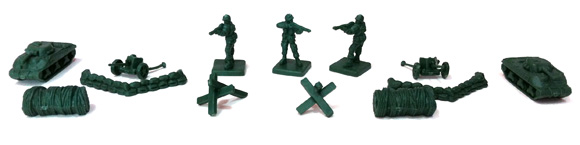
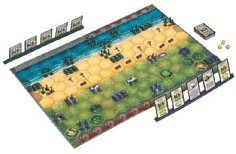
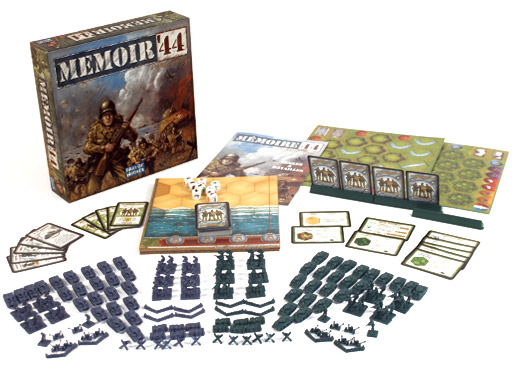
Did you ever play with those little green army men as a kid? The ones you could buy in bags by the hundreds? If so, you are in for a treat! The pieces bear a significant resemblance to those little guys, with green for Allies and Blue for Axis. There are a lot of components to this game, as one might expect in a game about war: infantry, tanks, artillery, as well as fortifications like sandbags, barbed wire and hedgehogs. These are all played on a large board divided into three parts (Right Flank, Center and Left Flank), onto which tiles are laid to represent terrain.
Like I said before, Memoir ’44 is a board game about war, and not a wargame. While this may seem like a subtle distinction, it absolutely is not. A wargame is a simulationist game that thrives on complexity, and usually takes multiple hours to play. This game is elegant in its simplicity, and delivers a satisfying experience in about an hour. Richard Borg, the designer, certainly made this simple with his Command & Colors system, which this game uses.
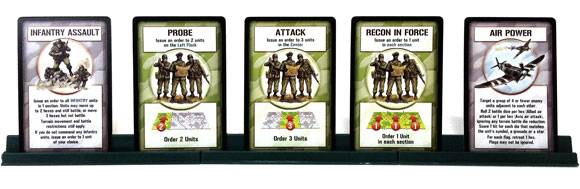
The Command & Colors system uses as its basic mechanic playing cards to represent which units to give orders to, and then resolves attacks with special dice. The command cards are dealt randomly from the card supply (a 70-card deck in the base game), and replenished each turn. A player’s turn consists of playing one command card, moving units, and resolving declared attacks. The design choice of having command cards, I feel, is the true innovation of this game and what sets it apart from a wargame. Having a limited set of choices speeds things along, and reduces the phenomenon known as “analysis paralysis”, where players get overwhelmed with the complexity of choices and take long times to decide their actions. As I said, the game play is about an hour, and this system is to thank. Within the context of using the action cards, however, there is still room to make clever, strategic plays. On a ten point scale, I would rate this about four on difficulty.
A typical turn consists of a player choosing one of his command cards and playing it. A typical command card is going to indicate ordering a number of units in a specific board section. After that, the player indicates which units are getting the orders, then resolves their movement in the order of his choice. After that, attacks are resolved in order of the player’s choice by rolling the attack dice, and models are removed from units if the die result matches their troop type. Cards are replenished, victory points (medals) are checked and play passes to the next player.

My favorite thing about Memoir ’44 is that it is scenario-based. The board gets set up to reflect a specific historical battle, with terrain pieces added and units in starting position in a way that somewhat reflects the battle. Each has a historical intro talking about the significance of the battle, and really sets the mood for the game. Additionally, enthusiasts may want to purchase the campaign books (there are two presently available), although the ones already present offer lots of choices or those who just want to pull it off the shelf once in a while.
Who will enjoy this game?
Downsides
The biggest downside to me is that this is indeed a two player game. This has limited the amount of times it has hit my table. Additionally, setting up a scenario map can sometimes be time-consuming; there are a lot of terrain tiles and bits. Small downsides, but notable nonetheless.
Final Thoughts
Since purchasing this game shortly after its 2004 release, this game has seen a lot of play in my household. I feel that I have certainly gotten my money’s worth on this one. My wife and I have spent hours and hours playing this game, and we have since purchased just about every expansion released. Days of Wonder never fails to deliver a great game.



Add a Review for "Memoir ’44"
You must be logged in to add a review.
What Is It About? – An Overview of the Game
Memoir ’44 is a fast-paced two-player World War II themed game. Players alternate playing cards from their hand to activate units on the board. Combat is resolved through rolling dice. The object is to be the first to collect a set number of medals through unit elimination and/or objectives on the board.
What Do I Get? – The Components in the Box
Days of Wonder spared no expense. Each side receives a custom army of Infantry, Armor, and Artillery in a soft plastic. Each army is in a single color (green for Allies, blue-gray for Axis) invoking memories of playing with Plastic Green Army Men.
The board is double-sided depicting a general country side on one side and a beach landing on the flip side. It is a hex pattern separated into three sections. Terrain is modified through hexagon cardboard tiles allowing limitless configurations through forests, hills, rivers, and villages.
The dice are wooden and custom made for battles and to resolve other card effects. A deck of cards is the main driving force of the game. These are nicely illustrated and clearly define the action to be taken.
A few other pieces round out the basic game including card holders, a host of tokens, and plastic miniatures of sandbags, barbed wire, and hedgehogs.
The rulebook is full color and clear to follow. Most importantly, it showcases several scenarios that step through varying game concepts.
What Do I Do? – Playing the Game
Players select a scenario and read over any special rules. The game plays out in five basic steps:
1) PLAY a card
2) Select unit(s) to ORDER
3) Of those unit(s) ordered, select unit(s) to MOVE
4) Of those unit(s) ordered, select unit(s) to BATTLE
5) DRAW a new card.
There are two main types of cards to play: Section or Tactic cards. A Section card is a generic card that allows you to move units of your choice in the indicate sections. Typically this is 1 to 3 units in 1 or 2 sections. Tactic cards are more specialized and allow you to move units from several sections, move specific units, or do some special effect.
All units must be noted as ordered before moving. An easy way to mark this is by placing a single die by each unit as you declare them ordered.
When moving, any ordered unit may move and in any order that you choose. Infantry can move 1 hex and still battle or 2 hexes and not battle. Armor can move up to 3 hexes and battle. Artillery must choose to either move 1 hex or battle, but not both. Terrain restrictions apply and can stop movement early or prevent battle. A unit may move and not battle or not move and still battle. However, all moves must be completed before battle takes place. Some scenarios grant a medal if your unit is occupying a hex at this point.
When battling, any ordered unit may battle and in any order that you choose. Infantry are most effective in close range rolling three dice and decrease their range by 1 die for every hex away (so 1 die at 3 hexes away). Tanks battle with 3 dice up to 3 hexes away. Artillery follows a 3-3-2-2-1-1 pattern of dice based on the distance. Terrain and obstacles can reduce the number of dice. Only the attacker rolls dice. For any result that matches the target (INF for Infantry, ARM for Armor), one figure is remove. A grenade is an automatic hit (the only way to hit Artillery). A flag forces a retreat of one hex each on the target and could result in additional losses due to terrain. A star result is usually a miss but can activate certain effects on Tactics cards. Infantry start with 4 figures and so can absorb 4 hits before being eliminated. However, the Infantry result shows up twice on the d6 so they have a 50% chance of taking a hit on each roll (including the wild grenade result). Armor has 3 figures while Artillery has 2 figures per unit. Special Forces may alter the number of figures per unit. As each unit is eliminated, it counts as a medal for the opponent.
After all combats are resolved individually, a card is drawn to bring your hand back up to the limit. Then the other player takes his turn. Play continues in this way until one person collects the winning medal for the scenario. It is suggested that after 1 game, switch sides and play again in what is known as Match play. This helps balance any historical imbalances in the battle and the winner is the person who collected the most medals over both games.
What Do I Think? – Final Thoughts
Memoir ’44 is my all-time favorite game. It combines enough strategy which the right amount of luck. It is a quick-playing war game that can be played in about 30-45 minutes. The rules are straight-forward and can be taught very quickly. The match play keeps things balanced and with a few minutes to reset the board, another session can quickly be had.
The design of the Command deck is very innovative. As I draw more Right flank cards, for example, there are less in the deck. My opponent is therefore more likely to draw Left flank cards then. Since my right is his left, we are more likely to duke it out in that section instead of each focusing on different sections. The focus centers on trying to out-maneuver and combine fire to get the maximum effect. Because center matches center, there are more Center section cards than either of the corresponding flank cards.
The Tactic cards offer up some variability as well. The Barrage is very powerful card that allows you to target any unit and roll 4 dice. Behind Enemy Lines is a card that allows an Infantry unit to move up to 6 spaces with a battle in between. Their Finest Hour is a great utility card that allows you to potentially order a number of units equal to your command (hand limit), giving each unit an extra die in combat. Ambush is a sneaky little card that allows you to attack when it is not your turn and really disrupt your opponent’s plans!
What is most important to me is the endless replay value of this game. I have played over 200 times and the game is still fresh to me, and this while I have barely scratched the surface. The modular board (through placing terrain tiles) allows many different scenarios to be played. The expansions add infinitely more combinations with new terrain and new rules.
This is a game I expect to play for many decades to come.
What Next? – Other Recommendations for this Game
The basic game is just the beginning for Memoir ’44. There are several expansions that add more armies (Russians, Japanese, British) or alter the board layout (Overlord, Breakthrough). There are also supplementary packs that add new generic figures and rules (Terrain, Air, Equipment ) along with two volumes of campaign play. The Overlord expansion allows two games to be placed side by side. This can accommodate up to 8 players with a unique experience as Commander-in-Chief leading your Field Generals.
If WWII is not to your taste, Richard Borg has several entries in his Commands and Colors line: C&C: Ancients and C&C: Napoleonics (GMT Games), BattleLore (Fantasy Flight Games), Battle Cry (Hasbro) and Samurai Battles (Zvezda). Production and rules change across each title but the same basic game play is present in each.
Disclaimer: The main goal of “Down to the Basics Reviews” is to show what the game is about, getting down to the basics, the bare minimum necessary to captivated the reader.
So, about Memoir 44:
1) What it is?
A Second World War game where you control allies or axis troops during specific battles that simulates real events of 1944.
2) How do you play?
Draw cards, move miniatures, throw attack dice, collect medals, play cards. Each scenario represents a real battle, has a historical background, different goals and setup. For the sake of accuracy, the sides are usually unbalanced like they supposed were in the real battle. But this is a great feature and not a problem because each play consist of two battles where the players switch sides. The game uses a clever mechanism known as Command and Colors where the player must choose a card to activate units from a particular section of the board. The winner is the one who collects more medals over the course of the two battles.
3) What are the decisions that you make?
– Devise a general plan according to the scenario’s goals. For instance, units less protected may be the best target.
– Choose a card from your hand and play it. There are common cards that allows you to activate (move and attack) units from a particular section and special cards that provides you with powerfull actions like healing, air attack, all units activated, etc.
– Decide which units you will move and which you will attack.
4) What is good about it?
The variety of historical scenarios. Although there are fifteen cenarios in the base game (that can be played several times each without losing the fun), you can get books full of scenarios if you wish.
The simplicity of the game. If you like war history but do not like those highly detailed and accurate war games, this may be the game for you. It plays quickly, looks nice over the table, has a decent number of decisions and provides an hour of fun.
5) What is not so good about it?
You throw dice and only attack dice. That said, it is possible for a single miniature soldier (that represents a number of real soldiers) to destroy a bunch of tanks in one throw of dice. The defender can’t do anything about it, with the exception of avoiding the situation in the first place. Also, sometimes you don’t have the best cards to fit your situation and can’t activate that set of units that you have to. So, if you mind about a high lucky factor you may pass this game.
6) What it feels when you play it?
If you like war history and light games, you will be amazed with the historical background, the position of your troops on the terrain and what could have happened if decisions were different. And you can even play an entire campaign playing the battles in sequence. If you don’t care about war history you will still have fun with this simple yet satisfying fighting experience.
Memoir ’44 is an excellent game and one of the gems of my collection. It does many things that I love in a game:
-Simple, accessible rules so it’s easy to learn and explain.
-Great components! Hefty, custom wooden dice, great little tank and infantry figures, barbed wire, titles for terrain. It’s a beautiful game and it feels great.
-A little bit of thinking required and a little bit of luck. It’s a great combination.
-Lots of variety with 15 scenarios in the base game (and let’s not mention expansions).
Memoir ’44 throws away much of the tedium that causes so many board games to be so overwhelming, tedious, and time consuming. Terrain variations are largely consistent, so you don’t need to learn the 15 rules that vary hedgerows from forests. This philosophy permeates the entire design — streamline away the tedium and focus on the fun.
On his turn, the active player chooses one card from his hand. This card will dictate which flank the player can command (left, center, right, or multiple fronts), which type of units, or how many units. Of course, some cards have special functionality.
The player then chooses which units to use on the flank dictated by the card. Do I move my infantry into position to attack? DO I wait for the enemy and maintain my current position? There are many choices and you’ll need to play your cards well to maximize your chances of emerging victoriously.
The base 15 scenarios provide varied terrain, units (tanks, infantry, artillery, all combined), special forces, and a variety of objectives (capture the town, hold for a certain amount of time, etc.).
This is an outstanding game and it’s one I love to play with my friends on afternoons. Give it a look as you won’t be disappointed.
Memoir ’44 is a great historical 2-player wargame that can be played in an hour or less. The game takes place in 1944, towards the end of WWII, Allies vs. Axis. There are many scenarios to choose from, and many expansions to this game to add even more scenarios and add to the games replayability.
In gameplay, the board is set up for a particular scenario, and then the Axis and Allies player each take their allocated number of cards. You play one card per trun. These cards tell you which types or units or which location of units and how many can be moved. You move and attack with those units, using dice to show hits and retreats on the enemies side. The goal is to acquire a required number of medals. Each medal is won by either defeating an enemy unit or completing a mission objective (such as holding a bridge).
The components are fantastic. The board is a good-sized six-fold board, double sided for ground or shore battles. The game comes with adequate tiles to customize each board for any scenario, adding rivers, bridges, bunkers, forests, and more! The units are also well designed miniatures for infantry, tanks, and artillery. There are also other miniatures including sandbags and hedgehogs. The units are the same for both sides, except that they are different colors. The good part of this is that it’s easier to recognize units from both sides. The bad side is some people like unique units to represent each army. The general units, though, also allow the Allies units to represent US troops, or French troops, or more. So the units are very reusable for different campaigns and scenarios.
The rulebook is well-organized, clear, and covered with many graphics and examples to explain gameplay. There are a lot of minor rules to remember for special tiles or units, but included with the deck are cards with reminder text for each of these special rules so you don’t have to constantly reference the rulebook. These cards are very concise and clear.
The dice in the game definitely add some randomness to it, but overall the game is designed such that the dice alone won’t ruin an experience. Superior troop commanding should regularly win over luck.
The game is also very quick. It does take some time to set up with all the units and tiles, but I’ve never had a game last over an hour. And I’ve always felt fulfilled after playing a game of Memoir ’44. I can’t wait to get this on the table more often. One of my favorite aspects of this game is that it’s a 2-player game that’s fast, simple, and fun, makign it something I can play with my wife or with one friend when we’re not having a big game night.
If you wish you had a game that could be played with only 2 players, I would recommend this game. Especially if you want something short, simple, and enjoy wargames or historical games. This game also makes a great gateway into more wargames.
Memoir ’44 is a great tactical wargame for 2 players that takes under an hour to play. It’s not just a game, but a whole game system that can be expanded and tweaked to your heart’s content with about 15 expansions so far. The game comes with over a hundred well crafted plastic miniatures that represent the Allies and Axis forces. There are fifteen scenarios to play from, giving you a lot of replay value before you move on to other expansions. The focus of this base game is the D-Day invasion of 1944 and the ensuing battles after the invasion.
PROS
Easy rules
Short playtime compared to other wargames
Nice components
CONS
Not entire historically accurate figures
Sometimes takes a while to setup and put back
Potentially too luck-driven for some people
Overview
This game is meant to be lightweight unlike other wargames that can bog you down in a thick rulebook and hours of playtime for a single scenario. It was designed by Richard Borg using his now famous “Command and Colors” system that started with “Battle Cry”, and can now be found in “BattleLore”, “Command and Colors:Ancients”, and “Command and Colors:Napoleonics”. This version of C&C is supposed to be accessible, and it works really great with younger kids to introduce them into wargames and history.
Since it’s so lightweight, it is more abstract, so do not expect an accurate historical simulation of the battle, but the game is designed to give you appreciation of the struggle. There is a huge following around this game system, and I’m talking about adults now, not kids.
Gameplay:
The game is centered around 3 types of units (tanks, infantry, and artillery) on each side that follow the same basic rules. These types of units each have different range and firepower. You position your units to maximize your firepower represented by the number of dice you roll, while minimizing your opponent’s firepower by proper use of nearby terrain. Certain terrain types reduce the number of dice your opponent rolls against you when attacking. The board is divided into three sections representing a players right flank, center, and left flank. The cards you draw are what allows you to activate which units you want to move and engage in battle. So, careful hand management is key to this game, if you want to be a consistent winner of Memoir’44.
Each scenario comes with a historical background and has been designed to reflect the conditions of the battle. This means that some scenarios will highly favor the Axis (Germans) or the Allies (US/Britain/France), but not all are lopsided. Some people may not like a lopsided battle, but historically some battles were lopsided. Also, each scenario will sometimes come with special rules such as treating units as “special forces”, special terrain factors, the number of cards each player has, who goes first, certain medal objectives, and how many medals are needed to achieve victory.
Conclusion:
This is by far one of my favorite games! I love how easy and quick it is to play(setup can sometimes take a while if there is lots of terrain). My six year old son loves it, and so do I because it’s FUN! I love the little army units and pushing them around. The game is expandable, so if you want to go deeper, there is room to grow. It also gives me an opportunity to talk to my son about the sacrifice these men made to achieve victory and secure our freedom.
Possible Con –
People who don’t like luck and dice will probably not like this game. However, the luck factor can be managed some through careful hand management and proper use of terrain. That is a skill in of itself that I enjoy. Also, the luck factor gives younger inexperienced players a better chance to win and not grow discouraged by pure skill games that Daddy crushes them at all the time! It also can make for some very thrilling victories!
Some scenarios are tougher on one side versus the other. Again, that is to remind us of how hard the sacrifice was for the men who freed France from Nazi control. For instance, the landing at Omaha Beach was exceptional brutal and high in US casualties, and the Omaha Beach scenario in the game is very tough for the Allies, but winnable. So, when you play it remember, and then switch sides so both people can share the challenge.
Get it! I think you’ll enjoy it!
INCOMING!
It’s June 1944 and the Allied troops pile out of their landing craft and storm the beaches of Normandy, taking heavy fire from the Axis’s vantage points. The Allied goal? The liberation of France, and an end to the Second World War!
Memoir ’44 is a World War 2 themed board game, initially published in 2004 to mark the 60th anniversary of the D-Day landings and liberation of France.
Players take the roll of either the Axis or Allied forces and play through a series of scenarios based on real-life historic battles from the latter half of the second world war – each scenario in the rule book provides set-up details and gives an overview of the story surrounding the battle, and aims to mimic the terrain, troop placement and objectives of each army.
Gameplay
The game starts with the selection of a scenario to play. Players determine the side they’ll play as (Axis or Allies) and set up the board as laid out in the rule book (placing forces and terrain as required). In particular players should note any special rules for the Scenario.
Each player then draws their starting cards from the deck and places them in front of them in their card holders – these cards contain commands which as the general, players can give to their forces on the ground.
A final very important point prior to the actual game commencing is to read out the scenario description from the rule book – giving the real-life details of the game you’re about to play and it’s significance
Turns take place in 5 basic sections:
1. The current player selects a command card to play from their hand.
2. The player confirms which of their units will be receiving the order.
3. The player moves any of the ordered units he wishes to move.
4. The player attacks with any of the ordered units he wishes to attack with (which still have this option after moving!)
5. The player draws a new command card, and places it in his hand ready for the next turn.
Command cards will either allow a certain amount of units to be ordered (often along the lines of ‘Order all units on the left flank’, or ‘Order up to 3 units’), or they will be tactical cards, which have some kind of special effect (such as allowing the player to initiate an aerial bombardment or heal their units etc.)
Each unit type has it’s own rules for movement and attacking. For example infantry can move one hex and attack, or they can move two hexes without the ability to attack.
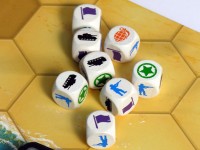
When attacking, the proximity of the enemy forces affects how likely you are to hit them – generally more dice are rolled the closer you are to the enemy. Units are made up of groups of miniatures (4 for infantry, three for tanks etc), so each successful hit wipes out one miniature of the unit. The dice also make hits on infantry more likely than hits on tanks etc (reflecting the relative strengths of the units). The dice faces are made up of pictures for infantry (hit against infantry), tanks (hits against tanks), grenades (a hit against any type) and flags.
If the dice rolls show up flags, the unit under attack is force to retreat back towards their side of the board by the amount of flags rolled – thus symbolising their forces being pushed back (retreats are always resolved after all hits and misses have been resolved.)
If a player knocks out an entire unit, then they take one of the pieces and add it to their score to symbolise a victory point.
Additionally, in some scenarios victory points can also be scored by meeting historical objectives (such as securing a bridge etc).
The game continues until one player has reached the pre-determined amount of victory points. At this point, as the game can be balanced towards either the Axis or Allies due to being based on historic events, it’s often a good plan to swap sides and replay the scenario – the winner is then the player who gained the most victory points in total over both plays.
These game mechanics are wonderfully simple, yet make for a fantastic game which has an excellent balance of strategy and luck.
Components
Memoir ’44 is produced by Days of Wonder, so the components are of the high quality you’d expect from the publisher. The cards are of a nice quality, the game board is lovely (and double sided, allowing for both beach and inland battles), additional hex tiles (to add buildings and forests etc) are printed on good quality, thick card and the miniatures themselves, whilst not of the kind of quality of a dedicated miniatures game are great for a board game.
The models come in two colours (green for the Allies, grey for the Axis), and are individual for each side…they’re very nice, and quite like a higher quality version of the little green army men that I’m sure many of us played with as children.
Play time
A typical two player game of Memoir ’44 takes 30-45 minutes (plus ten minutes or so for game set-up). As mentioned however, as the scenarios are based on historic battles they can at times slightly favour one side over the other (i.e. in a battle that the Allies won outright in real life, that side may have a slight advantage going into the scenario).
For this reason, when I play with friends we’ll play the scenario twice, swapping sides on the second play – so in general I’d set aside one and a half to two hours for a game – the time does certainly seem to fly by though, and I’ve never felt the game was dragging on (even when I’ve clearly been in a losing position, just waiting for the inevitable victory of my opponent!)
(I have to say I’ve never played the ‘Overlord’ variant (the 4 player game, which makes use of 2 copies of the game…although I believe some scenarios actually allow 8 players to play over 3 boards!…so can’t comment on how long a game of that would take, however I’d assume it would take at least twice as long).
Summary
Memoir ’44 is a fantastic game, and while it certainly contains an element of luck it doesn’t feel too unbalanced in this direction, and there’s plenty of space for strategy. The gameplay mechanics are also wonderfully simple, making it very easy to quickly pick up the game and get playing.
The historic scenarios are fantastic, not only giving the game a real sense of history, but also encouraging players to learn more about the background to the game (an aim expressed by the publisher on the official website).
The game itself has plenty of scenarios to play through in the rule book, and due to the randomness added by the command cards deck this provides excellent replay value. Also, addition to various expansions available the games longevity can be increased with the purchase of campaign books, which provide further historically accurate scenarios to play.
Overall, Memoir is a game that I’d heartily recommend to players who like games with a nice balance of strategy and luck, and a passing interest in history (although even if you don’t have this you might find you develop one as you play!)
The stage is set, the battle lines are drawn…and you are in command!
Memoir ’44 is a game in which you recreate battle scenarios from the Second World War. The base game focuses on D-Day and the battles after that day, but a lot of expansions have appeared in which you can relive the battles of the Eastern front as well as fight in the Pacific theatre.
The game is played on a gameboard consisting of hexagonal tiles on which terrain tiles (like forests, hills, cities and the infamous hedgerow) can be placed. At the start of the game the two players select a scenario they want to play and set up the board according to the starting positions of the scenario. There might be special features like points in a city either the Germans or the Allies have to take.
After the terrain is set up the army units (infantry, tanks and artillery) are placed according to the scenario set up. The players are dealt command cards with which they can give orders to their units. The game board is divided in three sections (left, middle and right) and most command cards only work in certain sections of the board.
The players need to think ahead, because moving a unit into a section of which he or she doesn’t have a command card might mean it is stuck for a while.
When units attack dice are rolled which determine if damage is done and how much. This introduces a chance element into the game that can be frustrating. However, proper planning and strategic manouvering is very important in this game. While some plans fail because of bad dice rolls, more fail because of bad foresight or bad tactics.
Memoir ’44 is a fun stragetic game. It’s not so heavy as some strategic games (and doesn’t last very long – a scenario typically is over within one to two hours) and if you want to play a campaign that is possible (campaign books are available). Perhaps the only drawback is that it’s a two player game. There are extensions which allow up to 8 players, but still there are only two real combatants in the game.
Personally I like the game for it’s variety (*lots* of scenarios) and replayablity. Also you can put the game away after two scenarios and pick up where you left months later. Well worth the playing time!
Me and Memoir ’44
I’ve always loved history and especially war history. Now when I started boardgaming, this game haunted me on the shelves. I always looked at it, but the cartoonish drawing on the box kind of made it look uninteresting to me. “War’s not cartoonish!”, I said in my head. Then I did some researching, and now I’ve ended up with Memoir ’44 and multiple expansions. And I love it!
The Premise
You are commander in chief for either Axis or Allies as you try to best your opponent in battle. You have infantry, tanks and artillery at your disposal and it’s up to you how you maneuver and engage with them. This is the second world war, and winning or losing means everything.
Out of the box
This game is beautiful. Really, the components are top notch. You got sturdy cards, a thick board and lots of gray and green army men to fight with. Even the miniatures are modeled after the sides they represent: the allies soldiers hold rifles and have Sherman tanks while the axis wield MP40 SMG’s and fight with Panzer IV’s. The artillery looks the same on both sides but that doesn’t matter. This game also has a manual which is quite well written and has almost twenty scenarios in it for you to play. Overall this is great.
Actual gameplay
The actual gameplay is really simple. You play a card and move/shoot with your units. Different terrains have different protective values for your army men to cover in. The game is so simple that even a total newbie to boardgames or a child could learn them easily. This is an excellent aspect.
The gameplay, even though being really simple, is surprisingly deep. You can maneuver with your forces, retreat to city in order to have better cover, flank with your forces to go around that barbed wire or take ground with your infantry when you drive the defenders away. There’s also different kind of cards to make the gameplay even deeper.
These two aspects are what makes Memoir ’44 so special. Simple and fast to learn, but hard to master. It does matter a lot if you are a new player or veteran of countless of battles. The scenarios aren’t really balanced, but the idea is to play the scenario on both sides and then decide the winner by gained medals/killed units in total. I would have loved if the scenarios would have been more balanced, but it’s hard to do with games like this. I don’t believe that they are supposed to be balanced either, but rather represent the historical situations. The game has all sorts of interesting mechanics as well, like paradrops.
The game also has multitude of expansions which is great, but smells a bit like money milking. You have to own, for example, two sets of Pacific Theater to play one of the scenarios in the included scenario booklet.
Final words
Memoir ’44 is a great game for new and old players alike. It has a solid gameplay, great components and short play time which all make it an excellent choice for family game. It scales from 2 to 8 players (if you play the overlord scenarios, needs two sets of Memoir ’44) and has a lot to play as there are a lot of user made scenarios on the internet.
The downside is the money milking scheme of the game, something you have to get used to if you want to have full experience out of Memoir ’44. Some of the expansions are OOP as well and never to be printed again it seems like, which is sad as some expansions like Air Pack seem to be a great addition to the game.
Buy this game if you are into war history and like tactical games.
Find The Video Review Here!: http://www.youtube.com/watch?v=CgsJ4veWtJ4
Click Here to Read a Memoir ’44 Battle Report!: http://thetabletopcommander.tumblr.com/post/22993261843/sainte-mere-eglise-memoir-44-batrep
Memoir ’44 is a light strategy game which will take it’s players from the beaches of Normandy, to the hills and forests of the Ardennes to relieve the battles of World War II! Battling as either the Americans or Germans, players will command infantry, tanks, artillery, and special forces in an effort to prove their military prowess.
’44 is probably best known for it’s simple and accessible combat system. If you can perform second grade math and count to six, then this game will give you no real problems. It’s such a popular system, that games such as Command and Colors, and Battlelore, use a modified version as well. Battle is conducted by seeing if a unit is in line of sight/range (either 3 spaces for infantry and tanks, 6 for artillery), counting the number of dice you get, and rolling those dice. Then, according to what you roll, a unit either takes casualties, retreats, takes no damage, or any mix of these things. It’s that easy! Depth is then added by terrain features such as hills, forests, rivers, hedgerows, cities, bunkers, bridges, sandbags, and tank traps, as well as unit abilities and special rules. However, at no time does this math get more complicated than adding or subtracting a few battle dice, negating a retreat flag, modifying line of sight, or blocking movement. Again, the math this includes is second-grade addition and subtraction, so it’s quick and simple!
However, that is not to say there is no tactical or strategic depth. Memoir ’44 requires a different type of strategy and tactics, and that’s the key to understanding, enjoying, and effectively playing this game; the command cards. Players draw a pre-defined number at the start of the game, and 1 every turn thereafter. These cards determine how many units you can activate, where they activate, and any number of special abilities (counter-attack, artillery strike, air support, ambush) which add to the ebb and flow of battle.
This is, undoubtedly, the biggest controversial factor of this game. Hardcore strategy gamers may not like the amount of luck involved, as you never really have /absolute/ control over units. What and where you can activate depends on your command cards. However, just like in the real world, as a general or commander, you cannot extend perfect control over your forces. Weather, fatigue, supplies, and other such factors can be said to be part of the ‘luck’ of this game. Therefore, this must be understood to enjoy the game; while about strategy, the focus is also to have /fun/.
The components of Memoir are not low quality; however, they do leave something to be desired. The board feels a bit ‘naked’ not having a smoother, glossy surface that is standard on many game boards. Moving so many units upon it’s surface, a ‘sturdier’ finish might have served well, and the same applies to terrain tiles. Granted, I like the ‘bare’ feel, but keeping in mind that younger children may be playing this game, the components could have been improved a slight bit. Command Cards are satisfactory. On a positive note, both German and American miniatures have different sculpts for tanks and infantry, a nice touch that was not necessary, but is appreciated by older gamers.
The rulebook includes both dialogue and diagrams, and includes options for both ‘normal’ game rules and ‘simple’ game rules, for younger children, a nice touch for parents and the younger crowd. All rules are easily understood and well written.
Including 15 scenarios, replay value is very good for Memoir ’44! Even if you play both sides once, that’s 30 individual games before you’re forced to replay a scenario (since starting conditions are different for each side)! Due to the amount of ‘luck’ involved concerning command cards, and considering the different strategies a player may employ, even a few games played in a row have the potential to play out very differently.
It is worth mentioning at this point, however, that game setup is quite lengthy, as it takes time to correctly place tiles and games pieces. One person setting up this game on their own, will take about 20 minutes, give or take 5 minutes.
While Memoir states more than two players can participate, most reviews and individuals seem to agree that 2 players is the ideal number.
The amount of enjoyment you get from Memoir ’44 can depend on the individual. Historians, World War II lovers, and strategy gamers will more likely enjoy this game to a greater degree than the ‘average’ gamer. This is not to say, however, that the average gamer won’t enjoy Memoir! I have played a few games with my own Mom before, who has certainly enjoyed the battles! But again, this all depends on what you want out of the game, and what aspects you enjoy.
If you are not sure whether or not you would like this game, I would highly suggest trying out the (temporarily) free version on Steam. That is where I first played Memoir ’44, and it gives you a great exposure to additional expansions, scenarios, and rules! You can fit in about 25 (not 50, thank you to the community for this correction) games before Steam requires you to buy additional credits, so it’s a great way to see if Memoir ’44 is up your alley!
Pros:
Simple and easy to learn, great for a range of ages, entertaining and educational, plenty of expansions and online resources.
Cons:
Lengthy setup time, ‘Luck factor’ may not be to everyone’s liking, Team play is possible, but not necessarily practicable.
Last Updated: October 11, 2012
When my friend and erstwhile Gaming Captain suggested that we play Memoir ’44 after dinner one evening, I was trepidatious. I’ve been a gamer for a long, long time, and I’ve killed nearly as many ***** as I have zombies. World War II as a gaming genre has become stale to me, and I don’t have much experience with wargames. But since it was just the two of us and I wanted to play something a bit meatier that night, I agreed.
I want to start the review proper with one sentence, and please keep it in mind as I go: Memoir ’44 is a good game. It is packed with replay value in the form of a very impressive number of maps and campaigns (all well fleshed-out with historical text explaining the actual battles the campaigns are based on). The production quality is high, and the rules are easy to understand. Setup and takedown are kind of a bear, but you’re playing a wargame — you knew what you were getting into. The combat is both simple and exciting, playing out through dice, with easily-explained rules for terrain and cover. There’s only one gripe I have with Memoir….but it’s a big one.
You are dealt a hand of command cards. Some of the cards have cool abilities and bonuses on them, but the map is divided up into three areas (left, mid, and right), and you can only do what the cards say. So if I have a promising assault going to the right side that I want to push through to completion, but I have no command cards that affect the right side in my hand, I have to find other things to do, even though I really want to take that town on the right side from those *able *****/Allies. This lack of full control of your forces is problematic, and while some might say it increases the strategic decisions you have to make, more often than not I find it annoyingly restrictive. I’ve made my strategic decision already, dang it — now let me do it!
Aside from that gripe (and of course, it’s just my opinion, your mileage may vary, it takes all kinds to make a world, but that’s an annoying mechanic), Memoir ’44 is a solid, fun two-player wargame that anyone can get into and play. Sometimes it feels a little short — you don’t have to kill too many units to win — but it did breathe new life into the idea of my Allied paratroopers storming the hedgerows or blitzkrieging my Panzer corps to victory.
Pros:
-Good components. Miniatures a little small so some of the guns and soldiers may be a little bent, but they still look great. Cards and cardboard pieces are sturdy. Everything is easy to pack up.
-Multiple scenarios you can put together from the book.
-Gameplay mechanics are not cumbersome to get through (no measuring, simple damage calculation, etc)
-Fun two player.
-Eye catching. Played this at a club house one time and it got a lot of interest from people passing by.
Cons:
-Box says you can have up to six players or more by playing in teams, but this isn’t really true. If each player had their own sets of cards and their own turns, this could be true. However the reality is you’re basically all playing one side and one person will inevitably dominate the decision making.
-Not that easy to learn. Compared to warhammer it’s easy but this is a different class of game. It’s not that it’s difficult its just a little complicated.
-Setup time is almost as long as the game takes to complete.
Summary:
I always have fun with this game. The only problem have is remembering all of the little details after not playing for a few months. And because its only a two player game and takes awhile to setup, it doesn’t get much play. Despite that, my wife and I want to play a “campaign” where we play all of the scenarios in the book overtime and keep a long running score to determine who wins the war. Great game.
When I was a young lad, I loved playing with army men. I’d set them up and battle it out on my family’s living room floor for hours.
And now that I’m a mature (?) adult, I find that I still love to set up those army men and tanks and battle it out for hours! But now I have a lightweight, easy-to-understand set of rules–along with fun, challenging scenarios–to guide me through those battlefield heroics.
WHAT I LIKE
– Easy-to-learn and easy-to-teach rules
– Cool descriptions of historical background and the commanders that puts me right on the battlefield
– A nice blend of control and luck that simulates the difficulty of executing battle plans (although some players don’t like the limitations of the cards)
– Highly re-playable, especially considering that the cards won’t let you play the same strategy/tactics with each play session
– Fast game play: less than an hour per game (not counting setup)
– Tons and tons of scenarios to play, many accessible for free on the web
– Tons and tons of expansions
WHAT I DON’T LIKE
– Setup can be tedious: about 15 to 20 minutes
– Only a 2-player base game , although the Overlord expansion increases that to 6 or 8
– Many of my family and friends don’t enjoy wargames, so I usually end up playing solo variants on quiet evenings.
FINAL THOUGHTS
This is one of my favorite games. I own almost every expansion and I really enjoy the ability to play out a series of battles that impact each other by using the campaign books. Highly recommended.
I’ve played this game a.lot with family and friends. Easy to teach and a good gateway game I’d say for anyone who you think would like a light wargame.
The good:
-teaches some history of ww2
-The terrain give bonuses to def and thematically slows down units crossing over.
-the miniatures are awesome
-a game you can teach kids
-each scenario is different enough to give it some replayabilty, and if you do get bored, there is tons of expansions.
-Like the ranged attack, artillery shoots up to 6 spaces, ta is shoot three with three dice, infantry shoot three space but one die.
The bad
-Takes around 5-6 min to set up each scenario
– Cards can make it a game driven more of Luck instead of strategy. But if played properly you can you can save the cards you want for a calculated strike..just takes some paintence and luck that your opponent gets their cards first.
You can’t counterattack >.<
“We have the perfect opportunity to take out this flank, why in the **** doesn’t the general send us orders to press the attack?” The lieutenant asked his sergeant. Sarge quickly responds to his frustrated officer (whom he continues to babysit), “sir, I think he hasn’t thought of it. That and he hasn’t gotten lucky enough to get that order to pass down to us on the right flank. Hopefully the enemy will play a right flank attack that he can use his counter orders on.” “This is the most ridiculous set of constraints any commander has ever put me under. Look at all the fighting they are doing over there on the left flank! Holy ****!”
The gist of the game:
This game is a World War 2 themed, based on an abstract squad or platoon level of fighting. There are two sides that start on opposite halves of the map. Throughout the battle, you advance upon each other positions and attack! The game board is broken up into 3 segments- a center, a left flank, and a right flank. Your troops will be given orders based on cards that you draw. You will be able to move a certain number of units in certain flanks each turn based on the cards that you have played. When you attack an enemy unit, you will roll custom 6-sided dice with unit symbols, a general kill ‘em! Symbol and a flag. If you get a general kill ‘em! symbol or the unit symbol, which represents casualties. The flag forces a unit to retreat one hex back. You trade turns back and forth doing this until someone wins!
Replay Value:
This game is designed for replay value right out. You will want to play a campaign, you will want to do battle after battle. If you don’t, our country will fall. If you won’t command our troops in future battles… who will!?
Components:
As a historical gamer, I am not a huge fan of the pieces. They are finely crafted, they just don’t feel right to my snobbish historical side. The cardboard bits are tough, you could probably run them over with a Sherman… but not a Tiger.
Easy to Learn:
The system is pretty simple. It is light on rules that you have to constantly refer to in the book. Most of the rules make pretty logical sense and so are easy to remember. The attack dice have the symbols of the different units directly on them! It’s so easy to see what you have blown up!
2 players This game can be expanded with further expansions to utilize more players. If you really wanted to, you could put a different player in charge of each zone to have 6 total players, but this makes the game about as exciting as sitting in a foxhole in the Ardennes in 1944… or wait, no, that’s not right at all. 8+ age I can see this game being a way to train your younger soldiers to prepare for battle. Put an M1 Garand into that kids hand instead of an AK-47, it is far more humane. 60 minutes The great thing about this game and the others in this format is the speed of play and resolution. You can finish a game of this in under an hour, faster than the enemy could even launch a retaliatory strike of panzers!.
Conclusion:
If you don’t already have Battlecry or Battlelore (or others I am not aware of that share the system) you should pick this game up. It is a fun game, but it isn’t much different from the other games except in flavor. If you are obsessed with World War II themed games, this is one you can’t pass up. If you are not a fan of dice based games, pass.
This is one of the best light wargames built on a classic hex grid system. For me, it brought back memories of playing command and conquer. I like the way the game really tries to stay true to history. All of the scenarios set up in the book are as close to the actual circumstances of history as possible.
I think the components are top notch, as to be expected with Days of Wonder.
The rule book was simple to understand and has plenty of timely examples to help.
Play is quick and very balanced. Since players switch sides after each battle, the game plays like history, but each player has an opportunity to play both sides of a battle, hence a good chance to win whether starting out on the strong side or not.
There are numerous expansions as the base game only as American and German armies in it, and each new expansion adds a book of scenarios and 1 additional faction.
The game also enjoys a large fan following, and from that online community, there are hundreds of fan written scenarios that can be downloaded and played.
The only think I dislike about this game is that outside of a four player, two board format; there is no way to play with more than two players. I would like to see some lopsided two against one battles in future expansions, but I think I would have better luck finding something like that in the online community.
Memoir’ 44 Provides a bit of history with a thrilling dance of both strategy and luck.
The rules are very easy to understand and cards are included to explain on the fly how terrain restrictions and penalties apply for each tile on the game board. This keeps you out of the rule book and into the gameplay.
The gameplay has you move units based on the cards you draw and attack based on the roll of some customized dice. This gives the game a great randomization to movement and battles that will appeal to both strategy gamers and social gamers alike.
The components are very high quality including plastic models for infantry, armor, artillery and obstructions(sandbags, barbed wire, etc.). Some pieces in my personal set had to be glued back to the bases but took nothing away from the quality of the overall components.
The setup takes a bit of time as tiles will need to be added to the gameboard to specific locations based on the scenarios in the rulebook. Think 5-8 minutes to setup once you understand the tiles.
Overall this is a must have for any gaming collection. Whether you play casually, socially or competitively you will find enjoyment in this wonderful WWII strategy board game.
This is one of my favorite lite WW2 war games. The game is card driven but even though luck plays a part, there is still a lot of strategy involved. A good player will usually win because knowing how and when to play your cards is a key strategy in this game. Also it helps if the dice are on your side. : )
There is very little downtime and depending on the scenario played and the person you are playing with, it doesn’t take too long to finish a game. There are many scenarios available that encompass all theaters of the war. The one thing I like about it is that it is available to play on Vassal as well as online in a digital format through Steam or the “Days of Wonder” website.
The quality of the components are very good; which is to be expected from all “Days of Wonder” games.
There are many expansions out for this game, and if you are like me,
you will want to buy everyone of them. It’s sort of like getting a tattoo, you can’t get just one.
I wouldn’t say this game is for everyone, but if you enjoy playing war games and not getting bogged down with rules, you may like to give this game a try.
Cheerio pip pip
I am not much of a war game fan, but this one I loved. It’s the best light war game I played so far, and it’s definitely a much better choice than Battle Lore.
The replay-ability it’s quite high once you get more scenarios and the expansions are bringing a lot to the game. From the expansions, I definitely recommend the Terrain Pack, Winter wars, Campaign Book (even though you can get a lot scenarios for free), but the others are also a very good addition to the game. The game alone is also enough once you get scenarios from the web. There are quite a few on the publisher’s website, but you can also find others on the net.
It has become one of my favorite games lately and I play it on every opportunity.
I’ve played most of the C&C games. I’ve owned this and Battlelore, and got rid of BL. This is the best. Set up is quick, easy to learn, plays in an hour, great mix of strategy and luck. Perfect game for ages 10 to 100.
In my opinion, this game is great. I really enjoy playing it but this might be due to the fact that I am really interested in war history. Consequently, one of the things that I appreciate the most is the little introduction provided for each scenario, summarizing some of the most relevant events that took place during each specific historical battle.
First of all, the board is well designed: the appearance is very attractive and the hexes make the setting up easier. The two-sided board provides a base for an inland or a coastal scenario, and the little hexes and obstacle that are added to each scenario change the combat field entirely.
The rules are well explained, which makes it easier to learn how to play. Besides, summary cards are provided so as to quickly check the basic rules for movement or attack depending on the type of unit or territory.
Each game lasts less than an hour (unless things get too complicated) so, on my experience, once you are done, if you lost, you might feel like you want to change the history one more time. As stated in the rulebook:
“The stage is set, the batte lines are drawn, and you are in command. The rest is history”