
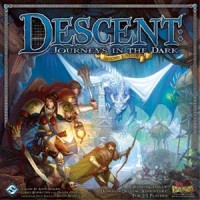
Descent: Journeys in the Dark (2ed)
2-5
14+
60+
Descent: Journeys in the Dark Second Edition is a board game in which one player takes on the role of the treacherous overlord, and up to four other players take on the roles of courageous heroes. Featuring double-sided modular board pieces, countless hero and skill combinations, and an immersive story-driven campaign, Descent: Journeys in the Dark Second Edition transports heroes to a vibrant fantasy realm where they must stand together against an ancient evil.
This updated version of the classic board game of dungeon-delving adventure features a host of enhancements, including new heroes and monsters, streamlined rules, a class-based hero system, campaign play, and much more.
images © Fantasy Flight Games




User Reviews (16)
Add a Review for "Descent: Journeys in the Dark (2ed)"
You must be logged in to add a review.
I can’t speak for the First Edition but Descent Second Edition is a lot of fun.
While it can be played with 2-5 players, I think that 4 – 5 is ideal. One player plays the “bad guys” and is the Overlord and the other players are the “good guys” or heroes. Once you play the introductary quest the other scenarios are designed to be played in sets of 2.
You can make your own quests, but there are a bunch that are ready to go and look to be very well balanced. Each Quest has specific victory conditions for the Overlord and the Adventurers. Both players and the Overlord can “level up” and get new items, spells, abilities or cards(for the Overlord).
Once the group decides what quest they are playing and choose the Overlord player then you set up the board according to the Quest Guide. Each Quest shows you which tiles to place and what goes on them. The Overlord gets a deck of cards that can be used during the game for special effects or abilities. Some are made to slow down or hinder the party’s movement, cause them damage, and some help give the monsters some extra cool things to do.
The number of monsters varies based upon the number of players and is indicated on the back of the monster cards. Most of the Quests give the Overlord the option to pick one extra set of monsters that they want… in addition to the other monsters that are part of the scenario. The back of the cards for the monsters show what traits they have and the Quest indicates what traits are best for the Quest. This helps add depth to the game and allows you to replay Quests and still have a totally different experience each time.
The players choose which character they want to adventure with – there are plenty to choose from. Each character has special abilities and items that they can choose from. The characters have basic abilities to start out with and can advance into new ones as the game progresses from Quest to Quest (if the optional Campaign Rules are being used – which I highly recommend). Choose a character that you think is cool, but there is a limit on how characters can be from each archetype.
Once the players are ready the Overlord will reveal the Quest, lay out the board and place the monsters as indicated. The players place their adventurers on the board as indicated and the journey begins.
Players go first and can each typically do two actions: Move, attack, use a skill, rest, search, revived a hero, stand up, open/close a door, and special.
They can go in any order and must work together in order to accomplish the objective.
Once they have all finished, the Overlord gets to activate their monster groups: move, attack, open/close a door and special.
The Overlord also gets to play cards – sometimes on their turn and sometimes on the Adventurers’ turn.
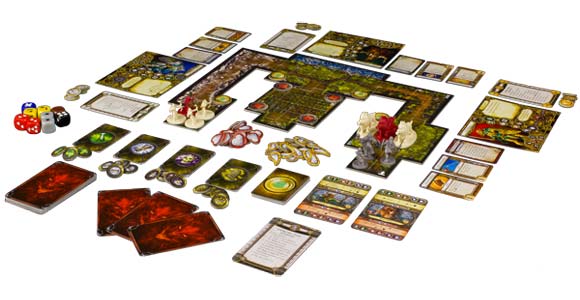
Combat, ability checks and actions are al performed by rolling the dice that come with the game. The dice are really cool and compliment the game very well. Each one is designed with a certain purpose: the red, blue, and yellow are used as attack dice and the gray and black are used for defense. Each of the attack die have either a number, some hearts or a lightning bolt. These are used to attack, initiate special abilities or determine range. If hit, the grey or black dice are used to lower the amount of damage taken.
I don’t think that I can do this game the justice that it deserves… you will have to play it for yourself. We only got through the intro. game and a couple of Quests and I can’t wait to play it again soon. I was the Overlord BTW… -Good Gaming
Descent: Journeys in the Dark is an easy to set-up, easy to teach/learn and easy and fun to play dungeon crawl with one interesting twist. In this review I’ll be comparing it to D&D a lot, but there’s a reason for that so please bear with me.
Almost 10 years back, when I started to play board games as a hobby for the first time I picked up D&D 3.5 Basic Game. A nice little box with few miniatures, boards and dice. Descent made me remeber my excitement exploring my first dungeons, but with one big plus: it allowed me to actually kill off the adventurers! I’ve never been a cruel DM, but I liked to challenge the players. Descent is all about that – confrontation between the Overlord and the Heroes, each trying to achieve (usually) different goal. It is very ellegant and simple, almost too simple.
Theme
The game is set in Terrinoth, the Runebound universe. I’ve never played Runebound or other games in the setting, so I’m not familiar with the lore, but from what I see in Descent, this is a fantasy setting that’s as generic as it gets. You’ve got your goblins and skeletons and evil mages, yadda yadda. However, the characters are colorful and interesting and I don’t have a problem with it. This is not a RPG and the setting is there to set the stage for the scenarios, nothing more.
Goal
Unlike D&D, here players clash against each other – one player plays all the badguys, kind of like a DM, but with the exception that he actively plays against the PCs. The rest of the players team up together against the evil.
Players choose a single stand-alone scenario or play a Campaign – series of many scenarios connected in a story. This is where Descent shines – it could be played as long or as short as players decide. Either way, eveybody is having fun.
Evey single scenario comes with a unique win condition and most of the scenarios are two-parters. The Heroes team up cooperatively to acheve their goal, while the Overword tries to stop them or to achieve his own goal. It’s elegant and really nicely designed system.
Rules and Gameplay
The rules are too simple, really. You’ve got your hero’s card and it has several stats on it. You equip weapons and gain skills as you progress, which are also represented by cards. Combat is resolved with custom “funny dice” with icons on them. You’ve got 4 icons to remember and that’s it. I can probably teach you how to play a Hero in 10 minutes.
On the other hand we’ve got the Overlord. He has his monsters (represented by cards) and Overlord cards in hand – these are mainly traps, debuffs for the heros and buffs for the monsters. Pretty much the same rules apply.
However, the easy to learn rules come with a price – everything is so simple, that on a Hero’s turn, a player is limited to several actions (fight, search, etc.). If you expect the complexity of a RPG, go play D&D instead.
Components
Fantasy Flight quality components – just amazing in every way. The box is full of map tiles, miniatures, cards and dice. Perfect graphic design and nice cartoony art.
Replayability
The rulebook it says the campaign is about 20 hours long. You can practically play it twice, repeating only few of the quests, so I’d say the basic set comes with 40 hours just in campaign time. Apart from that, you can play the single scenarios all you want, plus you can create your own with the adventure builder on the FFG site. The game also comes with several expansions, plus a Coversion kit that allows players to use miniatures and tiles from the previous edition of the game. If you really like the game and get invested, the adventure could never end!
My thoughts
To be completely honest, I was overhyped about this game. I really missed my D&D days back in hughschool and I was sure this game will bring them back in a way. While being very quick to understand and play, the game lacks half the depth and fun from a classic style RPG. You can’t really create a character, and you can’t interract with the world apart from the few set actions you are given each turn. On the other hand the game allows the DM to go straight for the players with no mercy – this really schraches an itch for me, especially looking back at bad D&D groups I’ve played with in the past, constantly having to come up with ways to keep them alive.
Descent is a wonderful, quick and painless dungeon crawl. It has both cooperative and competative elements, different scenarios, amazing art and components and is overall really great. It’s not a roleplaying game, so don’t have high expectations there. Open the box, kick some doors and slay some monsters and adventurers. Than close it until next time. I strongly recommend the game to everyone who is looking for a D&D experiance that could be had with non-D&D group.
There are a number of games out there that use the mechanic of pitting a group of players against a single player who becomes the adversary. Betrayal at House on the Hill, Last Night on Earth, and Mansions of Madness come to mind. But to my knowledge, Descent is one of the first roleplaying/adventure games to use this mechanic without putting the antagonist in the role of simply dictating what happens. Let me explain: A dungeonmaster or gamemaster usually tends to be the ‘storyteller’ for the rest of the group, and usually has very little to gain by running players through a campaign. Descent changes this, in a very creative and dynamic way.
Let me explain a bit about Descent. It is, at its heart, a roleplaying game, but it also is a board game. The board itself is modular, and the board pieces can be used to construct dungeons or overland hazards of varying complexities. Which is good, because these pieces will be usd in varying ways depending on the scenarios you play. The game provides all these board pieces, along with monster figurines, cards for each monster to describe their various statistics, a campaign book to put the players through their paces, equipment cards, player cards, and even overlord cards (the overloard is what the antagonist of the game is called). Basically, everything you need is available, and that brings me to how the game is played.
Each player who plays Descent chooses a character in which to begin their adventure. Therr are typical classes, such as a fighter, thief, cleric, wizard, and so forth, but these classes have two paths to take which describe their eventual power set. For instance, the fighter can choose to be either a Berserker or a Knight, and once that choice is made, it cannot be unmade. Each character gets starting equipment based on their choice, and a starting power they can use related to their class. Characters themselves have several key attributes: Health, Fatigue, Speed, Armor, Willpower, Strength, Agility, and Perception. Health is represented by heart tokens, of which each character receives a starting amount. Fatigue is represented by fatigue tokens (usually four of them) which a character can use to gain extra movement or activate special powers. Speed indicates how much movement you have in terms of squares on the board. Armor indicates which armor die you roll in response to attacks. The other four traits are purely used to handle specific tests that the Overlord pits the players against with the use of his or her Overlord cards.
Speaking of the Overloard, his role is significantly different than most adversary roles. The Overlord effectively functions as another character in the game. The Overlord gains experience along with the hero characters, and can level up as well. The Overlord can also select classes to advance on, the same as the heroes. While the Overlord doesn’t actually fight the characters, he or she does interact with them by playing Overlord cards to trip up the heroes, or by controlling monsters to combat or delay them. What isthe most interesting, however, is that with every adventure, the Overlord has his own agenda to keep. It’s not about killing the heroes (the heroes can’t actually die), but rather about completing some nefarious purpose…if the Overlord succeeds, he or she can become even MORE powerful as the campaign goes on.
Descent is played in turns; the heroes’ turn, and the Overlord’s turn. During the heroes’ turn, each hero activates and can do any two actions a turn: Move, Attack, Rest, Search, Stand Up (if they lost all Health the prior turn and are down), Revive a hero, use a special power, or perform a heroic feat (each character has them, and can only do so once per game). The Overlord, in contrast, can use Overlord cards at any time they are appropriate, but can only move monsters or perform scenario actions on his or her turn. Monsters typically can only move or attack.
Everything in the game short of moving is tested using special dice. The dice have special symbols on them that are related to each die roll, and different dice are used for attack and defense. Damage is determined by how many hearts are rolled, and defense is determined by the number of shields rolled. Tests for an attribute are also determined by shields rolled, but the lower the number of shields on that roll, the better; players are trying to roll under a certain number to determine success. The dice also have lightning bolts at times; these are surges, and surges can be spent to allow additional effects or increase the potency of certain attacks.
All in all, Descent is a very interesting take on a classic fantasy roleplaying genre, and it lends a certain edge to the game. Heroes have a general idea of what the Overlord is planning, but are never totally clued in, and many confrontations against the Overlord can easily swing in his or her favor if the heroes aren’t hasty or careful. A lot of the scenarios are well-balanced and fun to play, so I recommend giving this a shot. It’s different enough that it might grow on you, wheher you play a hero or overlord.
Theme
Descent: Journeys in the Dark is set in a classic fantasy universe.
Components: The components are typically Fantasy Flight well made and beautiful. I wish they would have made the player figures be colored minitures, but you can purchase them separately if desired.
The Game:In Descent players take roles of a hero each, and one player acts as the overlord, controlling the monsters and playing against all the other players. The heroes available are 4 classes with 2 career choices. These are: Warrior (Champion/Berserker), Healer (Knight/Disciple), Scout (Thief/Wildlander), Mage (Runemaster/Necromancer). You can play one-off games of Descent, but it is fun to play the game in campaign mode. In this version you play a chain of quests according to the quest book. Your heroes gain experience and buy new skills, loot treasures and buy items they can keep. They travel between missions and there’s a card deck to tell you what event happened during these travels.
The game does scale depending on how many people are playing. So you can play the game with 2-5 people. Once person has to play the overlord which can be troublesome in some groups where no one wants to play the role. So if you are playing with just two people one person is the overlord and the other player plays two heroes.
Good:
This game scales to the number of people playing.
Each enounter only takes around 45 minutes to play.
The quests have enjoyable stories where are well connected together.
The tiles are cool to look at and lay down.
When you first play you think this is a very simple game, but after a few games, you realize there is some strategy to keeping your hero group alive and winning.
Bad:
The game at heart is a boardgame not a role playing game. If you are looking for a true pencil and paper experience this game does not fill that nitch.
Heroes are only knocked out – which means there can be frustration with some heroes who are knocked out again and again in a scenario. Once down I think the Overlord can kill them again very easily.
Someone has to be the Overloard.
Ugly:
All game decisions come down to die rolling. If you don’t roll well your party will not succeed. There is nothing more frustrating than to be standing right next to someone and miss them entirely, just because you can’t roll dice.
There are no solo rules.
Wrap-up
I love the game because it is short adventure boardgaming. You can introduce people to the game and have them playing and having a good time within a few minutes. Even though it is not role playing game in the true sense – we all play our characters as if they existed. There are many options of character types which make replay possible. If you have 45 minutes and 2-4 friends try out an adventure.
Ever since my friend got Heroquest back when I was ten, I have harbored a love of being dungeon master/ overlord on a game. I loved watching as my friends band together as a team and try to figure their way through an adventure as they reason with each other about who goes first or how to tackle a strong enemy or clear an area of weaker enemies, I loved the tension as they gathered around a door to the next room before opening the room and then I would fill it up with their next opponents and watch them put their tactics against mine. Then my friend and I grew apart as we grew up and soon the game was forgotten.
I think, deep down I was always a board gamer but that part of me was put away as life took over and I got jobs and married and had a child. Things just sped up and I forgot about the good times I had had.
I always looked at D&D but thought, it looked like a bit too much. I played a few games of monopoly but that was it until, two years ago, we took out Risk. Then my deep-down passion was reborn and I started looking into other versions of Risk and then, other, better board games. To say that this is my true hobby and I love it is understating.
I am 35 now and I have a reliable group of like minded and similarly aged friends who meet weekly. We play leagues and compete competitively. I started thinking would it be possible to get back to an adventure? Would they take that on?
I asked about them what they thought if I was to get D&D but we all felt that that could be a bit too much. We wanted the speed of the games we play now, but in the form of an adventure that would have lasting impacts as you played with items and loot that you kept as you progressed.
In truth, the game I found was Star Wars Imperial Assault but when I went into the shop to purchase… It was sold out and I had a choice to make. Zombicide or Descent. The choice took me half an hour, finally choosing Descent, knowing that my paid parking was running out, outside the shop. (I don’t like to rush my decisions.)
What a great choice!
This game lets my friends go on a quest against me as the overlord for the first play-through. (I swear I will let one of them be the Overlord, really!!!) The tile pieces click together to allow for multiple quest set-ups and the overlord can gain extra abilities as the game progresses in tandem with the heroes.
Gone are the strict rules, where everything is placed on the map and, for example, watching to see if the heroes put a foot wrong on a ***** trap! All the tiresome extra details have been trimmed. If they set a trap off it is because the overlord plays a card to make them. Ha Ha! The game sets up quick and a quest takes about an hour to an hour and a half to play. The booklet says the campaign will take a total of 20 hours to play.
Throughout the course of a campaign you will all play an intro, three quests, an interlude, three more quests and then a big finale.
The finale will decide who wins overall but the victory’s earned from each quest will net the heroes or the overlord experience points to be spent on skills or items and weapons which grant more abilities to the winning side. This gives the game an epic feel and a real sense of progression as it is played. You know that everything you get as you go is all going to be used in the big fight at the end.
Utterly fantastic as my days of gaming bliss from Heroquest can be relived in a much tidier, streamlined game. There is so much more I could mention about how awesome the rules are and how they speed the game up but it is actually a joy to discover them yourself!
The one thing I really should add that the game scales excellently whether you are playing a 2 player game or a 5. Different amounts of monsters and treasure are placed on the board depending on the number, they, (FFG), really thought of everything!
Replay Value: So many quests to choose from. So many different tactical choices. Eight Heroes means no hero groups will be alike and each campaign can have a different Overlord. Value for money!
Components: Beautiful little miniatures, sturdy tokens and cards. usual excellence from Fantasy Flight. ( I think they are my favorite BG company)
Easy to learn: I would say yes, just that there is so much to learn. I would recommend playing two missions as skirmishes first to iron out the rules and then start the campaign proper.
I will just end to say that I am delighted i got this as it is the joy I believe I would get from Dungeons and Dragons but minus the extra more hardcore involvement that someone like me does not have the time for anymore.
Descent is a dungeon crawler that allows both the players and the GM (who becomes the evil overlord) to play. The game offers a few different modes of playing: single quest, epic play (basically single quest with a bit of skill and item customization) and the great and truly epic campaign mode (where you build up your character over a series of many quests). The campaign mode can last over 10 hours so it’s expected to be played over many sessions, which is why the game includes a pad which allows you to record both hero and overlord progress.
The game is fun. Heroes will encounter many monsters and locations over the course of the campaign (both indoor and outdoor locations). There are regular monsters and master monsters, and also lieutenants (which are somewhat like heroes, but on the overlord’s side) and quest specific monsters. The amount of monsters scale with player, although it is generally harder with 2 heroes, and easier as you increase the amount of heroes.
The Overlord also gets to have fun. He gets to control the monsters, but also play his Overlord cards to hinder the progress of the heroes (some are traps, others boost his own monsters). The Overlord cards can also be upgraded over the course of the campaign.
The balance is fine. Perhaps some quests may favor one side, while others favor the opposite side, but generally they are fairly balanced. In fact, if you check out the boardgamegeeks forum, you will see that some players have compiled polls and spreadsheets allowing other players to vote on the difficulty and win rate for different quests, and statistically they are quite balanced. Of course, it’s is important for both sides to remember the win conditions and read the rules properly. A rule incorrectly understood or a bunch of heroes too keen on killing rather than completing quest objectives will tilt the favor to the other side.
The components are also great. The figures are well made and detailed, while the cards, boards, and tokens are of great quality (as is usually the case with FF games).
Overall, I highly recommend this game to anyone interested in the dungeon crawling or RPG genre.
This game is a favorite of mine. I’ve been playing the campaign mode and my group and I have been having a lot of fun. Descent gives you the characters to choose from and throws you into the action. It gives you the scenarios to face and there is no need for a player to have to create an elaborate story for all the players to explore.
The game forces you to have one character of every basic class (healer, fighter, mage, thief/scout). Unfortunately for me I agreed to be the healer, but even that is fun. I am already debating what class I want to be for the next campaign. Heroes each have a heroic feat which is a one time use ability per mission that triggers an appropriately impressive effect (an extra attack for the dwarf berserker, a big group heal from my healer, a vanish from our rogue).
There is a tension between killing enemies, exploring for loot, and finishing the objective. Maybe this is just for my character who for some reason just wants us to get $$$. After every mission there is a chance to buy items that will give you better dice to attack, better armor etc… The money is pooled so there can be some debate as to what the group should spend the cash on.
The Overlord (GM) has complained that he has been losing scenarios to the players, but some of our wins have been very close. It seems advisable to have the most strategic player be the GM if possible to solve any balance issues.
There are dice to be rolled when you attack – and if you roll an X on the blue die your attack misses (odds 1 in 6). Die faces can have surges that can trigger special attacks, one or more hearts (damage), and a range value which only matters for ranged attacks.
I highly recommend this game and would strongly recommend playing the campaign mode which allows you to buy better abilities and flesh out your character to one you enjoy playing.
..but unfortunately I can’t. After reading numerous reviews on different sites I had the chance to try it with a bunch of people playing a random mission and I really liked it, so I got very excited when a friend of mine told me that he bought the game. We got together with some gamer friends to play the initial first mission then kick off a campaign over the following few weekends.
Theme
Descent: Journeys in the Dark is set in a classic fantasy universe filled with all kinds of sentient races, great monsters and the evil forever lurking in the shadows. Great forests, deep caverns, wizards, druids, knights, rangers and thieves and all the other usual components of adventure give any hero-to-be the perfect breeding ground.
Components
All the components are well designed and great quality and FFG made sure you get a bang for your buck. Beautiful cards, game tiles, nice hero and monster minis, everything. The only thing I don’t understand is why they didn’t make minis for the lieutenants (the overlord’s agents, basically evil heroes), only tokens. You can purchase the figures separately from FFG in metal but it would have been nice to include them, perhaps in black or dark grey plastic.
The Game
In Descent players take roles of a hero each, and one player acts as the overlord, controlling the monsters and playing against all the other players.
The heroes available are 4 classes with 2 career choices each, totalling at 8. These are: Warrior (Champion/Berserker), Healer (Knight/Disciple), Scout (Thief/Wildlander), Mage (Runemaster/Necromancer). The 8 models are only assigned to the 4 classes (2 each) so with their different skillsets and heroic feat you can assign them to your choice of career, giving you 16 different heroes out of the box but don’t expect a drastic difference. As I just mentioned heroes all have a ‘heroic feat’ ability which they can use once per encounter. This is usually a quite powerful action, or a certain bonus to the standard actions. As it is once/encounter you will have to choose wisely when to pop this but it is quite rewarding.
The 4 main stats for heroes are Movement, Health, Stamina and Defence. These are your most important stats and much of the game and the flavour of your character depend on these. There are also 4 more stats for further tests.
You can play one-off games of Descent, but where it should really shine is campaign mode. In this version you will play a chain of quests according to the quest book. Your heroes will gain experience and buy new skills, loot treasures and buy items they can keep. They travel between missions and there’s a card deck to tell you what event happened during these travels. The quests are set up by the overlord who decides what monsters to take and where they go (unless specified by the quest), then once everything is ready heroes enter the board and the game starts.
A hero can take 2 actions per turn, which can be move, attack, search, revive a hero, anything special from a card or feat etc… in any combination and in any order. Some actions also cost ‘fatigue’ points, these can only be taken if you have enough stamina left.
Once all the heroes finished acting, the overlord takes over and activates all the monsters in groups. Their activation is almost the same as that of the heroes with the exception that they they cannot attack twice in a turn. Additionally the overlord has a hand of cards that he can play against the players or to buff his monsters.
The turns go back and forth until either the heroes or the overlord achieve their goal, then wrap up the game, gain XP and move onto the next quest.
Replayability
All the quests and their combinations and the different combinations of hero parties should give this game a good replay value, but I did not get to play it that much. With all the expansions out and in the pipeline, if you like this game you will have fun with it for a long time.
Last words
So all of this sounds pretty good, and all the reviews say what a great replacement this is for any RPG that would take more planning and work. Sadly, we did not experience any of that. We played through a campaign and found the following things annoying:
The overlord will win most quests, unless he’s doing something very wrong or he gets very unlucky / heroes get very lucky with dice.
Winning or losing quests does not matter throughout the game, it only influences the storyline as whoever wins the final game wins overall.
Heroes don’t ever die. If you die you just get up next turn, or wait for someone to revive you
The game consists solely of running around and killing stuff. Most missions can be solved by running up to a key monster and killing it as fast as you can. Yes you have to go and find the secret thing or pick the magic lock, etc.. but the only way of getting there (or getting through) is by killing everything else that blocks your way. And there’s a lot of that on a game board built with 2 square wide corridors. There is no alternative solution, no real logical puzzle and no challenge.
There is 0 amount of roleplaying involved.
Many combinations of heroes make the game unplayable, mainly due to the above 2 issues.
I may be the wrong kind of RPG player for this game, or maybe I had too big expectations but I would pick any pen and paper RPG with pre-generated quests over Descent any time. It is a very good looking game and it is very enjoyable up to a certain point, but there is only so much fun to be had in rolling dice and killing monsters.
This game is simply fantastic. It’s a slaying the monster, rescuing the princess, getting out in just the nick of time GREAT game. I can’t rave enough about it.
For those of you who have NOT played the first edition
Jump in and go, customize your character with a quick class pick and if at the end of the first session you’ll want to start the built in campaign. Quick and can be broken down into 45min-60min session if need be, although most of the time my group ends up playing for about 2-3 hours simply because we continue mission after mission.
For those of you who HAVE played the first edition
Remember how fun that was? But.. /sigh it took so long! Not anymore! All the fun of the old 2-4 hour session you used to have packed into 45min sessions. Remember how you wish you could take your hero onto a campaign with a good story but nothing was built into the base game.. BAM! Big ‘ole 8-9 mission campaign, right there. Oh and get the conversion kit, and now there’s about a billion heroes to pick from along with all the monsters.
For EVERYONE
Get it, get now. There is only one campaign (9/10 not 10/10), yes, but I have played the first mission, the intro mission, about 10 times now (as both hero and overlord) and it’s fun, exciting and I can’t get enough, neither can anyone I play with.
What we like best about descent: journeys in the dark (2ed) is campaign mode. We feel for the investment we received many hours of play-ability. We picked it up for Christmas and it took us a month to get through the first campaign. For some this many sound like an eternity to play a game but we were able to break it down to many 1-2 hour sessions. Each quest was unique so it felt like a different game each time because the goal for winning was varied. Because each campaign has many options to choose from we can play the same campaign with different heroes, choose different quests, rotate who the overlord is or choose to be a different hero class. And then you can change up the monsters used as well.
Just a great game, you get a lot of bang for your buck!
When we first opened the box, we were intimidated by the rule books. However, the beautiful maps and wonderful monsters and art for the game kept us interested. Once we got going, we realized that if you have ever played D&D, this game is pretty easy to understand. We love it and own all the expansions we could find.
If you need a D&D fix in between your regular meet-ups, I cannot recommend Descent highly enough.
If you aren’t a D&D gamer (why not?), you can still enjoy this game. As long as you like to go on quests for fortune, treasure and glory in a fantasy world that is.
I’ll admit the first Descent was good, but not my favorite game. The second edition makes it so much more simple and quick. The quests are more than just hack and slash and the campaign gives it a lot of replay ability.
All the components look much better too. The miniatures are sharper and the player cards have better drawings. I am a little sad that pretty much all of the first edition components are useless now though. I guess that just comes with having new editions.
I don’t like spending a lot of time on one game. After an hour I start to get bored so the 30-45 minutes sessions in the campaign are great for me. I’ve heard people say that if you are a heavy into roleplaying games that this may not satisfy your need in that area though.
I love this game, even in 1st edition, but I think the game is more skewed towards the players, or maybe it’s easier for the Overlord to win depending on number of players. Either way this game is a lot of fun and better than Castle Ravenloft.
Only thing I don’t like, none of the 1st edition characters are in the base set. While it’s not really a big deal, I’m just picky about my characters. Eventually I’ll get the expansions so I’ll have more choices, but for now, Overlord is my position.
Honestly, I’m used to Fantasy Flight games being difficult for the players; it’s one of the reasons I enjoy them. This, however, was just an excessive dealing in frustration.
Don’t get me wrong, I like the game, the concepts, and a lot of the execution, it just didn’t feel like the playtesters actually checked to make sure they could WIN.
It’s heavily die-roll based, and very easy to lose entire turns. It really doesn’t help that the GM (instead of other FF games, there’s a player that controls the monsters and events, which just make it that much worse) can REALLY **** with the other players. It feels like the GM was supposed to me BAD decisions, versus smart ones, since that felt the only way to give the heroes a chance.
When the senarios take a while, and you need to play about 10 scenarios to finish the game, and you’ll probably lose about 80% of them… it just becomes unfun. ****, it’s really easy to lose the TUTORIAL mission.
Would I recommend this game? Only if you enjoy making a lot of house rules.
Descent is a wonderful game for people that like to play D&D that don’t want to spend a few hours creating characters with new players. I’ve found that the more players you get to play the more interesting gets as the difficulty for every player scales. It can be just as fun with two or three people though, especially for experienced players that have played the same characters over and over for new levels. The inclusion of several dungeons greatly increases the replay value of this game. I would recommend this game to anyone that likes adventure based board games.
Descent 2nd edition is an awesome game which I love to play either
– competitive as an overlord or hero in 1 vs many mode
– full coop in group or solo with free app
With so many expansions, hero, items, skills, overlord decks, app content, …combinations and replay value is unmatched. I enjoy it a lot and it is definitely a keeper.
I should add it is addictive and consequently costly because it can easily pull you in until you want to get every expansion for it…been there and I do not regret it a bit. 🙂