
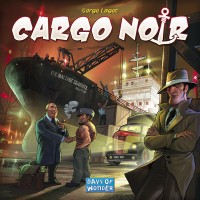
Cargo Noir

Little Hong Kong: Hour of the Tiger - Loaded with clandestine goods, a sampan glides through the dark waters of Aberdeen Harbour. It slips unnoticed under the bow of a British patrol boat whose crew seems more interested in sleep than watchfulness.
Cargo Noir is a game of illicit trading in which players run "families" who traffic in smuggled goods. Designed by Serge Laget, the game takes place in the thrilling and evocative setting of 1950's film noir.
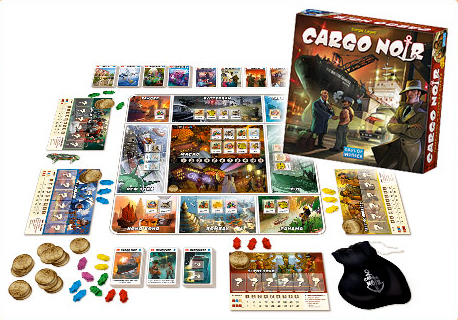
Game play revolves around a changing set of notorious smuggling ports around the world, each filled with contraband. Players dispatch cargo ships loaded with gold to these ports - hoping to acquire goods that will later be traded for Victory Spoils.
Cargo Noir is quickly learned, but offers many routes to victory; and is the rare trading game that works equally well with 2 players as well as more.



User Reviews (6)
Add a Review for "Cargo Noir"
You must be logged in to add a review.
- Themes
Crime, Film Noir, Money, Nautical - Mechanics
Auction/Bidding, Modular Board, Set Collection, Trading - Gamer Types
Avid Gamer, Casual Gamer, Power Gamer, Social Gamer, Strategy Gamer - Designers
Serge Laget - Official Game Site
🔍 Cargo Noir - Rulebook
🔍 See official rulebook - Price (MSRP)
$50
Cargo Noir is a board game published by Days of Wonder that can accommodate 2-5 players. Players bid on goods at various ports in the hopes of collecting sets that they can sell for victory points and special abilities.
Components
The components for this game really work well together. The plastic, poker-like chips that represent money work well with the bidding mechanic. It’s a nice touch over using paper money and allows players to quickly see what they need to do if they want to outbid someone. The color plastic ships to represent actions work as well, and easily sit on top of bids to show which player made the currently winning bid.
The board is modular, in that it is setup different by the number of players you have playing. I think this could have still be accomplished with a single folding board, but it still works fine and setup is still fast with the individual board pieces.
The one thing I might have changed is not using large cards to represent victory points. It ends up taking up a lot of room and most are simply just victory points. Cardboard chits, smaller cards, or poker type chips would have worked just as well and saved a lot of table space on when setting up. But that’s a minor thing and you just need to be mindful of the table space when fanning out the cards for purchase.
Mechanics
Bidding – The game does shine as a light bidding game. This mechanic works well. Like I said above, the use of plastic, poker-like chips was a nice touch and makes bidding and sizing up a bid easy. It’s a nice visual with the stack of chips and one of the player’s ships on top.
Set Collection – You’re bidding on goods at various ports. Why? Each player has a storage area and a trade conversion mat in front of them. You can only store so many goods, and you can trade in sets of like goods, or sets of differing goods to obtain victory cards, some with special abilities (like more ships – actions, or more warehouse space, etc…). I’ve seen casual gamers struggle a little bit on this, but mostly because they are new to these types of games. Overall, this works well and the player mats help explain the conversion.
Worker Placement – Each player starts with the same amount of ships; which equate to action points. On a player’s turn they get to place their ships at various ports to either earn money or bid on goods. You can acquire more ships in the game by buying victory cards that give you more ships. So a player has to manage their available resources in terms of money and ships they have available. If you are in a bidding war for a port; that ship is tied up until you win the port or pull out of the bidding. A pretty simple mechanic that again works well in the overall game
Scalability – This game does scale well, with the game board that closes/opens various ports depending on the number of players. But to really see it in action I’d recommend more than two players. Around 4-5 some of the resources get a bit limited (like extra warehouse space, etc…) and you need to make some tougher decisions at times. I have played it 2-player and it is enjoyable, but I think it shines better with more.
Theme
I think this is where a lot of people either love or hate this game. It is billed as a 1950’s noir style game about smuggling goods. It’s really not. The theme is thinly painted on at best. You really don’t get any of the flavor this theme promises. But if you aren’t in it for the theme, this is a great filler game.
Overall Impressions
Personally, I like the game. As someone that participates in a lot of gaming events that aim to teach games to people, this is an easy one for me to add to the list. It’s a great, light, gateway game and a good filler in a night of gaming as well. Again, if you’re looking for the rich theme, keep looking. But if you’re looking for a light, bidding game that you can easily bring casual gamers in with; this will do it!
Let me first preface this review with a little information about my gaming experience. I have played designer games for less than a year.
I think that I might be able to offer a good perspective, that of a bright, wide eyed gamer initiate.
Cargo Noir is fun, cut throat and calculating and is just as entertaining with 2,3,4 or 5 players thanks to great modular board design. Do you like stockpiling goods? Love to push your luck and gamble it all on the last few turns of a game? How about the ability to build different point scoring engines that have to take into account other players choices and resource availability? Like snatching certain victory from the grasp of your competitors? Do you enjoy games that end in 3 way ties where the most longsighted and steel nerved player comes out on top? If You do You will enjoy Cargo Noir too.
This game will make you smile as you open it up for the first time with the quality of its components and the excellent artwork. Days of Wonder’s reputation for quality is well known and I am beginning to see why.
The theme is good, it may not quite feel like you are a goods smuggler but you will probably use a fake accent a few times. The game is very easy to learn, when teaching new players just run through a few turns and you are ready to start buying Yachts Nightclubs Banks and Principalities. Or maybe Dive Bars, Militia and Cronies are more your style?
The genius is that Cargo Noir’s simplicity belies the amount of tough decisions you will have to make every turn. Constantly keeping an eye on others ship placement, cargo, gold on hand and calculating the ever changing value of cargo as others collect their sets. Do you head to the Casino to get some gold? Should you press your luck for random cargos or calculatingly swap your illicit goods at the black market? How much are those four cargos in Rotterdam really worth? At what point do you stop building your engine and start going for those Victory Spoils? Do you cash in early and block people late in the game? Do you wait patiently, building a set that makes your opponents tremble? There are a lot of hard choices to be made. Whether to grab Cargo Noir should not be one of them.
If you want an easy to learn, fun, competitive game that can easily take a nasty turn when you least expect it, do yourself a favour, go grab Cargo Noir.
Remember to enjoy the game you are playing for what it is, do not lament for what you thought it might have been.
A game of modern black market trading in foreign ports around the world by the seediest groups know to man, sign me up. At least this was my though with game in hand as I walked out the the FLGS with game in hand and smile on my face. Did it live up to my expectations, you’ll see below……
Gameplay
At its heart this is a bidding game with set collections. Players bid at various ports on black market commodities vs. other players. These commodities are collected and traded in for victory points, essentially, that is Cargo Noir. The game is not difficult and is easy to teach, gameplay is right around 1 hour.
Artwork/Components
Well, since this is a DOW game, you can assume that the components will be top shelf, and, they are. The modular boards have great art with heavy card stock, the cards themselves are nicely painted, and the ships and coins are outstanding. Days of Wonder always delivers in this area.
Overall Impressions
This is a game that I was very excited to play due to its exotic theme. Dangerous marketplaces, swarthy mob members, and stolen/black market commodities, who couldn’t love this right? WRONG! The theme in this game was as thin as tissue paper. This game could have easily been rebranded as children bartering for toys at different stations in a Daycare and there would have been no difference in gameplay. I love a game where the theme is so integrated to the gameplay that it becomes an essential component of the game. This is definitely not the case here.
This brings me to the next question. Can a game that has failed so badly at garnering the essential theme be a fun game? In this case I would say YES. Despite the games weak theme, the game is enjoyable to play and often hits our table primarily as a gateway game for friends and relatives. We have never heard any comments that the game was not enjoyable and in fact we have had requests for repeated games.
If you are looking for a gateway game that has strong player interaction and is simple to teach (but are unconcerned with a weak them) this could be your game. Enjoyable game and weak theme is what you’ll get in every box of Cargo Noir.
I have played this game several times, and own it.
Background: Gather cargo, spend it on ships, special cards (“Syndicate”), etc. get money. Bid on ports (where there is a certain type of cargo.) You can only hold so much cargo (space), so you need to think ahead/horde/compete.
This is a good bidding game that does not require a lot of complex thinking. It is neither silly/easy to play, nor so complicated that you need to run through it several times to figure it out. So, it’s a good game to occupy an hour or more.
Furthermore, if you’re a decent player, playing against other competent players, it is very difficult for someone to run away with it. It’s very competitive, and can have several players in the hunt until the very end.
I picked this game up at Gen Con this year and I have played it several times with different groups and everybody enjoys it. It is an easy game to pick up and play and it gets very competitive when trying to outbid each other for goods in the ports. The Black Market is another pretty cool idea to the game. You can either trade one of our goods for another type available in the Black Market or you can draw a random good from the bag.
This game scales very easily and very well from 2-5 players. I have enjoyed it every time I have played. The components to the game are very good quality, especially the game boards that flip over to accommodate the number of players as well as your cargo ships and especially the coins.
I would highly recommend this game to anyone who wants a fun bidding strategy game that plays well with only 2 players or up to 5.
First and foremost, this is not a bad game, but it has one major flaw. The game is too repetitive, even within the first game. By the end of the game you feel as if you’ve done the same thing over and over again for the last 45 minutes with little variation between players strategies. The components are nice, especially the pawns, and the art is lovely. But the game is a little too light for any hobby gamer to want to play more than once.